artist
Hopper Reproductions: Still in Copyright Until 2038
Hopper stays in copyright until 2038. What a licence requires, what a faithful copy must get right, original sizes, difficulty and alternatives.
Oil Painting ReproductionsUpdated
The short answer
Hopper's paintings do not enter the public domain until 2038 in Europe, and each US work runs 95 years from publication. The Whitney Museum licenses the estate rights, so a commercial copy needs a licence. Ask any seller whether it holds one.
Why Hopper is reproduced so often
On 13 November 2018 Hopper's Chop Suey (1929) sold at Christie's New York for $91.9 million including fees, a record for the artist and for any pre-war American painting. Nighthawks, bought by the Art Institute of Chicago within months of being finished in 1942 for $3,000, is among the most reproduced images in American culture.
That reproduction is mostly parody, homage and licensed print — not hand-painted copies. Hopper occupies an awkward position in the reproduction trade: the demand is very large and the legal position is very clear, and the two are not compatible until 2038. This page covers the legal question first, because for Hopper it changes what you should do.
Copyright status
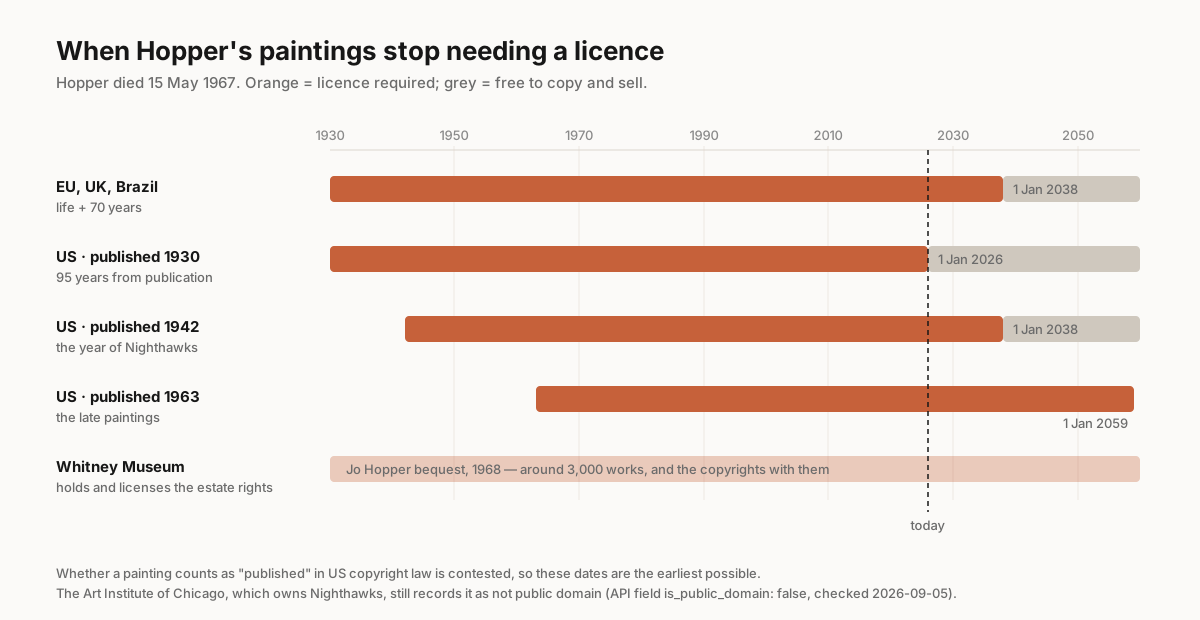
Hopper died on 15 May 1967. In the European Union, the United Kingdom, Brazil and every other life-plus-70 jurisdiction his work is protected until 1 January 2038. In the United States the term does not run from his death at all: for works first published between 1930 and 1977 it is 95 years from first publication, which means Hopper's paintings fall out of copyright one year at a time over the next three decades rather than all at once.
Two facts make this concrete rather than theoretical. First, when Josephine Nivison Hopper died in 1968 she left roughly 3,000 works to the Whitney Museum of American Art — the largest single gift in the museum's history — and the Whitney states that it holds the right to license all copyrights held by Edward and Josephine Hopper at the time of their deaths, other than those that have since entered the public domain. Some works in its collection are credited to the Heirs of Josephine N. Hopper, licensed through the Artists Rights Society. Second, the Art Institute of Chicago's own collection data records Nighthawks with the field `is_public_domain` set to false — checked on 2026-09-05. The museum that owns the picture does not treat it as free.
It is worth checking what sellers actually say. Reproduction Gallery lists 113 Edward Hopper paintings from $299 across four pages; the page carries a site-wide "All rights reserved" notice for its own content and no statement about the copyright status of the works it reproduces, and whether it holds a licence is not stated either way (checked 2026-09-05). That is the usual pattern across the trade, not an outlier. The general framework — what is and is not permitted — is set out in are oil painting reproductions legal.
For completeness: whether a painting counts as "published" in US copyright law is genuinely contested, and some Hopper works may already be free in the United States on that argument. That is a defence a seller might raise in litigation. It is not a basis on which a buyer should assume anything.
What a faithful copy must get right
If you are commissioning a licensed copy, or a painting in Hopper's manner of a subject that is not his, the technical demands are unusually specific — and, unusually, they are all visible in a photograph.
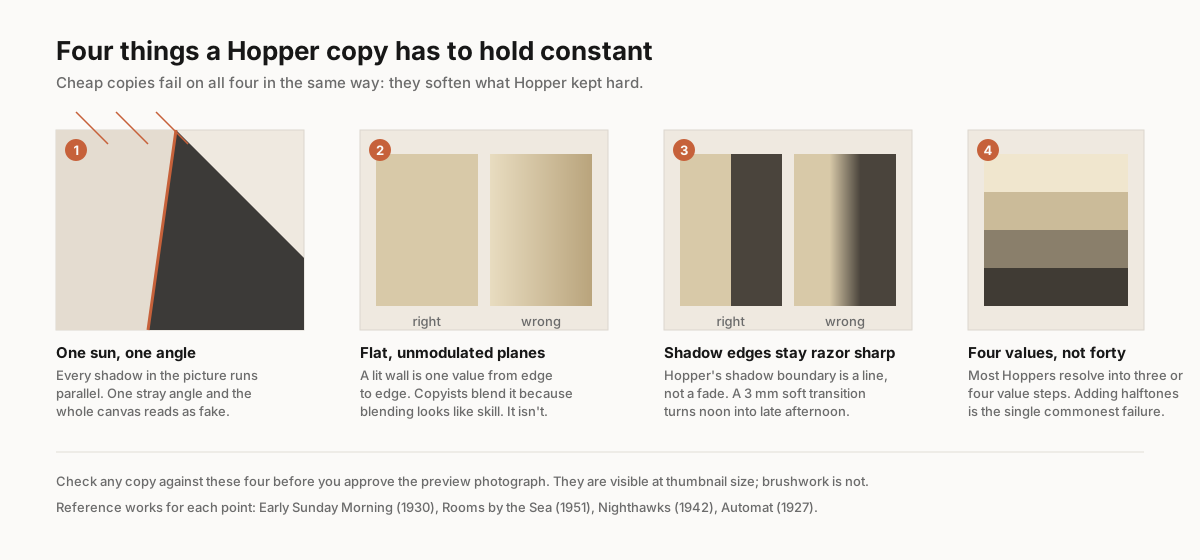
- One light source, one angle. Every shadow in a Hopper runs parallel because there is exactly one sun. A copyist who adjusts an individual shadow to make a form read better has broken the picture's only physical law.
- Flat, unmodulated planes. A lit wall is one value from edge to edge. Copyists blend across it because blending looks like skill, and the result is a Hopper with weather in it.
- Hard shadow edges. The boundary between light and shade is a line, not a fade. Three millimetres of softening moves the time of day by two hours.
- Three or four values, not forty. Most Hoppers resolve into a handful of value steps. Adding halftones is the single commonest failure and it makes the picture look like an illustration of a Hopper.
- Thin, matte paint. There is no impasto and no gloss. A copy with visible brush ridges or a shiny varnish is wrong before anyone looks at the drawing.
Hopper is, in purely technical terms, easier to copy than Van Gogh or Vermeer. He is harder to copy well, because everything that makes the picture work is a restraint, and restraint is what a fast studio removes first.
Most requested works
Difficulty is this site's rating, 1 to 5. The price column reads differently on this page from every other one: it is what a shape-matched canvas would cost, not a recommendation to buy an unlicensed copy.
| Work | Year | Museum | Original size | Difficulty | Nearest canvas / status |
|---|---|---|---|---|---|
| Nighthawks | 1942 | Art Institute of Chicago | 84.1 × 152.4 cm | 4 | 1.81:1 — no stock canvas; in copyright to at least 2038 |
| Early Sunday Morning | 1930 | Whitney Museum of American Art, New York | 89.4 × 153 cm | 3 | 1.71:1 — no stock canvas; in copyright in the EU/UK to 2038 |
| Chop Suey | 1929 | Private collection | 81.3 × 96.5 cm | 4 | 1.19:1 — fits 24 × 20 in; in copyright in the EU/UK to 2038 |
| Automat | 1927 | Des Moines Art Center | 71.4 × 91.4 cm | 4 | 1.28:1 — fits 30 × 24 in; in copyright in the EU/UK to 2038 |
| Gas | 1940 | Museum of Modern Art, New York | 66.7 × 102.2 cm | 3 | 1.53:1 — fits 60 × 40 in at 1.50; in copyright to at least 2038 |
| House by the Railroad | 1925 | Museum of Modern Art, New York | 61 × 73.7 cm | 3 | 1.21:1 — fits 24 × 20 in; in copyright in the EU/UK to 2038 |
Dimensions from the holding museums; Nighthawks from the Art Institute of Chicago collection API, checked 2026-09-05. Copyright terms are the EU/UK life-plus-70 term expiring 1 January 2038, and in the US 95 years from each work's first publication.
Notice how many of them do not fit a canvas either. Hopper composed in wide horizontals — Nighthawks at 1.81:1, Early Sunday Morning at 1.71:1 — and the longest standard stretcher is 1.50:1, at 60 × 40 in. A Nighthawks delivered on a 40 × 30 in canvas has had roughly a quarter of its width removed, which usually means the empty street at the left, which is the subject.
Common mistakes in cheap copies
- No licence, and no mention of one. The first and largest problem, and the one a photograph will never show you.
- Cropped horizontals. Nighthawks squeezed onto a 1.33 canvas, losing the emptiness that the picture is about.
- Softened shadow edges. The single most visible technical failure. Hopper's light is hard.
- Modelled walls. Gradients painted into flat planes to make them look three-dimensional.
- Warmed-up colour. Hopper's greens and yellows are slightly sour. Copies made from web images push the saturation and the diner becomes cosy, which inverts the picture's meaning.
- Faces given expressions. The figures are deliberately unreadable. Copyists add a mood, and the loneliness disappears.
Sizes that work at home
Hopper's wide horizontals want a wide wall and a low hang. The compositions are built around empty space to the side of the subject, so cropping to a squarer canvas does more damage here than with almost any other painter in this guide.
- 40 × 30 in (101.6 × 76.2 cm), $529.95. A 1.33:1 canvas. Fine for Chop Suey, Automat and House by the Railroad, all of which sit near 1.2.
- 48 × 36 in (121.9 × 91.4 cm), $599.95. Also 1.33:1. Bigger, not wider — it does not solve the Nighthawks problem.
- 60 × 40 in (152.4 × 101.6 cm), $769.95. The longest rung on the ladder at 1.50:1, and the closest stock size to Gas at 1.53:1 — about 2 % off the width, so a couple of centimetres come off the ends rather than a quarter of the picture. Still nowhere near Nighthawks.
- Custom, around 150 × 83 cm. The only honest way to hold Nighthawks at 1.81:1. Expect a bespoke quote rather than a list price.
- Custom, around 160 × 94 cm. For Early Sunday Morning at 1.71:1, which is 89.4 × 153 cm in the original — nearly life size at this scale.
Light a Hopper flat and cool. There is no relief to reveal and no glaze to warm; the picture already contains its own light, and adding a warm lamp works against it. The prices above are the standard unframed ladder — Art & See's published sizes run from $249.95 at 16 × 16 in through $599.95 at 48 × 36 in to $769.95 at 60 × 40 in and $1,299.95 at 72 × 48 in, and its custom-orders page states sizes from 8 × 10 in upward with custom dimensions on request.
Where to buy
If you want a licensed Hopper, the route is the rights holder — start with the Whitney Museum and the Artists Rights Society, not a reproduction store. If what you actually want is the look of an empty American interior in strong light, these three routes sell public-domain paintings you can buy without a rights question. Checked 2026-09-05.
Hand-painted oil on canvas from $249.95, drawn from a catalogue its own product data puts at 37,978 active titles, with public-domain painters of solitary figures and empty light — Munch, Friedrich, Vermeer — evidenced on their own product pages; its custom-orders page also states custom sizes and content, so a painting of your own street in Hopper's manner is orderable where a Hopper is not.
Art & See- Reproduction Gallery — Lists 113 Hopper titles from $299 and a far broader catalogue overall — catalogue breadth is where it beats Art & See. Its pages say nothing about the copyright status of the works reproduced, so if you order a Hopper from it, ask about the licence first.
- A commissioned original, from a living painter — For a Hopper-like picture of your own street or diner, a commission from a contemporary realist costs about the same as a large reproduction, raises no copyright question at all, and is the only option here that produces something nobody else owns.
Frequently asked questions
Are Edward Hopper reproductions legal?
Not without a licence. Hopper died in 1967, so his work is protected until 1 January 2038 in the EU, the UK and other life-plus-70 countries, and in the US for 95 years from each work's first publication. The Whitney Museum holds and licenses the estate rights. Sellers rarely address it: Reproduction Gallery lists 113 Hopper titles from $299 and says nothing on that page about the copyright status of the works it reproduces, so whether it holds a licence is not stated (checked 2026-09-05). Ask, in writing, before you order.
When does Nighthawks enter the public domain?
1 January 2038 in life-plus-70 countries. In the United States the term for a 1942 work is 95 years from first publication, which also points to 2038 at the earliest — and the Art Institute of Chicago, which owns the painting, still records it as not public domain in its own collection data.
Can I get in trouble for buying one?
In most jurisdictions the regulated act is making and selling the copy, not owning it, so the exposure sits with the seller. The practical risk to you is different: an unlicensed order can be cancelled or stopped mid-production, and you have no recourse against a workshop in another country.
What can I buy instead that looks like a Hopper?
Vilhelm Hammershøi's grey interiors (died 1916, public domain), Gustave Caillebotte's rain-washed Paris streets (died 1894), and the American realists whose work is out of copyright. All reproduce legally, all use the same hard light and empty space, and none of them requires a licence.
Why does Nighthawks never fit the canvas I ordered?
Because it is 84.1 × 152.4 cm — a 1.81:1 proportion — and the longest standard stretcher is 1.50:1, at 60 × 40 in. Fitting it to a 1.33 canvas means removing roughly a quarter of the width, usually from the empty left-hand side of the street, which is the part of the picture that does the work.
Sources
- Record $91.9m sale of Edward Hopper's Chop Suey at Christie's — The Art Newspaper. Accessed September 5, 2026.
- The Hoppers and the Whitney — the 1968 Josephine N. Hopper bequest and licensing rights — Whitney Museum of American Art. Accessed September 5, 2026.
- Nighthawks, 1942 — collection record; is_public_domain reported as false — Art Institute of Chicago collection API. Accessed September 5, 2026.
- Circular 15a: Duration of Copyright — 95 years from publication for 1930–1977 works — United States Copyright Office. Accessed September 5, 2026.
- Images and Permissions — ARS clearance requirement for works in the Whitney collection — Whitney Museum of American Art. Accessed September 5, 2026.
- Edward Hopper artist page — 113 titles listed from $299, with no statement on the copyright status of the works reproduced — Reproduction Gallery. Accessed September 5, 2026.
Keep reading
painting
Nighthawks reproduction: the one famous painting you cannot legally have copied
Hopper's Nighthawks stays in copyright until 1 January 2038. What that means if you want one, and what the online hand-painted listings really are.
legal
Are Oil Painting Reproductions Legal?
Yes for public-domain paintings, no for artists still in copyright. Country rules, 21 artists with dates, and the line between a copy and a forgery.
catalog
The 20 most popular oil painting reproductions, and what each one costs to copy well
The 20 paintings ordered most often, cross-checked against five stores' own bestseller lists, with museum, original size, difficulty and price for each.
price
How much do oil painting reproductions cost?
Compare equivalent sizes, finishes, shipping and payment terms with a dated total-cost worksheet. Unknown charges stay visible instead of becoming zero.