legal
Are Oil Painting Reproductions Legal?
Yes for public-domain paintings, no for artists still in copyright. Country rules, 21 artists with dates, and the line between a copy and a forgery.
Oil Painting ReproductionsUpdated published
The short answer
Check copyright status in the countries where a painting will be reproduced and sold. Protected works generally require permission unless an exception applies. Honest labelling does not remove copyright obligations; selling a copy as an original raises a separate issue.
Copyright basics for paintings
Correction, 18 September 2026: this guide previously said that only misrepresenting a copy could have criminal consequences. That was too broad: US law also provides criminal penalties for certain willful copyright infringements. The questions below distinguish copyright permission from honest labeling.
- Is the painting still in copyright? Copyright in a painting runs for a fixed term measured from the artist's death. When it expires the work is in the public domain and anyone may copy it, sell the copy, and photograph it.
- Does the copy create a new copyright? No. A faithful copy adds nothing original, so no new right comes into being — which is why nobody can stop you copying the same painting they copied.
- Is the copy honestly described? Selling a copy as an original can raise fraud issues, but accurate labeling does not excuse copyright infringement. In the United States, willful infringement can carry criminal penalties when the conditions in 17 U.S.C. §506 are met.
On the second point, both major systems say the same thing in writing. The US Copyright Office lists among works that fail the originality requirement "an exact reproduction of the Mona Lisa that cannot be distinguished from the original" (Compendium of U.S. Copyright Office Practices, Third Edition, §313.4(A)). In the European Union, Article 14 of Directive (EU) 2019/790 provides that material resulting from an act of reproduction of a public-domain work of visual art is not covered by copyright or related rights unless it is original in the sense of being the author's own intellectual creation.
The public domain rule, country by country
The rule that binds you is the rule where the copy is made and where it is sold — not where the painting hangs. A studio in Shenzhen, a seller in London and a buyer in Toronto can each be under a different clock for the same canvas.
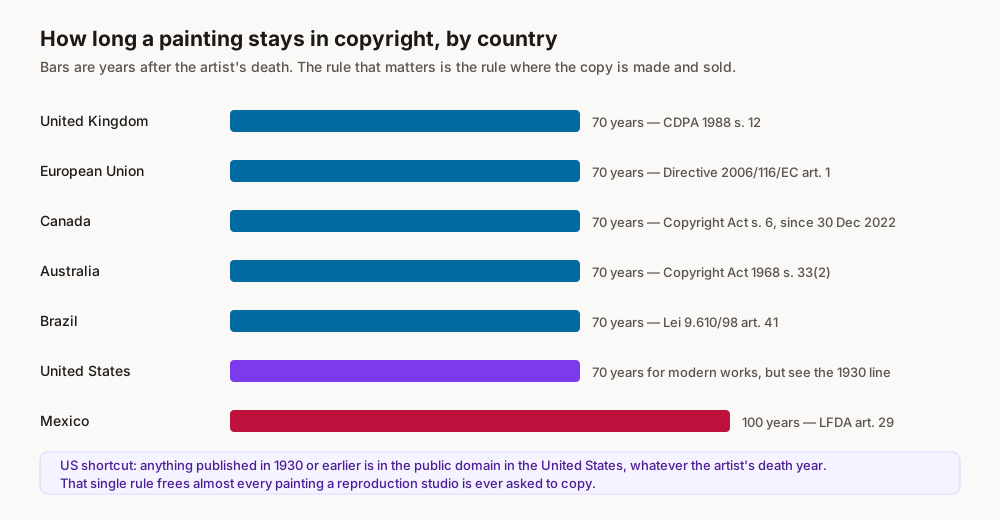
| Jurisdiction | Rule | Primary source | What it means for a reproduction ordered in 2026 |
|---|---|---|---|
| United Kingdom | Life of the author plus 70 years, from the end of the calendar year of death | Copyright, Designs and Patents Act 1988, s. 12(2) | Artists who died in 1955 or earlier are free; Matisse and Kahlo (d. 1954) became free on 1 January 2025 |
| European Union | Life plus 70 years, harmonised across member states | Directive 2006/116/EC, art. 1 | Same cut-off as the UK; a studio in France or Poland is under the identical clock |
| United States | Life plus 70 for modern works, but everything published in 1930 or earlier is in the public domain outright | 17 U.S.C. §§ 302–304; U.S. Copyright Office Circular 15a | The 1930 line frees nearly every painting a reproduction studio is ever asked to copy, regardless of the artist's death year |
| Canada | Life plus 70 years since 30 December 2022 (previously life plus 50) | Copyright Act, R.S.C. 1985, c. C-42, s. 6 | The extension did not revive expired copyrights, so works already public before the change stayed public |
| Australia | Copyright subsists until 70 years after the end of the calendar year of the author's death | Copyright Act 1968, s. 33(2) | Same practical cut-off as the UK and EU for post-1955 deaths |
| Brazil | 70 years counted from 1 January of the year following the author's death | Lei 9.610/1998, art. 41 | Counting from the following 1 January, not the death date, moves some borderline artists by a year |
| Mexico | Life plus 100 years — the longest general term in the world | Ley Federal del Derecho de Autor, art. 29 | Frida Kahlo is public domain in the UK and EU from 2025 and still protected in Mexico; origin of the studio decides which applies |
Statutes read directly at legislation.gov.uk, eur-lex.europa.eu, copyright.gov, laws-lois.justice.gc.ca, legislation.gov.au, planalto.gov.br and diputados.gob.mx on 2026-09-05. This is a summary of general terms, not legal advice; anonymous, posthumous and jointly authored works follow separate rules in every one of these systems.
The US 1930 rule, and the trap underneath it
American law does not ask when a foreign painter died. For published works it asks when the work was published, and everything published in 1930 or earlier is now free by operation of law. That single line covers the entire Impressionist and Post-Impressionist canon and most of early Modernism.
The trap is the other direction. Foreign works first published after 1929 that were still protected at home on 1 January 1996 had their US copyrights restored under the Uruguay Round Agreements Act, and run 95 years from first publication (U.S. Copyright Office, Circular 38b). A Kahlo painted in 1939 or a Mondrian painted in 1942 can therefore be public domain in Europe and still protected in the United States — the reverse of what most people assume.
Twenty-one artists and exactly where they stand
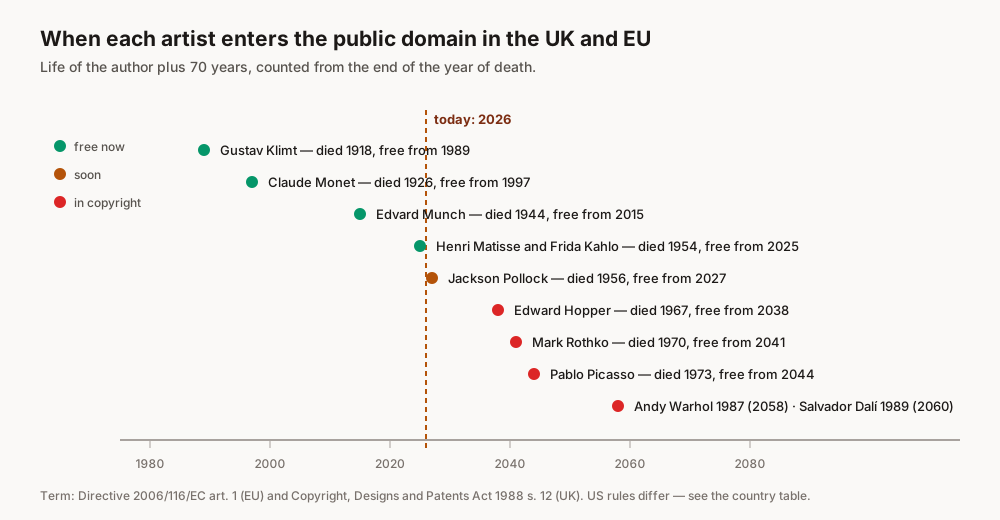
| Artist | Died | Free in the UK and EU from | Status in the United States |
|---|---|---|---|
| Leonardo da Vinci | 1519 | Long expired | Public domain |
| Rembrandt van Rijn | 1669 | Long expired | Public domain |
| Johannes Vermeer | 1675 | Long expired | Public domain |
| Caspar David Friedrich | 1840 | 1911 | Public domain |
| Katsushika Hokusai | 1849 | 1920 | Public domain |
| Vincent van Gogh | 1890 | 1961 | Public domain |
| Paul Cézanne | 1906 | 1977 | Public domain |
| Gustav Klimt | 1918 | 1989 | Public domain |
| Amedeo Modigliani | 1920 | 1991 | Public domain |
| Claude Monet | 1926 | 1997 | Public domain |
| Edvard Munch | 1944 | 2015 | Free if published by 1930; later works may be restored for 95 years from publication |
| Wassily Kandinsky | 1944 | 2015 | Free if published by 1930; later works may be restored |
| Piet Mondrian | 1944 | 2015 | Free if published by 1930; the New York canvases are not |
| Henri Matisse | 1954 | 2025 | Mostly still protected; only the pre-1931 work is clearly free |
| Frida Kahlo | 1954 | 2025 | Mostly still protected; and protected in Mexico until the 2050s |
| Jackson Pollock | 1956 | 2027 | Protected |
| Edward Hopper | 1967 | 2038 | Protected |
| Mark Rothko | 1970 | 2041 | Protected |
| Pablo Picasso | 1973 | 2044 | Protected |
| Andy Warhol | 1987 | 2058 | Protected |
| Salvador Dalí | 1989 | 2060 | Protected |
"Free from" means 1 January of the year given; the artist is still in copyright through 31 December of the year before. Column computed as death year plus 70 full calendar years, per CDPA 1988 s. 12(2) and Directive 2006/116/EC art. 1. US column applies the pre-1931 publication rule and the URAA restoration rule in Circular 38b. Death years taken from each artist's Wikipedia entry, checked 2026-09-05. Status of individual works can differ from the artist's general position; where money is at stake, check the specific painting.
Read the table as a shopping list rather than a warning. Everything in the top two-thirds — the entire supply of famous subjects a studio is actually asked for, from The Starry Night to The Kiss to Water Lilies — is free to copy anywhere. The restrictions bite only on a narrow band of 20th-century names, and that band is exactly the band where the price of a licence would exceed the price of the painting.
Reproduction, replica, forgery: intent and labelling
Two identical canvases can sit on the same table, one perfectly legal and one criminal. Nothing about the object separates them. What separates them is what the seller says.
| How it is described | What it means | Legal position | Where you meet it |
|---|---|---|---|
| Reproduction / copy after [artist] | A new hand-painted version of a known work, sold as such | Lawful for public-domain works; the standard trade description | Reproduction studios, museum shops, decorators |
| "After [artist]" in a saleroom catalogue | A copy of a known work by an unidentified hand, of any date | Lawful; the recognised cataloguing term | Auction houses selling period copies |
| Replica | Loose trade word, usually meaning a same-size faithful copy | Lawful, but vague — pin the seller to "reproduction after" in writing | Marketplace listings |
| Sold or offered as the original | A copy passed off as the artist's own work, or with a master's signature added to deceive | Fraud. The FBI runs a dedicated Art Crime Team for this offence | Never legitimately |
Cataloguing terms follow published saleroom glossaries; enforcement position per the FBI Art Crime Team programme page, checked 2026-09-05.
There is no statute anywhere that requires a hand-painted reproduction to carry a label. There is, everywhere, a body of fraud and consumer-protection law that punishes misdescription. The practical consequence is that labelling is voluntary and also the cheapest insurance available: a studio stamp on the stretcher reading "hand-painted reproduction after [artist]" with the year travels with the canvas for the rest of its life and removes any argument about intent — including for the person who inherits it in forty years and wonders what they have.
Can you sell one?
Reselling a reproduction you bought
Yes, provided the underlying painting is in the public domain and you describe the canvas honestly. You own the physical object and may dispose of it. There are no rights to transfer with it, because a faithful copy generated none. Practically, see are oil painting reproductions worth anything first — the legal answer is easier than the commercial one.
Selling copies as a business
Also lawful, and it is the entire basis of an established industry. The constraints are the ordinary ones: copy only public-domain works or licensed ones; describe every piece as a reproduction after a named artist in listings, invoices and on the object; do not imply endorsement by a museum or an estate; and keep your own photographs of what you sold. Trading-standards and consumer-protection regimes are far more likely to reach you than copyright law is.
Copying a living or recently dead artist
Needs a licence from the rightsholder, and for a single decorative canvas that licence will not be economic to obtain. This is the one genuine no from a reproduction studio, and a studio that says yes without mentioning rights is telling you something about how it operates.
Museum image rights are not rights in the painting
A museum can own a painting outright, hold no copyright in it whatsoever, and still restrict what you do with the photograph on its website. All three facts are true at the same time, and confusing them is the most common mistake in this area.
In the United States the position on the photographs themselves is settled: exact photographic copies of public-domain works of art are not copyrightable because they are not original — the holding in Bridgeman Art Library v. Corel Corp., 36 F. Supp. 2d 191 (S.D.N.Y. 1999), which the Copyright Office cites in its own Compendium. In the EU, Article 14 of the 2019 Directive reaches the same result by statute. Elsewhere the case law has gone the other way, and museums in some countries assert rights in their photography.
The part that catches people is contract, not copyright. Downloading a museum's high-resolution file usually means accepting its terms of use, and those terms often restrict commercial reuse whatever the copyright position. That is a promise you made, enforceable as a promise. The clean route for a studio is to use images the institution has explicitly released for open access — many major museums now publish exactly such files — and to keep a record of which file was used.
Estates and trademarks: Picasso, Kahlo, Warhol, Rothko
For the 20th-century names buyers ask about most, rights are not lying dormant with a family — they are actively licensed by organisations set up for the purpose. In the United States that job is largely concentrated in one body: the Artists Rights Society, founded in 1987, which states that it is the exclusive licensing representative of the estates and foundations of Pablo Picasso, Henri Matisse, Marc Chagall, Joan Miró, Andy Warhol, Frida Kahlo, Mark Rothko, Jackson Pollock, Jacob Lawrence, Isamu Noguchi and Georgia O'Keeffe, among others. In Europe the equivalent work is done by national collecting societies. Either way, a commercial reproduction of a work by any of them requires a permission a decorative studio will not have, and the request goes to the licensing body rather than to a relative.
Kahlo is the instructive case, because two different kinds of right point in different directions. Copyright in her paintings expired in the UK and EU on 1 January 2025 — she died in 1954 — while Mexico's hundred-year term keeps them protected at home into the 2050s. Separately, the Frida Kahlo Corporation asserts trademark rights in her name and likeness for merchandising. That is a different legal animal from copyright in the paintings, and it has been litigated against members of her family: the corporation and the artist's grand-niece have been in dispute over those marks, a fight that escalated publicly around a Frida Kahlo Barbie in 2018 and whose US chapter was dismissed by a Florida court in 2021. Trademark restricts branding and merchandise; it does not, by itself, stop someone painting a copy of a painting that is out of copyright where they are painting it.
What to check before ordering a 20th-century artist
- Find the artist's death year. Add 70. If that year has passed, you are clear in the UK, EU, Canada, Australia and Brazil.
- If it has not passed, check the country the studio paints in. A Mexican studio copying Kahlo is under a hundred-year term; a Polish one is not.
- For US buyers, check the publication date too. Published 1930 or earlier means public domain in the United States regardless of the artist's death year. Later foreign works may have been restored for 95 years from publication.
- Ask the studio directly whether it holds a licence. For an in-copyright artist there is only one right answer, and the absence of an answer is itself an answer.
- Ask for the label. "Hand-painted reproduction after [artist], [year]" on the stretcher. Free, permanent, and it settles every future question about the canvas.
For the whole picture of what you are actually buying, see what is an oil painting reproduction and the most popular oil painting reproductions — a list that is, not coincidentally, almost entirely public domain.
Where to buy
Three routes, all lawful, differing in how the copyright question is handled for you.
A catalogue of roughly 38,000 active products whose best-known subjects are public-domain paintings — hand-painted oil on canvas, $249.95 for 16x16 inches rising to $1,299.95 for 72x48 inches unframed, with a photograph sent for approval before shipping (collected 5 September 2026), which is also your chance to specify how the signature is handled.
Art & See- Artists Rights Society (licensing, not retail) — Where the artist is still in copyright there is no shop to buy from — permission has to be requested from the licensing body, which is something no independent studio, Art & See included, can do on your behalf.
- Reproduction Gallery — The widest published catalogue of public-domain subjects in the category, which matters when the painting you want is obscure enough that other storefronts do not list it.
Frequently asked questions
Is it legal to buy a hand-painted copy of a Van Gogh?
Yes, everywhere. Van Gogh died in 1890, so his work has been in the public domain in the UK and EU since 1961 and is public domain in the United States under the pre-1931 publication rule. You can commission a copy, buy one, hang it, resell it and photograph it. The only rule is that you describe it as a reproduction if you sell it on.
What about Picasso, Dalí or Warhol?
Not without a licence. Picasso died in 1973, so his work stays in copyright in the UK and EU until the end of 2043 and becomes free on 1 January 2044; Warhol on 1 January 2058; Dalí on 1 January 2060. In the United States the Artists Rights Society is the exclusive licensing representative for the Picasso and Warhol estates, among others. A studio that offers to paint them without mentioning rights is not a studio to buy from.
Can I sell a reproduction I bought?
Yes. You own the object and there are no rights attached to it — a faithful copy of a public-domain painting generates no new copyright of its own. Describe it accurately as a reproduction after the named artist. The legal question is easy; the resale value question is the hard one.
Is it legal for the copy to include the artist's signature?
Yes, when the signature is part of the painting being copied — it is one more mark on the canvas. What is not lawful is adding a signature the original never had, faking age, or inventing provenance, because those show intent to deceive. If it bothers you, ask the studio to leave the signature off; most will.
The museum's website says its photographs are copyrighted. Does that stop me?
Not through copyright, in the US or the EU. Exact photographs of public-domain paintings are unoriginal and unprotected — Bridgeman v. Corel in the US, Article 14 of Directive (EU) 2019/790 in the EU. What can bind you is the museum's terms of use, which is contract rather than copyright. Use openly released files and keep a note of which one you used.
Does a reproduction have to be labelled as one by law?
No statute requires a label. Fraud and consumer-protection law punish misdescription instead, which amounts to the same thing at the point of sale. A permanent stamp on the stretcher reading "hand-painted reproduction after [artist]" with the year costs nothing and settles the question for every future owner.
Frida Kahlo died in 1954, so is she free to copy now?
In the UK and EU, yes, since 1 January 2025. In Mexico, no — the term there is life plus 100 years under article 29 of the Ley Federal del Derecho de Autor. In the United States most of her work is still protected, because foreign works published after 1929 had their US copyrights restored for 95 years from publication. Separately, the Frida Kahlo Corporation asserts trademark rights in her name and likeness, which govern merchandising rather than painting.
Sources
- Compendium of U.S. Copyright Office Practices, Third Edition, §313.4(A) Mere Copies — U.S. Copyright Office. Accessed September 5, 2026.
- Circular 15a: Duration of Copyright — U.S. Copyright Office. Accessed September 5, 2026.
- Circular 38b: Copyright Restoration Under the URAA — U.S. Copyright Office. Accessed September 5, 2026.
- Copyright, Designs and Patents Act 1988, section 12 — The National Archives (legislation.gov.uk). Accessed September 5, 2026.
- Directive 2006/116/EC on the term of protection of copyright and certain related rights — EUR-Lex. Accessed September 5, 2026.
- Directive (EU) 2019/790 on copyright in the Digital Single Market, article 14 — EUR-Lex. Accessed September 5, 2026.
- Copyright Act (R.S.C., 1985, c. C-42), section 6 — Justice Laws Website, Government of Canada. Accessed September 5, 2026.
- Copyright Act 1968, section 33 — Federal Register of Legislation, Australia. Accessed September 5, 2026.
- Lei nº 9.610, de 19 de fevereiro de 1998, artigo 41 — Presidência da República, Brazil. Accessed September 5, 2026.
- Ley Federal del Derecho de Autor, artículo 29 — Cámara de Diputados, Mexico. Accessed September 5, 2026.
- Art Theft — Art Crime Team — Federal Bureau of Investigation. Accessed September 5, 2026.
- History — exclusive licensing representation of the Picasso, Matisse, Chagall, Miró, Warhol, Kahlo, Rothko, Pollock, Lawrence, Noguchi and O'Keeffe estates and foundations — Artists Rights Society. Accessed September 5, 2026.
- Legal battle over Frida Kahlo trademark comes to a close in the US — The Art Newspaper. Accessed September 5, 2026.
- Owning Frida Kahlo: The Frida Kahlo Corporation and Trademark Law — Center for Art Law. Accessed September 5, 2026.
- Artist death years used in the public-domain table (individual artist entries) — Wikipedia. Accessed September 5, 2026.
Keep reading
definition
What Is an Oil Painting Reproduction?
An oil painting reproduction is a new painting in oil that copies an existing work. What that means legally, materially and financially — term by term.
price
Are Oil Painting Reproductions Worth Anything?
Most painted copies have no resale value. Four kinds do — with auction evidence, an identification checklist, and realistic prices for selling one.
catalog
The 20 most popular oil painting reproductions, and what each one costs to copy well
The 20 paintings ordered most often, cross-checked against five stores' own bestseller lists, with museum, original size, difficulty and price for each.
artist
Picasso Reproductions: In Copyright Until 2044
Picasso stays in copyright until 2044, licensed by the Picasso Administration. What that means for buyers, plus periods, sizes and alternatives.
artist
Frida Kahlo Reproductions: The Rights Question First
Kahlo copyright differs in Mexico, Europe and the US, and her name is trademarked. Plus original sizes, why she painted small, and alternatives.