artist
Picasso Reproductions: In Copyright Until 2044
Picasso stays in copyright until 2044, licensed by the Picasso Administration. What that means for buyers, plus periods, sizes and alternatives.
Oil Painting ReproductionsUpdated
The short answer
Every Picasso is under copyright until at least 2044 in life-plus-70 countries, licensed through the Picasso Administration. Sellers rarely say whether they hold a licence, and a commercial copy needs one. Check that before you check the price.
Why Picasso is reproduced so often
In May 2015 Les Femmes d'Alger (Version 'O') sold at Christie's for $179.4 million, and in November 2023 Femme à la montre took $139.4 million at Sotheby's — the most valuable artwork auctioned that year. Picasso worked across seventy years and every medium, which means there is a Picasso for every taste and, unusually for a modern master, a genuine mass market in his imagery.
It also means the reproduction trade is enormous. Reproduction Gallery alone lists 587 Picasso paintings from $315 across twenty pages; that page carries a site-wide "All rights reserved" notice for its own content and no statement about the copyright status of the works it reproduces, so whether it holds a licence is not stated either way — checked on 2026-09-05. What a licence involves is the subject of the next section, and it is the most important thing on this page.
Copyright status
Picasso died on 8 April 1973. France, where he lived and died, applies a life-plus-70 term, so his entire output is protected until 1 January 2044 — in France, across the EU, in the UK, in Brazil and in every other country with the same rule. In the United States the term is calculated differently: 95 years from first publication for works first published between 1930 and 1977, which produces a staggered set of expiry dates rather than one.
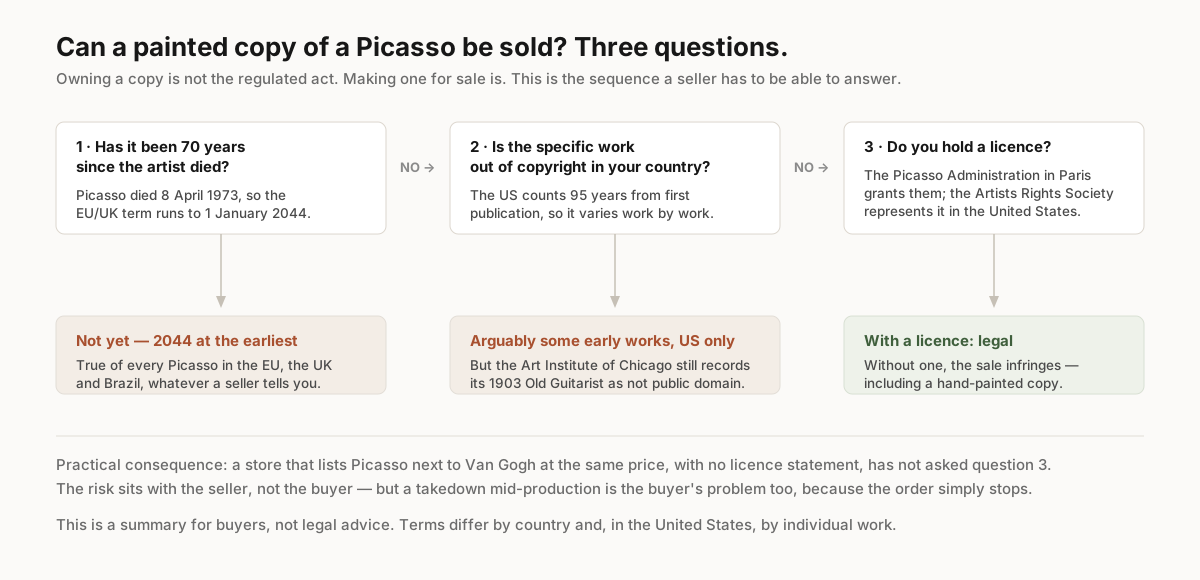
The rights are administered by the Picasso Administration in Paris — Succession Picasso — which licenses use of the works, the name and the signature, and the Artists Rights Society represents that interest in the United States. ARS lists Picasso among the artists it acts for and publishes a route for obtaining a licence. This is not a dormant estate: it is one of the most active rights-management operations in twentieth-century art.
A useful reality check comes from the museums. The Art Institute of Chicago's collection data records The Old Guitarist — painted in 1903 and 1904, and therefore old enough that a US publication argument might have run out — with the field `is_public_domain` set to false, checked on 2026-09-05. The institution that owns the painting does not treat it as free. Its Van Goghs, Monets and Renoirs in the same database are marked true.
The exposure sits with the seller rather than the buyer in most jurisdictions, but the practical risk to a buyer is real: an unlicensed order can be halted mid-production, and there is no realistic recourse against a workshop in another country. Ask, in writing, whether the seller holds a licence and from whom. The general framework is in are oil painting reproductions legal.
What a faithful copy must get right
"A Picasso" is not one painting problem. It is at least nine, and a studio that handles one of them competently has no particular claim to handle the others. This is the question worth asking before any commission, licensed or otherwise: which period has this painter actually painted before?
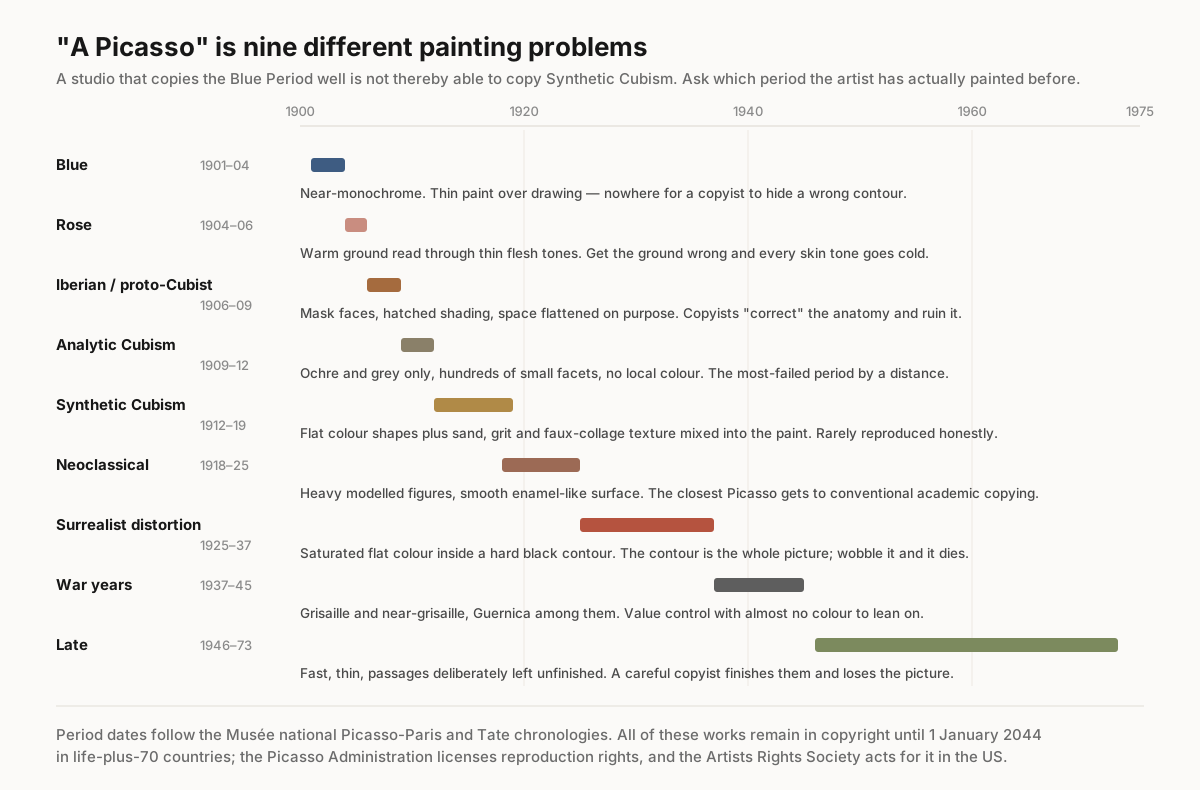
- Blue period (1901–04). Near-monochrome, thin paint over drawing. There is nowhere to hide a wrong contour, which makes it the most demanding drawing test in his whole output.
- Rose period (1904–06). A warm ground read through thin flesh tones. Get the ground wrong and every skin tone in the picture goes cold.
- Analytic Cubism (1909–12). Ochre and grey only, hundreds of small facets, no local colour anywhere. The most-failed period by a distance, because a copyist who cannot see the underlying structure just paints shapes.
- Synthetic Cubism (1912–19). Flat colour shapes with sand, grit and faux-collage texture mixed into the paint. Almost never reproduced honestly, because the texture costs money and does not photograph.
- Surrealist distortion (1925–37). Saturated flat colour inside a hard black contour. The contour is the entire picture; a wobbling line kills it.
- Late work (1946–73). Fast, thin, with passages deliberately left unfinished. A conscientious copyist finishes them, and in doing so loses the painting.
The one general rule across all of them: Picasso drew fast and did not correct. Copies made slowly and carefully read as hesitant even when every shape is in the right place, and that hesitancy is visible from across a room.
Most requested works
Difficulty is this site's rating, 1 to 5. The last column gives the nearest standard canvas and the copyright position together — every one of these works is protected until at least 2044 in life-plus-70 countries.
| Work | Year | Museum | Original size | Difficulty | Nearest canvas / status |
|---|---|---|---|---|---|
| Guernica | 1937 | Museo Reina Sofía, Madrid | 349.3 × 776.5 cm | 5 | 2.22:1 — no stock canvas; in copyright to 2044 |
| Les Demoiselles d'Avignon | 1907 | Museum of Modern Art, New York | 243.9 × 233.7 cm | 5 | Near square — fits 36 × 36 in at 37 %; in copyright to 2044 |
| The Old Guitarist | 1903–04 | Art Institute of Chicago | 122.9 × 82.6 cm | 3 | 1.49:1 — fits 60 × 40 in at 1.50; museum records it as not public domain |
| Girl before a Mirror | 1932 | Museum of Modern Art, New York | 162.3 × 130.2 cm | 4 | 1.25:1 — fits 30 × 24 in; in copyright to 2044 |
| The Weeping Woman | 1937 | Tate Modern, London | 61 × 50 cm | 4 | 1.22:1 — fits 24 × 20 in; in copyright to 2044 |
| Le Rêve | 1932 | Private collection | 130 × 97 cm | 3 | 1.34:1 — fits 40 × 30 in; in copyright to 2044 |
Dimensions from the holding museums and Wikidata; The Old Guitarist (122.9 × 82.6 cm) from the Art Institute of Chicago collection API object record for id 28067, read 2026-09-05, which reports is_public_domain as false. Reproduction sizes from Art & See's public price pages, same date. Copyright: 1 January 2044 under the EU/UK life-plus-70 term, and in the US 95 years from each work's first publication.
Guernica deserves a separate note. At 349.3 × 776.5 cm it is a 2.22:1 mural-scale canvas that no standard stretcher approaches, it is grisaille — grey, black and white, with no colour to carry a copyist — and it is the single most politically loaded painting of the twentieth century. Anything sold as a Guernica reproduction at a list price has been cropped, shrunk and simplified, on top of the licensing problem.
Common mistakes in cheap copies
- No licence, and no mention of one. The defining problem. A store can list hundreds of Picassos without saying anywhere whether it is licensed to; absence of a statement is not proof of absence of a licence, which is exactly why you have to ask in writing.
- A forged signature. Some copies arrive with "Picasso" painted in the corner. The signature is separately protected, and a signed copy moves from infringement towards forgery.
- Careful, hesitant line. Picasso's contour is a single fast stroke. Copied slowly it becomes a wobble, and the picture goes dead.
- Cubism painted as pattern. Facets copied as shapes without the underlying figure, so the picture reads as decoration rather than as a head seen from four sides.
- Missing texture. Synthetic Cubist works contain sand and grit mixed into the paint. Copies leave it out because it costs money and does not show in a photograph.
- Colours from a screen. Picasso's reds and blues are specific and often slightly dirty. Copies made from web files come back fluorescent.
Sizes that work at home
Picasso's domestic-scale pictures are the 1930s portraits and heads — The Weeping Woman at 61 × 50 cm, Le Rêve at 130 × 97 cm, Girl before a Mirror at 162.3 × 130.2 cm. Those fit standard canvases well. The manifesto paintings — Guernica, Les Demoiselles — do not fit anything, and shrinking them removes the only thing they were made to do.
- 24 × 20 in (61 × 50.8 cm), $359.95. Exactly life size for The Weeping Woman, which is 61 × 50 cm. The single best size-to-original match on this page.
- 40 × 30 in (101.6 × 76.2 cm), $529.95. 78 % of Le Rêve, at almost exactly its proportion.
- 30 × 24 in (76.2 × 61 cm), $430.95. 47 % of Girl before a Mirror. Small for that picture, but the proportion is right.
- 36 × 36 in (91.4 × 91.4 cm), $549.95. 37 % of Les Demoiselles d'Avignon. The composition survives; the scale does not.
Prices above are the standard unframed ladder — Art & See's published sizes run from $249.95 at 16 × 16 in through $599.95 at 48 × 36 in to $769.95 at 60 × 40 in and $1,299.95 at 72 × 48 in, with 2–3 weeks of production and a photograph of the finished piece for approval before shipping. None of that changes the licensing position for a twentieth-century artist, which is a separate question to put to any seller.
Where to buy
For a licensed Picasso, the route is the Picasso Administration in Paris, or the Artists Rights Society in the United States — not a reproduction store. If what you want is early modernism you can buy without a rights question, these three routes are honest about what they sell. Checked 2026-09-05.
Hand-painted oil on canvas from $249.95, out of a catalogue its own product data puts at 37,978 active titles; the pre-1919 modernists whose work is genuinely free are evidenced on their own product pages — Munch's The Scream, Klimt's The Kiss, Van Gogh — and a photograph of the finished piece comes for approval before shipping.
Art & See- Reproduction Gallery — Lists 587 Picasso titles from $315 and a far broader catalogue overall — catalogue breadth is where it beats Art & See. Its pages say nothing about the copyright status of the works reproduced, so if you order a Picasso from it, ask about the licence first.
- A commissioned original, from a living painter — A cubist portrait commissioned from a contemporary painter costs roughly what a large reproduction costs, raises no copyright question at all, and produces a picture that exists nowhere else.
Frequently asked questions
Are Picasso reproductions legal?
Not without a licence. Picasso died in 1973, so his work is protected until 1 January 2044 in France, the EU, the UK and every other life-plus-70 country, and in the US for 95 years from each work's first publication. The Picasso Administration licenses the rights, with the Artists Rights Society acting in the United States. Most online sellers hold no licence and say nothing about it.
When does Picasso enter the public domain?
1 January 2044 in life-plus-70 countries. In the United States it is work by work: 95 years from first publication for anything first published between 1930 and 1977. Even for the very early paintings, museums are conservative — the Art Institute of Chicago still records its 1903 Old Guitarist as not public domain.
Does hand-painting rather than printing make it legal?
No. The right the copyright holder controls is reproduction, not printing. A hand-painted copy made to order and sold commercially reproduces the work just as a poster does, and the manual labour involved is irrelevant to the analysis.
Should a Picasso reproduction be signed?
Never. The signature is separately protected and a signed copy shifts from an infringing reproduction towards a forgery. If a seller offers to include the signature, that tells you what kind of seller it is.
What can I buy instead that reads as early modernism?
Cézanne (died 1906), Toulouse-Lautrec (1901), Modigliani (1920), Klimt (1918) and Schiele (1918) are all public domain, all reproduce legally, and cover most of what people actually want when they ask for a Picasso: flattened space, strong contour and unnatural colour.
Sources
- Picasso's Femme à la montre sells for $139.4 million at Sotheby's, November 2023 — CBS News. Accessed September 5, 2026.
- How to obtain a Pablo Picasso licence for your project — Artists Rights Society. Accessed September 5, 2026.
- The Old Guitarist, id 28067 — object record returning is_public_domain: false and 122.9 × 82.6 cm — Art Institute of Chicago collection API. Accessed September 5, 2026.
- Circular 15a: Duration of Copyright — 95 years from publication for 1930–1977 works — United States Copyright Office. Accessed September 5, 2026.
- IP case study: Pablo Picasso's art — the estate, Succession Picasso and the 2044 term — Creatives Unite (European Commission). Accessed September 5, 2026.
- Pablo Picasso artist page — 587 titles listed from $315, with no statement on the copyright status of the works reproduced — Reproduction Gallery. Accessed September 5, 2026.
Keep reading
legal
Are Oil Painting Reproductions Legal?
Yes for public-domain paintings, no for artists still in copyright. Country rules, 21 artists with dates, and the line between a copy and a forgery.
catalog
The 20 most popular oil painting reproductions, and what each one costs to copy well
The 20 paintings ordered most often, cross-checked against five stores' own bestseller lists, with museum, original size, difficulty and price for each.
price
How much do oil painting reproductions cost?
Compare equivalent sizes, finishes, shipping and payment terms with a dated total-cost worksheet. Unknown charges stay visible instead of becoming zero.
process
How Oil Painting Reproductions Are Made
The 12 steps of a hand-painted oil reproduction, how long each takes, why drying cannot be rushed, and what separates a $100 copy from a $1,000 copy.