process
How Oil Painting Reproductions Are Made
The 12 steps of a hand-painted oil reproduction, how long each takes, why drying cannot be rushed, and what separates a $100 copy from a $1,000 copy.
Oil Painting ReproductionsUpdated
The short answer
A hand-painted reproduction is built in about 12 steps: canvas, priming, drawing transfer, underpainting, opaque colour, glazes, impasto, varnish. Roughly 11 working days of painting and 13 days of drying, which is why studios quote two to four weeks.
The 3 ways (hand / giclée / textured print)
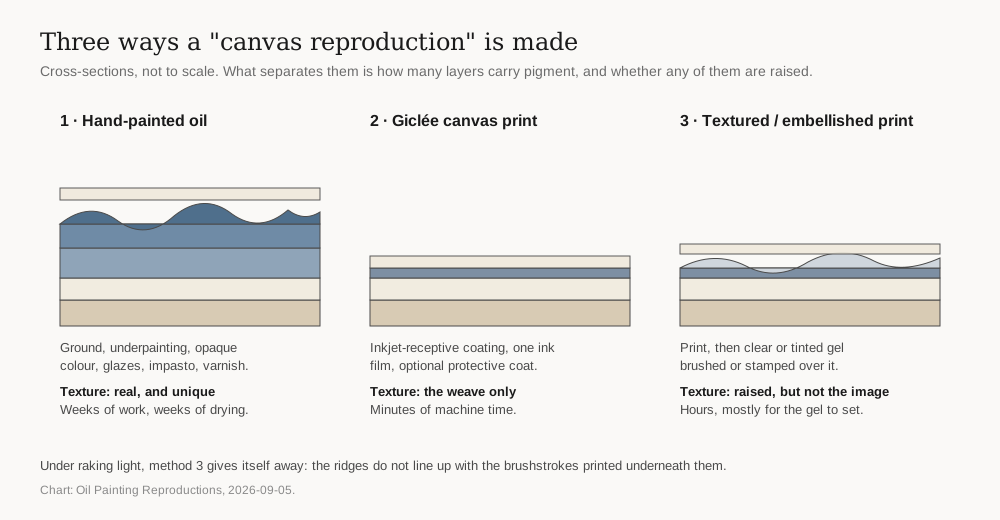
Three completely different manufacturing processes are sold under the phrase "canvas reproduction", and the listings often do not say which one you are getting. They differ in what actually carries the image: pigment suspended in a drying oil and built up over weeks, a single film of inkjet ink, or an ink film with a layer of clear gel worked over the top. Only the first is a painting, and only the first behaves like one once it is on a wall.
| Method | What carries the image | Surface texture | Elapsed time to make | What ages first |
|---|---|---|---|---|
| Hand-painted oil | Pigment in a drying oil — "oils which have the property of forming a solid, elastic surface when exposed to air in thin layers" — built up in several dried layers | Real and unrepeatable: ridges, brush marks and knife edges that follow the image | Weeks. Art & See publishes 2–3 weeks typical, up to 4 for complex paintings and up to 8 for particularly large or intricate pieces | The varnish. Natural-resin varnishes yellow and are replaced by a conservator; the paint film outlives them |
| Giclée canvas print | One film of inkjet ink on a coated canvas | The canvas weave only. Perfectly flat under raking light | Machine minutes, plus stretching | The ink and the coating, under UV. Pigment inks are far better than dye but are still a printed film |
| Textured / embellished print | An ink film, with clear or tinted acrylic gel brushed or stamped over the top | Raised, but the ridges rarely align with the brushstrokes printed underneath | Print time, plus however long the gel needs to set | The gel layer, which can yellow and can lift at the edges |
| Oleograph (historical, no longer made) | A chromolithograph "treated to imitate the variable surface of an oil painting", then "usually glued to canvas to further the imitation" | "Some form of embossing or stamping" — mechanical, and repeating | Press time, once the stones were cut | The paper and the mount; the sheet acidifies and the cloth backing lifts |
Drying-oil definition quoted from the Smithsonian Museum Conservation Institute's Painting Conservation Glossary of Terms; oleograph description quoted from Wikipedia, Chromolithography; Art & See turnaround from its published shipping policy. All accessed 2026-09-05. Prices are deliberately not in this table: the only figures verified for it are Art & See's own ladder, given in the text, and a single seller's ladder is not a market range.
The hand-painted process in 12 steps
This is the sequence a competent studio follows. Order matters: several steps are irreversible once the layer above them is dry, and the cheap versions of this product are cheap precisely because steps 4, 6, 9 and 11 have been shortened or skipped.
Reference sourcing
The copy can only be as good as the file it is painted from. A studio working from a museum's own high-resolution scan sees the brushwork; a studio working from a 900-pixel web thumbnail is inventing the detail it cannot see. Colour is the harder half: museum photography is lit and profiled differently from gallery conditions, so the artist has to decide which version of the picture is the target. Ask which source file a studio uses — the answer separates the top of the market from the bottom immediately.
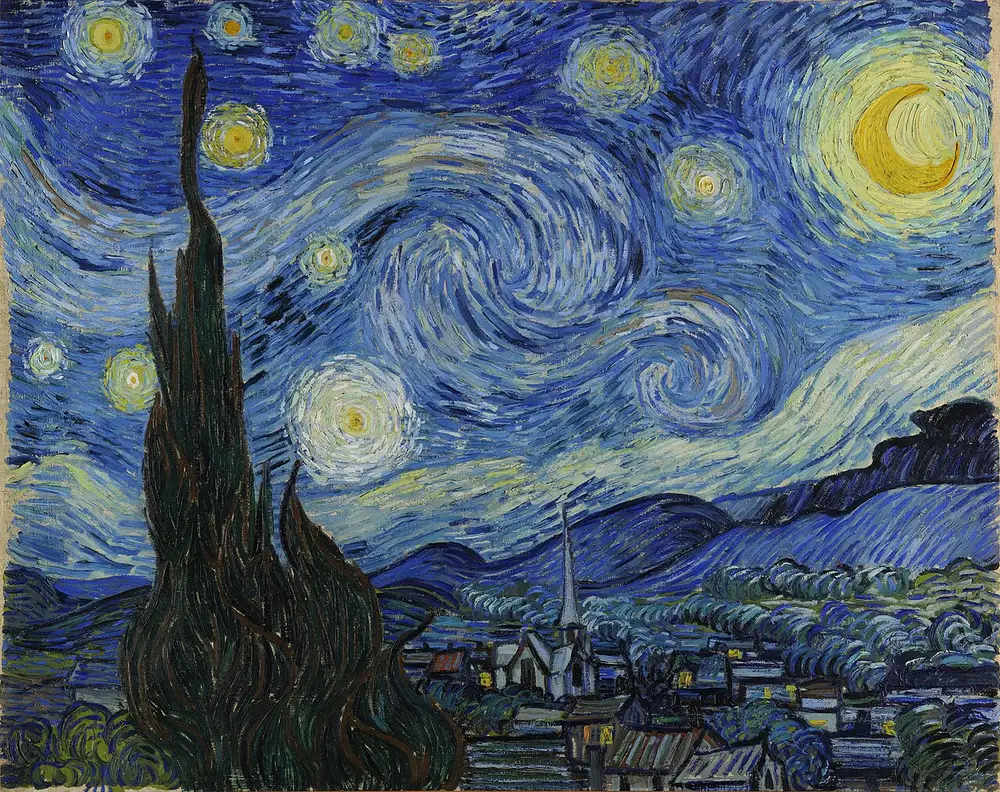
A usable reference: the Google Art Project scan of The Starry Night, in which individual strokes in the sky are resolvable. This is the input a good copy starts from. Wikimedia Commons, public domain Canvas choice
Linen or cotton, and at what weight. Linen's threads are irregular and its longer flax fibres hold tension without sagging; cotton duck is uniform, stretchier and cheaper — Jackson's lists its cotton duck at 339 g/m² (10 oz) and 390 g/m² (12 oz). Weight matters more than fibre for large formats: a 48-inch canvas on lightweight cotton will ripple. The full comparison is in linen vs cotton canvas.
Stretching
The canvas is pulled over a keyed stretcher — corner-wedged, so it can be re-tensioned years later — and stapled or tacked from the centre of each side outwards, alternating sides so the weave stays square. A strainer with fixed corners costs less and cannot be adjusted; on a large piece that is a decision you will regret when the canvas slackens. Studios that ship rolled do this step at the end instead, or leave it to you.
Priming
A glue size seals the fibres so the oil cannot reach and rot them, then two or more coats of ground go on, each sanded back. Oil grounds are slow to make and non-absorbent, which keeps the paint glossy and workable; acrylic grounds are fast and absorbent, which flattens the paint slightly. Either is acceptable. One thin coat is not: it is the single most common corner cut, it saves a day, and it is invisible until the film starts to crack.
Transfer of the drawing
Two honest methods. Grid transfer divides reference and canvas into matching squares and rebuilds the drawing square by square — slow, and it forces the artist to look at every part of the picture. Projection throws the reference onto the primed canvas and the artist traces the main contours. Studios are often coy about projection; they should not be. Getting the geometry right is a mechanical problem, and using a mechanical solution frees the hours for the part that is not mechanical. What matters is that the drawing is checked against the reference by eye afterwards, because a traced outline will still be wrong wherever the projector was off-axis.
Underpainting
A thin monochrome or two-tone lay-in that fixes the value structure — where the darks are, where the lights are — before any colour decision is made. Cheap copies skip it and paint local colour straight onto white ground, which is why they read as flat: the shadows have no weight because nothing was ever established underneath them. On a Rembrandt or a Caravaggio, the underpainting is most of the picture.
First colour layer
Opaque paint goes down over the dry underpainting, area by area, establishing hue and temperature. It is deliberately kept lean — less oil, more solvent — because everything above it has to be fatter. Big flat areas of sky, wall or drapery are laid in first; faces, hands and any signature passage are left until the artist has calibrated the palette on the easy parts.
Drying 1
Nobody touches the painting. Winsor & Newton states that its Artists' Oil Colour becomes touch-dry in thin films "within two to 12 days", and that the range is pigment-dependent: umbers, cobalt blues, Prussian blue and raw sienna are at the fast end, while titanium white, zinc white, alizarin crimson and the quinacridones take more than five days. That is not a scheduling inconvenience — a studio that paints over a wet layer gets a film that wrinkles and cracks, and you will not see it for a year.
Glazes and layers
Thin transparent films laid over dry paint, each shifting the colour underneath optically rather than by mixing. This is where a copy of Vermeer, Rembrandt or Klimt either gets its depth or does not; a single opaque pass can match a photograph of the original but cannot match the original, because the original's colour is the sum of several layers seen through each other. Each glaze needs its own drying interval, which is why this step alone can take a week.
Impasto
Raised paint, applied last on the passages where the original has it: Van Gogh's skies and wheat, Monet's water, Rembrandt's highlights, the gold in Klimt. It is applied with a knife or a stiff brush, undiluted, and it is the most conspicuous thing a cheap copy leaves out — partly because it costs paint, and mostly because thick paint takes weeks rather than days to dry and blocks the studio's schedule.
Drying 2 and varnish
The final cure, then the varnish. Winsor & Newton recommends "waiting at least three months before varnishing" because the colour needs to be completely dry. Almost no commercial studio can hold stock for three months, so most ship with a retouch varnish — a thin, removable, temporary coat — or with no varnish at all. Both are defensible; being told which one you have is not optional. A final varnish can be applied at home or by a framer after a few months.
Sides and QC against the reference
The painted sides — the edges of a gallery-wrapped canvas — are either continued from the image, painted a solid colour, or left raw. Raw white edges are the tell of a rushed job and of a piece designed to be hidden inside a frame. Then the last check: the painting is placed beside the reference under daylight-balanced light, photographed, and compared. The reputable studios send you that photograph and wait. Ocean's Bridge's process page — the page that ranks for this question, and which blocks automated retrieval, so this is what search-engine excerpts of it report rather than a page read in full — describes the finished painting being checked by a master artist and a photo emailed to the customer. Art & See's published shipping policy commits to the same step in its own words: "Before your artwork is dispatched, you will receive a photograph of the final piece for your approval."
How long it really takes
The honest answer has two numbers, and studios that quote only one of them are usually quoting the wrong one. The first is elapsed time, and that one is published: Art & See states 2–3 weeks of typical processing, up to 4 weeks for complex paintings and up to 8 weeks for particularly large or intricate pieces, and Reproduction Gallery's FAQ quotes "a minimum of 21 days for production before shipment" (both accessed 2026-09-05). Two independent sellers landing on three weeks is the closest thing this category has to a benchmark.
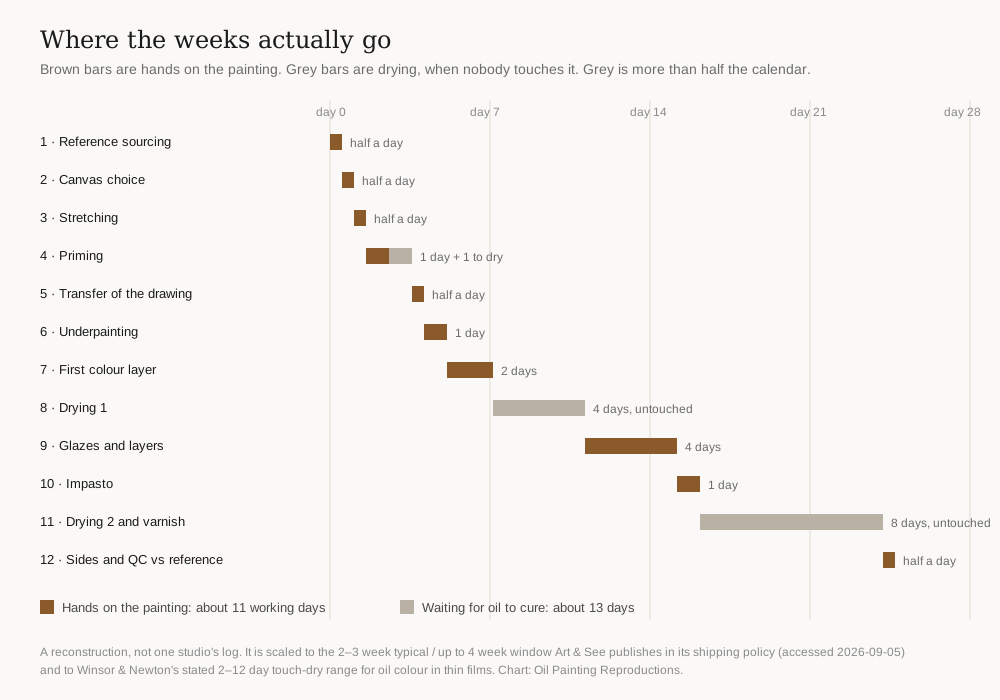
The second number — hours actually spent painting — is not published by anyone, so the table below does not pretend to be a measurement. It is a schedule reconstructed backwards from the two things that are documented: those published turnarounds, and Winsor & Newton's stated 2–12 day touch-dry range for oil colour in thin films. Read it as a model of where three weeks goes, not as one studio's timesheet. Its shape is the part that matters, and the shape is robust: on any schedule that respects the drying intervals, roughly half the calendar is a painting nobody is allowed to touch.
| Step | Hands-on time | Waiting time | Cumulative day |
|---|---|---|---|
| 1 · Reference sourcing | Half a day | — | 0.5 |
| 2 · Canvas choice | Half a day | — | 1 |
| 3 · Stretching | Half a day | — | 1.5 |
| 4 · Priming | 1 day | 1 day between coats | 3.5 |
| 5 · Transfer of the drawing | Half a day | — | 4 |
| 6 · Underpainting | 1 day | — | 5 |
| 7 · First colour layer | 2 days | — | 7 |
| 8 · Drying 1 | — | 4 days | 11 |
| 9 · Glazes and layers | 4 days | included above | 15 |
| 10 · Impasto | 1 day | — | 16 |
| 11 · Drying 2 and varnish | — | 8 days | 24 |
| 12 · Sides and QC against the reference | Half a day | — | 24.5 |
A reconstruction, not one studio's log: about 11 working days of painting and 13 days of waiting. It is scaled to the 2–3 week typical / up to 4 week processing window Art & See publishes in its shipping policy (accessed 2026-09-05) and to Winsor & Newton's stated 2–12 day touch-dry range. Large or intricate pieces run to 8 weeks.
Why drying can't be rushed
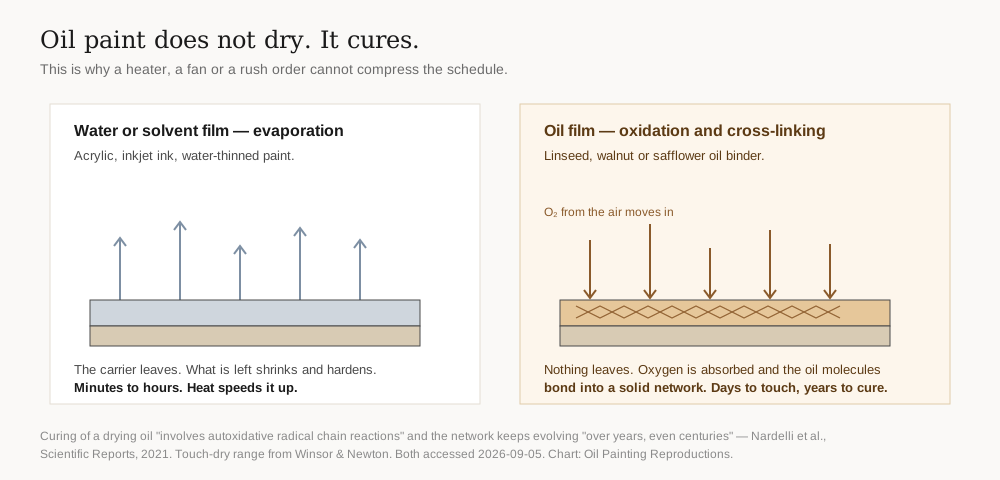
Because oil paint does not dry. It cures, and the two are different chemistry with different consequences.
The Smithsonian's Museum Conservation Institute defines the binder by that behaviour rather than by its ingredients: drying oils are "oils which have the property of forming a solid, elastic surface when exposed to air in thin layers", and the ones used in oil painting were "linseed oil, walnut oil and poppy oil". Exposed to air is the operative phrase. The same glossary defines a drier as "any catalytic material which when added to a drying oil accelerates drying or hardening of the film" — which is the only lever a studio actually has, and it is a chemical one, not a scheduling one.
Water-based and solvent-based films dry by evaporation: the carrier leaves, the solids stay, and heat or moving air speeds it up. An oil film does the opposite — it takes something in. Nardelli and colleagues, writing in Scientific Reports in 2021, describe the curing of a drying oil as a process that "involves autoxidative radical chain reactions, which are light initiated, and metal catalysed": oxygen from the air is absorbed, the fatty acids in the triglycerides are transformed, and new carbon–carbon and carbon–oxygen–carbon bonds knit the small oil molecules into a single solid network. The composition of that network, they note, keeps evolving "over years, even centuries".
Three practical consequences follow, and they are the reason your delivery date is what it is.
- Oxygen has to reach the paint, and it reaches the top first. A thick layer skins over while it is still soft underneath. Force it with heat and the skin sets over a moving interior; the surface later wrinkles or cracks in a pattern conservators recognise on sight.
- The pigment sets the clock, not the studio. Winsor & Newton lists umbers, cobalt blues, Prussian blue, raw sienna and permanent mauve at the fast end of the 2–12 day touch-dry range, and titanium white, zinc white, alizarin crimson, the quinacridones and Winsor yellows and orange at more than five days. A sky full of titanium white simply takes longer than a burnt-umber underpainting, whatever the deadline says.
- Fat over lean is a scheduling rule as much as a technical one. Each layer must contain more oil than the one below, and must be dry before the next goes on. Break the order to save three days and the film cures at different rates at different depths, which is what pulls it apart.
The failure has a name, and conservators can read it years later. The Smithsonian's Museum Conservation Institute defines crazing as "fine lines or minute surface cracks occurring on painted surfaces due to unequal contraction in drying or cooling" — unequal contraction being exactly what a rushed layer schedule produces, because the top of the film sets while the bottom is still moving. That is distinct from craquelure, which the same glossary describes as "a pattern of cracks that develops on the surface of a painting as a result of the natural drying and aging of the paint film": the slow, even network an old painting earns honestly.
This is the practical reason to be suspicious of an unusually fast quote rather than merely disappointed by a slow one. A compressed schedule does not show up on delivery day. It shows up in year three or year eight, as a fine crack pattern in the thickest passages — the impasto, the highlights, the places the studio spent the most paint on — and by then the returns window closed years ago.
$100 copy vs $1,000 copy
The gap is not talent, or not mainly. It is how many of the twelve steps survived the price, and the differences are physical enough to list.
- Reference. $100: a web-resolution image, so the brushwork is invented. $1,000: a museum-grade scan in which individual strokes are resolvable, like the Google Art Project file of The Starry Night.
- Canvas and stretcher. $100: light cotton on a fixed strainer, no keys, often stapled crooked. $1,000: heavier cotton duck or linen on a keyed stretcher that can be re-tensioned in ten years.
- Ground. $100: one thin coat, sometimes straight from a pre-primed roll with nothing added. $1,000: two or more coats, sanded between.
- Layers. $100: one opaque pass, wet-into-wet, finished in a day. $1,000: underpainting, opaque colour, glazes — three or more dried stages.
- Impasto. $100: flat, or a token ridge in one corner. $1,000: raised where the original is raised, absent where it is not.
- Division of labour. $100: assembly line. Al Jazeera described Dafen production as "each artist painting a small section of a larger piece, such as a tree or an eye, before passing the painting on" — fast and consistent, but nobody owns the whole picture. $1,000: one artist, one canvas, start to finish.
- Drying. $100: days, sometimes hours, sometimes in a warm room. $1,000: weeks, at ambient temperature.
- Proof before shipping. $100: none; you see it when it arrives. $1,000: a photograph for approval and revisions before dispatch — the practice Art & See describes as a complimentary photo preview before shipment in its published shipping policy (accessed 2026-09-05), with its ladder running $249.95 for 16×16 in to $599.95 for 48×36 in unframed.
- Edges. $100: raw white sides, designed for a frame to hide them. $1,000: sides painted or continued from the image.
Whether the extra money buys something you will actually perceive on your wall is a separate question, answered with prices in how much do oil painting reproductions cost.
How to check workmanship on arrival
Do this in the first hour, before the tube or the crate goes in the bin, and photograph everything as you go.
- Raking light. Kill the room lights, hold a single lamp almost flat against the surface from one side, photograph, then move the lamp to the other side and photograph again. Real paint casts shadows that flip; a print stays flat and only its weave lights up.
- Look at the back. The reverse should show canvas, staples or tacks, a keyed stretcher, and — on an honest piece — a label naming the original artist with the word after, plus the studio and the year.
- Check the edges. Painted or continued sides mean the studio expected the piece to be seen unframed. Raw white edges mean it did not.
- Smell it. Fresh oil and varnish have a distinct linseed smell for weeks. A print smells of nothing, or faintly of plastic.
- Compare to the reference on a screen, side by side, in daylight. Not from memory — actually put the file up. Check the darkest darks first: cheap copies lose the shadow detail before they lose anything else.
- Measure it. Compare against the size you ordered. A canvas cut short and stretched to fit is not rare.
- Then read the returns clock. Art & See's published refund policy gives a full refund on cancellation within 24 hours of placing the order, and keeps a resolution open for 90 days from delivery — but its stated preference is refinement by the artist, with resolutions otherwise issued as store credit and cash refunds "issued at our discretion" (accessed 2026-09-05). That is different from an unconditional money-back window such as Reproduction Gallery's "45-Day 100% Refund or Replacement Guarantee". Whatever studio you used, find its exact wording before you unwrap anything.
Each of those checks is expanded, with pass and fail examples, in museum quality oil painting reproductions.
Where to buy
Three ways to buy a hand-painted copy, with the trade-off stated in each case.
Hand-painted oil on canvas with a photo preview sent for approval before shipment and a published 2–3 week typical processing window (up to 8 weeks for large or intricate pieces), framed and unframed options, from $249.95 for 16×16 in (verified 2026-09-05).
Art & See- Canvas Replicas — A small US studio that publishes its own three-tier grading — museum, retail, commercial — and states it uses only the highest-quality canvases and Winsor & Newton oil paints, which is more material detail than most sellers put in writing; orders go through a phone call rather than a cart.
- Dafen Village Online — Buying direct from the Shenzhen village that Al Jazeera reported once produced 60% of the world's new oil paintings cuts out the Western retailer's margin and is the cheapest route to a hand-painted canvas — this is where Art & See loses on price, in exchange for handling customs yourself and having no local returns route.
Frequently asked questions
How many hours does a reproduction actually take to paint?
No studio in this category publishes an hours figure, so treat any number you are quoted — including the one in this article's schedule table, which is a reconstruction and says so — as an estimate rather than a measurement. What is published is elapsed time, and it is consistent: Art & See states 2–3 weeks typical and up to 8 weeks for large or intricate pieces, and Reproduction Gallery quotes "a minimum of 21 days for production before shipment". The gap between painting hours and elapsed weeks is drying: Winsor & Newton puts touch-dry at two to 12 days for thin films depending on pigment, and each layer has to reach that state before the next goes on.
Are the same paints used as in the original?
The same category, not the same tubes. Modern artists' oil colour uses pigments that are more lightfast and less toxic than the 17th- or 19th-century equivalents — no lead white, no genuine ultramarine ground from lapis. Some studios name their brand in writing: Canvas Replicas states it uses "only the highest quality canvases and Winsor & Newton oil paints", and Reproduction Gallery's FAQ says every painting is created with "Winsor & Newton Professional Artists' Oil Colors and premium canvas" (both accessed 2026-09-05). Ask; a studio that cannot name its paint has probably not chosen it.
Why does it take weeks when the painting itself takes days?
Because oil cures by absorbing oxygen rather than by evaporating, so each layer has to sit before the next one can go on. Winsor & Newton puts touch-dry at two to 12 days for thin films depending on pigment, and recommends at least three months before final varnishing. On a typical 24×20 in piece, about 11 working days are painting and about 13 are waiting.
Will it arrive rolled or stretched?
Usually rolled in a tube, because a stretched canvas needs a crate and costs several times more to ship — Art & See's shipping policy states the painting "is rolled and placed in a protective tube". A local framer will stretch it for a modest fee. If you want it stretched on arrival, confirm it in writing before you pay, and expect the shipping cost to change.
Is the drawing traced?
Often, and that is not the problem people assume. Both grid transfer and projection are legitimate ways to solve the geometry, and museum copyists have used mechanical aids for centuries. What matters is what happens after the outline: the value structure, the layering, the colour and the impasto are where a copy is won or lost, and none of them can be traced.
Sources
- Understanding drying times for oil colour — Winsor & Newton. Accessed September 5, 2026.
- The stability of paintings and the molecular structure of the oil paint polymeric network — Nardelli et al., Scientific Reports, 2021. Accessed September 5, 2026.
- Dafen oil painting village: The world's art factory — Al Jazeera, 18 February 2018. Accessed September 5, 2026.
- Understanding Oil Reproductions (quality grades) — Canvas Replicas. Accessed September 5, 2026.
- The Oil Painting Reproduction Process (benchmark page for this query) — Ocean's Bridge — returns HTTP 403 to automated requests; the page was not retrievable on 2026-09-05 and is reported here from search-engine excerpts, not from a full read. Accessed September 5, 2026.
- Painting Conservation Glossary of Terms (drying oils, drier, impasto, glaze, craquelure) — Smithsonian Museum Conservation Institute. Accessed September 5, 2026.
- FAQ — materials, production time and guarantee — Reproduction Gallery. Accessed September 5, 2026.
- Chromolithography (oleograph definition) — Wikipedia. Accessed September 5, 2026.
- Cotton duck canvas rolls (339 g/m² / 10 oz and 390 g/m² / 12 oz listings) — Jackson's Art Supplies — returns HTTP 403 to automated requests; figures read from the product listings via search-engine excerpts on 2026-09-05. Accessed September 5, 2026.
- The Starry Night, 1889 (Google Art Project scan) — Wikimedia Commons. Accessed September 5, 2026.
Keep reading
definition
What Is an Oil Painting Reproduction?
An oil painting reproduction is a new painting in oil that copies an existing work. What that means legally, materially and financially — term by term.
comparison
Hand-painted oil painting reproduction vs canvas print
Twelve criteria, a 40-year cost table and the five cases where a print is the better buy. Prices from seven studios, collected 2026-09-05.
price
How much do oil painting reproductions cost?
Compare equivalent sizes, finishes, shipping and payment terms with a dated total-cost worksheet. Unknown charges stay visible instead of becoming zero.
buying
Museum Quality Oil Painting Reproductions: What to Check Before Ordering
A sourced checklist for materials, finished-painting approval, cancellation and returns, with policy exceptions and limits of visual checks.
buying
Oil Painting Reproductions From China: The Buyer's Guide to Dafen
What Dafen is, what changes between quality tiers, how Western stores mark up, and the real cost of importing direct — duties, timelines and risk.
process
Linen vs cotton canvas: what you can verify
Compare named canvas specifications, preparation and seller claims. Learn what documents establish and what a photograph cannot prove.