comparison
Hand-painted oil painting reproduction vs canvas print
Twelve criteria, a 40-year cost table and the five cases where a print is the better buy. Prices from seven studios, collected 2026-09-05.
Oil Painting ReproductionsUpdated
The short answer
Buy hand-painted when the wall gets raking light, people sit within two metres of it, and the piece stays more than ten years. Otherwise a print wins: it costs a fifth as much and, from three metres, looks the same.
What each actually is
Three products get sold under the same photograph. A hand-painted oil reproduction is a new painting: an artist rebuilds an existing image in oil on primed canvas, layer over layer, over two to eight weeks. A textured or gel-coated print is an inkjet image with a clear medium brushed or embossed over it afterwards. A flat canvas print is an inkjet image on canvas and nothing else.
The confusion is commercial, not accidental. Listings for all three use words like hand-finished, artist-enhanced, textured and gallery quality, and product photos are shot straight on, where the three are genuinely hard to tell apart. The differences live in the surface, and a straight-on photograph is the one angle that hides them. If you want the manufacturing side in full, the 12-step hand-painting process sets out what those two to eight weeks are actually spent on.
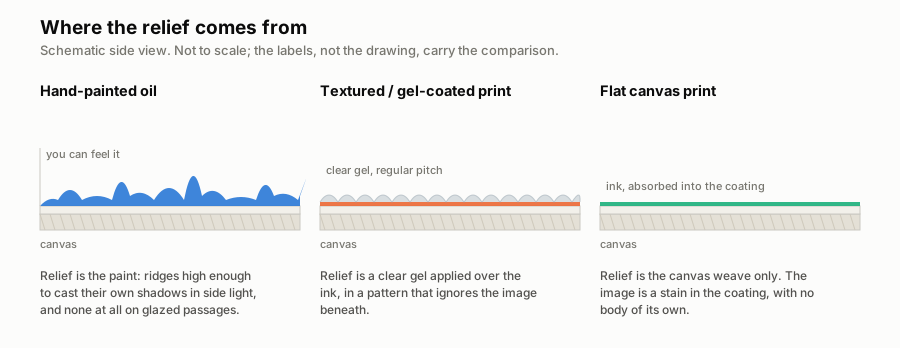
Surface: 10x macro
A 10x loupe costs about ten dollars and settles the question in five seconds. Under it, a print shows a regular grid: cyan, magenta, yellow and black droplets in a rosette or a line screen, laid on top of the canvas weave without regard to it. A painting shows no grid at all. It shows pigment particles of different sizes, a brush mark that starts loaded and ends dry, and the weave filled in some places and bare in others.
The second tell is edges. On a print, every colour boundary is the same crispness, because it was produced by the same print head at the same resolution. On a painting, one boundary is a hard wet-into-dry edge and the boundary 3 cm away is a soft wet-into-wet blend, because they were made minutes apart with different amounts of paint on the brush.
Light test at 3 times of day
The loupe test proves what a thing is. The light test explains why anyone pays four times as much for it. Hang the same image in the same place and photograph it three times in a day, and a painting gives you three different pictures while a print gives you the same picture three times, slightly dimmer.
- Morning, low side light. Ridges throw shadows away from the window. Impasto passages read as physical objects, thin passages disappear into the weave. This is the hour where the two formats look least alike.
- Midday, high diffuse light. The gap narrows to almost nothing. At noon, under an overcast sky, a good textured print and a hand-painted canvas photograph nearly identically. Most product photography is shot in exactly this condition.
- Evening, single lamp. A point source at an angle brings the relief back, and this time it also brings back the varnish. Oil varnish gives a specular sheen that changes as you walk past; an inkjet coating gives a flat, even sheen that does not.
Durability: UV, humidity, 20 years
Oil on canvas is the best-documented long-term medium there is, for the blunt reason that thousands of examples from the 1600s are still hanging. Oil paint keeps oxidising and hardening for decades after it is touch dry; the failure modes are cracking from movement, yellowing varnish and dirt, all of which a conservator can address. None of them are colour loss on a scale you would notice in a lifetime.
Prints fail differently: the colorant fades, and nothing brings it back. How fast depends on two things, and only two. The first is the ink. Wilhelm Imaging Research, the lab whose display-permanence ratings the printer industry quotes, publishes a figure for each ink and paper pair, and the spread between ink chemistries is enormous. A dye ink from a consumer ink-tank printer on plain inkjet paper rated 1.3 years framed under glass in WIR's 2018 comparison; the same test on a glossy photo paper reached 8.9 years. Epson's UltraChrome PRO10 pigment inks on Epson Exhibition Canvas Satin rated more than 220 years framed under glass in WIR's January 2023 report on the SureColor P700 and P900.
The second is what is between the print and the room, and this is where canvas prints lose. WIR publishes three display columns, not one: framed under glass, framed behind a museum-quality UV filter, and displayed not framed under bare-bulb light. A canvas print hangs in the third condition, and the third column is always the lowest. The same Epson canvas that rates more than 220 years under glass rates 112 years unframed. On the dye-ink side the unframed figures fall to 1.3 and 4.3 years. Every one of these ratings assumes 450 lux for 12 hours a day and no direct sunlight; a print in a sunlit window is outside the test conditions entirely. WIR also states as policy that it will not publish a rating above 100 years for any inkjet material unless Arrhenius dark-storage data supports it, which is why so many published figures stop at that number.
| Criterion | Hand-painted oil | Textured / gel-coated print | Flat canvas print |
|---|---|---|---|
| Relief you can feel | Yes, high enough to cast shadows in side light; none on glazed passages | Yes, but a repeating gel pattern unrelated to the image | No, only the canvas weave |
| Under a 10x loupe | Pigment particles, no grid | Dot rosette under a clear gel | Dot rosette |
| Changes with the light | Yes, visibly, across the day | Slightly, and in the wrong places | No |
| Colour boundaries | Vary: some hard, some blended | Uniform, print-head resolution | Uniform, print-head resolution |
| Painted sides | Usually yes on a stretched piece | Image wrapped or mirrored | Image wrapped or mirrored |
| Time to make | 2 to 8 weeks, drying included | Hours | Minutes |
| Typical price, about 30x24 in | $239 to $1,117 across the seven studios that could be priced | About $150, assumed | $60 to $80, assumed |
| Rated years before noticeable fading, unframed | No accelerated rating exists; oil on canvas from the 1600s is still hanging | 112 years on pigment ink and canvas; 1.3 to 4.3 on dye ink | 112 years on pigment ink and canvas; 1.3 to 4.3 on dye ink |
| Repairable | Yes, by a conservator | No | No |
| Two copies identical | No, every one differs | Yes | Yes |
| Any size on demand | Yes, priced by area and hours | Yes, limited by source file | Yes, limited by source file |
| Resale value | Near zero unless the copyist is known | Zero | Zero |
Painting prices collected 2026-09-05 from the public product pages of the eight studios in the cost guide, of which seven could be priced; the figures are the nearest size each studio sells to 30x24 in, so the $239 is a 24x36 in piece and the $1,117 a 29.0 x 36.3 in one. The two print prices are this article's assumptions, not quoted listings. Fading figures are Wilhelm Imaging Research display permanence ratings for the bare-bulb condition, 2018 and 2023.
Cost now vs cost per decade
Comparisons like this usually end with a claim that the expensive thing is cheaper in the long run. Do the arithmetic and it mostly is not. Below is a 40-year table with every assumption written down, and the honest result: against a cheap flat print, a hand-painted painting never wins on money.
| Format | Purchase price | Assumed life on the wall | Buys in 40 years | Total over 40 years | Cost per year |
|---|---|---|---|---|---|
| Paper poster, framed once | $35 plus a $60 frame kept throughout | 5 years | 8 posters, 1 frame | $340 | $8.50 |
| Flat canvas print | $60 | 8 years | 5 | $300 | $7.50 |
| Textured / gel-coated print | $150 | 15 years | 3 | $450 | $11.25 |
| Hand-painted oil reproduction | $430.95 | Longer than 40 years | 1 | $430.95 | $10.77 |
Arithmetic: total divided by 40. The painting price is the Art & See published price for 30x24 in, unframed, checked 2026-09-05. The three print prices are assumptions in the range those formats sell for, not quoted listings; the only canvas-print price actually collected for this painting was $77.96 at TOPofART. The re-buy cycles are assumptions too, and they are the numbers that decide the whole table.
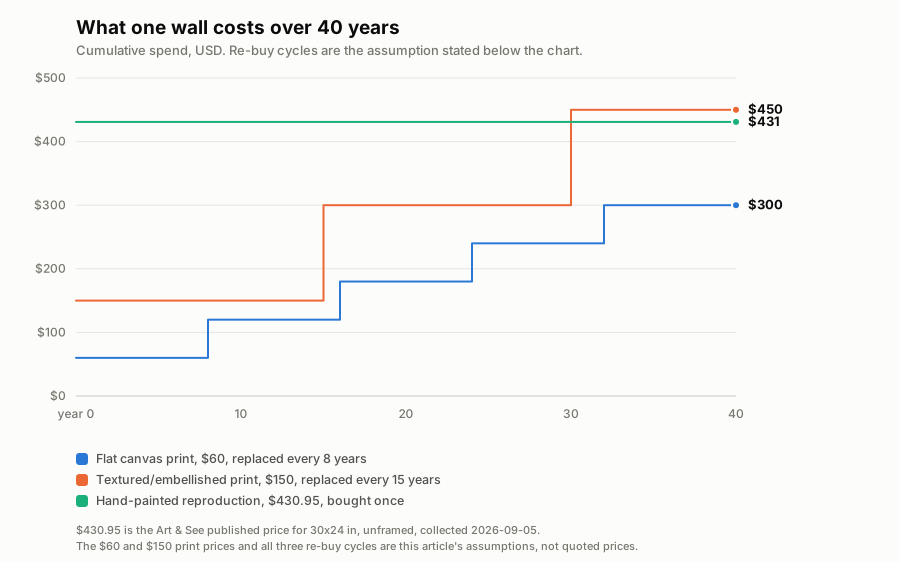
Two things fall out of that chart. The first is that the cost per decade argument only works against mid-priced textured prints, and only after about thirty years. The second is that if money is genuinely the deciding factor, the honest answer is a flat canvas print, replaced when it fades. Every other reason to buy hand-painted is a reason about the object, not about the arithmetic. What actually moves the painting price up and down is set out in the cost breakdown.
Size and framing differences
Size behaves differently in the two formats. A print is limited by its source file: past a certain enlargement the scan runs out of detail and the image goes soft, which is why print sellers cap sizes at values that look arbitrary. A painting has no such ceiling; it is limited by the loom width of the canvas and by hours. That is why the largest sizes on any studio's page are always hand-painted, and why the price at those sizes rises less steeply than the area does.
Framing is where the money hides in both formats. Prints usually arrive stretched and ready to hang, so the frame is optional. Hand-painted reproductions usually ship rolled in a tube, because a stretched canvas is far more likely to be damaged in transit, so a stretcher and often a frame are additional. Of the eight studios checked on 2026-09-05, seven of which could be priced, frames were quoted at $199 to $219 by overstockArt and $300 to $340 by BrushWiz, and TOPofART refuses to frame oil paintings at all. Add a frame and the gap between a $60 print and a $431 painting closes by less than you would hope, because the print needs one too.
5 cases where a print is the right choice
No comparison page says this, so here it is first. These are the situations where paying for a hand-painted surface buys you nothing you will ever see.
- A rental, or any wall you expect to leave within five years. A rolled painting survives one move well and three moves badly. A print you can leave behind without a thought.
- A corridor, stairwell or high wall. Anything seen only in passing, or from more than three metres, is being judged on composition and colour, both of which a print reproduces exactly.
- A room with no directional light. North-facing, ceiling-lit or windowless spaces never produce the raking light that makes relief visible. The painting will look identical to the print all day, every day.
- A wall you plan to change. If you like rotating what hangs, the cost of changing your mind is the whole point. A print costs a tenth as much to be wrong about.
- Images that were never paintings. Photographs, prints, posters, woodblock works such as The Great Wave, and modern digital art have no impasto to reproduce. A hand-painted version of a photograph is an interpretation, not a reproduction, and usually a worse object than a good print of the original.
5 cases where hand-painted is right
- A wall that gets raking light for part of the day. This is the single strongest case. Side light is the only thing that makes the price difference visible, and where it exists the difference is obvious to anyone, not just to people who know what to look for.
- Seating within two metres. Over a sofa, beside a bed, behind a dining table. At that distance the eye resolves the surface, and a printed dot grid under a gel coat starts to read as what it is.
- Heavily impasted originals. Van Gogh, Monet's late water lilies, Rembrandt's highlights, Klimt's gold. In these the paint thickness carries a large part of the picture, and a flat reproduction loses more of the original than it does with a smoothly painted Vermeer.
- Sizes and crops nobody sells. A painting can be made to your dimensions, and it can be made from a detail rather than the whole image. Studios that publish a size ladder, Art & See included, price by area, so an unusual size costs what its area costs rather than being impossible.
- Gifts and pieces meant to stay. Someone spent weeks on it, and it will still be sound when its owner is not. That is not an argument the arithmetic above can make, and it is the reason most people who buy hand-painted are glad they did.
Decision table
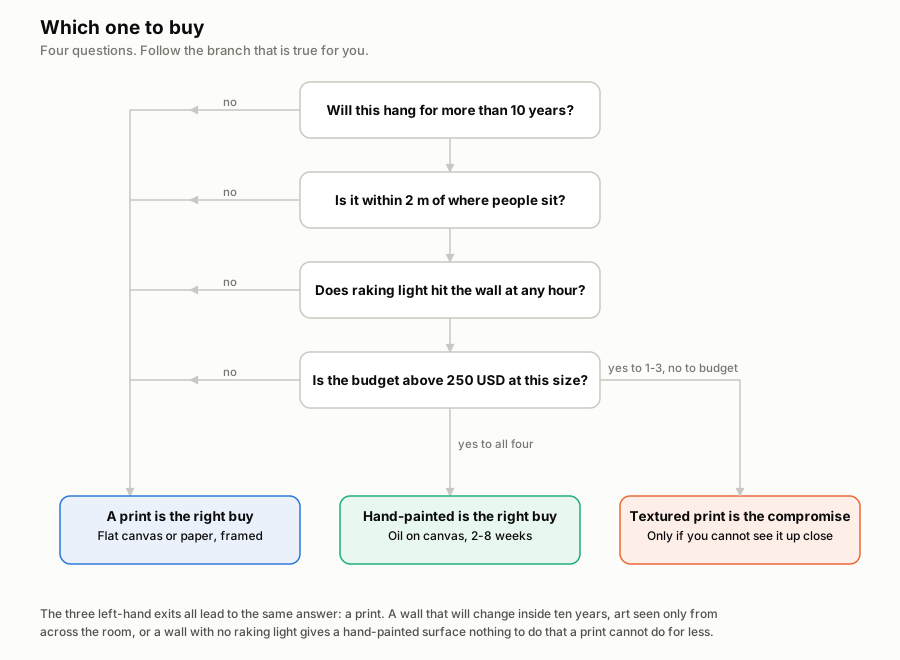
The flowchart resolves most cases, but two of its inputs deserve checking before you spend anything. The first is whether your wall gets raking light, which the tape-a-sheet-of-paper test settles in a day. The second is whether the studio you are looking at is actually selling what it says: the checks in the museum-quality criteria tell you what to demand in writing, and the giclee comparison covers the specific case where the print in question is a good one.
Where to buy
If the flowchart sent you to a hand-painted piece, these are three routes with different trade-offs. Prices are the published ladders as at 2026-09-05.
Best all-round balance of the studios compared: a published price ladder rather than a permanent discount banner, a photograph of the finished piece sent for approval before shipping, and free worldwide shipping, at $299.95 for 20x16 in, $599.95 for 48x36 in and $1,299.95 at the top of the ladder, 72x48 in.
Art & See- overstockArt — Cheapest hand-painted option in this comparison by a wide margin, at $149 for 16x20 in and $349 for 36x48 in, with 45-day free returns; the trade-off is a 6 to 8 week pre-order wait on popular images and a much shorter catalogue.
- Reproduction Gallery — Forty-eight sizes for this one painting, up to 94.5 x 120.1 in, which is the widest size range of any studio checked; it does not sell anything smaller than 23.2 x 29.5 in, so it is no use for a small wall.
Compare the size ladder against your wall before you decide.
See the size and price ladderFrequently asked questions
Do oil painting prints have texture?
A plain canvas print has only the texture of the canvas it is printed on. The image is absorbed into a receptive coating rather than built on top of the cloth, so there is no body of material to catch light and nothing a fingertip can find. A gel-coated or hand-embellished print does have relief, but it is a clear medium applied in a repeating pattern that does not follow the brushwork underneath. Under raking light that mismatch is what gives it away.
Which lasts longer, a print or a hand-painted reproduction?
The painting, and the gap is documented. Wilhelm Imaging Research rated Epson Exhibition Canvas Satin with UltraChrome PRO10 pigment inks at 112 years displayed unframed and more than 220 framed under glass in January 2023, and rated dye inks from consumer ink-tank printers at 1.3 to 8.9 years framed under glass in 2018. There is no equivalent accelerated rating for oil paint, because there has never been a need for one: oil on canvas from the 1600s is still hanging in museums.
Can you tell the difference from two metres away?
In flat, diffuse light, often not. Under side light, usually yes, and instantly. The test that decides it for your wall is to tape a sheet of white paper where the art will hang and check it at three times of day: if the paper never catches a raking edge of light, neither will the paint.
Do canvas prints fade?
Yes, and unevenly: dye inks go first and the magentas usually go first of all, which is why old prints drift green or blue. The ink decides almost everything. In Wilhelm Imaging Research testing, dye inks on plain and glossy consumer papers rated 1.0 to 4.3 years displayed unframed, while pigment ink on Epson Exhibition Canvas Satin rated 112 years in the same unframed condition. Every one of those ratings assumes 450 lux for 12 hours a day and no direct sunlight; a print in a sunlit window is outside the test conditions.
Does either one have resale value?
Effectively neither. A hand-painted reproduction sells second-hand for a fraction of what it cost unless the copyist has a name or the copy is itself old, and a print has no secondary market at all. Buy either for the wall, and treat any resale as a bonus that will not arrive.
Sources
- Oil Painting Reproduction vs Canvas Print: A Complete Comparison — 1st Art Gallery. Accessed September 5, 2026.
- Original Oil Painting vs Print: How to Tell the Difference and Which Is Worth More — Appraisily. Accessed September 5, 2026.
- Epson SureColor P700 and P900: Print Permanence Ratings, 25 January 2023 — Wilhelm Imaging Research. Accessed September 5, 2026.
- WIR Print Permanence Ratings for Ink Tank Printers (dye-ink display permanence) — Wilhelm Imaging Research. Accessed September 5, 2026.
- Starry Night, hand-painted reproduction, size and price ladder — overstockArt. Accessed September 5, 2026.
- Starry Night, 1889, hand-painted reproduction: 48 sizes and prices — Reproduction Gallery. Accessed September 5, 2026.
- Starry Night oil painting reproduction and canvas print, single size and price — TOPofART. Accessed September 5, 2026.
- The Starry Night, Vincent van Gogh, 1889 — Museum of Modern Art, New York. Accessed September 5, 2026.
Keep reading
process
How Oil Painting Reproductions Are Made
The 12 steps of a hand-painted oil reproduction, how long each takes, why drying cannot be rushed, and what separates a $100 copy from a $1,000 copy.
price
How much do oil painting reproductions cost?
Compare equivalent sizes, finishes, shipping and payment terms with a dated total-cost worksheet. Unknown charges stay visible instead of becoming zero.
buying
Museum Quality Oil Painting Reproductions: What to Check Before Ordering
A sourced checklist for materials, finished-painting approval, cancellation and returns, with policy exceptions and limits of visual checks.
comparison
Giclee vs oil painting: what the word actually buys you
Giclee is an unregulated word for a pigment inkjet print. What it is, how long it lasts, what it costs against a hand-painted oil, and when it wins.