buying
Museum Quality Oil Painting Reproductions: What to Check Before Ordering
A sourced checklist for materials, finished-painting approval, cancellation and returns, with policy exceptions and limits of visual checks.
Oil Painting ReproductionsUpdated published
The short answer
Treat “museum quality” as a description that needs a written specification. Check materials, your actual painting’s approval process, cancellation stages and return exceptions. Published policy is evidence of a promise; it is not evidence that we ordered, received or tested the product.
Turn the phrase into a documented order
The useful question is what the seller commits to deliver for your chosen painting. A phrase such as “museum quality” does not, by itself, identify the support, paint, mounting, reference image or remedy if the result is unsuitable. Ask for the specification behind it. This guide does not make a universal claim about regulation in every jurisdiction; it explains the documents and observations a buyer can keep.
This is a documentary review, checked on 18 September 2026. We read manufacturer guidance and published seller policies; we did not commission test paintings, inspect samples or test a seller’s service. Material specifications, marketing claims, policy promises and observed practice are separate categories. A good written policy can be compared with another policy, but it does not demonstrate how a particular order will be handled.
Use the same order specification throughout the process. Save the chosen artwork, dimensions, support, finish, reference image and any agreed changes before payment. At preview, compare the pictured item with that record. At delivery, record its condition and any discrepancy without altering the object. If a specification is missing, keep it marked unknown rather than inferring it from a price, an attractive photograph or a review score.
Our review method explains how we use published evidence. A material score describes the stated specification, not a fibre analysis or lifespan test. The linen and cotton guide provides exact manufacturer examples, and the cost worksheet keeps a material or frame upgrade separate from freight and other charges. These checks help define an order; they do not promise investment value.
The checklist below is an editorial aid, not a technical certification scheme. Some questions can be answered by a specification, some by a policy, and others remain uncertain without suitable examination. Preserve that distinction rather than turning every missing answer into a failed material test. A seller should be asked about the actual item and order category, because standard catalogue work, custom commissions and frames can follow different terms.
Ten checks, and the evidence each needs
| Check | Ask for | Useful record | Limit |
|---|---|---|---|
| Support | Fibre, product variant and preparation | Written material specification connected to the order | A weave photograph does not establish composition |
| Medium | Whether the item is painted, printed or embellished; named paint system if supplied | Product description and order confirmation | Smell or gloss is not a reliable binder-identification test |
| Surface | Requested texture and treatment of important passages | Agreed reference and finished-item detail photographs | Raised texture alone does not prove how the image was made |
| Dimensions | Image size, margins, orientation and any crop | Order specification and nondestructive measurement | Frame dimensions and image dimensions are different |
| Finish | Rolled, stretched or framed; edges and mounting | Itemised finish specification | An unframed price does not identify the mounting |
| Varnish and care | Whether applied, product if known, and relevant care instructions | Written finishing record | No universal timetable follows from dispatch date alone |
| Preview and revisions | Photograph of this finished item; when approval is needed; changes included | Approval policy and dated preview record | A catalogue picture is not a finished-item approval |
| Cancellation | Time window, work stage, payment and exclusions | Applicable cancellation terms | A preview does not guarantee an unconditional cancellation |
| Delivery condition | Packaging, damage-reporting procedure and deadline | Condition photographs and carrier records | Do not repair first and assume the same return terms remain |
| Post-delivery remedy | Refund, revision, replacement or credit; costs and excluded components | Full return policy and written clarification | A longer window does not necessarily mean a cash refund |
Keep the answers with the quote and the policy version applicable to the order. “Not stated” remains a valid entry.
1 · Support and preparation
Ask for the fibre, preparation and, where available, full manufacturer code. GOLDEN’s preparation guidance considers the support and paint system together. It does not establish that every linen canvas outlasts every cotton canvas. Keep the studio’s claim separate from proof about the delivered object, and do not infer material identity from an irregular weave alone. The material comparison explains the difference between a maker’s record and an order-specific claim.
2 · The medium promised in the listing
Record whether the product is offered as a hand-painted oil, a print or a print with applied material. If the wording is ambiguous, ask what parts are printed and what parts are painted. A smell test, a shiny surface or a soft stroke edge is not sufficient evidence to identify the binder. A claim about the ground is also different from a claim about the paint: record both when that distinction matters to you.
3 · Surface and reference
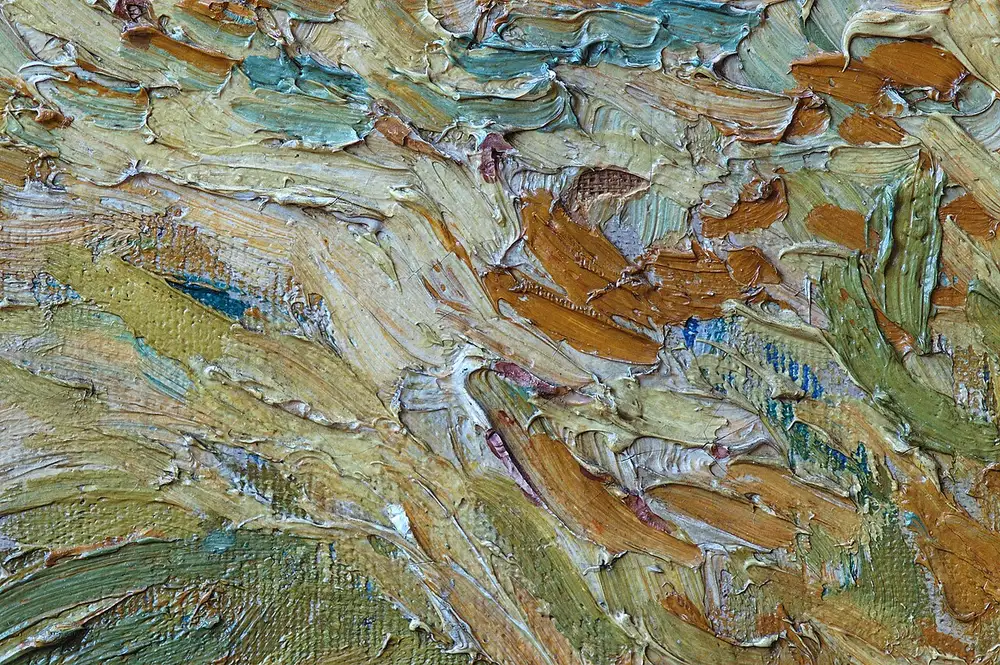
Agree which reference image and visible features matter to the commission. Ask for overall and detail photographs of the finished item, with consistent lighting and without filters. These can help identify differences in composition or requested surface treatment. They do not establish the number of dried layers or prove that a textured surface is entirely painted. Describe the discrepancy you can actually see rather than assigning a cause that the image cannot demonstrate.
4 · Dimensions and crop
Save the requested image width and height, the units, orientation and any margin for later mounting. If fitting an existing frame requires a different proportion, agree how the composition will be handled before production. On arrival, compare the appropriate measurement with the specification. Do not introduce an arbitrary one-centimetre tolerance that the order never stated, or assume the reproduction must be the size of the museum original.
5 · Delivery format and edges
State whether the order is loose canvas, stretched canvas or a framed painting. Agree any wrap, edge colour and hardware you want, and distinguish those choices from claims about quality. White edges can simply be part of a specification for a framed work; they do not automatically demonstrate a failed reproduction. If the item will be mounted locally, record the spare-cloth margin and seek a quote using that information before ordering.
6 · Varnish and care instructions
Winsor & Newton’s drying guidance distinguishes different paint ranges and conditions and advises allowing paint to dry before varnishing. Ask what finish the particular painting has received and what future care is recommended for it. Do not deduce from a two-week dispatch date that the item must be a print, or promise that every painting needs the same treatment at six months. A sticky surface or damage should be documented and reported, not tested with household solvents.
7 · Preview of your actual painting
Confirm that the preview will show the finished item assigned to your order, rather than a stock example. Keep the file, date and order reference with your requested changes. Ask which revisions are included, whether any request affects the price or schedule, and what happens if an unresolved discrepancy remains. Do not assume that viewing a photograph confirms the unseen materials or creates an unrestricted right to cancel after production.
8 · Cancellation before dispatch
Read the cancellation clause before payment and distinguish it from both approval and returns. A policy can offer early cancellation yet limit what happens once work begins. Record the event that starts the clock and whether a deposit or an already-started custom item is treated differently. If the terms are unclear, keep the uncertainty explicit in your comparison rather than turning “contact us” into a guaranteed refund.
9 · Condition on arrival
Retain the packaging and record the outer parcel, label and visible condition when unpacking. Save clear photographs of any damage and the order details needed for a report. Follow the applicable seller and carrier reporting process promptly. Do not apply varnish, stretch a disputed loose canvas, repair a frame or throw away the packaging while assuming the original return terms still apply. This is a documentation checklist, not a recommendation to carry out conservation work.
10 · Remedy, exclusions and return costs
Read the full remedy, not only the number of days in a banner. Refunds, replacements, further painting and store credit are different outcomes. Check the start date, authorization requirement, return address, packaging rules, responsibility in transit and excluded charges. Then check whether the same terms apply to a custom size, frame or changed item. A broad slogan should not replace those details; the policy examples below show why.
Approval and returns: what the policies actually say
These examples distinguish publicly stated policy from observed service. Dates below are the date of this document review, not a purchase date. The summaries were checked against the published source text, including the full HandmadePiece returns page. Confirm the version applicable to your purchase. No seller was contacted and no test order was placed.
| Seller / source | Approval and remedy | Costs, exclusions or unresolved scope |
|---|---|---|
| Art & See — refund policy in Sources | Finished-item preview; 24-hour cancellation; 90-day post-delivery resolution period prioritising refinement, then credit; cash refunds discretionary | Authorization and original condition/packaging required; customer arranges return; specified fees excluded; frames final sale; one return/refund request per customer per 365 days |
| HandmadePiece — returns | Finished-item photos and approval before dispatch; 60 days from receipt to request replacement or refund | Return shipping reimbursement only for delivery damage; confirm order-specific scope if your purchase adds custom work or a frame |
| overstockArt — FAQ | 45-day guarantee; exchange, credit or requested refund; custom-art preview described separately | Refund return freight may be charged; free exchange/credit return shipment has contiguous-US and packaging conditions; custom, special-size and clearance exceptions; alterations can void returns |
| Reproduction Gallery — shipping and returns | 45-day refund/replacement for standard catalogue work; report damage or order issues within 7 days | Return instructions and address supplied after contact; this page does not price return postage or establish identical terms for every custom commission |
These are summaries of specified published documents, not a promise that a policy will be performed in a particular way. Read the source and the order-specific terms together.
Six questions to settle before ordering
Use this short checklist with any shortlisted studio and keep the answers beside the quote. A question without a reply stays unanswered; do not count it as a promised service. Refer to the review method when comparing our documentary findings, and use the cost worksheet to separate the selected product from local finishing or delivery charges.
- What exactly is included? Record the artwork, image dimensions, crop, support, medium, mounting and frame. Ask which specifications remain unspecified.
- Will I approve this finished painting before dispatch? Ask which images you receive and how your order is identified in the preview. A portfolio example is a different document.
- Which changes are included? Ask how to request revisions, whether a changed brief costs more and whether the completion estimate changes. Record the answer rather than assuming unlimited work.
- When can I cancel? Record the window, its starting event and any treatment of a deposit or production already begun. Approval and cancellation are different stages.
- What remedy applies after delivery? Compare cash, replacement, revision and credit, including exceptions and return costs. The Art & See shopping link below should be read alongside its current refund-policy summary above; a 90-day resolution window is not an unconditional 90-day cash-refund promise.
- What should I do if it arrives damaged? Confirm the reporting deadline, documents, authorization and packaging requirements. Keep the relevant instructions with the order before dispatch.
Where to buy
Three studios that publish enough detail to be held to it, with the trade-off named in each case. All eight tracked on this site are compared in best oil painting reproduction companies.
Hand-painted oil on canvas with a photo preview sent for approval before shipment, framed and ready-to-hang options, and a published 2–3 week typical processing window (up to 8 weeks for large or intricate pieces); from $249.95 for 16×16 in unframed, verified 2026-09-05.
Art & See- Dafen Village Online — Ordering direct from the Shenzhen village that Al Jazeera reported once produced 60% of the world's new oil paintings removes the Western retailer's margin, and it is the cheapest way to get a hand-painted canvas — this is where Art & See loses on price; you give up the photo-approval step, the written returns route and any help with customs.
- Canvas Replicas — Publishes an explicit three-tier grading — museum, retail, commercial — and states it uses "only the highest quality canvases and Winsor & Newton oil paints", which is more material specificity in writing than most of this category offers; ordering is by phone or email, with no online price list.
Frequently asked questions
Does “museum quality” prove how a reproduction was made?
The phrase alone does not specify the support, paint, process or remedy. Ask for the written description applicable to the chosen order. This guide does not treat a seller’s wording as a technical certificate or make a universal legal claim about the phrase.
Can I identify linen or oil paint from a photograph or smell?
Those observations alone are not reliable identification tests. Photographs can document visible condition and appearance. Keep fibre and medium claims connected to written specifications, and do not describe them as physically verified without appropriate examination.
Does photo approval guarantee that I can cancel?
No such promise should be assumed. Approval, included revisions, pre-dispatch cancellation and post-delivery remedies are separate terms. Read the applicable policy and ask what happens if a requested change cannot be agreed before dispatch.
Are a longer return window and a full cash refund the same?
No. Record the remedy, authorization requirement, excluded components and charges, and who arranges the return. The policy comparison distinguishes refinement, replacement, store credit and discretionary cash refunds rather than ranking protection by days alone.
What should I check when the painting arrives?
Record condition, packaging, visible discrepancies and the dimensions relevant to the order. Keep the original packaging and follow the applicable reporting procedure. Do not carry out destructive material tests or alter a disputed item before clarifying the next step.
Sources
- Preparing a painting support — GOLDEN Artist Colors. Accessed September 18, 2026.
- Drying times for oil colour — Winsor & Newton. Accessed September 18, 2026.
- Refund policy — preview, cancellation and resolution conditions — Art & See. Accessed September 18, 2026.
- Returns — approval, return period and shipping reimbursement — HandmadePiece. Accessed September 18, 2026.
- FAQ — approval, returns and custom-order exclusions — overstockArt. Accessed September 18, 2026.
- Shipping and returns — standard catalogue scope — Reproduction Gallery. Accessed September 18, 2026.
- Wheat Field with Cypresses — object 1993.132 — The Metropolitan Museum of Art. Accessed September 18, 2026.
Keep reading
process
How Oil Painting Reproductions Are Made
The 12 steps of a hand-painted oil reproduction, how long each takes, why drying cannot be rushed, and what separates a $100 copy from a $1,000 copy.
comparison
Hand-painted oil painting reproduction vs canvas print
Twelve criteria, a 40-year cost table and the five cases where a print is the better buy. Prices from seven studios, collected 2026-09-05.
buying
The best oil painting reproduction companies (2026): our ranking, and the ten criteria behind it
Our ranking of eight hand-painted reproduction companies, with ten criteria measured on each store's own pages and a URL and date behind every cell.
process
Linen vs cotton canvas: what you can verify
Compare named canvas specifications, preparation and seller claims. Learn what documents establish and what a photograph cannot prove.
comparison
Oil Painting or Print? Seven Checks and Their Limits
Compare surface, print patterns, edges and labels without mistaking visual clues for proof of oil paint, age or authorship. Sources and limits explained.