process
Linen vs cotton canvas: what you can verify
Compare named canvas specifications, preparation and seller claims. Learn what documents establish and what a photograph cannot prove.
Oil Painting ReproductionsUpdated published
The short answer
Choose a documented support and preparation for the painting you ordered. Linen and cotton are fibre descriptions, not quality certificates. Match the exact product variant, ask what the studio will use, and keep unverified material or lifetime claims separate.
Documented, declared and not verified
A useful comparison of linen and cotton starts with three different questions: what does the canvas manufacturer specify, what does the studio promise to supply, and what has actually been checked on the finished object? This article reviews public documents, checked on 18 September 2026. We have not purchased samples, tested fibre identity or measured long-term durability. Those limits apply equally to every studio mentioned.
A manufacturer’s technical sheet can establish the published description of a named product. A studio’s written order confirmation can establish its promise to use that product. Neither document alone establishes that a particular delivered canvas is the same material. Keep the product code and variant together: “Belgian linen” omits the preparation, weight, weave and the evidence connecting the cloth to your order.
Read our review method alongside this guide. A score for a declared material is an editorial assessment of the published specification, not a laboratory measurement of the painting. Silence is recorded as information missing; it does not prove that a studio used an inferior cloth. A supplier that offers cotton with a clear specification is easier to compare than an unnamed “premium” support whose composition is not given.
Read the exact product specification
Three manufacturer records show why the suffix and preparation matter. Claessens 66 and Claessens 66AC are both described as medium linen, but they do not have the same ground or published weight. Fredrix Artist Series 548 is raw cotton: its unprimed state makes it a different purchasing specification, not a ready-made substitute for either primed product.
| Field | Claessens 66 / 2.10 m | Claessens 66AC / 2.10 m | Fredrix Artist Series 548 |
|---|---|---|---|
| Fibre | Linen | Linen | 100% cotton |
| Preparation | Oil; two oil primer coats | Acrylic/universal; two primer coats; acrylic/oil use listed | Raw / unprimed |
| Published weight | 460 g/m² | 470 g/m² | 12 oz, as stated by maker |
| Published weave | 17 warp × 14.5 weft threads/cm | 17 warp × 14.5 weft threads/cm | Close construction; no numerical thread count in overview |
| Roll width | 2.10 m | 2.10 m | Several options; confirm full roll variant |
Maker-published specifications, not measurements of a reproduction. 66AC’s 470 g/m² must not be copied into oil-primed 66. Product pages are linked in the preceding paragraph.
| Field | Record this | Do not infer |
|---|---|---|
| Fibre | The stated fibre or blend for the exact code | A fibre identity from colour or slubs alone |
| Weight | Units, product variant and whether the stated product is primed | Finished paint weight, lifespan or tear resistance from grams alone |
| Ground | Oil, acrylic/universal, raw, or another named system | That every linen has the same preparation |
| Weave | Texture label or documented thread count | That coarse necessarily means worse or fine necessarily means authentic |
If the maker does not provide a measurement, write “not stated”; do not borrow it from an adjacent grade.
For a quote, copy the manufacturer, full product number, preparation and weight into a single line, then ask the seller whether that is the material offered for your particular size. If a substitute may be used, ask to be told before painting begins. A general product catalogue can contain many supports; the existence of a fine linen in that catalogue says nothing about which roll is allocated to your commission.
Preparation belongs in the comparison
GOLDEN’s support-preparation guidance treats support, paint system and preparation as a combination. It discusses sizing to limit oil penetration and explains that humidity-sensitive glue can affect both cotton and linen. That supports asking about the whole preparation; it does not support a universal claim that linen never moves, cotton fails above a particular width, or either fabric guarantees a fixed lifespan.
- Identify the ground. Ask for the preparation used under the paint and the maker’s directions for that system. “Oil painting” describes the offered paint medium; it does not by itself identify the ground beneath it.
- Identify the mounting. Ask whether the quoted canvas is supplied loose, on stretcher bars, or in a frame, and record the bar dimensions if they matter to the order. Do not assume a textile upgrade includes a different mount.
- Identify the intended surface. Ask for a sample photograph of the requested texture as an appearance reference. A coarse or smooth weave can be a deliberate choice; neither description is a universal pass/fail grade.
- Keep care claims limited. A preparation specification is useful, but it is not a durability test of the complete painting. Ask for care instructions for the actual materials and condition supplied.
| Entry | Your answer | Why keep it |
|---|---|---|
| Maker and variant | Not stated until confirmed | Distinguishes products with similar names |
| Ground / size | Supplier instructions or named prepared product | Records preparation separately from fibre |
| Paint system | Record offered medium | Connects preparation to intended use |
| Mounting | Format and dimensions | Keeps finish and support together |
Save the seller’s answer with the order. This is a worksheet, not an examined sample.
Compare the order, not a fibre slogan
Start with the same painting, dimensions, preparation and mounting. If one option changes both the fibre and the ground, the price difference is not a comparison of fibre alone. For a large work, ask what support and mounting the studio proposes for that size. There is no documented universal 48-inch cutoff in the sources reviewed here, so this guide does not disqualify cotton or guarantee linen on that basis.
| Decision | Ask for | Keep unresolved if missing |
|---|---|---|
| Support | Fibre, maker and exact variant, if known | Unspecified canvas |
| Preparation | Named sizing/ground or a supplier-prepared product code | Preparation not stated |
| Appearance | Requested coarse/smooth surface and an example | Texture preference not confirmed |
| Mounting | Rolled, stretched or framed; mounting and margin dimensions | Finishing cost incomplete |
| Upgrade | A written list of everything changed in the quoted upgrade | Cannot attribute the surcharge to fibre alone |
| Care | Instructions appropriate to the supplied paint and support | No guarantee of a particular lifespan |
These questions are an editorial purchasing checklist, not a material-testing standard.
What a photograph and a product label cannot establish
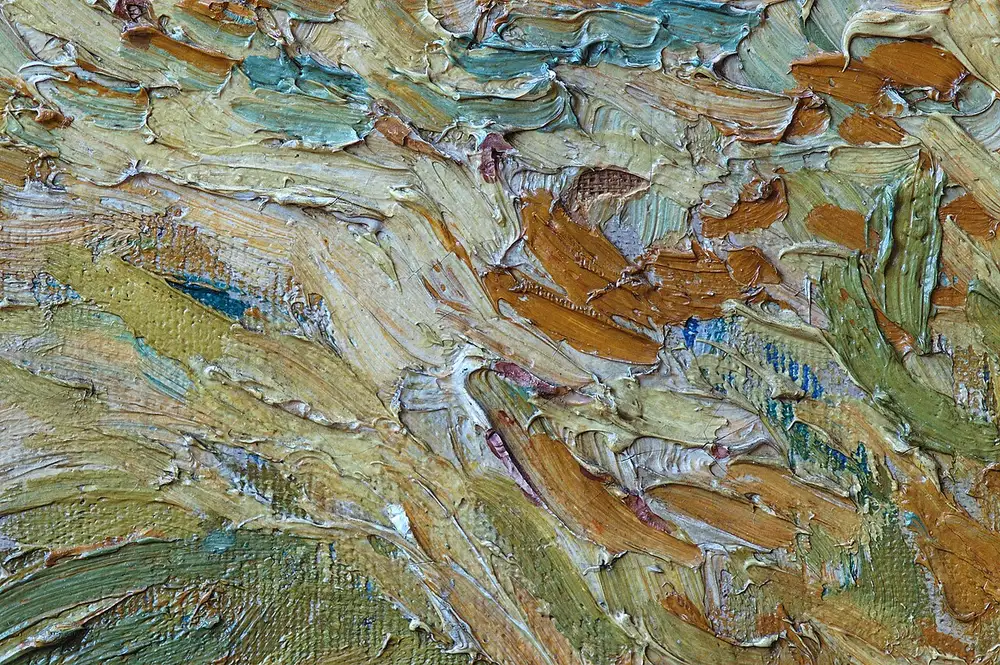
A coloured reverse can be especially misleading. Claessens’ variants page describes cotton variants whose backs may be coloured to resemble linen. The same page distinguishes oil, universal and absorbent preparations. Its absorbency labels are the manufacturer’s categories, not percentages measured for a painting ordered from an unrelated studio. Use the original product record rather than transferring a number across variants.
A photograph of the reverse, a label, a roll reference and an itemised invoice are useful parts of a record. Their limits remain different: a photograph shows what was photographed; a label records a claim; an invoice connects the specified material to an order. If those disagree, ask for clarification before approval. Avoid destructive fibre tests, scraping paint or applying solvents to a new purchase; such actions change the object and can also complicate a return.
What this means when you buy a reproduction
Before ordering, save the listing and the seller’s written answers with the date and selected size. Put the support specification beside the delivery format, rather than treating “linen” as the entire order. The approval and returns checklist explains the next step; the process guide provides context for preparation and painting. If the seller cannot identify a mill or grade, record that limit explicitly instead of supplying a likely brand yourself.
Use the same questions for every seller, including the product pages linked in the shopping box below. The box retains a commercial snapshot dated 5 September 2026; its prices and relative-price statements have not been refreshed by this material review and should not be read as current quotations. Neither a brand mention nor a material claim in that box establishes the specification of the painting you will receive.
For a linen upgrade, ask for the two complete order specifications and their delivered totals. A retail canvas-roll price does not reveal a studio’s actual purchasing cost, waste, labour or margin, so this guide does not calculate what a seller “must” be paying for cloth. The total-cost worksheet keeps finishing, freight and unconfirmed costs visible. Choose between the documented offers on that basis, with the surface and mounting you actually want.
Where to buy
Three routes, and what each one publishes about its canvas. All prices are the published ladders as at 2026-09-05.
Best overall of the studios compared, with one published ladder from $249.95 at 16x16 in to $1,299.95 at 72x48 in unframed, free worldwide shipping and an approval photograph before dispatch; its about-us page claims Belgian linen canvas but does not name the mill or grade, so ask before ordering.
Art & See- HandmadePiece — Cheaper than Art & See at the small end, $251 against $299.95 for about 16x20, and one of the few studios that states linen canvas in the product copy, with a 60-day return; it does not name the mill or thread count either, and its size ladder is built from surcharges on a small base size.
- Jackson's Art Supplies — If you would rather supply the canvas than argue about it: Claessens No. 13 by the metre with the weight, priming and thread count published, which is the specification no reproduction studio in this comparison provides.
Frequently asked questions
Is linen always better than cotton for oil painting?
A fibre label alone does not establish the performance of the complete painting. Compare the exact support, preparation, mounting and intended use. The sources reviewed here do not establish a universal size cutoff or a guaranteed lifespan for either fabric.
Can a photograph prove that my canvas is linen?
No. Photographs can record weave and labels, but do not establish composition on their own. Claessens even describes cotton products with backs coloured to resemble linen. Ask for a written material specification connected to your order and keep any unresolved identity question explicit.
Are Claessens 66 and 66AC the same specification?
No. The manufacturer lists 66 as oil-prepared linen at 460 g/m² and 66AC as acrylic/universal-prepared linen at 470 g/m². Preserve the suffix and preparation when recording the product rather than merging nearby catalogue entries.
How should I compare the price of a linen upgrade?
Request equivalent dated quotes and identify every changed component. Compare the total delivered and finished order, not only the fibre name. Retail roll prices are not evidence of a studio’s trade cost or profit, and an old shopping-box price is not a new quote.
Sources
- Preparing a painting support — GOLDEN Artist Colors. Accessed September 18, 2026.
- Canvas 66 / 2.10 m — oil preparation — Claessens Artists’ Canvas. Accessed September 18, 2026.
- Canvas 66AC / 2.10 m — acrylic preparation — Claessens Artists’ Canvas. Accessed September 18, 2026.
- Variants — preparation categories and coloured cotton reverses — Claessens Artists’ Canvas. Accessed September 18, 2026.
- Artist Series 548 — raw 100% cotton — Fredrix Artist Canvas. Accessed September 18, 2026.
- Wheat Field with Cypresses — object 1993.132 — The Metropolitan Museum of Art. Accessed September 18, 2026.
Keep reading
buying
Museum Quality Oil Painting Reproductions: What to Check Before Ordering
A sourced checklist for materials, finished-painting approval, cancellation and returns, with policy exceptions and limits of visual checks.
process
How Oil Painting Reproductions Are Made
The 12 steps of a hand-painted oil reproduction, how long each takes, why drying cannot be rushed, and what separates a $100 copy from a $1,000 copy.
price
How much do oil painting reproductions cost?
Compare equivalent sizes, finishes, shipping and payment terms with a dated total-cost worksheet. Unknown charges stay visible instead of becoming zero.
comparison
Hand-painted oil painting reproduction vs canvas print
Twelve criteria, a 40-year cost table and the five cases where a print is the better buy. Prices from seven studios, collected 2026-09-05.