definition
What Is an Oil Painting Reproduction?
An oil painting reproduction is a new painting in oil that copies an existing work. What that means legally, materially and financially — term by term.
Oil Painting ReproductionsUpdated
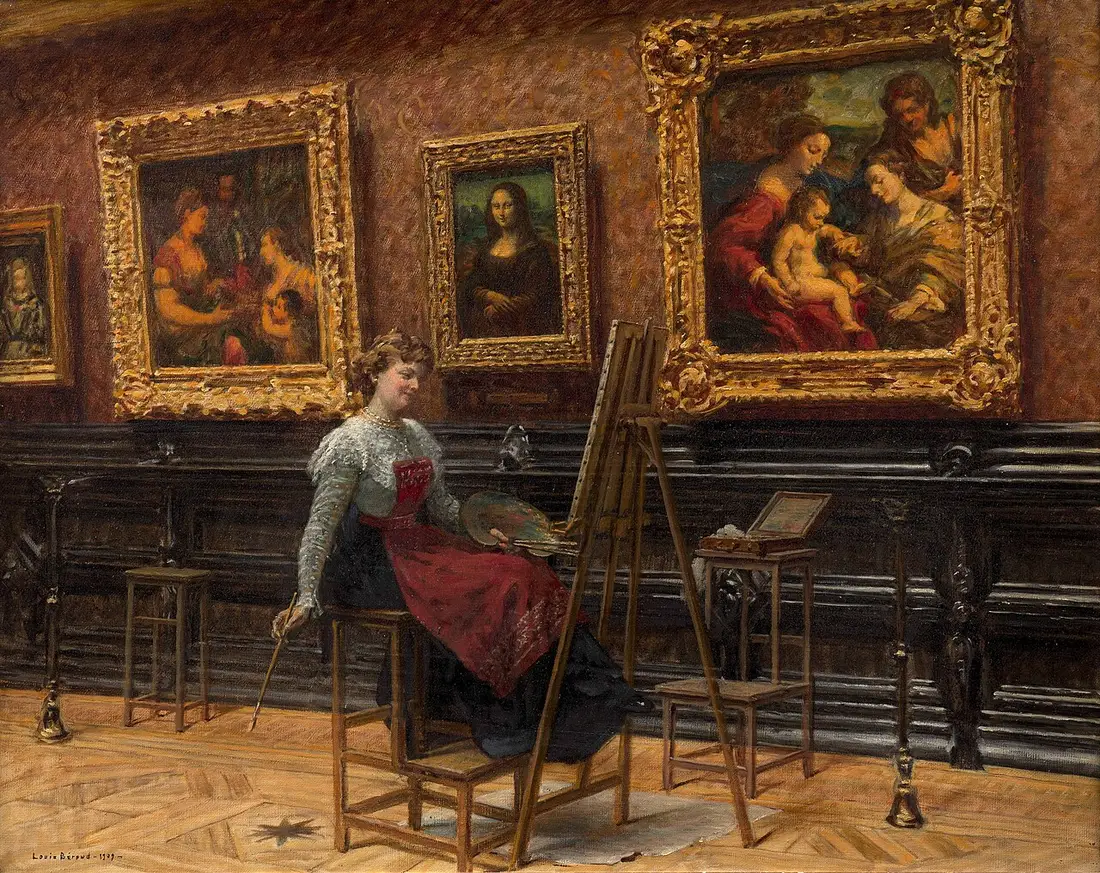
The short answer
An oil painting reproduction is a new painting in oil, by a living artist, that copies an existing work. It is legal when the original is out of copyright and the copy is sold as a copy. It has almost no resale value.
Definition
An oil painting reproduction is a painting created by copying an existing oil painting in oil. Wikipedia's entry states it plainly: reproductions "have been created by copying in oils an original oil painting by an artist". Three things follow from that sentence, and each one is a decision you are making when you buy.
- It is a painting, not an image of a painting. Pigment is applied by hand, layer by layer, and dries on the canvas. A poster, a giclée and a photographic canvas print are images of a painting. They are a different product with different economics, covered in hand-painted vs canvas print.
- It is new. The reproduction hanging in a living room was painted in the last few weeks or months, by someone alive today, from a photograph or a museum visit. Its age is the age of the copy, never the age of the original.
- It is honest about being a copy. The moment a copy is presented as the original — a fake signature, a manufactured provenance, an invented date — it stops being a reproduction and becomes a forgery. The paint is identical; the intent is what changed.
The word also gets stretched. Print shops sell "reproductions" that are inkjet output on canvas; furniture retailers sell "oil reproductions" that are prints with clear gel brushed over the top. Nothing in the word forces the seller to mean paint. The way to settle it is to ask what the surface is made of, and to look at it under a raking light — the method is in how to tell an oil painting from a print.
The 4 categories (after / studio of / circle of / style of)
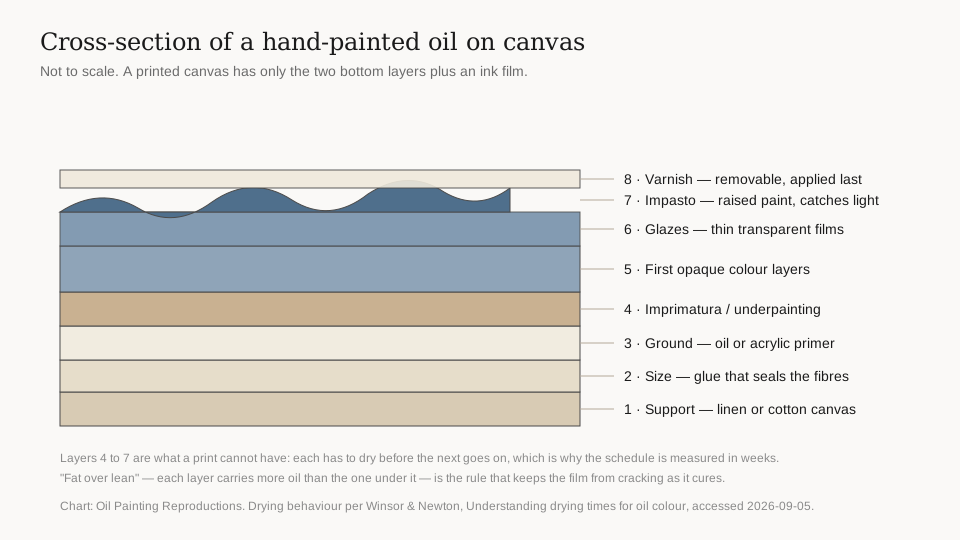
Art history does not treat every copy as the same object. Auction houses grade a copy by how close the hand that made it was to the artist, and the grade drives the price by orders of magnitude. Sotheby's publishes its definitions in its Guide for Buyers, and they are the working vocabulary of the whole trade.
| Category | What it means | When it was made | Typical example |
|---|---|---|---|
| Studio of / Workshop of | "A work by an unknown hand in the studio of the artist which may or may not have been executed under the artist's direction" | In the artist's lifetime | A second Madonna from Raphael's workshop, painted by an assistant on the master's cartoon |
| Circle of | "A work by an artist as yet unidentified but distinct hand, closely associated with the named artist but not necessarily his pupil" | During or just after the artist's lifetime | A Caravaggesque canvas by a Roman painter who saw the originals but never worked for Caravaggio |
| Follower of | "A work by an artist, working in the style of the artist, contemporary or close to his time but not inevitably his pupil" | Contemporary with the artist or shortly after | A Delft painter working Vermeer's manner of light in the 1670s, with no link to the studio |
| Style of or Manner of | "A work in the style of the artist and of a later date" — Sotheby's files both phrases under one heading | Later, sometimes centuries later | A 19th-century canvas painted in Vermeer's manner, with no attempt to copy a specific picture |
| After | "A copy of a known work of the artist" | Any date, including this month | Every hand-painted reproduction sold new today: The Starry Night, after Vincent van Gogh |
Definitions quoted verbatim from Sotheby's Guide for Buyers, Glossary and Important Notices, accessed 2026-09-05.
The category that matters for anything you can buy new is after. A reproduction commissioned in 2026 is, in catalogue language, after Van Gogh — regardless of how good it is, how expensive it was, or who painted it. That single word is also the reason reproductions do not appreciate, which is worked through in are oil painting reproductions worth anything.
Reproduction vs replica vs copy vs print vs forgery
These five words are used interchangeably by sellers and are not interchangeable at all. Two of them describe a painting, two describe a printed object, and one describes a crime.
| Term | What it actually is | Legal to sell? | Resale value |
|---|---|---|---|
| Reproduction | A new hand-painted copy of an existing work, sold openly as a copy | Yes, when the original is in the public domain and the copy is labelled as a copy | Effectively none — you resell it as second-hand decor |
| Replica | Strictly, a copy made by the original artist or their studio; loosely used by sellers to mean any close copy | Yes, but check which sense the seller means before paying a premium for the word | None if it is a modern copy; substantial if it is a genuine period studio replica |
| Copy | The neutral, honest word. Covers everything from a student exercise to a commissioned reproduction | Yes | None, unless it is old enough or documented enough to have a history of its own |
| Print / giclée | An inkjet image on paper or canvas. "Giclée" comes from the French gicler, to squirt, and was coined around 1990 for fine-art inkjet output | Yes, subject to the copyright in the image and in the photograph of the painting | None for open editions; small and real for signed, numbered editions by a living artist |
| Oleograph | A 19th-century chromolithograph "treated to imitate the variable surface of an oil painting", by varnishing or "some form of embossing or stamping", then "usually glued to canvas to further the imitation" | Yes | Low, but genuine antique oleographs do trade — they are historical objects |
| Forgery | A copy passed off as the original, or as an unrecorded work by the artist, through a false signature, false provenance or false date | No. This is fraud | None. Value is negative once identified |
Giclée etymology and date per Wikipedia, Giclée; oleograph process quoted from Wikipedia, Chromolithography. Both accessed 2026-09-05. Attribution terms per Sotheby's, as above.
Brief history (16th c. → Dafen)
Copying was not invented by the internet. It was the standard method of art education for four hundred years, and the standard way a workshop met demand it could not otherwise supply.
Copying as training
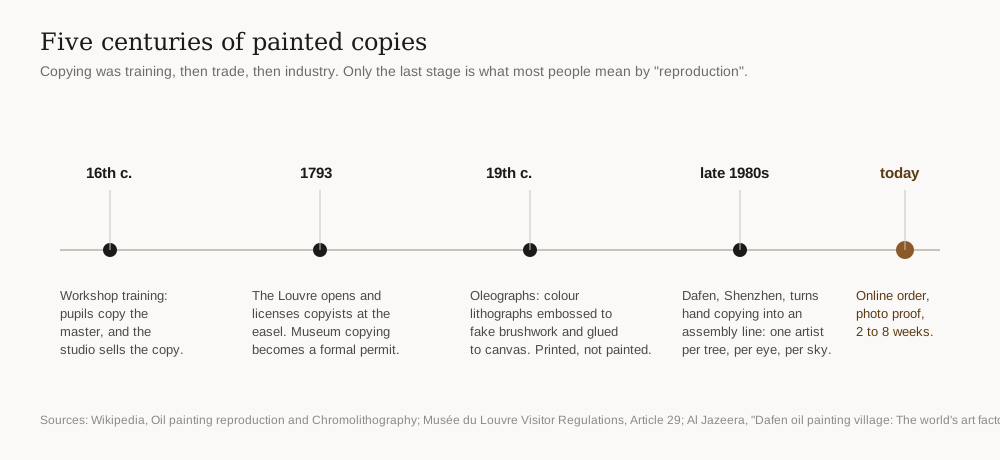
From the 16th century, apprentices learned by imitating the master's work in the master's studio; Wikipedia's entry on the practice names John Singer Sargent, Edgar Degas and Pablo Picasso among the artists who copied their way to competence, and cites Leonardo's apprenticeship with Andrea del Verrocchio as the founding anecdote. Those studio copies are the "studio of" and "circle of" pictures that still come up at auction.
Copying as a licensed museum activity
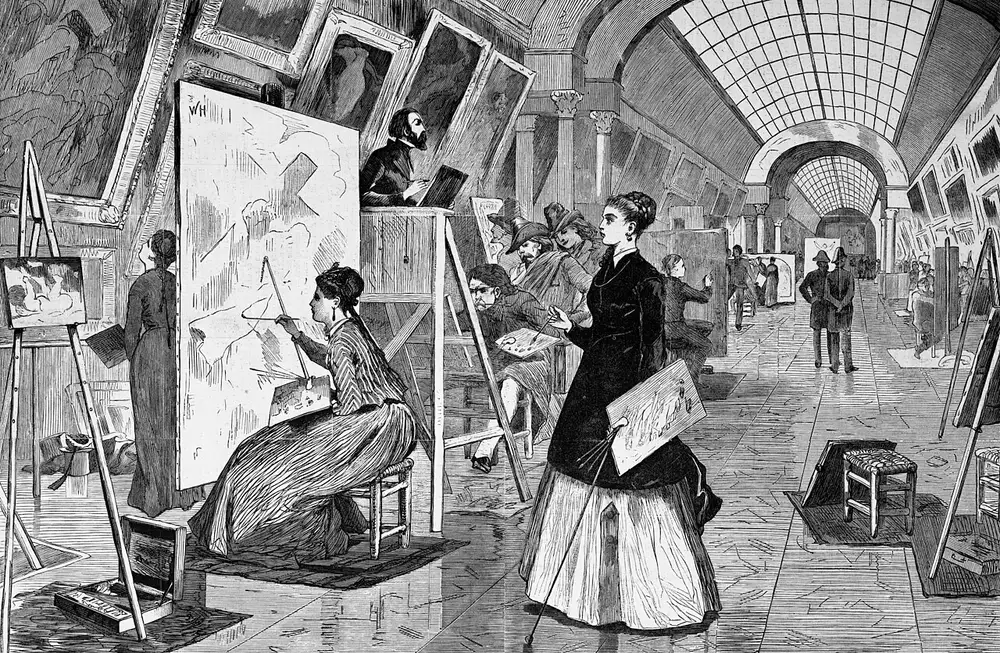
The Louvre opened to the public in 1793 and has run a copyists' bureau ever since. It is still a permit system: the museum's own visitor regulations state at Article 29 that "the copying of artworks in the museum is subject to authorisation from the President-Director of the Musée du Louvre" and that "all authorisation requests shall be submitted in advance to the Office of Copyists". The anti-forgery conditions attached to that permit are reported by My Modern Met, which covered the programme with the photographer Ivan Guilbert: "canvases must be one-fifth smaller or larger than the original", "the original artist's signature is not to be reproduced on the copies", and finished work is stamped by the head of the copy office before it leaves the building.
The National Gallery in London publishes the same logic in more detail. Its copyist code of practice requires that the copy "must not be the same size as the original painting", that "the size of the canvas or board must differ by at least 1" / 2.5 cm in both directions from the original, and the proportions of the copy must also differ", that the canvas "must not exceed 48" / 124 cm in either direction", and that "copying for commission or sale is not permitted". The size rule exists for one reason: a copy that cannot be mistaken for the original's dimensions is much harder to sell as the original later.
Copying as printing, then as industry
The first mass-market reproduction was not painted at all. The 19th-century oleograph was a chromolithograph — a colour print pulled from a separate stone for each colour — that had then been "treated to imitate the variable surface of an oil painting", either "by brushing with varnish, or some form of embossing or stamping", and was "usually glued to canvas to further the imitation". Every element of the modern textured canvas print is already there: a printed image, a mechanically applied surface relief, and a cloth support chosen to complete the impression.
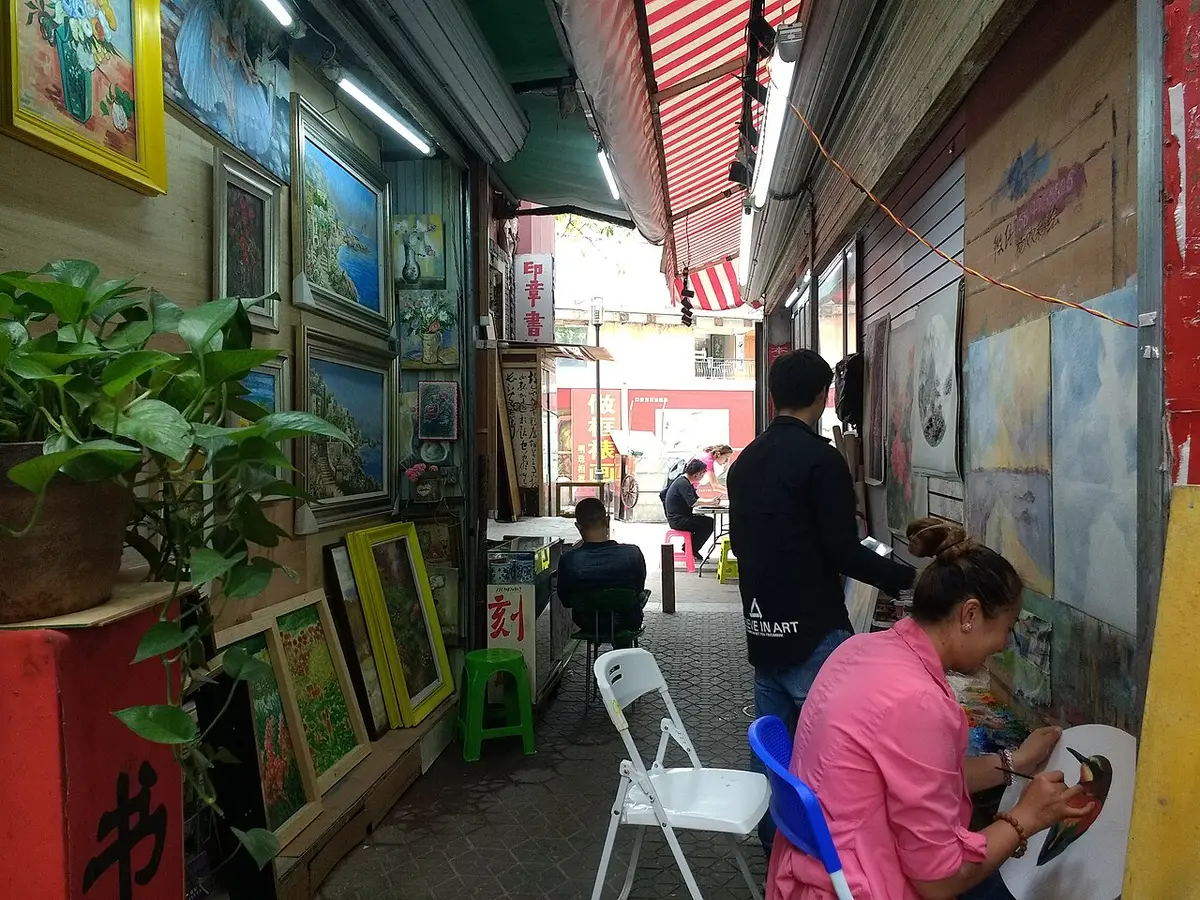
Hand copying returned at scale in the late 1980s in Dafen, a village absorbed into Shenzhen. Al Jazeera reported in February 2018 that Dafen at its height produced "60 percent of all new oil paintings available worldwide", that around 8,000 people live there, and that work moved along an assembly line with "each artist painting a small section of a larger piece, such as a tree or an eye, before passing the painting on". Demand from the West fell after the 2008 financial crisis, and the village has been shifting toward original work since. The economics of that supply chain are unpacked in oil painting reproductions from China.
What it's made of
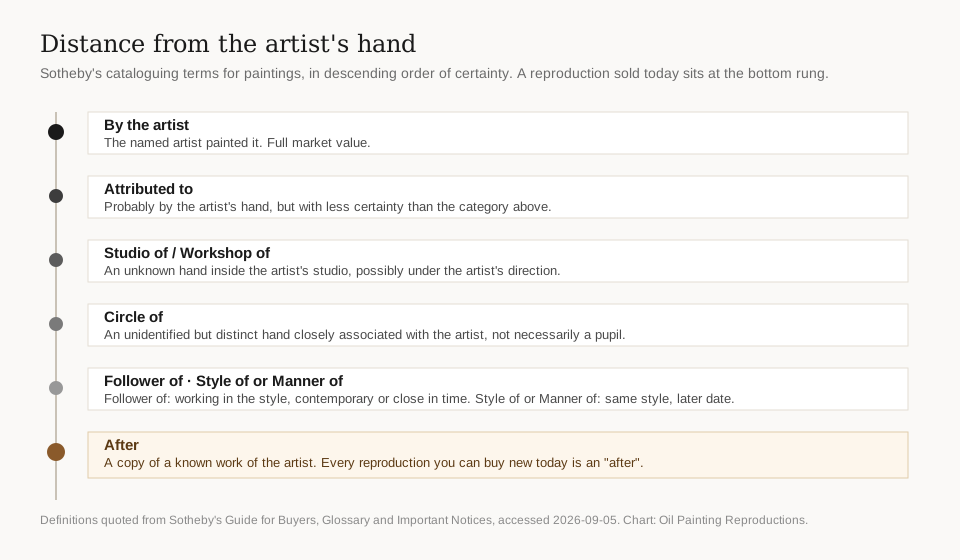
A reproduction is a stack of materials, each of which a studio can spend money on or save money on. From the wall outward:
- Support. Linen or cotton canvas over a wooden stretcher. Linen threads are irregular and hold tension without sagging; cotton duck is even, cheaper and stretchier — Jackson's sells its cotton duck at 339 g/m² (10 oz) and 390 g/m² (12 oz). The trade-offs are in linen vs cotton canvas.
- Size and ground. A glue size seals the fibres, then one or more coats of oil or acrylic primer give the paint something to grip. Skipping coats here is invisible on delivery and shows up as cracking later.
- Underpainting. A monochrome or thinly tinted lay-in that establishes the drawing and the value structure before any colour is committed.
- Colour layers. Opaque paint, built up in passes, each of which has to be touch-dry before the next goes on. Winsor & Newton states its Artists' Oil Colour becomes touch-dry in thin films "within two to 12 days", depending on the pigment.
- Glazes. Thin transparent films that shift colour optically rather than by mixing. These are what give a good copy of Vermeer or Rembrandt its depth, and they are the first thing a cheap copy leaves out.
- Impasto. Raised paint. On a Van Gogh it is not decoration, it is most of the image, and a copy without it is not a copy of the painting.
- Varnish. A removable protective film applied after the paint is dry. Winsor & Newton recommends "waiting at least three months before varnishing".
How those layers are actually applied, in what order and on what schedule, is the subject of how oil painting reproductions are made; which of them a studio can be held to is the subject of museum quality oil painting reproductions.
What it is not: legality and value
It is not illegal, with one condition
Copying a painting whose copyright has expired is lawful, and selling that copy is lawful, as long as it is sold as a copy. Van Gogh died in 1890, Monet in 1926, Vermeer in 1675 — their paintings are in the public domain in every major market. Twentieth-century artists are a different matter: Picasso, Dalí, Kahlo, Rothko and Warhol are all still in copyright somewhere, and estates enforce. The country-by-country rules and a status table for twenty artists are in are oil painting reproductions legal.
It is not an investment
A reproduction is catalogued as after the artist, and the market prices "after" as decor. Expect to recover a fraction of what you paid, the way you would with furniture. The exceptions — period copies, documented workshop pieces, copies by an artist who later became known in their own right — are narrow and are covered in are oil painting reproductions worth anything.
What to expect when you buy
The purchase behaves less like buying a product and more like commissioning one, because that is what it is: nothing is painted until you order it.
- A wait measured in weeks, not days. Art & See states 2–3 weeks of typical processing, up to 4 weeks for complex paintings and up to 8 weeks for particularly large or intricate pieces, according to its published shipping policy (accessed 2026-09-05). That is normal for the category, and a studio quoting three days is not painting anything.
- A photo of your painting before it ships. The same policy describes a complimentary photo preview before shipment, with adjustments made before dispatch. Treat this as a hard requirement of any studio you order from — it is the only quality check you get while you still have leverage.
- Returns terms that are not a simple money-back window. Art & See's published refund policy gives a full refund on cancellation within 24 hours of placing the order, and keeps a resolution open for 90 days from delivery — but its stated preference is refinement by the artist, with resolutions otherwise issued as store credit and cash refunds "issued at our discretion" (accessed 2026-09-05). That is common in this category, because a hand-painted commission cannot be resold. Read the terms before ordering, not after.
- A price set by size, not by fame. The same ladder applies to The Starry Night, The Kiss and Mona Lisa: $249.95 for 16×16 in, $299.95 for 20×16 in, up to $599.95 for 48×36 in, unframed, in USD, verified 2026-09-05. What actually drives the number is broken down in how much do oil painting reproductions cost.
- A rolled tube, usually. Most studios ship rolled and let you stretch locally, because a stretched canvas in a crate costs several times more to send. Ask, and price the stretching before you compare quotes.
Where to buy
Three routes, with the trade-off named in each case. Compared in full in best oil painting reproduction companies.
Hand-painted oil on canvas with a photo preview sent for approval before the piece ships, framed and ready-to-hang options, and a published 2–3 week typical turnaround; the price ladder starts at $249.95 for 16×16 in unframed (verified 2026-09-05).
Art & See- Reproduction Gallery — Its FAQ states paintings are made with "Winsor & Newton Professional Artists' Oil Colors and premium canvas", quotes "a minimum of 21 days for production", and covers standard catalogue work with a "45-Day 100% Refund or Replacement Guarantee" — an unconditional written money-back term, where Art & See's policy routes first to refinement and store credit with cash refunds at its discretion.
- Dafen Village Online — Sells direct from the Shenzhen village that Al Jazeera reported once produced 60% of the world's new oil paintings, which removes the Western retailer's margin entirely; this is where Art & See loses on price, and you take on the customs paperwork and the absence of a Western returns route in exchange.
Glossary (14 terms)
The vocabulary a studio or a listing will use, in the sense the trade uses it. Where the Smithsonian's Museum Conservation Institute publishes a definition in its Painting Conservation Glossary of Terms, that is the one quoted, because it is the wording conservators use rather than the wording sellers use.
- After — a copy of a known work by the named artist. The correct label for every reproduction sold new.
- Attributed to — probably by the artist's own hand, with less certainty than an outright attribution. Not applicable to anything you can order.
- Drying oil — the binder that makes an oil painting an oil painting. Smithsonian MCI: "Oils which have the property of forming a solid, elastic surface when exposed to air in thin layers. The drying oils most commonly used in oil painting were linseed oil, walnut oil and poppy oil."
- Ground — the primer layer between the canvas and the paint. Oil grounds are slower to make and non-absorbent; acrylic grounds are fast and absorbent.
- Impasto — Smithsonian MCI: "The texture created in a paint surface by the movement of the brush. Impasto usually implies thick, heavy brushwork, but the term also refers to the crisp, delicate textures found in smoother paint surfaces."
- Glaze — Smithsonian MCI: "To cover paler under painting with a layer consisting of transparent pigments and excess medium. Traditionally used to add color to forms modeled in monochrome opaque paint."
- Fat over lean — the studio rule that each successive layer must contain more oil than the one beneath it, so the film cures without cracking.
- Imprimatura — a thin transparent tone brushed over the white ground before painting starts, to kill the glare and set a mid-value.
- Drier — Smithsonian MCI: "Any catalytic material which when added to a drying oil accelerates drying or hardening of the film." A studio working to a deadline is using them; ask how much.
- Giclée — fine-art inkjet printing, from the French gicler, to squirt; the term was coined around 1990. It is a print, however it is framed or described.
- Oleograph — a 19th-century chromolithograph treated to imitate an oil surface and glued to canvas. The first industrial fake-oil, and the ancestor of the textured print.
- Craquelure — Smithsonian MCI: "A pattern of cracks that develops on the surface of a painting as a result of the natural drying and aging of the paint film." On a new reproduction it is either absent or deliberately faked.
- Stretcher vs strainer — a stretcher has keyed, adjustable corners so the canvas can be re-tensioned; a strainer is fixed and cannot be. Cheap reproductions arrive on strainers.
- Provenance — the documented ownership history of a work. A reproduction has none, and any provenance offered with one is a red flag rather than a selling point.
Frequently asked questions
Is an oil painting reproduction the same as a print?
No. A reproduction is painted in oil by hand and has real, uneven paint thickness; a print is an ink image on paper or canvas and is flat except for the weave. Some sellers brush clear gel over a print and call the result an oil reproduction — under a raking light the ridges do not line up with the brushstrokes in the image. The full test is in how to tell an oil painting from a print.
Is it legal to buy and own one?
Yes, when the original is in the public domain and the copy is sold as a copy rather than as the original. Van Gogh, Monet, Vermeer, Klimt and Leonardo are all out of copyright. Twentieth-century artists such as Picasso, Dalí, Kahlo and Warhol are not universally, and their estates enforce — see are oil painting reproductions legal.
Will it be signed?
The copyist's convention is to reproduce the composition, not the original artist's signature as a claim of authorship. Museum copyist schemes make this explicit. My Modern Met's report on the Louvre's copyists records both conditions of the permit — "canvases must be one-fifth smaller or larger than the original" and "the original artist's signature is not to be reproduced on the copies" — and the National Gallery in London requires the copy to differ from the original by at least 1″ / 2.5 cm in both directions. Ask any studio to sign or label the reverse with the word "after", the original artist's name and the year the copy was made.
How long does an oil painting reproduction last?
As long as any oil painting, which is to say centuries if the materials and the layering are sound. Oil paint does not evaporate dry — it cures by absorbing oxygen and cross-linking, and the film keeps evolving "over years, even centuries" according to Nardelli et al. in Scientific Reports (2021). Lifespan is decided by the canvas, the ground, the fat-over-lean discipline and the varnish, not by whether the picture is a copy.
Can any painting be reproduced?
Any oil painting that is out of copyright, yes. Two categories cause problems: works still under copyright, and works that are not oil paintings at all. Hokusai's The Great Wave is a woodblock print and Michelangelo's Creation of Adam is a fresco — both can be painted in oil, but the result is a translation into another medium rather than a reproduction of the object.
Sources
- Oil painting reproduction — Wikipedia. Accessed September 5, 2026.
- Guide for Buyers — Glossary & Important Notices — Sotheby's. Accessed September 5, 2026.
- Copyist code of practice — The National Gallery, London. Accessed September 5, 2026.
- Dafen oil painting village: The world's art factory — Al Jazeera, 18 February 2018. Accessed September 5, 2026.
- Musée du Louvre Visitor Regulations (Article 29, Office of Copyists) — Musée du Louvre. Accessed September 5, 2026.
- Louvre Copyists, a Lasting Tradition from the French Revolution (photographs by Ivan Guilbert) — My Modern Met — source for the one-fifth size rule and the no-signature rule, which are not in the Louvre's own published regulations. Accessed September 5, 2026.
- Chromolithography (oleograph definition) — Wikipedia. Accessed September 5, 2026.
- Painting Conservation Glossary of Terms — Smithsonian Museum Conservation Institute. Accessed September 5, 2026.
- Cotton duck canvas rolls (339 g/m² / 10 oz and 390 g/m² / 12 oz listings) — Jackson's Art Supplies — returns HTTP 403 to automated requests; figures read from the product listings via search-engine excerpts on 2026-09-05. Accessed September 5, 2026.
- FAQ — materials, production time and guarantee — Reproduction Gallery. Accessed September 5, 2026.
- All Artists ("over 500 artists… in excess of 23,000 replica oil paintings") — Reproduction Gallery. Accessed September 5, 2026.
- Understanding drying times for oil colour — Winsor & Newton. Accessed September 5, 2026.
- The stability of paintings and the molecular structure of the oil paint polymeric network — Nardelli et al., Scientific Reports, 2021. Accessed September 5, 2026.
- Giclée — Wikipedia. Accessed September 5, 2026.
Keep reading
process
How Oil Painting Reproductions Are Made
The 12 steps of a hand-painted oil reproduction, how long each takes, why drying cannot be rushed, and what separates a $100 copy from a $1,000 copy.
comparison
Hand-painted oil painting reproduction vs canvas print
Twelve criteria, a 40-year cost table and the five cases where a print is the better buy. Prices from seven studios, collected 2026-09-05.
price
How much do oil painting reproductions cost?
Compare equivalent sizes, finishes, shipping and payment terms with a dated total-cost worksheet. Unknown charges stay visible instead of becoming zero.
buying
The best oil painting reproduction companies (2026): our ranking, and the ten criteria behind it
Our ranking of eight hand-painted reproduction companies, with ten criteria measured on each store's own pages and a URL and date behind every cell.
buying
Museum Quality Oil Painting Reproductions: What to Check Before Ordering
A sourced checklist for materials, finished-painting approval, cancellation and returns, with policy exceptions and limits of visual checks.
price
Are Oil Painting Reproductions Worth Anything?
Most painted copies have no resale value. Four kinds do — with auction evidence, an identification checklist, and realistic prices for selling one.
legal
Are Oil Painting Reproductions Legal?
Yes for public-domain paintings, no for artists still in copyright. Country rules, 21 artists with dates, and the line between a copy and a forgery.