price
Are Oil Painting Reproductions Worth Anything?
Most painted copies have no resale value. Four kinds do — with auction evidence, an identification checklist, and realistic prices for selling one.
Oil Painting ReproductionsUpdated
The short answer
Almost none. A modern hand-painted reproduction is worth what a good sofa is worth: a fraction of its price the moment it leaves the shop. Four kinds of copy do hold value — old, documented, or painted by someone who later mattered.
Why most reproductions have no resale value
The trade has been saying this quietly for years. The Fine Art Trade Guild's own buyer FAQ puts it flatly: "the majority of reproductions of famous paintings have little value", and prints after a work such as Constable's The Haywain "are of no real value and are not expected to increase in value over time" (Fine Art Trade Guild). That page covers printed reproductions; the same logic reaches hand-painted ones, and for the same reason.
A reproduction has no resale market for a structural reason, not a snobbish one: nothing about it is scarce. The image is in the public domain, the painter is anonymous, and another identical canvas can be commissioned next week for the same price. Scarcity is what auction rooms sell. A copy has none of it.
The law says the same thing in its own language. The US Copyright Office refuses registration to what it calls a mere copy, and its worked example is exactly this object: "An exact reproduction of the Mona Lisa that cannot be distinguished from the original" is listed as a work that does not satisfy the originality requirement (Compendium of U.S. Copyright Office Practices, Third Edition, §313.4(A)). No new copyright is created, so there is nothing to license, and no rights follow the canvas when it changes hands.
That leaves only the physical object: stretched canvas, oil paint, a frame if there is one, and however many hours of skilled labour went into it. Those hours are real, and they are why a hand-painted copy costs several hundred dollars rather than forty. But labour already spent is not an asset. The second-hand buyer can commission fresh labour at list price and choose their own painting, so they will not pay list price for yours.
The four exceptions that do hold value
Copies are not uniformly worthless. Four categories trade, and all four earn their price from something other than the image.
1. Period copies — the copy is itself an antique
Before photography, copying was how paintings travelled. A gentleman who saw a Rubens in Munich commissioned a copy to hang at home, and that copy is now a two-hundred-year-old object in its own right. Salerooms sell them routinely. Bonhams catalogued a canvas as "After Sir Peter Paul Rubens, early 19th Century, The Lion Hunt", 37.7 by 55.5 cm, unlined, after the Rubens now in the Alte Pinakothek in Munich; it made £4,845 including premium (Bonhams, Old Master Paintings, sale 26568, lot 29). Nobody paid for a Rubens. They paid for an early 19th-century painting with a good subject, honest condition and an unlined canvas.
2. Documented copies catalogued as "after"
Value follows evidence. A copy with an old dealer label, an inventory number, an exhibition sticker or a line in a probate list can be catalogued properly, and a catalogued picture can be sold by a saleroom. The same picture stripped of its back — relined, reframed, labels binned — drops to the bottom of the ladder because nobody can say what it is.
3. Copies from known ateliers and museum copyists
Copying inside a master's workshop, or under a museum's copyist programme, produces pictures with a traceable origin. Where a workshop can be identified, salerooms use "Studio of" or "Workshop of" rather than "After", and the price moves accordingly. This is a documentation question again, not a quality one: a superb anonymous copy stays anonymous.
4. Copies by an artist who later became collectable
Students copy masters. Some of those students end up with markets of their own, and their student copies then sell on their name. The test is brutally practical: can the signature or the inscription be tied to a person with an auction record? If not, the picture is anonymous, and anonymous copies do not appreciate no matter how well painted.
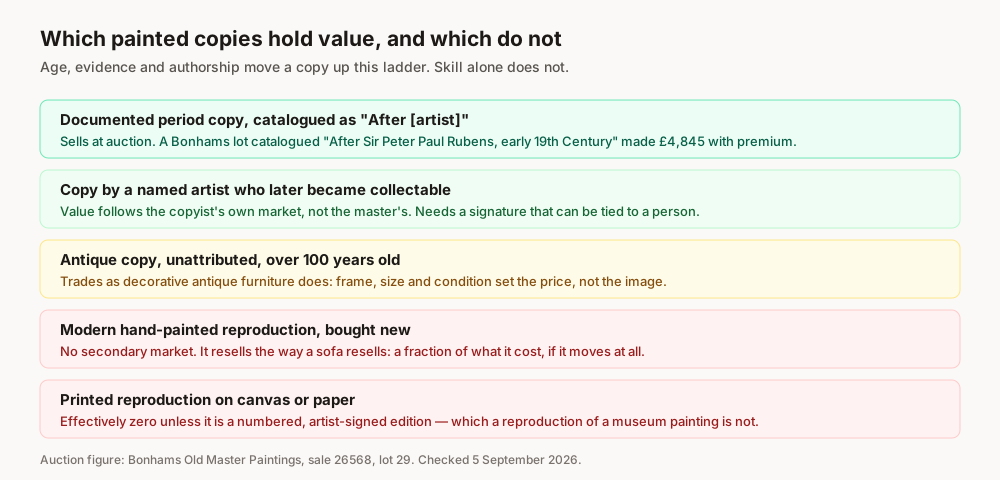
| Type of copy | What makes it that type | Realistic outcome | Where to sell it |
|---|---|---|---|
| Documented period copy | Old enough to be catalogued by century rather than by decade, catalogued "After [artist]", labels or provenance on the back | Sells in a specialist sale; four figures is possible for a good subject in honest condition | Regional or specialist saleroom with an Old Master or European pictures department |
| Copy by a later-collectable artist | Signature that ties to a person with an auction record | Priced against that artist's own market, not the master's | The saleroom that handles that artist |
| Undocumented antique copy | Clearly old — tacks, hand-cut stretcher, oxidised linen — but nothing on the back | Decorative-antique money; frame and size often carry the lot | General house sale, or a dealer who buys by the metre |
| Modern hand-painted reproduction | Commissioned new; staples, machine-cut bars, bright ground | No secondary market; expect a small fraction of purchase price, if it sells | Local classifieds or a consignment shop; auction houses will decline it |
| Textured canvas print | Dots under a loupe; repeating relief that ignores the image | Effectively zero; treated as home decor | Classifieds only |
| Poster or paper print of a museum painting | Paper, published edition, no artist involvement | Zero unless the poster itself is a collected design object | Not worth consigning |
Auction figure for the period-copy row: Bonhams sale 26568, lot 29, checked 5 September 2026. New-reproduction price context: the one full public price ladder in the category (Art & See), collected 5 September 2026. Marketplace figures behind the last three rows are set out with their caveats in the table under "Where to sell".
What "after" and the other saleroom words mean
If you plan to sell, learn the vocabulary before you write the listing, because using the wrong word is how honest sellers end up accused of something worse. Salerooms use a fixed ladder of attribution terms, published by the houses themselves and broadly consistent between them (Lyon & Turnbull, Understanding Art Attribution Terms).
- After [artist] — a copy of a known work by that artist, made by someone else, at any date. This is the correct term for every reproduction discussed here.
- Studio of / Workshop of [artist] — made in the artist's studio, possibly under supervision. Not a copy bought from a shop.
- Circle of [artist] — an unidentified painter working in the artist's style, during the artist's lifetime.
- Follower of [artist] — an unidentified painter working in the style, at the time or soon after.
- Manner of / Style of [artist] — the style, later date, no claim of contact with the artist.
- Bearing signature — there is a signature on it and the house is not vouching for it.
How to identify what you have
Work in this order. The front of a picture is designed to persuade you; the back was never meant to be seen and therefore tells the truth.
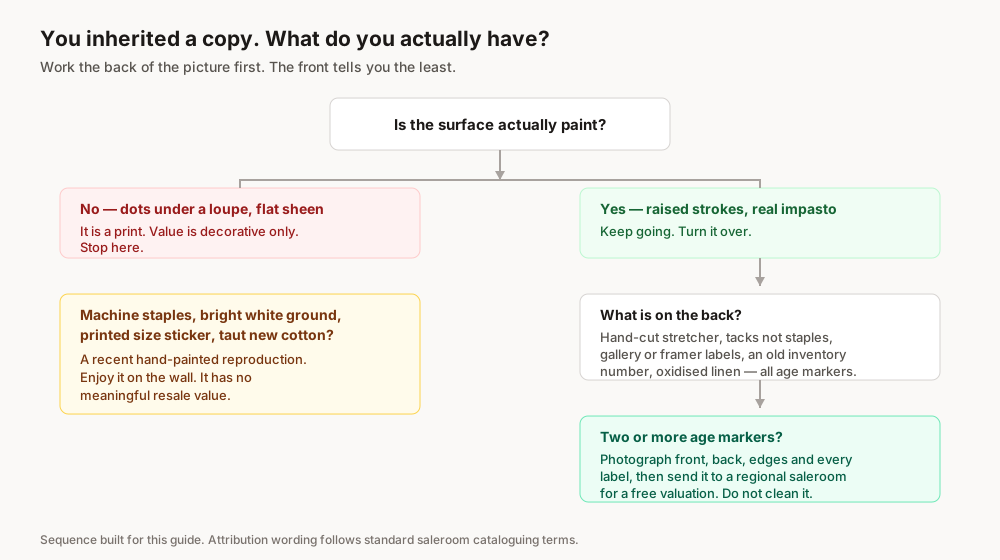
| Where to look | Points to age and possible value | Points to a recent reproduction | Why it matters |
|---|---|---|---|
| Surface, under a 10x loupe | Brushstrokes of varying width and height; no dots anywhere; fine craquelure that follows the paint layer | Regular or scattered dot pattern; uniform sheen; relief that repeats regardless of the image | Settles paint versus print before anything else is worth doing — see oil painting or print: how to tell |
| Fixings on the stretcher | Iron tacks, sometimes irregularly spaced and rust-haloed | Steel staples in an even machine rhythm | Staples put the canvas firmly in the modern era |
| Stretcher bars and keys | Hand-cut mortise joints, loose wooden keys, darkened timber | Milled bars, printed size stamp, pale new wood | Cheapest single indicator of period |
| Canvas back | Oxidised, uneven linen weave; old repairs; dust ingrained at the edges | Even white or cream cotton; clean priming visible through the weave | Linen and oxidation are consistent with age; bright cotton is not |
| Labels and inscriptions | Dealer or framer labels, stencilled inventory numbers, chalk lot marks | Barcode, courier sticker, printed size label, nothing at all | Provenance is what converts an old copy into a saleable lot |
| Signature | A copyist's own name, or an inscription such as "after Rubens" | The master's signature reproduced as part of the copied image | A copied master signature adds nothing; a copyist's own name can add everything |
Checklist compiled for this guide; attribution terminology follows published saleroom glossaries, checked 5 September 2026.
Where to sell, and what to expect
- Photograph it properly first. Front square-on in daylight, back, all four edges, every label close up, and one raking-light shot across the surface. Salerooms and appraisers work from these images and will not chase you for better ones.
- Send it to a regional saleroom for a free valuation. Most run a photo-valuation form. This costs nothing and takes days, and it is the only route that reaches buyers of period copies.
- If the saleroom declines it, it is decorative. That is information, not a setback. Sell it locally, where a buyer can see the size and the frame in person and no commission or shipping eats the proceeds.
- Price against the frame and the size, not the image. For an undocumented copy, a good period frame is frequently worth more than the canvas inside it — and can be sold separately.
- Never list it under the master's name alone. "After Rubens" or "19th-century copy after Rubens" is accurate and keeps you out of trouble. "Rubens" is not, and marketplaces remove those listings.
What the marketplaces actually show
Three price points, all checked on 5 September 2026, and each measuring a different thing. Read them together, because separately each one flatters or damns the category.
| Where | The figure | What it measures | How much weight to give it |
|---|---|---|---|
| 1stDibs, "master copy" category | "Prices for a master copy start at $159 and top out at $20,600 with the average selling for $1,460" across 214 items listed | Dealer asking prices on a curated marketplace, mostly for old copies with some provenance | The realistic ceiling for a good documented copy — but these are dealers' asks, not what a private seller is offered |
| Bonhams, sale 26568, lot 29 | £4,845 including premium, "After Sir Peter Paul Rubens, early 19th Century" | A hammer result for a documented period copy in a specialist Old Master sale | The strongest single data point here: a real buyer paid a real price at auction |
| eBay, Van Gogh canvas paintings | eBay's own filter bands split at under $150 / $150–$350 / over $350; the equivalent Monet category splits at under $75 / $75–$150 / over $150 | The live open market for modern reproductions, where most of the stock is new or near-new | Bands generated from listed inventory, not from completed sales — treat them as the shape of the market, not as prices achieved |
| The gap between them | 1stDibs average $1,460 versus eBay bands topping out around $350 | The difference between a copy with age and documentation and a copy without either | This gap, not the absolute numbers, is the thing to remember |
1stDibs statistics quoted verbatim from the category page on 2026-09-05; asking prices, not sold prices. The Bonhams page returns 403 to automated requests — the lot title and premium-inclusive result were read from the search index of that page and the sale date could not be established. eBay's completed-listing (sold) data could not be retrieved for this guide, so no sold figure from eBay is printed here; the bands quoted are eBay's own category filters.
Expect a wide spread and a slow sale. Undocumented antique copies are traded by dealers who buy on volume and margin, so the offer you receive lands well below the 1stDibs asking prices above — that spread is the dealer's business model, not a slight. New reproductions rarely find a second owner at all, which is worth knowing before you buy rather than after. For context on what they cost new, a hand-painted copy at retail in Dafen ran to about 1,500 yuan, roughly $220, when AFP reported from the village in March 2023.
Buy for the wall, not for the portfolio
Nothing above is an argument against owning a reproduction. It is an argument against a specific and common mistake: paying a premium for a copy in the belief that the premium is recoverable. It is not. The right question is whether the object gives you several hundred dollars of pleasure over ten or twenty years on your wall — which, at the price of a mid-range piece of furniture, it very often does.
Judge the purchase the way you would judge any other made-to-order object: what the canvas is, how many paint layers went on, whether the sides are painted, whether you get to see a photograph before it ships, and what happens if it arrives wrong. Those decide how long you keep it. For the full picture on what drives the price, see how much oil painting reproductions cost; for what the category actually is, what is an oil painting reproduction; and before you commission a 20th-century image, check whether reproductions are legal.
Where to buy
Three honest routes, depending on whether you want something new, something old, or the lowest possible price.
Hand-painted oil on canvas made to order, with a photograph of the finished piece sent for approval before it ships and a published ladder running $249.95 (16x16 in) to $1,299.95 (72x48 in) unframed, collected 5 September 2026 — the safest way to buy new, though a new copy is exactly the kind with no resale value.
Art & See- A regional auction house — The only place to buy a copy that already has age and a catalogue entry — often for less than a new commission, which is where any made-to-order studio, Art & See included, simply cannot compete.
- Direct from a Dafen studio — The cheapest hand-painted canvas there is, at village prices rather than Western retail, in exchange for handling your own import, stretching and risk — see reproductions from China.
Frequently asked questions
I inherited an oil painting that looks like a famous work. Is it worth anything?
Possibly, if it is old. Check the back before anything else: iron tacks, a hand-cut stretcher, oxidised linen and any paper label are the four markers that justify a free valuation from a regional saleroom. Machine staples and milled bars mean a recent reproduction with no resale market. Do not clean it and do not remove the labels.
It is signed. Does a signature make it valuable?
Only if the signature belongs to the copyist, not the master. A copied signature is part of the copied image and adds nothing — every reproduction of The Starry Night carries Van Gogh's. A copyist's own name, or an inscription such as "after Rubens", is the useful kind, because it can be researched against auction records.
How old does a copy have to be before it is worth something?
There is no published threshold year, and any guide that gives you one has invented it. What is observable is that copies old enough to be catalogued by century — the Bonhams lot cited above was "early 19th Century" and made £4,845 with premium — reach specialist sales, while post-war copies do not. Age alone is not enough either: without labels or provenance an old copy still sells as decoration.
Should I insure a hand-painted reproduction?
Insure it for replacement cost, not appraised value — what it would cost to commission the same canvas again, which is the price you paid. There is no appraisal to obtain and no upward revaluation to expect, so a named item on a home contents policy is usually enough. Keep the invoice.
Where can I actually sell one?
Old and documented: a regional saleroom with a pictures department, via their free photo valuation. Old but undocumented: a general house sale, or a dealer who buys decoratively. Modern: local classifieds. Auction houses decline modern reproductions because the commission does not cover the cataloguing.
Does the copy have its own copyright, so nobody can copy my copy?
No. The US Copyright Office lists an exact reproduction of a public-domain painting as a mere copy that fails the originality requirement, so no new copyright arises. Nothing transfers with the canvas and there is nothing to license, which is one more reason there is no investment case.
Sources
- Compendium of U.S. Copyright Office Practices, Third Edition, §313.4(A) Mere Copies — U.S. Copyright Office. Accessed September 5, 2026.
- After Sir Peter Paul Rubens, early 19th Century, The Lion Hunt — sale 26568, lot 29 — Bonhams. Accessed September 5, 2026.
- Understanding Art Attribution Terms — Lyon & Turnbull. Accessed September 5, 2026.
- Art Theft — Art Crime Team — Federal Bureau of Investigation. Accessed September 5, 2026.
- What is a reproduction worth? — Fine Art Trade Guild. Accessed September 5, 2026.
- China's 'art factory' painters turn from fakes to originals — AFP / France 24. Accessed September 5, 2026.
- Master copy — category price statistics and listings (214 items; "start at $159 and top out at $20,600 with the average selling for $1,460") — 1stDibs. Accessed September 5, 2026.
- Canvas art, Vincent van Gogh paintings — category price bands — eBay. Accessed September 5, 2026.
- Claude Monet canvas oil paintings — category price bands — eBay. Accessed September 5, 2026.
Keep reading
definition
What Is an Oil Painting Reproduction?
An oil painting reproduction is a new painting in oil that copies an existing work. What that means legally, materially and financially — term by term.
price
How much do oil painting reproductions cost?
Compare equivalent sizes, finishes, shipping and payment terms with a dated total-cost worksheet. Unknown charges stay visible instead of becoming zero.
legal
Are Oil Painting Reproductions Legal?
Yes for public-domain paintings, no for artists still in copyright. Country rules, 21 artists with dates, and the line between a copy and a forgery.
comparison
Oil Painting or Print? Seven Checks and Their Limits
Compare surface, print patterns, edges and labels without mistaking visual clues for proof of oil paint, age or authorship. Sources and limits explained.