comparison
Oil Painting or Print? Seven Checks and Their Limits
Compare surface, print patterns, edges and labels without mistaking visual clues for proof of oil paint, age or authorship. Sources and limits explained.
Oil Painting ReproductionsUpdated published
The short answer
Magnification and angled light can reveal useful clues, but neither proves oil paint or authorship. A print can have added paint and texture; a painting can have dots. Record what you can see, request a written process description and leave uncertain results unresolved.
Seven observations, with a limit for each
This is a documentary guide to questions a buyer can ask, not a report of physical examinations or a validated authentication test. We have not inspected the products offered below. Getty conservators combine close looking with microscopy and other imaging to understand a painting. That broader process is a useful corrective to an instant yes-or-no rule: distinguish the appearance of a surface, the process used to make the image, the paint medium, and the identity of its maker. Evidence for one does not automatically establish the others.
1. Magnification — look for a process, not any dot
A small round mark is not sufficient evidence of printing. The Art Institute of Chicago describes Seurat building La Grande Jatte with painted dots and dashes. The relevant question is whether you can identify a printing structure across the image, rather than whether the artist used dotted brushwork. Make a clear photograph of the area and explain what you think you see; avoid turning an uncertain mark into a claim about the whole object.
The University of Illinois photomechanical-process guide distinguishes different structures produced by printing. A recognizable halftone screen can support identification of a printed image. It does not follow that every print has the same screen, that it will be visible at one chosen magnification, or that a printed area rules out paint elsewhere on the object. Use an identified process characteristic, with its limitations, rather than a universal dots-equal-print rule.
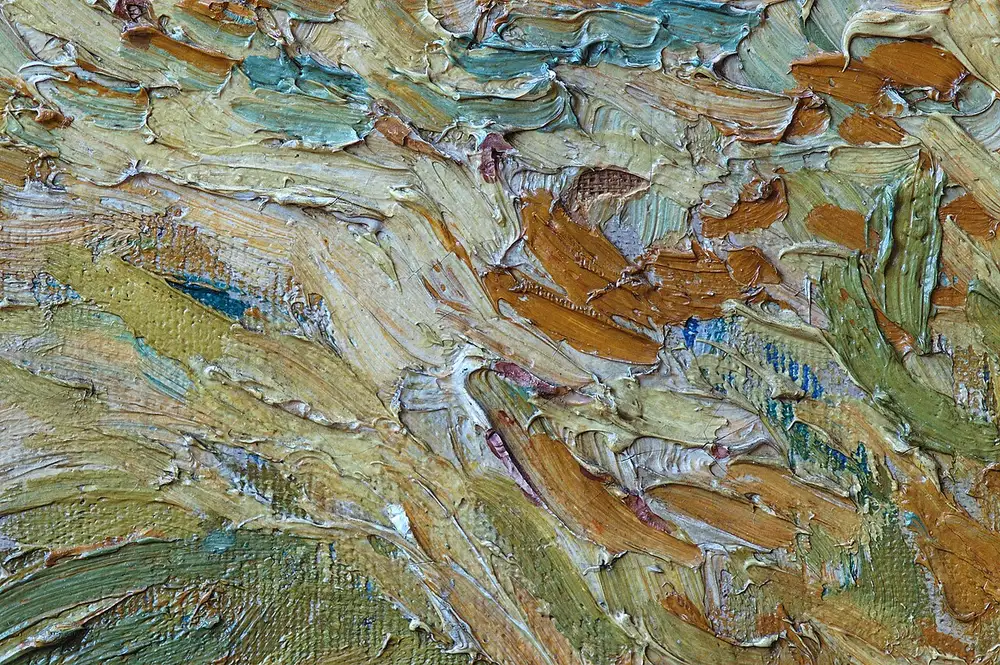
If a loupe or phone photograph does not resolve the structure, write “not determined at this magnification.” Do not change that into “no printing present.” Record the area inspected and retain the uncropped image. Compare more than one area only when the object can be viewed safely; the purpose is to explain an observation to the seller or an examiner, not to accumulate a score until a preferred answer wins.
2. Raking light — useful for relief, not medium identification
The Canadian Conservation Institute describes raking light as light directed across a surface at an oblique angle. It can make surface texture and irregularities easier to see. Use brief, cool illumination, keep the light away from the object and do not touch the paint. If paint is loose or the frame unstable, stop handling it.
Raised texture does not establish that the image was painted entirely in oil. GOLDEN’s gel-topcoat documentation describes adding texture and changing the sheen of digital prints. A smooth-looking passage is not the converse proof of a print. Record relief separately from the claimed material: “raised clear coating visible” is a more useful question for a seller than “the shadows prove oil paint.”
3. Edges — document what continues around the support
Photograph an accessible side and corner without pulling the canvas or opening the frame. Ask whether the displayed dimensions describe the painted image, the support or the outside of a frame, and whether the edge was finished separately. A clean edge, a ragged edge or a wrapped image is not a sufficient classification by itself. Compare the particular object with its written specification instead of assuming that every maker must finish every canvas in the same way.
4. The back — read records without turning hardware into a date
If the back is safely visible, transcribe labels, numbers and inscriptions exactly and photograph their position. Ask who applied each label and which record connects it to this object. A barcode can record inventory or handling; its presence is not proof that the image is printed. Likewise, do not date or authenticate an image solely from the apparent age of its stretcher, fasteners, backing or frame. Those observations need their own explanation and history.
CCI’s examination checklist treats labels, inscriptions, the support, paint and ground as separate observations. It also explains that transmitted light may reveal cracks, losses and thin areas. That is not a universal painting-versus-print test. For a buyer, photographs of already accessible areas are preferable to dismantling or backlighting an unfamiliar object to force an answer.
5. The signature — separate a name from evidence of authorship
Record whether the signature seems to be part of the image, separately applied or simply unreadable in the photograph. Then ask what the seller says it means. A copied composition may also reproduce a name or signature. A separately painted name would still need evidence connecting it to the claimed person. Do not let the presence of a famous name substitute for an object history, a clear description of a modern copy, or appropriate expertise when authorship matters.
6. Cracking — describe it without testing it by touch
Do not run a fingernail over a crack, lift an edge or scratch a coating. Photograph the visible feature and say whether it appears to interrupt the surface or only the pictured image. If that cannot be determined, leave it open. An apparent crack is not, by itself, a documented age or an authentication result, and attempts to make it more visible can damage the object.
7. Sheen — an observation, not a deciding vote
Record where reflections change as your viewpoint changes, using photographs if possible. Do not interpret an even gloss as proof of printing or an uneven gloss as proof of oil paint. Ask whether a coating or added surface treatment is present. If observations disagree with the product description, request an explanation and supporting records. The disagreement is a reason to investigate, not permission to declare whichever clue looks most convincing decisive.
| Observation | Useful question | What it does not establish |
|---|---|---|
| A possible printing screen | Can the image-making process be identified? | That every area is printed or that no paint was added |
| Raised surface under angled light | What creates this relief? | An oil binder or a wholly hand-painted image |
| An edge or wrap | How was this particular support finished? | A universal distinction between painting and print |
| Label or barcode | Which record and object does it identify? | The image process or authorship by itself |
| Signature | What is the basis of the stated attribution? | That the named artist made this object |
| Cracking | Is the surface stable and should it be examined? | A reliable date from appearance alone |
| Uneven sheen | Is there a coating or surface treatment? | Oil paint rather than acrylic, gel or another material |
| An unclear result | What further evidence would resolve the question? | Permission to scratch, wet or solvent-test the surface |
Editorial checklist, not measured diagnostic accuracy. Process descriptions and examination limits are linked in the surrounding text. We did not test or authenticate products.
Why paint and printing can occur in the same object
GOLDEN’s technical article on inkjet prints describes artists adding paint, gel media and varnish after printing. This directly limits the idea that textured prints must all have an identical, machine-applied ridge pattern. A printed image can receive individually applied surface work. The buyer needs an accurate description of that combination, not a contest between “real texture” and “fake texture.”
Ask two separate questions: how was the underlying image made, and what was added afterward? A print with hand-applied paint can have both processes. Conversely, observing brush-applied material does not identify its binder. The Getty Conservation Institute’s binding-media research describes analytical approaches used to identify paint binders. A photograph or a loupe observation is not that analysis and should not be reported as a chemical identification of oil.
- Underlying image: ask whether any photographic or digital image was printed before surface work began. Request a direct answer in writing, not a replacement label such as “hand-finished.”
- Added materials: ask which paint, gel or coating was applied and to which areas. Distinguish the maker’s statement from an independently examined finding.
- Photos of the actual object: request an overall view and relevant details tied to the same order or inventory number. A stock photograph does not document your individual purchase.
- Scope of the promise: ask whether “hand-painted” describes the entire image or only added finishing. Keep that answer with the specification and approval record.
A clearly described embellished print can be a suitable purchase. The problem is a mismatch between what was promised and what was delivered. Make comparisons between the actual specifications, prices and terms offered, rather than treating one process label as a universal quality ranking. For format terminology see hand-painted versus canvas print and giclée versus oil painting; neither label substitutes for the description of the particular object.
Shortcuts that should not become conclusions
- Smell: record an unexpected odor and ask about materials and recent work; do not identify a binder or date from smell. This guide supplies no validated odor test.
- Weight: weight includes the support, frame and other components. Ask what was weighed before comparing two objects; do not turn their difference into proof of an image-making process.
- Surface contact: do not rub, wet, scrape, heat or solvent-test the object to settle a buying question. A written claim, a photograph and an expert examination are different kinds of evidence.
- Apparent perfection: resemblance to a reference image does not identify how the copy was produced. Ask for the process description and relevant evidence instead of relying on an impression of accuracy.
- Price: retain the dated quote, size, finish and delivery terms. Price can guide a buying decision but does not independently identify the material of the delivered object.
What to request before drawing a conclusion
Prepare a small record: the listing and its date, the seller’s exact description, the object or order identifier, the overall photograph, the detail views and the question you want answered. Keep observations separate from conclusions. “A regular pattern is visible in this area” can be assessed; “everything with dots is a print” conceals the uncertainty. This also makes it easier to identify whether an answer refers to the actual delivered object or only to a generic example.
If age, authorship or value matters, ask for the appropriate professional assessment rather than deciding that a print has no value or that old-looking hardware proves an old painting. State what records and images are available and whether an in-person examination is needed. The separate guide to reproduction value addresses the buying context; it is not an appraisal of your object.
Before ordering, request photographs of the actual finished piece, its written materials description and the policy for a product that differs from that description. The existing Art & See link leads to its reproduction offering; check the current seller terms before relying on an approval promise. The shopping block below preserves a 5 September 2026 snapshot, not newly checked prices or evidence that any listed service was physically tested for this article.
Where to buy
If the answer was "print" and you wanted paint, three routes — priced very differently for good reasons.
Hand-painted oil on canvas made to order, $249.95 for 16x16 inches up to $1,299.95 for 72x48 inches unframed, with a photograph of the finished painting sent for approval before shipping (collected 5 September 2026) — which is exactly when the loupe-and-raking-light questions should be asked.
Art & See- A local artist or copyist — You can stand in front of the canvas while it is being painted, which no online service can offer, and you can watch the layers go on rather than trusting a photograph.
- Direct from a Dafen studio — Materially cheaper per canvas than any Western storefront — the one criterion on which Art & See loses outright — if you are willing to run the import and the stretching yourself.
Frequently asked questions
Can a print have real brushwork or texture?
Yes. GOLDEN documents adding paint and gel media to inkjet prints. A hand-applied surface layer does not establish that the underlying image was also painted. Ask for both processes to be described, and do not assume that all embellished prints have a uniform machine-made texture.
Does a dot prove that an image was printed?
No. Painted dots and dashes are part of Seurat’s documented technique. An identifiable printing pattern is a different observation from an isolated dot or a dotted painting style. Failure to resolve a pattern at a chosen magnification should remain inconclusive, rather than becoming proof of hand painting.
Does a signature mean the named artist made it?
No. A name visible in an image, or even a separately applied signature, does not supply the object history and attribution evidence needed to identify its maker. Ask the seller whether the item is a modern copy, a print, an embellished print or an attributed work, and what supports that description.
Can angled light establish oil rather than acrylic paint?
It shows aspects of the surface, not the chemistry of the binder. Getty’s binding-media project describes analytical methods for identifying those materials. Do not label a buyer’s photograph or torch inspection as a laboratory determination.
What if the observations disagree?
Do not force a pass-or-fail decision, and do not attempt a destructive test. Save the listing, written specification and photographs, identify the unresolved question and request suitable professional advice when it matters to the purchase or the object’s care. This guide makes no claim of diagnostic accuracy or physical examination.
Sources
- Condition Reporting – Paintings. Part II: Examination Techniques and a Checklist — Canadian Conservation Institute. Accessed September 18, 2026.
- How We Use the Naked Eye and Other Tools to Understand a Painting — J. Paul Getty Museum. Accessed September 18, 2026.
- Binding Media — Getty Conservation Institute. Accessed September 18, 2026.
- The Enduring Relationship of Science and Art — Art Institute of Chicago. Accessed September 18, 2026.
- Photomechanical Prints — Preservation Self-Assessment Program, University of Illinois. Accessed September 18, 2026.
- GAC Products on Inkjet Prints — GOLDEN Artist Colors. Accessed September 18, 2026.
- Reinventing the Future: GOLDEN Digital Grounds and Gel Topcoats w/UVLS — GOLDEN Artist Colors. Accessed September 18, 2026.
Keep reading
price
Are Oil Painting Reproductions Worth Anything?
Most painted copies have no resale value. Four kinds do — with auction evidence, an identification checklist, and realistic prices for selling one.
comparison
Hand-painted oil painting reproduction vs canvas print
Twelve criteria, a 40-year cost table and the five cases where a print is the better buy. Prices from seven studios, collected 2026-09-05.
buying
Museum Quality Oil Painting Reproductions: What to Check Before Ordering
A sourced checklist for materials, finished-painting approval, cancellation and returns, with policy exceptions and limits of visual checks.
comparison
Giclee vs oil painting: what the word actually buys you
Giclee is an unregulated word for a pigment inkjet print. What it is, how long it lasts, what it costs against a hand-painted oil, and when it wins.