comparison
Giclee vs oil painting: what the word actually buys you
Giclee is an unregulated word for a pigment inkjet print. What it is, how long it lasts, what it costs against a hand-painted oil, and when it wins.
Oil Painting ReproductionsUpdated
The short answer
A giclee is a pigment inkjet print, usually on cotton-rag canvas or paper. The word is not regulated and guarantees nothing. Wilhelm Imaging Research rates one named pigment ink and canvas pair at 112 years unframed. It costs a fifth of a hand-painted oil.
What giclee actually means
Giclee, pronounced zhee-clay, comes from gicleur, the French word for a nozzle, and gicler, to squirt or spray. It was applied to inkjet prints in 1991 by Jack Duganne, a printmaker at Nash Editions in Manhattan Beach, California, who wanted a word for fine-art output from a modified Iris proofing printer that did not sound like an office machine. That is the whole origin: a marketing term, invented for a real technical improvement, that has since been applied to almost anything printed on canvas.
No standards body defines it. There is no minimum resolution, no required ink chemistry, no required substrate, and nobody to complain to. In practice the word is used for two very different products. The serious version is a pigment-ink print at high resolution on a cotton-rag or alpha-cellulose substrate, made by a printer who profiles the paper and keeps the file. The other version is a dye-ink print on coated polyester canvas from a print-on-demand queue, sold at four times the price of the identical thing labelled canvas print.
The single specification that separates them is the ink. Pigment inks suspend solid particles that are far more light-stable; dye inks dissolve colorant that fades several times faster. A seller who cannot tell you which one was used has told you which one it is.
One layer against six
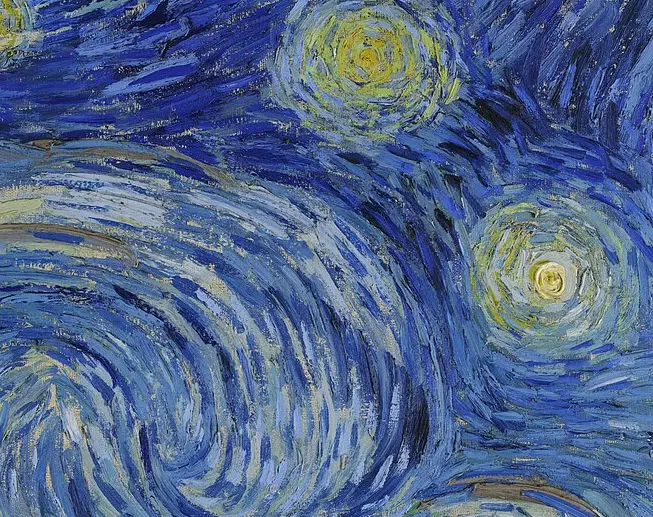
The physical difference is not subtle once you know where to look, and it is not really about quality. It is about how many layers the image is made of. A giclee is one: ink sprayed into a receptive coating, absorbed rather than stacked, with no body of its own. An oil painting is a stack of size, ground, underpainting, colour layers, glazes and varnish, and on top of that the impasto passages stand proud of everything beneath them, high enough that a fingertip finds them and a lamp at a low angle throws their shadows across the canvas.
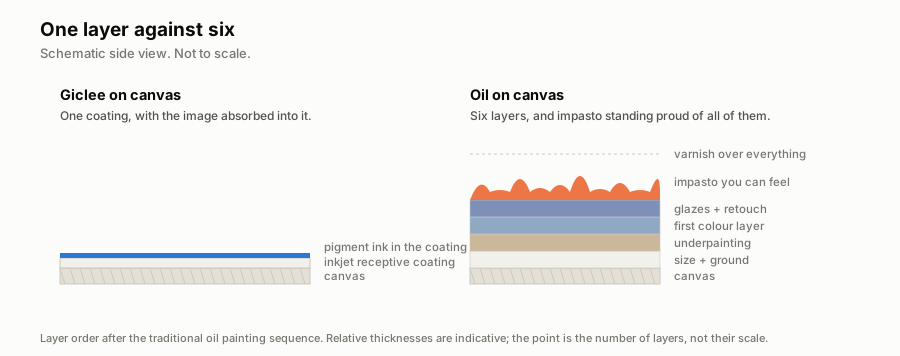
That difference produces every visible consequence. Relief casts shadows, so a painted surface changes across the day while a print does not. Uneven paint scatters light unevenly, so a painting has hotspots and dead passages that move as you walk past. And because the paint was applied wet into wet in some places and wet over dry in others, the edges inside the image vary, whereas every edge in a print is exactly as crisp as the print head could make it. If you want the practical bench test, the format comparison sets out the loupe and raking-light checks.
How long each lasts
This is where giclee earns its price over an ordinary canvas print. Wilhelm Imaging Research, whose display-permanence ratings the printer industry quotes, publishes a figure for each ink and media pair in three separate display conditions: framed under glass, framed behind a museum-quality UV filter, and displayed not framed under bare-bulb light. That third column is the one a canvas print lives in, and it is always the lowest of the three. In WIR's January 2023 report on the Epson SureColor P700 and P900, UltraChrome PRO10 pigment inks on Epson Exhibition Canvas Satin rated 112 years unframed, more than 220 framed under glass and more than 350 behind a UV filter. In WIR's 2018 ink-tank comparison, dye inks from consumer printers rated 1.0 to 4.3 years unframed on plain and glossy papers.
Three caveats matter as much as the headline number. The first is that those ratings belong to one named ink on one named canvas: a print sold as a giclee with no ink or substrate stated has no rating attached to it at all. The second is that every WIR figure assumes 450 lux for 12 hours a day and no direct sunlight, extrapolated from accelerated testing at 25 klux; a print in a sunlit window is outside the test entirely. The third is that WIR states as policy that it will not publish a rating above 100 years for any inkjet material unless Arrhenius dark-storage data supports it, which is why so many published figures stop exactly there.
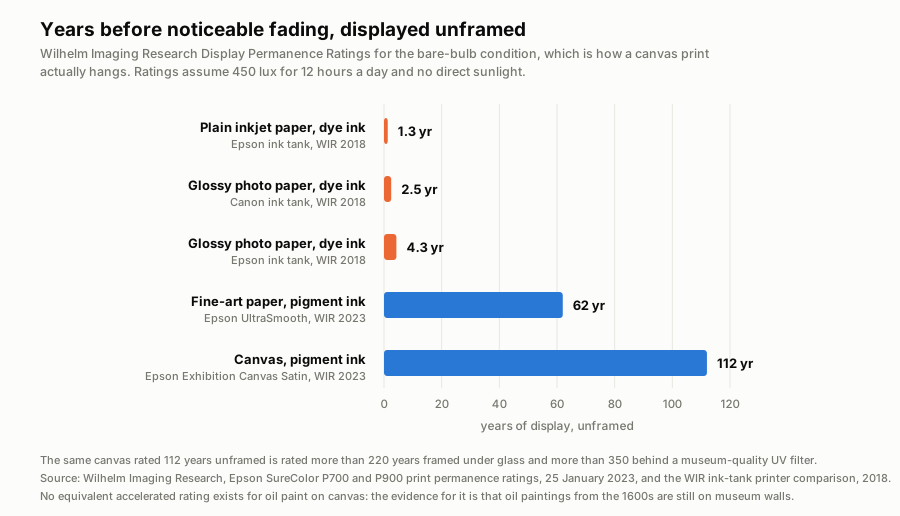
The failure modes differ as much as the timescales. A print fails by losing colorant, usually unevenly, and the loss is permanent: magentas typically go first, which is why old prints drift green. A painting fails by cracking, by dirt, and by varnish yellowing, and all three are things a conservator can work on. There is no accelerated rating for oil on canvas at all, because none has been needed: the evidence is that oil paintings from the 1600s are still on museum walls. Nothing about a faded print can be undone.
What each costs
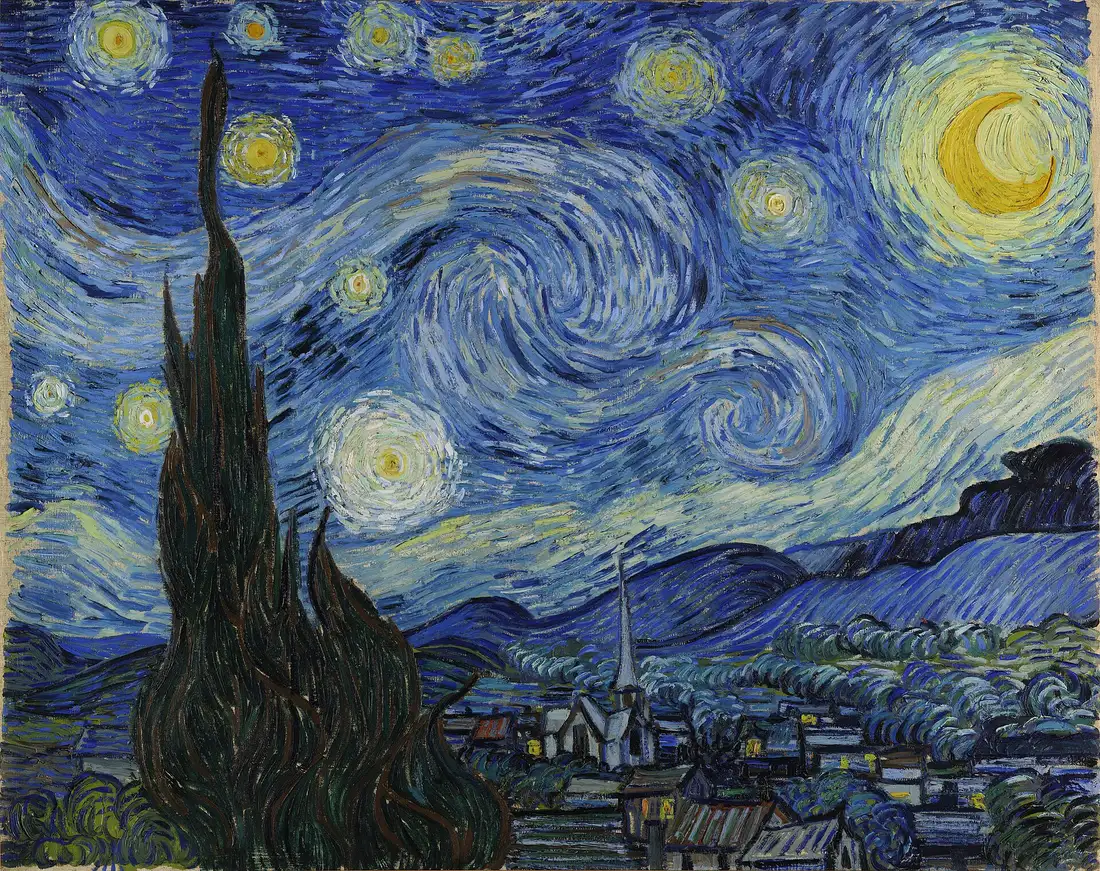
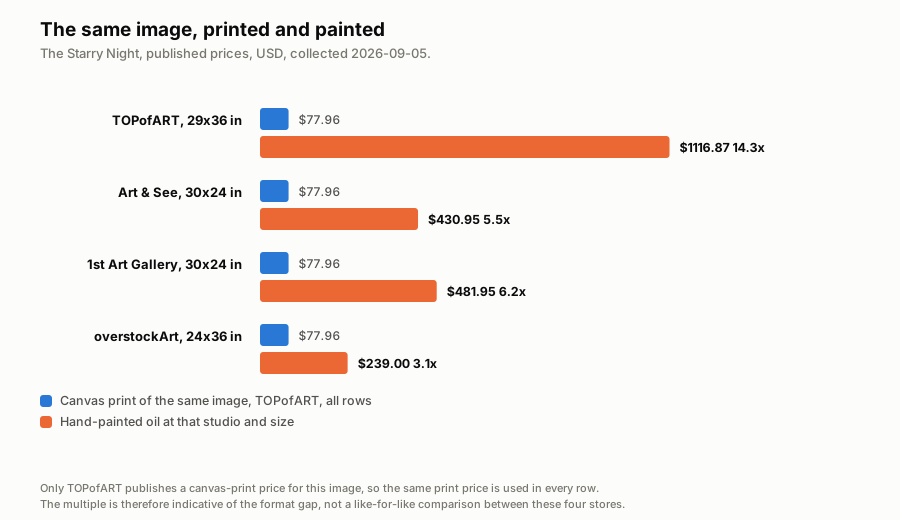
TOPofART is the only studio in this comparison that publishes both a canvas print and a hand-painted oil of the same image, which makes it the cleanest available measurement of the format gap: $77.96 for the print of The Starry Night against $1,116.87 for the painting, both collected 2026-09-05. That is a factor of fourteen at the top of the market.
| Giclee on canvas | Hand-painted oil reproduction | Original | |
|---|---|---|---|
| What it is | Pigment inkjet print of a photograph of a painting | A new painting in oil on canvas | The painting itself |
| Typical price, about 30x24 in | $60 to $250, a market range rather than a quoted listing | $239 to $1,117 across the seven studios that could be priced | Auction, if it is available at all |
| Time to produce | Under an hour once the file exists | 2 to 8 weeks including drying | Not applicable |
| Relief you can feel | None beyond the canvas weave | Ridges high enough to cast shadows in side light | Whatever the artist put there |
| Rated life on the wall | 112 years unframed for one named pigment ink on one named canvas; 1.0 to 4.3 years for dye inks | No rating is issued; oil on canvas from the 1600s is still hanging | No rating is issued; the same paintings are the evidence |
| Every copy identical | Yes | No | There is only one |
| Resale value | None | Near zero unless the copyist is known | The whole point |
Painting prices from the studios priced for the cost guide on 2026-09-05, seven of eight of which could be priced. The print price range is a market range, not a quoted listing; the only canvas-print price collected for this painting was $77.96 at TOPofART. Rated lives are Wilhelm Imaging Research display permanence ratings for the bare-bulb condition, 2018 and 2023.
Is giclee worth it?
Against an ordinary canvas print, yes, and the reason is measured rather than argued. In Wilhelm Imaging Research testing, pigment ink on Epson Exhibition Canvas Satin rated 112 years displayed unframed while dye inks on consumer papers rated 1.0 to 4.3 years in the same condition: a factor of 26 to 86 on display life. The price gap between the two formats is nothing like that wide. Against a hand-painted oil it depends entirely on what the wall does with light, and there is no answer that is right for every room.
- A giclee is the better buy when the piece is seen from more than three metres, when the wall has no directional light, when you expect to change what hangs there within a decade, or when the source image was never a painting in the first place: photographs, woodblock prints and digital work have no impasto for a painter to reproduce.
- A hand-painted oil is the better buy when raking light hits the wall for part of the day, when people sit within two metres of it, when the original is heavily impasted, and when the piece is a gift or is meant to outlive its owner.
- Neither is an investment. A giclee has no secondary market at all, and a hand-painted reproduction sells second-hand for a fraction of what it cost unless the copyist has a name of their own.
If the answer comes out on the painted side, what to check before ordering is set out in the ten museum-quality criteria, and what the weeks are actually spent on is in the process article. Studios that publish a full size and price ladder rather than quoting on request make the comparison easier to run; Art & See's Starry Night listing runs $299.95 at 20x16 in to $599.95 at 48x36 in, unframed.
How to check what you were sent
Whether you bought a giclee or a painting, the same six specifications tell you what arrived, and all six can be checked in five minutes with a loupe and a lamp. Ask for them in writing before you pay, then verify them on delivery.
| Specification | What you want | Acceptable | Red flag |
|---|---|---|---|
| Ink or medium | Named pigment ink set, or oil paint | Pigment ink, brand unnamed | Not stated, or the word giclee used as the answer |
| Substrate | Cotton rag or linen, named | Alpha-cellulose or cotton duck | Coated polyester canvas sold as fine-art canvas |
| Surface under a 10x loupe | Pigment particles and varied edges (painting) | A clean droplet pattern (print) | A droplet pattern under a clear gel, sold as hand-painted |
| Under raking light | Relief that follows the brushwork | No relief at all | Regular relief that ignores the image beneath |
| Edges of the canvas | Paint carried around the turn, or a stated wrap | Mirrored wrap on a print | A white margin with the image stopping at the fold on a piece sold as a painting |
| What arrives before shipping | A photograph of your actual piece for approval | Photographs of previous work | Only the catalogue image |
The loupe and light tests take five minutes and need a ten-dollar 10x loupe and one lamp.
Where to buy
If the checks send you to a painted piece rather than a print, these are three routes with different trade-offs. Prices are the published ladders as at 2026-09-05.
The most predictable of the studios compared: one published ladder, from $249.95 at 16x16 in to $1,299.95 at 72x48 in unframed, that applied to every painting checked, plus free worldwide shipping and a photograph of the finished piece sent for approval before it is packed.
Art & See- overstockArt — Cheapest hand-painted route in this comparison at every size, $149 for 16x20 and $349 for 36x48, with 45-day free returns; the catalogue is much shorter and popular images carry a 6 to 8 week pre-order wait.
- TOPofART — The only studio here that publishes both a canvas print and an oil of the same image, so you can compare formats without leaving the page; it sells one size per painting and had suspended new oil painting orders on 2026-09-05.
Frequently asked questions
What is a giclee painting?
There is no such thing. Giclee describes a printing process, not a painting: a pigment inkjet print, usually on cotton-rag canvas or paper. A listing that says giclee painting is either using the word loosely or is hoping you will not notice the difference. If the item is a print, the honest description is giclee print.
Is a giclee worth it compared with a normal canvas print?
Usually yes, if the ink is pigment and the substrate is archival, and only if the seller will name both. Wilhelm Imaging Research rated Epson UltraChrome PRO10 pigment inks on Epson Exhibition Canvas Satin at 112 years displayed unframed in January 2023, and rated dye inks from consumer ink-tank printers at 1.0 to 4.3 years in the same condition in 2018. If the seller cannot name the ink set and the substrate, no rating attaches to what you are buying and you are paying the giclee premium for an unknown print.
Does a giclee print have texture?
Only the texture of the material it is printed on. The ink is absorbed into a receptive coating rather than built on top of the cloth, so there is no body of material and nothing a fingertip can find. Some sellers brush a clear gel over the print and call it hand-finished; that does add relief, but in a repeating pattern that does not follow the brushwork in the image, which is exactly what gives it away under raking light.
Do giclee prints hold their value?
No. Open-edition giclees have no secondary market. Signed and numbered limited editions by a living artist trade at a fraction of their issue price and only where the artist has a following. A hand-painted reproduction does not hold value either, but it at least remains a physical painting that can be conserved rather than a print that can only fade.
Sources
- WIR Print Permanence Ratings for Ink Tank Printers (dye-ink display permanence) — Wilhelm Imaging Research. Accessed September 5, 2026.
- Epson SureColor P700 and P900: Print Permanence Ratings, 25 January 2023 — Wilhelm Imaging Research. Accessed September 5, 2026.
- Giclee: origin of the term, coined by Jack Duganne at Nash Editions in 1991 — Wikipedia. Accessed September 5, 2026.
- Starry Night: oil painting reproduction and canvas print of the same image — TOPofART. Accessed September 5, 2026.
- Original oil painting vs print: how to tell the difference — Appraisily. Accessed September 5, 2026.
- The Starry Night, Vincent van Gogh, 1889, oil on canvas, 73.7 x 92.1 cm — Museum of Modern Art, New York. Accessed September 5, 2026.
- File: Van Gogh, Starry Night, Google Art Project scan, public domain — Wikimedia Commons. Accessed September 5, 2026.
Keep reading
comparison
Hand-painted oil painting reproduction vs canvas print
Twelve criteria, a 40-year cost table and the five cases where a print is the better buy. Prices from seven studios, collected 2026-09-05.
process
How Oil Painting Reproductions Are Made
The 12 steps of a hand-painted oil reproduction, how long each takes, why drying cannot be rushed, and what separates a $100 copy from a $1,000 copy.
buying
Museum Quality Oil Painting Reproductions: What to Check Before Ordering
A sourced checklist for materials, finished-painting approval, cancellation and returns, with policy exceptions and limits of visual checks.
comparison
Oil Painting or Print? Seven Checks and Their Limits
Compare surface, print patterns, edges and labels without mistaking visual clues for proof of oil paint, age or authorship. Sources and limits explained.