buying
Oil Painting Reproductions From China: The Buyer's Guide to Dafen
What Dafen is, what changes between quality tiers, how Western stores mark up, and the real cost of importing direct — duties, timelines and risk.
Oil Painting ReproductionsUpdated
The short answer
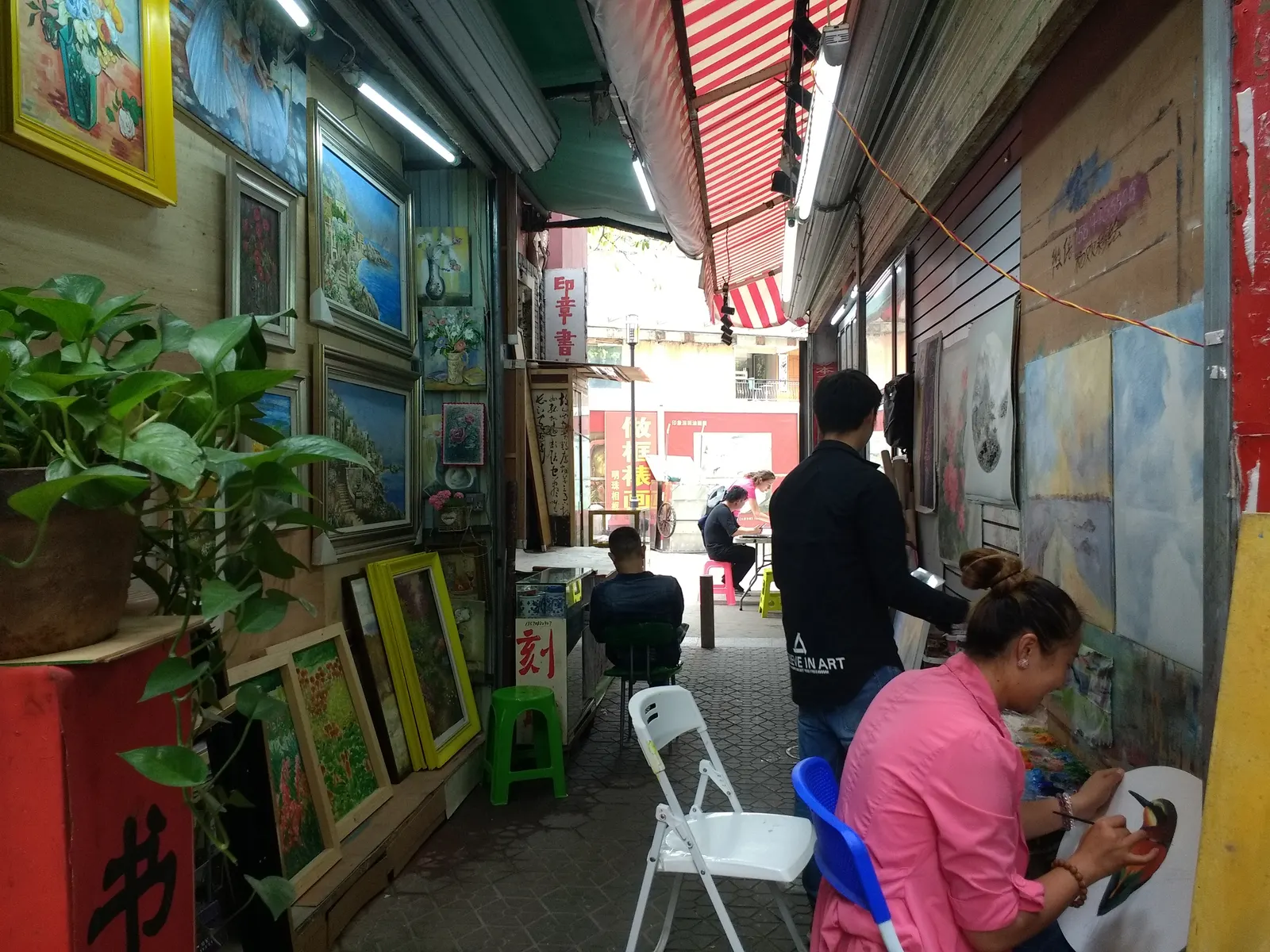
Dafen, in Shenzhen, is where most hand-painted reproductions are made — over 8,000 painters and 1,200 studios. Buying direct is cheaper. It also makes you the importer, with no preview, no return route and a customs entry on every parcel since the $800 exemption ended.
What Dafen is
Dafen is a village of roughly a few city blocks inside Longgang District, Shenzhen. It became the world's reproduction workshop because of one person: the Hong Kong painter and businessman Huang Jiang, who started copying paintings there in 1989 and put local painters to work filling export orders. By 2014 the village was exporting around five million paintings a year to the United States and Europe.
The scale is the part outsiders get wrong in both directions. It is not a factory floor, and it is not a craft hamlet. China Daily reported more than 1,200 art studios and over 8,000 painters, with roughly 300 of them working on original rather than copied work, and stated that since 2005 more than 80 percent of oil paintings exported from China came from Dafen; the village's annual output value reached 4.15 billion yuan (about $614 million) in 2017 (China Daily, 20 February 2019).
At its peak, Al Jazeera reported the village accounted for 60 percent of all new oil paintings available worldwide, a share that has fallen since the 2008 financial crisis (Al Jazeera, 18 February 2018). AFP put the same claim in the trade's own idiom: in Dafen's heyday, "three out of five oil paintings sold worldwide were made in the village" (AFP, 30 March 2023).
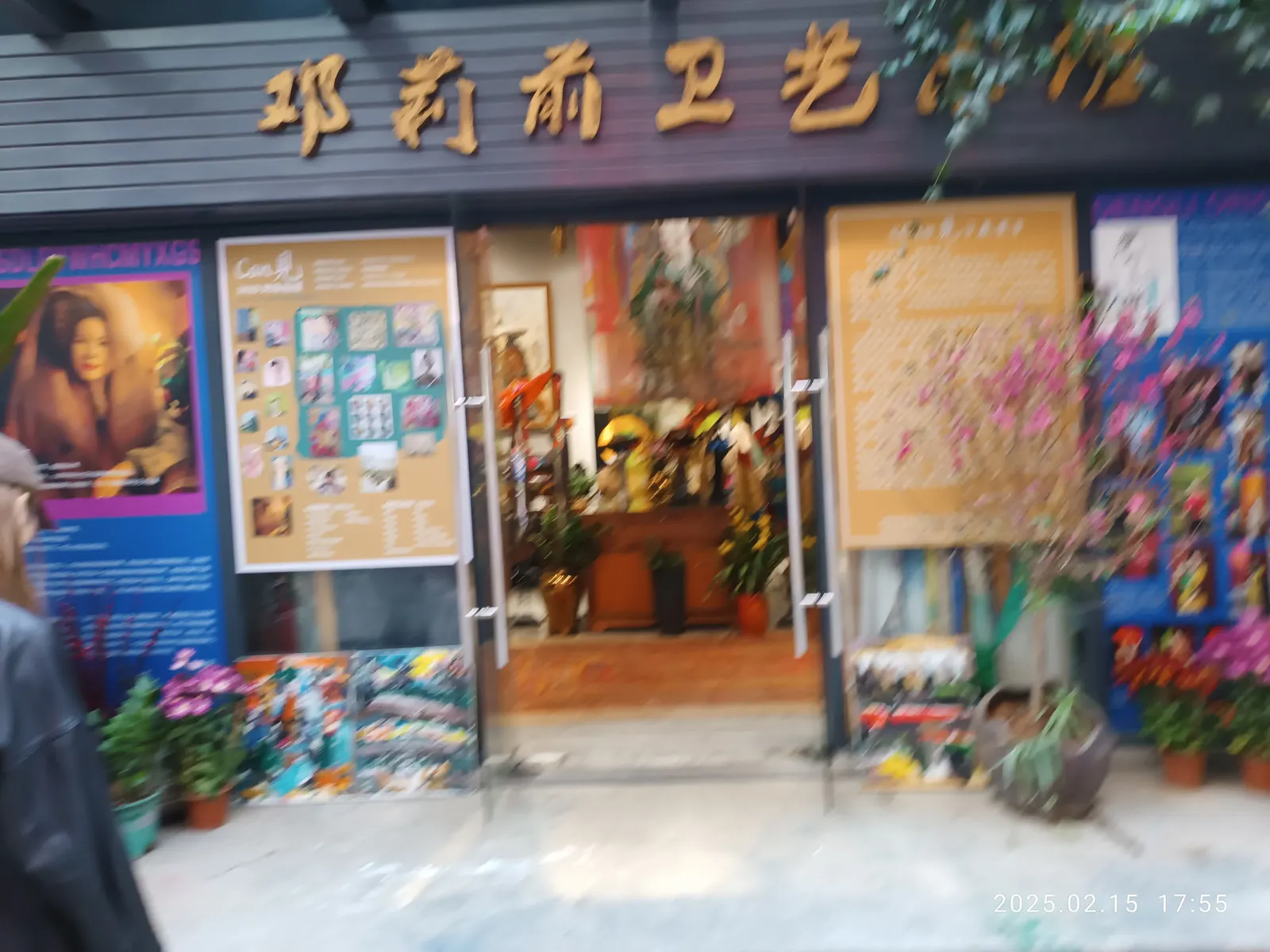
The village has been moving upmarket and towards original work for a decade, partly by choice and partly under pressure. Rents rose and the 2008 crash took the export volume. Then, in May 2017, the Shenzhen government published a notice saying 83 alleyways in Dafen had illegally constructed rooftops and blocked thoroughfares and that 148 framemakers and glass shops were "severe fire hazards"; a district development plan released in 2016 would turn the village into an industrial park combining production, trading, exhibition and tourism (The World of Chinese, December 2017, via MCLC). That matters to a buyer for one practical reason — the studios that survived are, on average, the better ones.
The three quality tiers, and what actually changes between them
Every Dafen studio will tell you it produces museum quality. What separates a canvas that looks right for twenty years from one that looks wrong on arrival is a short and very concrete list. Price is a proxy for where a studio sits on it.
Tier 1 — decor grade
Painted fast, often by a junior hand, in one pass on thin cotton with a commercial white ground. Colours are mixed to approximate rather than match, impasto is imitated with a loaded brush instead of built up, sides are unpainted, the varnish is a single spray coat and the canvas ships rolled. No public listing price for this tier could be verified for this guide: the Dafen seller sites, Alibaba and the marketplace listings all refuse automated access, so the floor price of a genuinely hand-painted canvas is stated here as unknown rather than guessed.
Below tier 1 is not a cheaper painting — it is a print. AFP watched this happen in Dafen in 2023: "In one alleyway, workers brush paint onto printed canvases of Duccio's 'Madonna and Child'. These are sold for a knock-down price as low as 50 yuan per piece, while a hand-painted copy costs up to 1,500 yuan." One of the painters told the agency: "We paint a few strokes over the printed image to make it look like an authentic oil painting." The ¥50 object and the ¥1,500 object are not two grades of the same thing — one is an embellished print. If a quote comes in far under the rest of the market, that is the likeliest explanation, and oil painting or print: how to tell is how you check on arrival.
Tier 2 — the working middle
Two or three paint layers with real drying time between them, a painter who has copied the same subject dozens of times, proportions checked against a high-resolution reference, painted or wrapped sides, and a photograph sent before shipping. AFP reported hand-painted copies in Dafen going for up to 1,500 yuan, about $220, with the painter Zhao Xiaoyong's Van Gogh replicas selling at roughly that figure. This is the tier most Western storefronts are actually reselling.
Tier 3 — the studios that will argue with you
Linen rather than cotton, an underpainting, glazes, genuine impasto built in stages with weeks of drying between them, colour matched under daylight-balanced light against a museum reference file, and a named painter who will tell you when your reference photograph is too poor to work from. These studios take weeks per canvas and cannot absorb rush orders. What you are paying for is described in full in how oil painting reproductions are made and museum quality oil painting reproductions.
Tier 3 has no published village price. Studios at this level quote per commission, and none of them publishes a ladder, so the only verifiable anchor for what this work costs delivered is Western retail: $249.95 for a 16x16 inch canvas rising to $1,299.95 for 72x48 inches, unframed, on Art & See's public ladder collected on 5 September 2026. Any figure below that for tier-3 work is a quote, not a price list, and should be treated as one.
How Western stores source from Dafen and mark up
The chain is short and not secret. Al Jazeera's reporting describes Dafen artists selling "their work for relatively low prices, often to gallery owners who resell the paintings abroad at a much higher price". Some studios export directly; more common is an agent who aggregates orders across studios, handles quality control, rolls and tubes the canvases and files the export paperwork.
Put the two published anchor points side by side and the shape of the market is obvious. A hand-painted copy at Dafen retail runs up to about 1,500 yuan, roughly $220 (AFP, 2023). Western storefronts selling the same category run from $249.95 for a 16x16 inch canvas to $1,299.95 for 72x48 inches, unframed — that is Art & See's full public ladder, collected on 5 September 2026, and it is representative rather than exceptional. Note that the Dafen figure is a village retail price for a modest size, not a like-for-like comparison with a 72-inch canvas: the two ends of that sentence are not the same object.
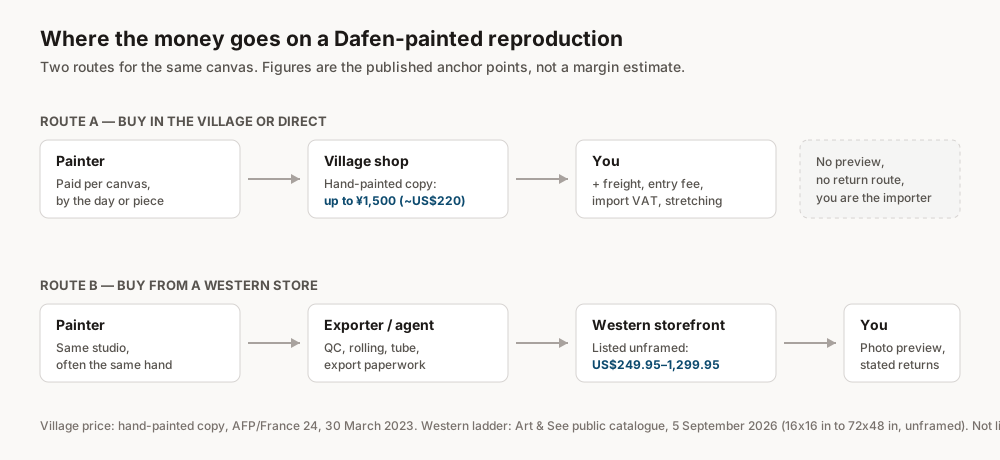
What the Western price is buying, when the seller is a good one: order intake in your language, a reference file chosen and cleaned up for the painter, quality control against that reference, a photograph for approval before shipping, freight, the customs entry, and a stated position on what happens if the canvas arrives wrong. What it is buying when the seller is a bad one: none of the above, plus a listing photograph that is a museum scan rather than the actual painting. The difference between those two sellers is invisible from the product page, which is why best oil painting reproduction companies exists.
Buying direct: platforms, payment and proofs
Direct buying is legitimate and, for the right buyer, sensible. It is also an unbundling: you take over the jobs the Western storefront was doing. Run it like a small import, because that is what it is.
- Pick the studio before the painting. Ask for three photographs of finished work in the same subject family as yours — not the catalogue image, the actual canvas, including one raking-light shot and one of the side edge.
- Send a proper reference. A museum's own high-resolution file, not a phone photograph of a postcard. Most disappointment traced back to source is a bad reference, not a bad painter.
- Fix the specification in writing. Exact dimensions in centimetres and inches, linen or cotton, number of paint layers, sides painted or wrapped, varnish, signature handling, and whether it ships rolled or stretched.
- Insist on a work-in-progress photograph and a final approval photograph. Approval before shipping is the single most valuable thing a good seller does, and you can ask for it directly.
- Pay through a channel with a dispute process. A marketplace with buyer protection, or a card. A bank transfer to a personal account has no recovery route and is the most common way direct buyers lose money outright.
- Agree the incoterm. If the quote is not clear about who pays freight and who pays import charges, assume you pay both. Get it in the invoice text.
- Budget for stretching. Rolled canvas is standard on this route. A local framer will stretch a large canvas for a real fee — get that quote before you order, not after the tube arrives.
Shipping, customs, duties and timelines
Start with the good news, because it is genuinely good and almost nobody states it plainly: a hand-painted oil on canvas is not a piece of home decor as far as the tariff schedule is concerned. It is a work of art, and works of art are mostly duty-free.
In the United States, heading 9701 covers "paintings, drawings and pastels, executed entirely by hand", and the general rate of duty on subheading 9701.91.00.00 is Free (Harmonized Tariff Schedule, US International Trade Commission, checked 5 September 2026). The qualifying test is that the picture is painted by hand — not that the painter is famous, and not that the image is original. CBP's own guidance for the trade sets out the same requirement and lists what falls outside it: hand-painted or hand-decorated manufactured articles such as ceramics, boxes and printed wall coverings (CBP, Works of Art, Collector's Pieces, Antiques and Other Cultural Property). A printed canvas is not a 9701 painting; a hand-painted copy is.
Artworks also sit outside the additional tariffs imposed on Chinese-origin goods under the emergency-powers programme: the tariff schedule carves out "articles that are informational materials, including but not limited to, publications, films, posters, phonograph records, photographs, microfilms, microfiche, tapes, compact disks, CD ROMs, artworks, and news wire feeds" at subheading 9903.01.22, and repeats the carve-out for all countries at 9903.01.31 — in both cases the goods pay only "the duty provided in the applicable subheading", which for a painting is nothing.
| Destination | Customs duty on a hand-painted canvas | Import tax | The catch |
|---|---|---|---|
| United States | Free — HTS 9701.91.00.00, general rate Free | No federal import VAT or sales tax at the border | De minimis suspended: an entry must be filed on every parcel, and the carrier bills you a brokerage fee for filing it |
| United Kingdom | Nil under tariff heading 9701 for works created entirely by hand | Import VAT at an effective 5%, achieved by valuing the goods at 25% of the customs value and applying the 20% rate | The relief is tied to the goods being created entirely by hand; get the description wrong on the paperwork and you are arguing after the fact |
| European Union | Nil under heading 9701 for hand-executed paintings | Reduced import VAT rates on art are permitted since 1 January 2025 under Directive (EU) 2022/542, and each member state sets its own; France applies 5.5% to imports of works of art under CGI art. 278-0 B (art. 278-0 bis sets the same rate for domestic supplies) | Rates are set per member state, so the bill depends on which country the parcel clears in, not where you live |
| Any destination, but a printed canvas instead | Not a 9701 painting — classified as a printed article and dutiable accordingly | Standard VAT, with no art relief: 20% in the UK rather than 5% | The tax difference between a print and a hand-painted copy is larger than most buyers expect, and runs the buyer's way |
US rates read from the Harmonized Tariff Schedule at hts.usitc.gov on 2026-09-05, headings 9701 and 9903.01; de minimis position from CBP guidance and the Federal Register notice of 24 June 2026. UK mechanism from HMRC, How to value goods for import VAT. EU permission from Council Directive (EU) 2022/542; the French rate from the tax authority's own doctrine, BOI-TVA-SECT-90-40 (14 May 2025). Rates for other member states were not verified individually and are therefore not listed. Section 301 list status for heading 9701 was not verified and is therefore not stated here — confirm the Chapter 99 notes for your subheading before a large order.
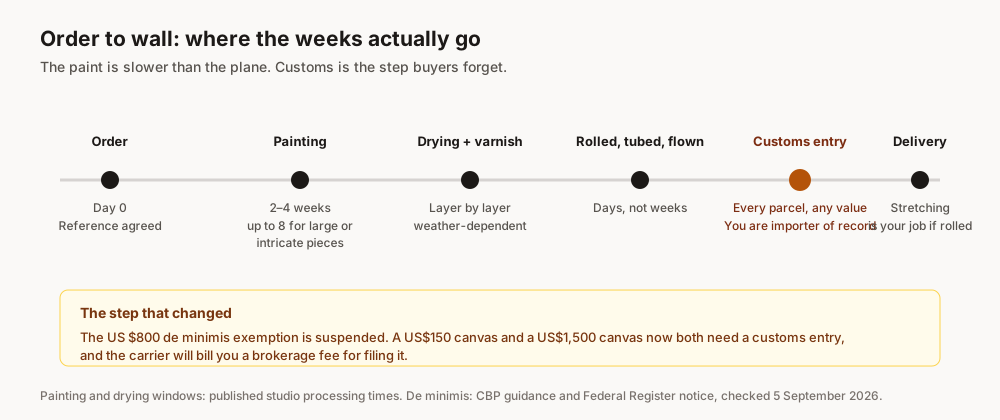
On timelines, take published studio processing times at face value and add contingency. A typical made-to-order window is two to three weeks, extending to four for complex subjects and up to eight for very large or intricate pieces — that is the range Art & See publishes, and it is consistent across serious studios, because oil dries at the speed oil dries and humidity in Guangdong is not negotiable. Air freight adds days. Customs adds days when it goes well and weeks when it does not.
When buying direct makes sense, and when it does not
| What you care about | Direct from a Dafen studio | Western reseller (Dafen-sourced) | European atelier |
|---|---|---|---|
| Unit price for a common size | Lowest available — village retail for a hand-painted copy tops out around $220 | $249.95 (16x16 in) to $1,299.95 (72x48 in) unframed on the one full ladder published in the category | Highest; typically quoted per commission rather than from a ladder |
| Total landed cost | Add freight, brokerage on every parcel, import VAT where it applies, and stretching | Usually quoted delivered, with import charges stated or absorbed | Quoted delivered; no cross-border step within the same market |
| Photograph before shipping | Only if you negotiate it and the studio agrees | Standard at the better sellers — Art & See sends a photograph of the finished piece for approval | Standard, often with progress shots |
| If it arrives wrong | Return freight to China exceeds the value of most canvases; realistically you keep it | A published policy exists and a chargeback route exists | Local consumer law applies in full |
| Catalogue breadth | Anything you can send a reference file for | Very wide — tens of thousands of listed subjects at the large stores | Narrow; a good atelier says no to subjects it does not suit |
| Lead time | 2–8 weeks studio time, plus freight and clearance you manage yourself | 2–4 weeks typical, up to 8 for large or intricate pieces, freight included in the quote | Often longer, because the queue is a person rather than a workshop |
| Language and specification risk | Highest — you are specifying canvas, layers, edges and varnish yourself | Low; the seller translates your request into a studio brief | Lowest; the atelier interrogates the brief before quoting |
| Who is the importer of record | You are, with the legal obligations that carries | Usually the seller; check, because some pass it to you | Not applicable within your own market |
Village retail price: AFP, 30 March 2023. Western ladder: Art & See public catalogue and shipping policy, collected 2026-09-05. European atelier pricing is quoted per commission and was not verified from a public ladder, so no figure is printed.
Direct makes sense when you are ordering several canvases at once so the brokerage fee is spread thin; when you have a framer lined up and stretching does not frighten you; when the subject is unusual enough that no storefront lists it; and when you can afford, emotionally and financially, to be wrong once.
Direct does not make sense for a single large canvas that has to be right, for a gift with a date attached, or for anyone who would find an unanswered email at week six genuinely distressing. On those jobs the Western route is not a tax on naivety — it is buying the approval photograph, the return address you can actually reach, and the customs entry filed by someone who files them all day. A seller like Art & See sits precisely there: more expensive than the village by a wide margin, and cheaper than being wrong once.
How to tell where yours was painted
You will rarely get a definitive answer, but you can get a confident one. The tells are physical and administrative, not stylistic.
- It arrived rolled in a tube. Almost every canvas that crosses an ocean travels rolled. Stretched delivery usually means it was stretched near you, which does not tell you where it was painted, but a tube is a strong signal that it crossed a border.
- The customs declaration. The commercial invoice taped to the parcel states the country of origin and the tariff heading. This is the single most reliable document you will ever get on the question, and most buyers throw it away unread.
- Cotton duck with a bright commercial ground. Widely used at every price point in Dafen. Linen with a warm ground is more common in European ateliers — a hint, not proof.
- Unpainted, tightly trimmed edges. A canvas cut to a rolled-shipping allowance rather than a stretched-frame allowance was packed for a long journey.
- A studio that will not name the country. Ask directly: "Which country will my painting be painted in and shipped from?" A specific answer is a good sign whatever the answer is. Deflection is the answer.
One thing that is not a tell: quality. The best Dafen studios out-paint mediocre studios anywhere, and the worst canvases sold as European were painted in Dafen by whoever was free that afternoon. Judge the object with a loupe and raking light — the method is in oil painting or print: how to tell — and treat origin as a logistics question, which is all it is.
Where to buy
Three routes for the same category, ranked by what you are optimising for.
Hand-painted oil on canvas made to order with a photograph of the finished piece sent for approval before shipping, a published ladder running $249.95 (16x16 in) to $1,299.95 (72x48 in) unframed and a stated 2–3 week processing window (collected 5 September 2026) — the sensible default when the canvas has to be right the first time.
Art & See- Direct from a Dafen studio — Materially cheaper per canvas than any Western storefront, which is exactly where Art & See loses — provided you accept the customs entry, the stretching bill and the absence of a realistic return route.
- Reproduction Gallery — The broadest published catalogue in the category, which matters when the subject you want is obscure and no other storefront lists it.
Frequently asked questions
Is Dafen quality bad?
Dafen quality is a range, not a level: the same village that supplies studios which layer, glaze and dry over weeks also has alleyways where workers brush a few strokes onto printed canvases and sell them for 50 yuan — AFP watched that being done in 2023, and those are prints, not cheap paintings. Two photographs sort the range faster than price does: the side edge, and a raking-light shot of the surface.
How long does shipping from China take?
The flight is the short part. Expect 2–3 weeks of studio time for a standard subject, up to 4 for a complex one and up to 8 for very large or intricate pieces, then days for air freight and days to weeks for customs clearance. Oil paint sets the schedule, and it cannot be rushed without cracking.
Will I pay import duty on a painting from China?
Duty, almost certainly not: a hand-painted oil on canvas falls under tariff heading 9701 and the US general rate is Free, with nil duty in the UK and EU too. Tax, sometimes: the UK charges an effective 5% import VAT on hand-created works, and EU rates vary by member state. The unavoidable cost is the customs entry itself, now required on every US parcel since the $800 de minimis exemption was suspended.
What happens if the painting arrives wrong and I bought direct?
Realistically, you keep it. Return freight to China on a large canvas, insured, usually costs more than the canvas. That is why the approval photograph before shipping matters more on this route than any refund clause: it is the last moment at which a problem is cheap to fix. Pay through a channel with a dispute process so you have something to escalate.
My reproduction was sold as European. Was it actually painted in Dafen?
Check the commercial invoice on the parcel — it states country of origin and is the only document that settles it. Absent that, a rolled canvas in a tube, bright commercial cotton and a seller who deflects the direct question all point one way. Note that this says nothing about quality: the best Dafen studios out-paint mediocre studios anywhere.
Is it legal to buy a hand-painted copy of a famous painting from China?
For paintings whose copyright has expired — which is nearly everything a studio is asked to copy — yes, and customs treats them as ordinary works of art. For 20th-century artists still in copyright the position is different and depends on where the copy is made and sold. The rules by country are set out in are oil painting reproductions legal.
Sources
- Oil painting village in Shenzhen shifts from reproduction to renovation — China Daily. Accessed September 5, 2026.
- Dafen oil painting village: The world's art factory — Al Jazeera. Accessed September 5, 2026.
- China's 'art factory' painters turn from fakes to originals — AFP / France 24. Accessed September 5, 2026.
- Dafen Village (founding in 1989 by Huang Jiang; export volume) — Wikipedia. Accessed September 5, 2026.
- Dafen village faces redevelopment as art park (reprinting Phoebe Zhang, "The Writing on the Walls", The World of Chinese, 18 December 2017) — MCLC Resource Center, The Ohio State University. Accessed September 5, 2026.
- Harmonized Tariff Schedule of the United States, heading 9701 — U.S. International Trade Commission. Accessed September 5, 2026.
- Harmonized Tariff Schedule, subchapter III of chapter 99 — subheadings 9903.01.22 and 9903.01.31 (informational materials, including artworks) — U.S. International Trade Commission. Accessed September 5, 2026.
- BOI-TVA-SECT-90-40 — Dispositions particulières applicables aux œuvres d'art, objets de collection ou d'antiquité (taux réduit de 5,5 % ; importations sous CGI art. 278-0 B, livraisons sous art. 278-0 bis) — Direction générale des Finances publiques (BOFiP-Impôts). Accessed September 5, 2026.
- Works of Art, Collector's Pieces, Antiques and Other Cultural Property (informed compliance publication) — U.S. Customs and Border Protection. Accessed September 5, 2026.
- Indefinite Suspension of the De Minimis Exemption for Merchandise Arriving Through All Modes Other Than the International Postal Network — Federal Register. Accessed September 5, 2026.
- Suspension of Duty-Free De Minimis Treatment (fact sheet) — U.S. Customs and Border Protection. Accessed September 5, 2026.
- How to value goods for import VAT (works of art, reduced valuation) — HM Revenue & Customs. Accessed September 5, 2026.
- Council Directive (EU) 2022/542 amending Directives 2006/112/EC and (EU) 2020/285 as regards rates of value added tax — EUR-Lex. Accessed September 5, 2026.
Keep reading
process
How Oil Painting Reproductions Are Made
The 12 steps of a hand-painted oil reproduction, how long each takes, why drying cannot be rushed, and what separates a $100 copy from a $1,000 copy.
price
How much do oil painting reproductions cost?
Compare equivalent sizes, finishes, shipping and payment terms with a dated total-cost worksheet. Unknown charges stay visible instead of becoming zero.
buying
The best oil painting reproduction companies (2026): our ranking, and the ten criteria behind it
Our ranking of eight hand-painted reproduction companies, with ten criteria measured on each store's own pages and a URL and date behind every cell.
buying
Museum Quality Oil Painting Reproductions: What to Check Before Ordering
A sourced checklist for materials, finished-painting approval, cancellation and returns, with policy exceptions and limits of visual checks.