artist
Frida Kahlo Reproductions: The Rights Question First
Kahlo copyright differs in Mexico, Europe and the US, and her name is trademarked. Plus original sizes, why she painted small, and alternatives.
Oil Painting ReproductionsUpdated
The short answer
Kahlo entered the public domain in the EU and UK on 1 January 2025, but most of her work is still protected in the United States and Mexico's position is disputed. Her name is separately trademarked. Check the rights before you check the price.
Why Frida Kahlo is reproduced so often
On 20 November 2025 Kahlo's El sueño (La cama), painted in 1940, sold at Sotheby's New York for $54.7 million. It became the highest price ever paid at auction for a work by a woman artist and for any Latin American artwork, beating her own 2021 record of $34.9 million for Diego y yo by nearly $20 million in about five minutes of bidding.
The demand for Kahlo images is not really an art-market phenomenon, though. Her face is one of the most widely circulated in the world, on everything from museum posters to supermarket tote bags, and that circulation drives a large trade in hand-painted copies. Two separate bodies actively assert rights over it — the Banco de México trust for copyright, through the Artists Rights Society in the United States, and the Frida Kahlo Corporation for the trademarks — which is why this page puts the legal position ahead of the technique.
Copyright status
Kahlo died on 13 July 1954. Three different rules apply in the three markets that matter, and they do not agree with each other.
| Jurisdiction | Rule | Status for a 1940 painting | Who to ask |
|---|---|---|---|
| EU, UK, Brazil | Life + 70 years | Public domain since 1 January 2025 | Nobody — no licence required |
| United States | 95 years from first publication, for works first published 1930–1977 | Protected; a work first published in 1940 runs to 1 January 2036 | Artists Rights Society, for the Banco de México trust |
| Mexico | Life + 100 years since the 2003 reform, but the retroactivity of the 1963, 1982 and 2003 extensions is disputed | Contested — most practitioners say protected to 2055; a minority argue it lapsed in the 1970s | Banco de México Diego Rivera and Frida Kahlo Museums Trust |
| Everywhere (trademark, not copyright) | Trademarks in the name and likeness, registered by the Frida Kahlo Corporation | Live, and unaffected by any copyright expiry | Frida Kahlo Corporation |
Positions summarised on 2026-09-05 from the Artists Rights Society's published guidance, the Center for Art Law's account of the trademark dispute, and reporting on the Mexican retroactivity question. This is a buyer's summary, not legal advice.
The point that catches almost everybody out is the American one. Widely shared headlines in January 2025 announced that Kahlo had "entered the public domain". That was true in Europe. The Artists Rights Society, which represents the Mexican trust in the United States, published a direct rebuttal: because the great majority of her works were not first published in the US until they became well known there, between 1930 and 1978, the 95-year clock still has years to run on most of them. If you are buying into the United States, treat Kahlo as protected unless a seller can name the specific work and its first publication date.
The trade is mostly silent about all of this. Reproduction Gallery lists 74 Frida Kahlo paintings from $309 across three pages; the page carries a site-wide "All rights reserved" notice for its own content and no statement about the copyright status of the works it reproduces, so whether it holds a licence is not stated either way (checked 2026-09-05). Ask any seller in writing whether they hold a licence and from whom, and treat silence as an answer. The general framework is set out in are oil painting reproductions legal.
What a faithful copy must get right
Kahlo's paintings descend directly from the Mexican retablo or ex-voto — small devotional pictures painted on sheets of tin, showing a disaster and a saint, usually with a written banner along the bottom explaining what happened. She collected them, hung them in the Casa Azul, and painted in their idiom for most of her career. Almost everything a copyist gets wrong follows from missing that.
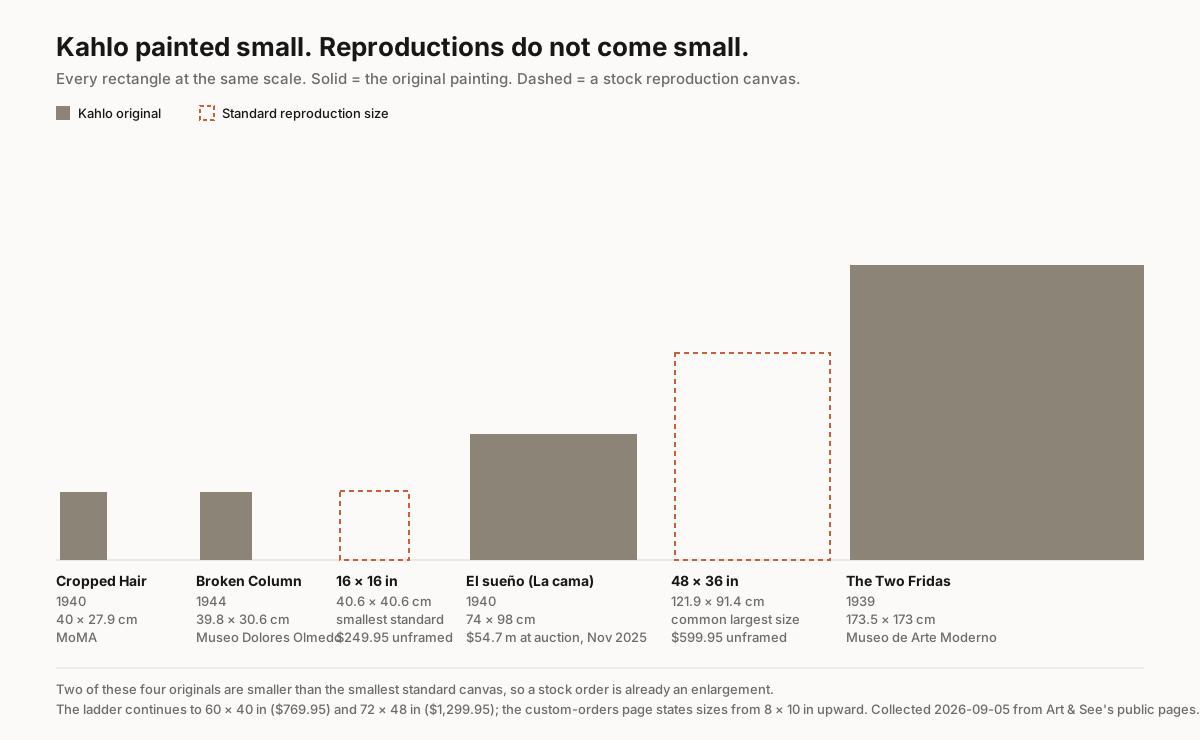
- The scale is small and deliberate. The Broken Column is 39.8 × 30.6 cm. Self-Portrait with Cropped Hair is 40 × 27.9 cm. These are objects to be held at reading distance, not wall statements, and the smallest stock reproduction canvas is already larger than either.
- The support is usually not canvas. Kahlo painted many works on masonite or on sheet metal, which takes a harder, smoother, more enamel-like surface than woven canvas. A reproduction on textured cotton duck has the wrong grain visible through every flat passage.
- Nothing is atmospheric. Retablo painting has no aerial perspective and no soft focus. Every leaf, thorn and vein is in the same hard focus, foreground and background alike. Copyists trained on European painting instinctively blur the distance, and the picture loses its flatness.
- The lettering is part of the painting. Where a banner or inscription appears, it was painted by Kahlo in a specific hand. Copyists set it in a font or approximate it, and it immediately reads as a reproduction.
- The face is a mask, not a portrait. Kahlo's self-portrait face is deliberately fixed and symmetrical. Softening it, or adding a hint of expression, produces a likeness of somebody else.
Most requested works
Difficulty is this site's rating, 1 to 5. The last column gives the nearest standard canvas and the copyright position together, because for Kahlo the second matters more than the first.
| Work | Year | Museum | Original size | Difficulty | Nearest canvas / status |
|---|---|---|---|---|---|
| The Two Fridas | 1939 | Museo de Arte Moderno, Mexico City | 173.5 × 173 cm | 4 | Square — fits 36 × 36 in at 53 % of the original; protected in the US |
| Self-Portrait with Thorn Necklace and Hummingbird | 1940 | Harry Ransom Center, Austin | 61.25 × 47 cm | 5 | 1.30:1 — fits 30 × 24 in; protected in the US |
| The Broken Column | 1944 | Museo Dolores Olmedo, Mexico City | 39.8 × 30.6 cm | 5 | Smaller than any stock canvas; protected in the US |
| Self-Portrait with Cropped Hair | 1940 | Museum of Modern Art, New York | 40 × 27.9 cm | 4 | Smaller than any stock canvas; protected in the US |
| El sueño (La cama) | 1940 | Private collection | 74 × 98 cm | 4 | 1.32:1 — fits 40 × 30 in; protected in the US |
| Viva la Vida, Watermelons | 1954 | Museo Frida Kahlo, Mexico City | 52 × 72 cm | 3 | 1.38:1 — near 40 × 30 in; protected in the US |
Dimensions from the holding institutions and standard catalogues. Copyright column reflects the US 95-years-from-publication rule for works first published 1930–1977; all six are public domain in the EU and UK since 1 January 2025. Checked 2026-09-05.
Common mistakes in cheap copies
- Sold with no licence and no mention of one. The commonest and most serious problem in the US market.
- Enlarged past recognition. A 39.8 cm picture painted at 76 cm is not the same object; the density of detail that makes it work becomes decoration.
- Blurred backgrounds. European atmospheric perspective applied to a retablo composition that has none.
- A softened face. Kahlo's self-portrait face is fixed and frontal. Any added warmth makes it a different person.
- Typeset inscriptions. Lettering approximated in a font instead of painted in her hand.
- Symbolism tidied up. The thorns, the hummingbird, the exposed heart and the veins are painted with anatomical bluntness. Copies soften them, and the picture becomes a decorative portrait of a woman with flowers in her hair.
Sizes that work at home
Kahlo is the only artist in this guide where the honest recommendation is to buy smaller than the smallest thing on the price list. Her paintings were made to be looked at from thirty or forty centimetres away, by one person, the way you look at a retablo in a chapel. Everything in them is scaled to that.
- 16 × 16 in (40.6 × 40.6 cm), $249.95. The smallest canvas on the standard ladder, and already 102 % of The Broken Column's height. This is the ceiling, not the floor, for her small self-portraits.
- 24 × 20 in (61 × 50.8 cm), $359.95. Right for Self-Portrait with Thorn Necklace and Hummingbird, which is 61.25 × 47 cm — almost exactly life size.
- 40 × 30 in (101.6 × 76.2 cm), $529.95. The correct scale for El sueño (74 × 98 cm) and Viva la Vida (52 × 72 cm), both of which are wider than they are tall.
- 36 × 36 in (91.4 × 91.4 cm), $549.95. The largest square on the ladder, and 53 % of The Two Fridas. Her one genuinely large painting is the one the standard sizes handle worst.
- Custom, around 40 × 31 cm. Art & See's custom-orders page states a size range starting at 8 × 10 in with custom dimensions on request. For The Broken Column or Self-Portrait with Cropped Hair that is the only way to get the object rather than an enlargement of it — and it is worth asking for a quote before defaulting to a stock size.
Hang the small pictures low and close — beside a desk, in a hallway, at the head of a bed — where somebody can stand within arm's length. Kahlo does not work as a statement piece over a sofa, and the reproduction trade sells her that way because that is what the price ladder is built for. Art & See's published sizes run from $249.95 at 16 × 16 in through $599.95 at 48 × 36 in to $769.95 at 60 × 40 in and $1,299.95 at 72 × 48 in; for Kahlo the bottom of that ladder is the right end, and the custom range below it is better still.
Where to buy
For a licensed Kahlo, the route is the rights holder: the Banco de México Diego Rivera and Frida Kahlo Museums Trust, and the Artists Rights Society in the United States. If what you want is Mexican modernism you can buy without a rights question, these three routes are honest about what they are. Checked 2026-09-05.
Hand-painted oil on canvas from $249.95, out of a catalogue its own product data puts at 37,978 active titles of public-domain painters, with a photograph of the finished piece for approval before shipping; its custom-orders page states sizes from 8 × 10 in upward, which is the only route on this page to Kahlo's actual scale.
Art & See- Reproduction Gallery — Lists 74 Kahlo titles from $309 and a far broader catalogue overall — catalogue breadth is where it beats Art & See. Its pages say nothing about the copyright status of the works reproduced, so if you order a Kahlo from it, ask about the licence first.
- A commissioned original, from a living painter — A retablo-style self-portrait or votive painting commissioned from a contemporary Mexican painter costs about the same as a large reproduction, raises no copyright or trademark question at all, and pays a working artist rather than a copyist.
Frequently asked questions
Is Frida Kahlo in the public domain?
It depends where you are. In the EU, the UK and other life-plus-70 countries, yes — since 1 January 2025. In the United States, mostly no: works first published between 1930 and 1977 run for 95 years from publication, so a 1940 painting is protected until 2036. Mexico's term is life plus 100, and whether the extensions apply retroactively to an author who died in 1954 is genuinely disputed among Mexican lawyers.
Do I need a licence to buy a Kahlo reproduction?
The licence obligation sits with whoever makes and sells the copy, not with you. But in the United States that obligation is real and it is administered by the Artists Rights Society on behalf of the Banco de México trust, and the sellers checked for this page say nothing about it either way. Ask in writing before you order.
Why is her name trademarked if the paintings are out of copyright in Europe?
Because trademark and copyright are separate rights with separate terms. The Frida Kahlo Corporation holds registered trademarks in her name and likeness, and those do not expire when copyright does. Owning a painted copy is unaffected; a seller branding a product line with her name is not.
What size should a Kahlo reproduction be?
Smaller than you think. The Broken Column is 39.8 × 30.6 cm and Self-Portrait with Cropped Hair is 40 × 27.9 cm — both smaller than the smallest canvas on the standard ladder, 16 × 16 in. Art & See's custom-orders page states a range starting at 8 × 10 in, so a size-accurate copy is a custom quote rather than a list price. Her paintings were made to be read at arm's length, and enlarging them turns density into decoration.
What can I buy instead?
Retablo and ex-voto painting itself, which is anonymous folk work with no rights holder, and the pre-1955 Latin American and European small-format painters whose work is genuinely public domain. Or commission a contemporary Mexican painter directly — for the price of a large reproduction you get an original.
Sources
- Frida Kahlo painting sells at Sotheby's for $54.7 m, a record for a woman artist — ARTnews. Accessed September 5, 2026.
- Are works by artists such as Frida Kahlo and Henri Matisse really in the public domain? — Artists Rights Society. Accessed September 5, 2026.
- Frida Kahlo, Diego Rivera and the public domain in Mexico: who's right? A copyright rabbit hole — Hugh Stephens Blog. Accessed September 5, 2026.
- Rolling over in her grave: Frida Kahlo's trademarks and commodified legacy — Center for Art Law. Accessed September 5, 2026.
- Works by Frida Kahlo and Henri Matisse enter the public domain — Hyperallergic. Accessed September 5, 2026.
- Frida Kahlo artist page — 74 titles listed from $309, with no statement on the copyright status of the works reproduced — Reproduction Gallery. Accessed September 5, 2026.
Keep reading
legal
Are Oil Painting Reproductions Legal?
Yes for public-domain paintings, no for artists still in copyright. Country rules, 21 artists with dates, and the line between a copy and a forgery.
catalog
The 20 most popular oil painting reproductions, and what each one costs to copy well
The 20 paintings ordered most often, cross-checked against five stores' own bestseller lists, with museum, original size, difficulty and price for each.
price
How much do oil painting reproductions cost?
Compare equivalent sizes, finishes, shipping and payment terms with a dated total-cost worksheet. Unknown charges stay visible instead of becoming zero.
buying
Museum Quality Oil Painting Reproductions: What to Check Before Ordering
A sourced checklist for materials, finished-painting approval, cancellation and returns, with policy exceptions and limits of visual checks.