painting
The Scream reproduction: why an oil copy is an interpretation
The 1893 Scream is tempera and crayon on cardboard, 91 x 73.5 cm. An oil-on-canvas copy changes paint and surface. Sizes, prices and what to check.
Oil Painting ReproductionsUpdated
The short answer
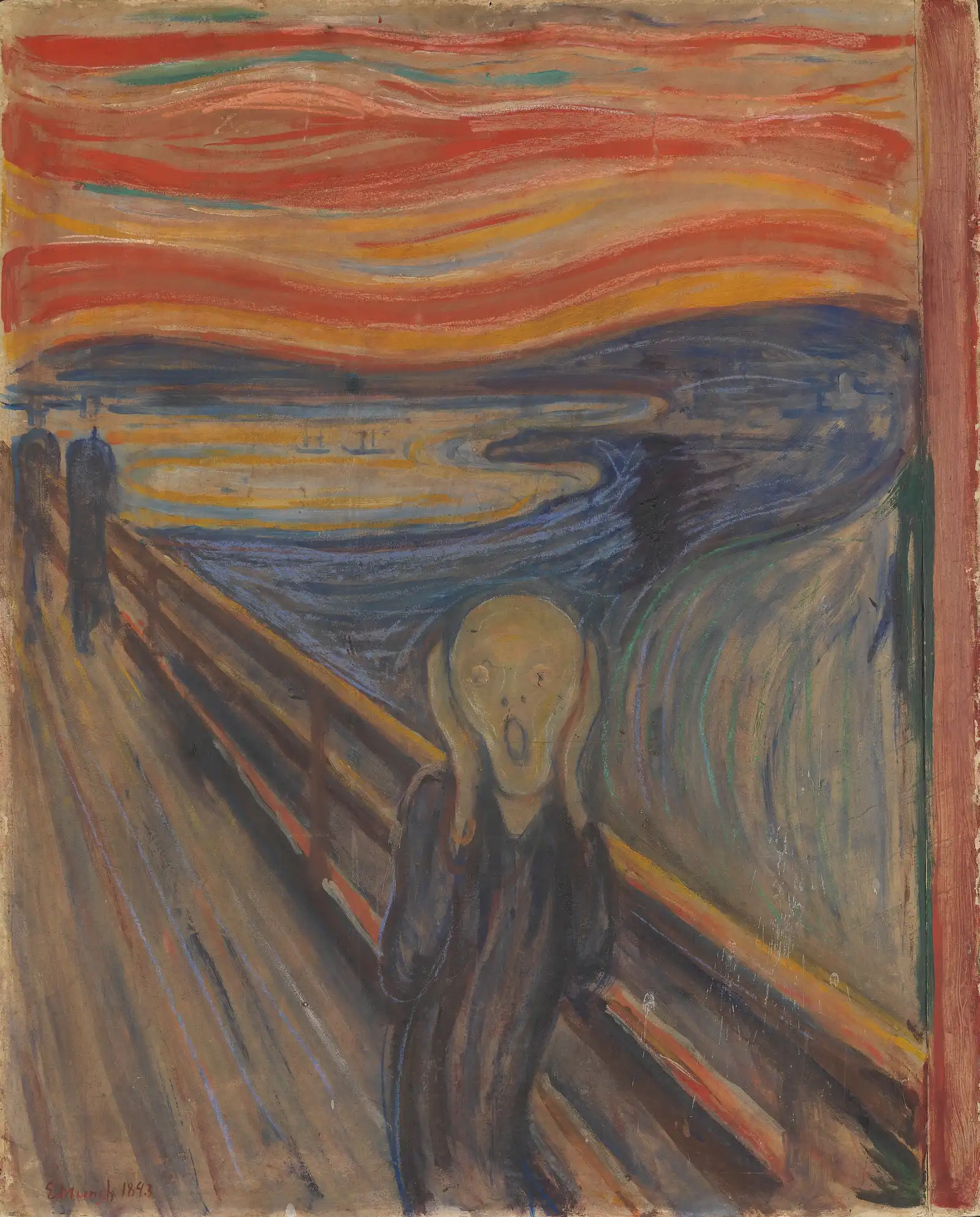
The 1893 version is not an oil painting. The National Museum of Norway records it as tempera and crayon on unprimed cardboard, 91 × 73.5 cm. Every oil-on-canvas version sold online is an interpretation, and honest studios say so. Expect $299.95 to $599.95.
The painting in numbers
| The original | What it means for a copy | |
|---|---|---|
| Year | 1893 | Public domain; Munch died on 23 January 1944. |
| Where it is | National Museum of Norway, Oslo, inv. NG.M.00939 | One of four versions. The 1895 pastel sold at Sotheby's in 2012 for $119.9 million. |
| Medium | Tempera and crayon on cardboard (museum record: 'tempera og fettstift på papplate') | Not oil, and not canvas. A hand-painted oil version is a translation of both. |
| Original size | 91 × 73.5 cm (35.8 × 28.9 in) | Smaller than a 30 × 40 in stock canvas. |
| Aspect ratio | 1.24 : 1 (portrait) | A 24 × 30 in stock canvas is 1.25:1 — an almost exact match. |
| Common reproduction sizes | 16 × 20, 20 × 24, 24 × 30, 30 × 40 in | 24 × 30 in reaches 84% of the original; 30 × 40 in exceeds it. |
Dimensions, inventory number and medium from the National Museum of Norway collection record and the painting's Wikidata entry (Q18891156), read 2026-09-05.
Why it is hard to reproduce
Start with the support. Munch worked on a sheet of unprimed cardboard and left large areas of it bare: the board itself, a warm grey-brown, is doing the work of a mid-tone in the sky, the water and parts of the bridge. Cardboard also absorbs binder unevenly, so the tempera sits dry and matte in some passages and slightly sunken in others. Oil on primed canvas has none of that. It sits on the surface, it is uniform, and it reflects light.
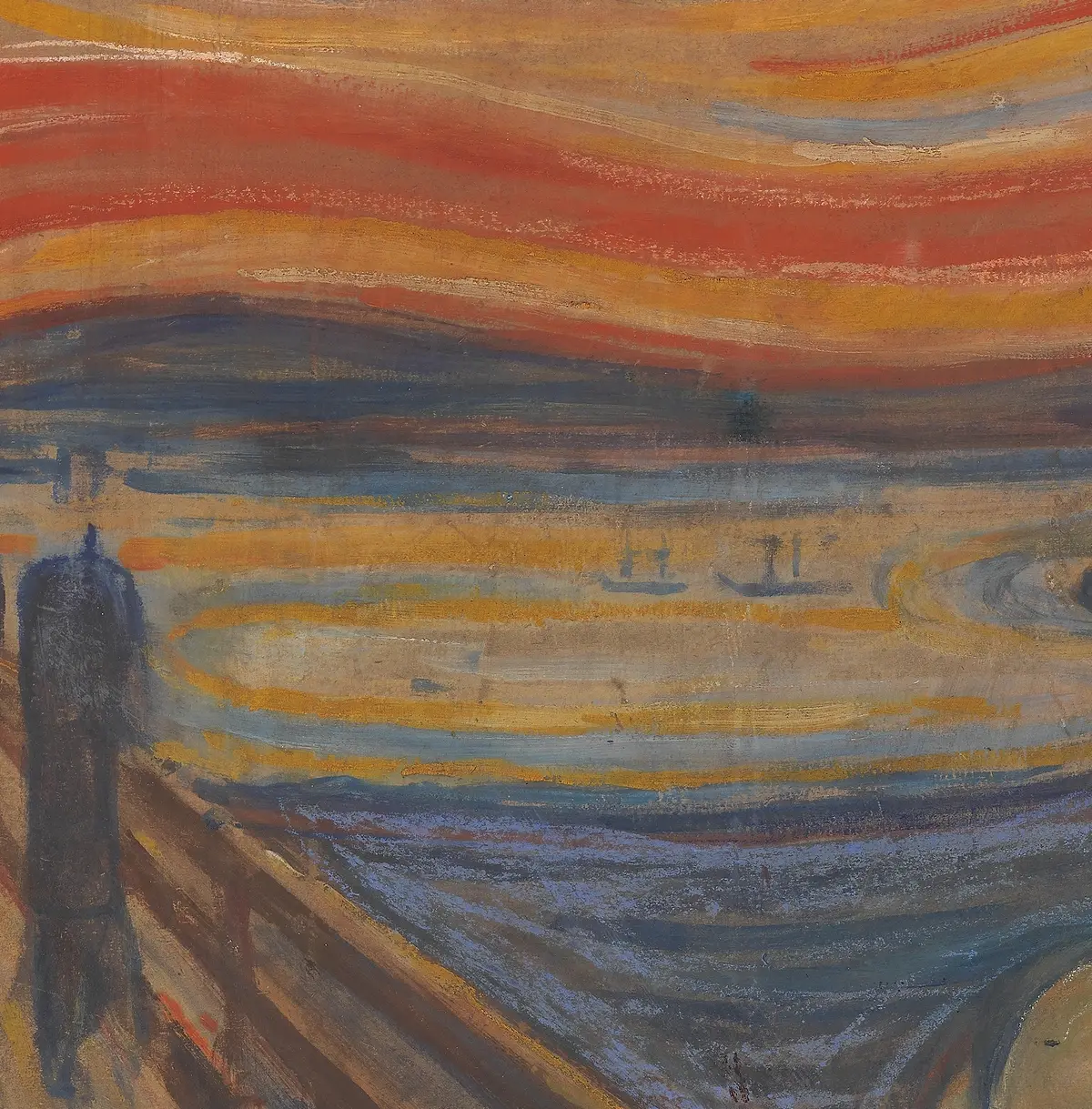
Then the mark. Much of the picture is drawn rather than painted: crayon and thinned tempera pulled across the board in long single strokes that skip where the board is rough. The wavy sky bands are not blended; they are separate ribbons with the ground showing between them. An oil painter reproducing those bands will naturally soften the joins, and the moment they are soft the picture loses its noise.
There is also a small piece of the original no reproduction includes: a pencil inscription in the sky reading 'Kan kun være malet af en gal Mand!' — 'could only have been painted by a madman'. It was first noticed at a Copenhagen exhibition in 1904 and was long assumed to be vandalism; infrared photography and handwriting analysis have since attributed it to Munch himself. It is invisible in nearly all reference images, so no studio paints it.
What cheap copies get wrong
- Glossy varnish. A high-gloss finish is the fastest way to make this picture look wrong. The original is matte and slightly powdery.
- Sky bands blended together. Softening the red ribbons into a sunset turns anxiety into decoration.
- A white sky between the bands. Those gaps are warm grey-brown board. Painted white, the sky goes cold and the figure separates from it.
- Wrong version. Studios often work from the 1910 tempera in the Munch Museum or the 1895 pastel; the colours and the bridge differ. Ask which version the reference is.
- Over-drawn face. The head has almost no detail — two dark ovals and a dark mouth. Adding modelling makes it a cartoon.
Sizes and where it hangs well
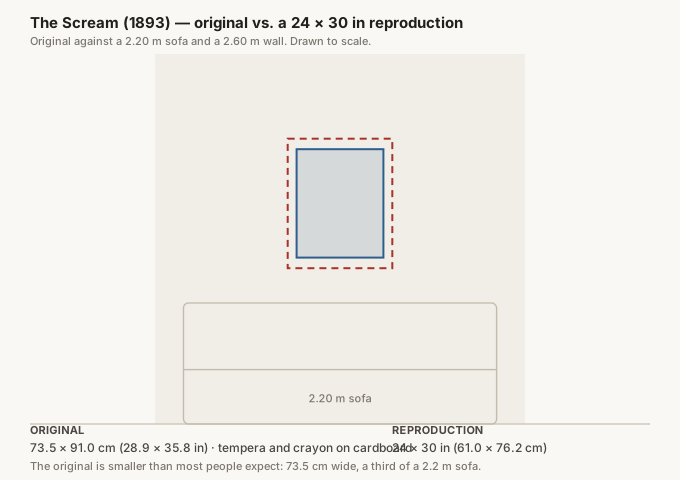
This is a loud picture in a small format, and enlarging it changes its character: at 30 × 40 in the sky bands become wall-sized ribbons and the piece reads as graphic rather than psychological. If you want the effect the painting actually has in Oslo, order 24 × 30 in and hang it at eye level on a narrow wall — a hallway, a stairwell, the space beside a doorway. It does not want to be centred over a sofa.
Colour-wise it is a difficult neighbour: the orange-red sky fights warm walls and reads best against a cool mid-grey or a deep blue-green. Keep other pictures away from it; it does not share a wall.
Price range
| Size (in) | Size (cm) | Price (USD, unframed) | Relative to the original |
|---|---|---|---|
| 16 × 20 | 41 × 51 | $299.95 | 56% of the original height |
| 20 × 24 | 51 × 61 | $359.95 | 67% |
| 24 × 30 | 61 × 76 | $430.95 | 84% — closest proportional match |
| 30 × 40 | 76 × 102 | $529.95 | 112% |
| 36 × 48 | 91 × 122 | $599.95 | 134% |
Art & See prices verified 2026-09-05 from the store's published price ladder, quoted width × height for portrait orientation. Frames are extra and, per the store's refund policy, final sale.
The eight studios were priced on 2026-09-05 against a single reference painting, Van Gogh's The Starry Night, at the nearest size each sells to 20 × 16 in: $149 (overstockArt), $251 (HandmadePiece), $300 (BrushWiz) and $362.95 (1st Art Gallery). Art & See carries The Scream itself as a stock product, The Scream, from $299.95 unframed; its shipping policy gives processing as 2–3 weeks typically, up to 4 weeks for complex work and up to 8 weeks for large or intricate pieces, and it sends a photograph of the finished canvas for approval before dispatch. None of these are cheaper than a good giclée print, which is worth weighing on a picture whose surface is this hard to translate.
Where to buy
Three routes for a painting where the medium never matches.
Stocks The Scream as a standing product from $299.95 unframed, hand-painted in oil, with a preview photo before dispatch — but like every commercial studio it is painting an oil interpretation of a tempera-on-cardboard original, and it costs twice what the cheapest studio charges.
Art & See- overstockArt — Cheapest of the eight studios priced on 2026-09-05, at every size ($149 at 16 × 20 in), which is the sensible choice if you accept the copy is an interpretation either way; expect a stated 6–8 week pre-order wait.
- A museum-licensed print — For this specific painting a high-quality print reproduces the matte, papery surface far more faithfully than oil on canvas does, and costs a fraction of a hand-painted copy.
Copyright
Edvard Munch died on 23 January 1944. Under the 70-years-after-death rule in the European Union, the United Kingdom and Norway, his work entered the public domain on 1 January 2015; in the United States it has been public domain far longer, since the 1893 version was published well before 1929. There is no licence to buy and no royalty to pay.
Two caveats that are not copyright. The National Museum of Norway sets its own terms for the high-resolution image files it publishes, which is a contract matter and does not touch a hand-painted canvas. And 'Munch' as an artist's name is not a trademark you can put on a product — describing a canvas as 'after Edvard Munch' is accurate; describing it as 'a Munch' is not.
Frequently asked questions
Is The Scream an oil painting?
The 1893 version in Oslo is not. The National Museum records it as tempera and crayon on cardboard; some catalogues add oil and pastel to the list. Oil-on-canvas reproductions are interpretations of a mixed-media work on board.
How big is The Scream?
91 × 73.5 cm — a little under a metre tall. A 24 × 30 in reproduction (61 × 76 cm) is 84 percent of it and matches the proportion within one percent.
Which version will a studio paint?
Usually the 1893 painting in Oslo, because it is the most photographed. There are four versions in total — two painted, two in pastel — and their colours differ noticeably. Ask, and ask for the reference image.
Would a print be better?
For this painting, often yes. The matte, absorbent cardboard surface and the bare-board gaps are things print reproduces well and oil paint cannot. A hand-painted copy makes more sense if you want the physical brush texture more than fidelity to the original surface.
Sources
- The Scream (Q18891156): dimensions, medium, inventory number NG.M.00939 — Wikidata. Accessed September 5, 2026.
- Collection record: Skrik (The Scream), NG.M.00939 — Nasjonalmuseet (National Museum of Norway). Accessed September 5, 2026.
- The Scream — versions, inscription and infrared analysis — Wikipedia. Accessed September 5, 2026.
- File:Edvard Munch, 1893, The Scream ... National Gallery of Norway.jpg — Wikimedia Commons. Accessed September 5, 2026.
- Edvard Munch (1863–1944) — biography and dates — Wikipedia. Accessed September 5, 2026.
- Refund policy (frames final sale; preview and refinement before dispatch) — Art & See. Accessed September 5, 2026.
- Shipping policy (production time, preview photograph before dispatch) — Art & See. Accessed September 5, 2026.
Keep reading
painting
Wanderer above the Sea of Fog: a buyer's guide to the reproduction
Friedrich's Wanderer is oil on canvas, 94.8 x 74.8 cm, and one of the few famous paintings whose proportions fit a stock canvas. Sizes, prices, pitfalls.
painting
The Milkmaid reproduction: a 45 cm painting that punishes enlargement
Vermeer's Milkmaid is 45.5 x 41 cm at the Rijksmuseum. Its pointille highlights and empty back wall are what copies fail at. Sizes and prices.
catalog
The 20 most popular oil painting reproductions, and what each one costs to copy well
The 20 paintings ordered most often, cross-checked against five stores' own bestseller lists, with museum, original size, difficulty and price for each.
price
How much do oil painting reproductions cost?
Compare equivalent sizes, finishes, shipping and payment terms with a dated total-cost worksheet. Unknown charges stay visible instead of becoming zero.