painting
The Milkmaid reproduction: a 45 cm painting that punishes enlargement
Vermeer's Milkmaid is 45.5 x 41 cm at the Rijksmuseum. Its pointille highlights and empty back wall are what copies fail at. Sizes and prices.
Oil Painting ReproductionsUpdated
The short answer
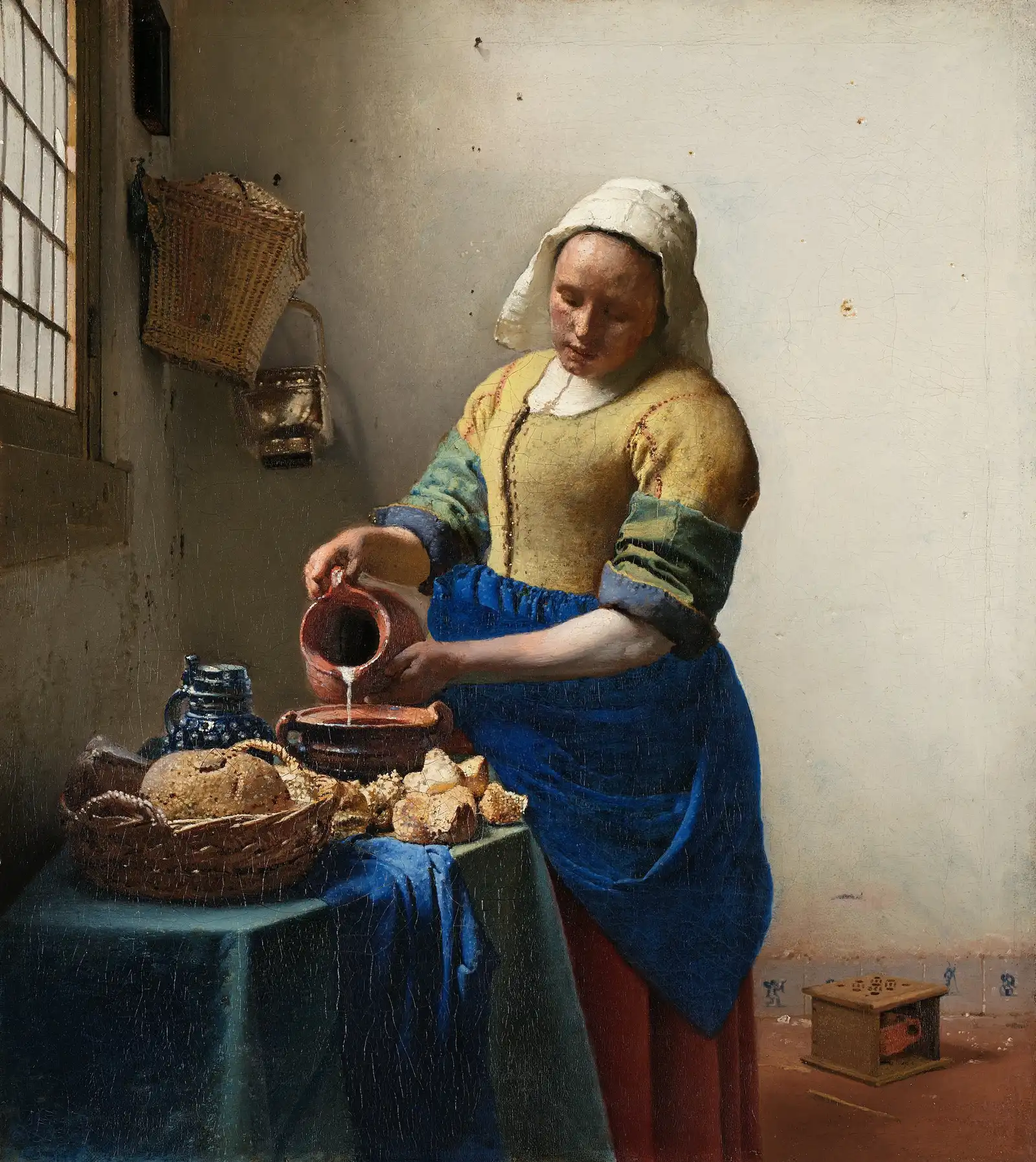
Oil on canvas, 45.5 × 41 cm, at the Rijksmuseum — smaller than a sheet of A2 paper. Almost everything that makes it work is optical and scale-dependent, so enlarging it is the main risk. Expect $249.95 to $549.95 unframed.
The painting in numbers
| The original | What it means for a copy | |
|---|---|---|
| Year | c. 1660 | Public domain; Vermeer died in 1675. |
| Where it is | Rijksmuseum, Amsterdam, inv. SK-A-2344; bought in 1908 with support from the Vereniging Rembrandt | The museum's own record marks the work public domain and publishes a high-resolution file. |
| Medium | Oil on canvas | Medium matches, but the paint is applied thinly and in very small units. |
| Original size | 45.5 × 41 cm (17.9 × 16.1 in) | One of the smallest paintings in this series. |
| Aspect ratio | 1.11 : 1 (portrait) | Almost square, and the catalog lists this product in square sizes only. |
| Sizes offered for this product | 16 × 16, 20 × 20, 24 × 24, 30 × 30, 36 × 36 in | 16 × 16 in (41 × 41 cm) matches the original's width exactly and is 4.5 cm short of its height. |
Dimensions, dating, acquisition and rights status from the Rijksmuseum collection record for SK-A-2344, read 2026-09-05.
Why it is hard to reproduce
Vermeer's signature device here is pointillé: small bright dots of light-coloured paint scattered over the bread, the basket and the rim of the jug. The Rijksmuseum calls this the most effusive use of the technique in any Vermeer, and it does two jobs at once — it suggests scintillating daylight and it suggests rough texture. The dots are roughly a millimetre across on a 45 cm canvas. Enlarge the picture to 24 × 30 in and each dot has to grow to three millimetres, at which point it stops reading as light and starts reading as a spot of paint. That is the whole reproduction problem in one sentence.
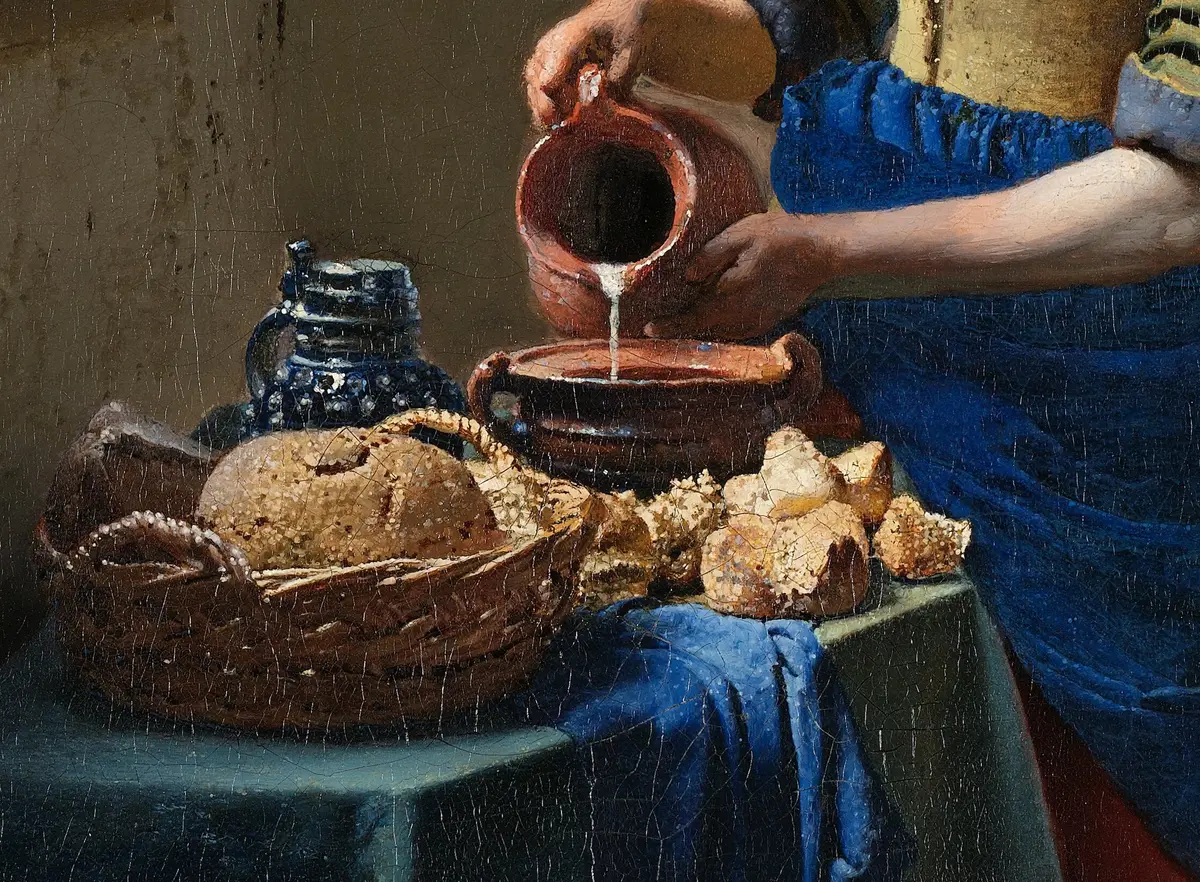
The second difficulty is the empty wall. Close to a quarter of the picture is bare whitewashed plaster with a nail, its shadow, and a few filled holes. There is no subject there, only very small shifts from cool grey at the left to warm cream near the window, and a copyist has nothing to hide behind: any streak, any patch, any uneven scumble is instantly visible. Studios that rush a painting rush the wall first, and it is the first thing to look at in a preview photograph.
There is also less in the picture than Vermeer first put there. X-rays show he painted out a large wall map behind the maid and a basket near the bottom, behind her red skirt; the pentimento still shows as a slight tonal shift on the wall by the foot warmer. Some reproductions, working from over-processed reference files, accidentally sharpen that ghost into a visible rectangle.
What cheap copies get wrong
- Pointillé as polka dots. Enlarged and evenly spaced, the highlights turn the bread into a spotted bun.
- A dirty wall. Streaky, patchy plaster is the most common giveaway. It should be almost featureless and still warm at the right.
- A broken stream of milk. The milk is one continuous, slightly translucent thread. Painted as a solid white ribbon it looks like paint, not liquid.
- Over-modelled face. She has a broad, unglamorous, half-shadowed face with no sharp features. Copies that prettify her destroy the picture's realism.
- Cropping the top. At 1.11:1 the painting is nearly square; forced into a 1.25:1 or 1.33:1 canvas the ceiling and part of the window vanish.
Sizes and where it hangs well
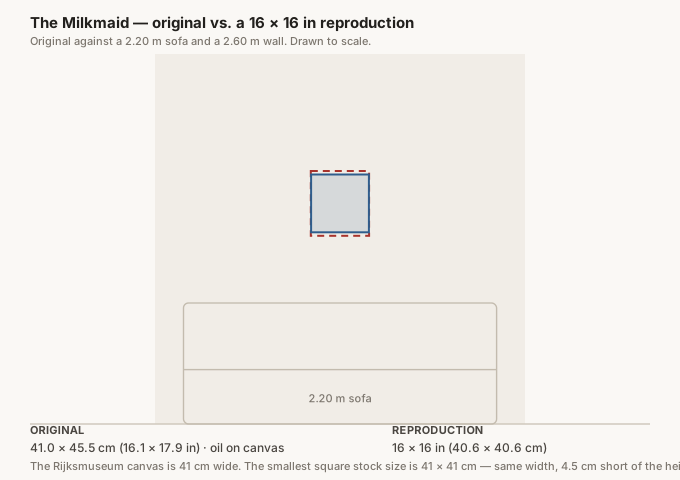
Small pictures need close viewing, so hang this where people stand rather than where they sit: a kitchen or dining wall, a hallway, beside a door, at the top of stairs. At 41 × 41 cm it will look lost on a large open wall and perfect in a group of three or four small pictures, or alone on a narrow pier between windows. Centre it at 1.5 m — slightly lower than usual, because the composition reads downward toward the poured milk.
Light matters more than usual. The original is lit from a window at the left and the illusion collapses if a lamp throws light from the right. If the wall has a directional light source, hang the picture so the painted light and the real light agree. A plain dark wood frame, or a black Dutch-style moulding with a narrow gilt slip, suits it; a wide gold frame swamps a 45 cm picture.
Price range
| Size (in) | Size (cm) | Price (USD, unframed) | Relative to the original |
|---|---|---|---|
| 16 × 16 | 41 × 41 | $249.95 | Exact width; 4.5 cm short of the height |
| 20 × 20 | 51 × 51 | $309.95 | 124% of the original width |
| 24 × 24 | 61 × 61 | $380.95 | 149%, and the pointillé starts to enlarge visibly |
| 30 × 30 | 76 × 76 | $479.95 | 186% — the 1 mm highlights become 2 mm |
| 36 × 36 | 91 × 91 | $549.95 | 222% — not recommended for this painting |
Art & See square-format prices verified 2026-09-05 from the store's published price ladder; the catalog records this product with square orientation, so the rectangular ladder used elsewhere on this site does not apply to it. Frames are extra and, per the store's refund policy, final sale.
The eight studios were priced on 2026-09-05 against a single reference painting, Van Gogh's The Starry Night, at the nearest size each sells to 20 × 16 in: $149 at overstockArt, $251 at HandmadePiece, $300 at BrushWiz and $362.95 at 1st Art Gallery. Those are rectangular canvases; Art & See carries The Milkmaid as a square-format stock product from $249.95 unframed; its shipping policy gives processing as 2–3 weeks typically, up to 4 weeks for complex work and up to 8 weeks for large or intricate pieces, and it sends a photograph of the finished canvas for approval before dispatch. Because the wall and the pointillé decide this painting, that preview is worth more here than on almost anything else in the catalogue.
Where to buy
Three routes. The deciding factor is shape: this listing is sold square, and the painting is not quite square.
Stocks The Milkmaid from $249.95 unframed at 16 × 16 in, hand-painted in oil, with a preview photograph before dispatch; processing is 2–3 weeks typically and longer for large work. The catalog lists it in square sizes only, so the 1.11:1 original loses 4.5 cm of height at every size, and the price is mid-market rather than low.
Art & See- overstockArt — Cheapest of the eight studios priced on 2026-09-05, starting at $99 for 8 × 10 in and $149 at 16 × 20 in, against a stated 6–8 week pre-order wait.
- Reproduction Gallery — Publishes 48 sizes per painting, from 23.2 × 29.5 in upward — larger than this painting, but rectangular, which is the shape Art & See does not offer for this listing at all.
Copyright
Johannes Vermeer died in 1675, so the painting is in the public domain in every jurisdiction and the Rijksmuseum's own collection record states as much. There is no licence to obtain and no royalty to pay for having a copy painted, and none for reselling one later.
The Rijksmuseum goes further than most museums and publishes its high-resolution photograph for free reuse, which means the reference file itself is unrestricted. What remains regulated is description: sell or gift the canvas as a reproduction 'after Vermeer', never as an original or as an unlabelled period painting.
Frequently asked questions
How big is The Milkmaid?
45.5 × 41 cm, according to the Rijksmuseum — a little smaller than a sheet of A2 paper, which is 59.4 × 42 cm. A 16 × 16 in reproduction is 41 × 41 cm: the same width, 4.5 cm shorter.
Why do enlarged copies look wrong?
Because the highlights are pointillé — dots about a millimetre across on a 45 cm canvas. Scale the picture up and the dots scale with it, and at three millimetres they read as spots of paint rather than as light.
What is the first thing to check on a preview photo?
The back wall. It is a quarter of the picture and has almost nothing in it, so any streaking, patchiness or uneven scumbling shows immediately. After that, check the milk is one continuous thread.
Is there a hidden image in the painting?
Two, both painted out by Vermeer himself and found with X-rays: a large wall map behind the maid and a basket near the bottom of the composition. A faint tonal shift on the wall by the foot warmer is all that remains.
Sources
- The Milkmaid, SK-A-2344: dimensions, dating, acquisition, rights status — Rijksmuseum. Accessed September 5, 2026.
- The Milkmaid (Vermeer): pointillé, painted-out map and basket, X-ray findings — Wikipedia. Accessed September 5, 2026.
- The Milkmaid (Q167605): collection, inventory number, dimensions — Wikidata. Accessed September 5, 2026.
- File:Johannes Vermeer - Het melkmeisje - Google Art Project.jpg — Wikimedia Commons. Accessed September 5, 2026.
- Rijksstudio terms — free reuse of collection images — Rijksmuseum. Accessed September 5, 2026.
- Refund policy (frames final sale; preview and refinement before dispatch) — Art & See. Accessed September 5, 2026.
- Shipping policy (production time, preview photograph before dispatch) — Art & See. Accessed September 5, 2026.
Keep reading
artist
Vermeer Reproductions: What a Good Copy Has to Get Right
Glazing, pointillé highlights and why Vermeer is the artist most damaged by enlargement. Original sizes, difficulty, prices and copyright status.
painting
Irises reproduction: the painting that has already changed colour
Van Gogh's Irises is 74.3 x 94.3 cm at the Getty. The flowers were violet before the red faded. What a copy should reproduce, and what it costs.
painting
The Scream reproduction: why an oil copy is an interpretation
The 1893 Scream is tempera and crayon on cardboard, 91 x 73.5 cm. An oil-on-canvas copy changes paint and surface. Sizes, prices and what to check.
catalog
The 20 most popular oil painting reproductions, and what each one costs to copy well
The 20 paintings ordered most often, cross-checked against five stores' own bestseller lists, with museum, original size, difficulty and price for each.
price
How much do oil painting reproductions cost?
Compare equivalent sizes, finishes, shipping and payment terms with a dated total-cost worksheet. Unknown charges stay visible instead of becoming zero.