artist
Vermeer Reproductions: What a Good Copy Has to Get Right
Glazing, pointillé highlights and why Vermeer is the artist most damaged by enlargement. Original sizes, difficulty, prices and copyright status.
Oil Painting ReproductionsUpdated
The short answer
Vermeer is the artist most damaged by enlargement: the originals are around 45 cm tall and the effects are microscopic. Buy small, insist on real glazing rather than opaque paint, and expect $249.95 to $430.95 unframed at the sizes that suit him.
Why Vermeer is reproduced so often
Between 10 February and 4 June 2023 the Rijksmuseum showed 28 of the 37 surviving Vermeers in one building. 650,000 people came in 16 weeks — the best-attended exhibition in the museum's history, beating The Late Rembrandt of 2015, which NL Times reports drew 520,698 visitors. Tickets sold out before it opened.
Scarcity is the whole story. There are around three dozen Vermeers in the world, held in a handful of museums across Europe and the United States; most people who want to live with one have no realistic alternative to a copy. That demand is stable and it is why Girl with a Pearl Earring and The Milkmaid appear in every reproduction catalogue in the trade.
It is also, unhelpfully, the hardest body of work in this guide to copy well. Nothing in a Vermeer is big, obvious or forgiving.
What a faithful copy must get right
Glazing: colour built in transparent layers
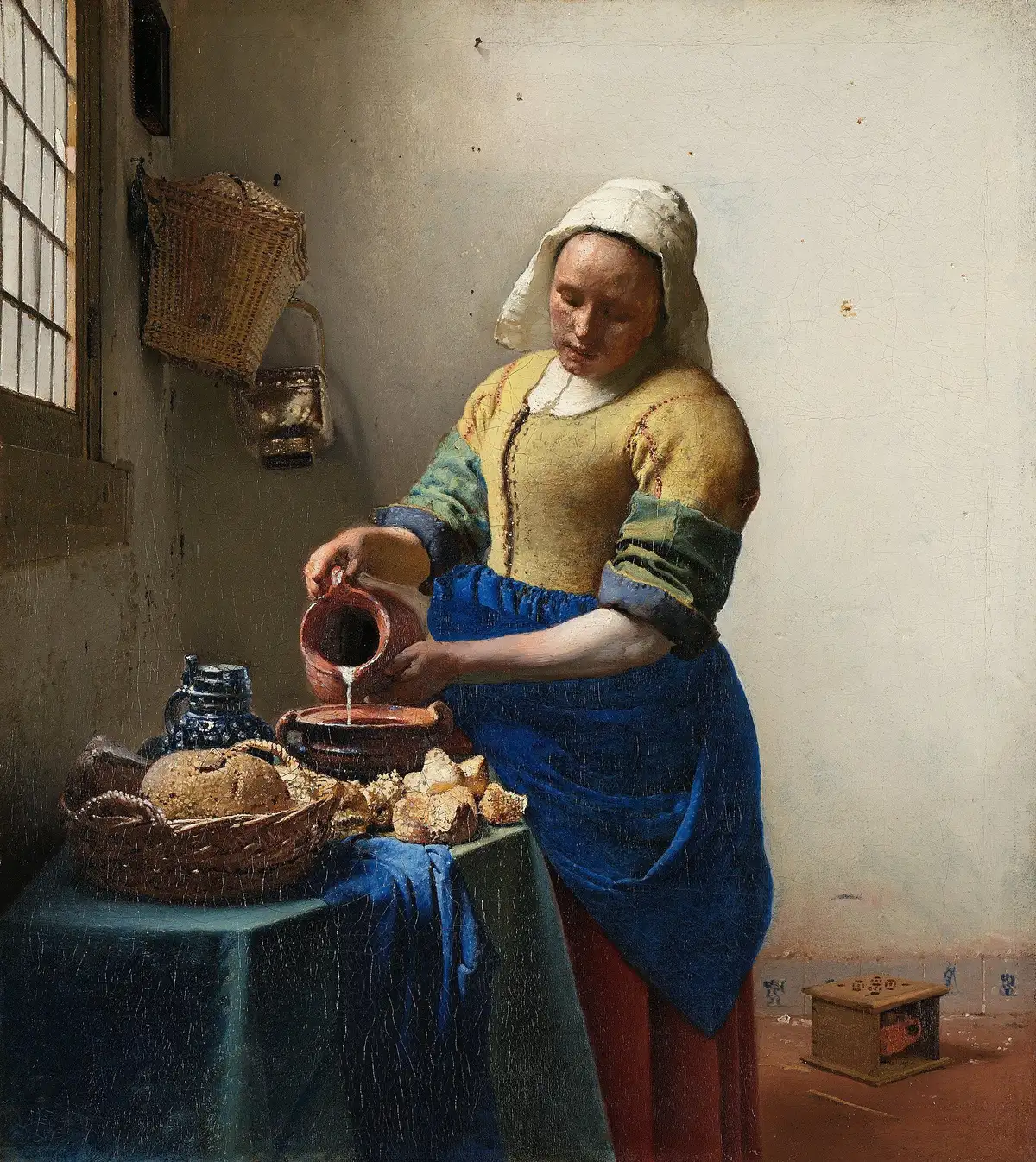
Vermeer laid down a light monochrome underpainting and then built colour over it in thin transparent glazes, letting the light travel through the paint film, bounce off the pale ground and come back. That is why his reds glow and his shadows stay luminous instead of turning to mud. Opaque paint mixed to the same colour and applied in one pass produces the correct hue and none of the light. A studio that finishes a Vermeer in two sittings has not glazed it, because each glaze has to dry before the next goes on.
Pointillé: the small hard highlights
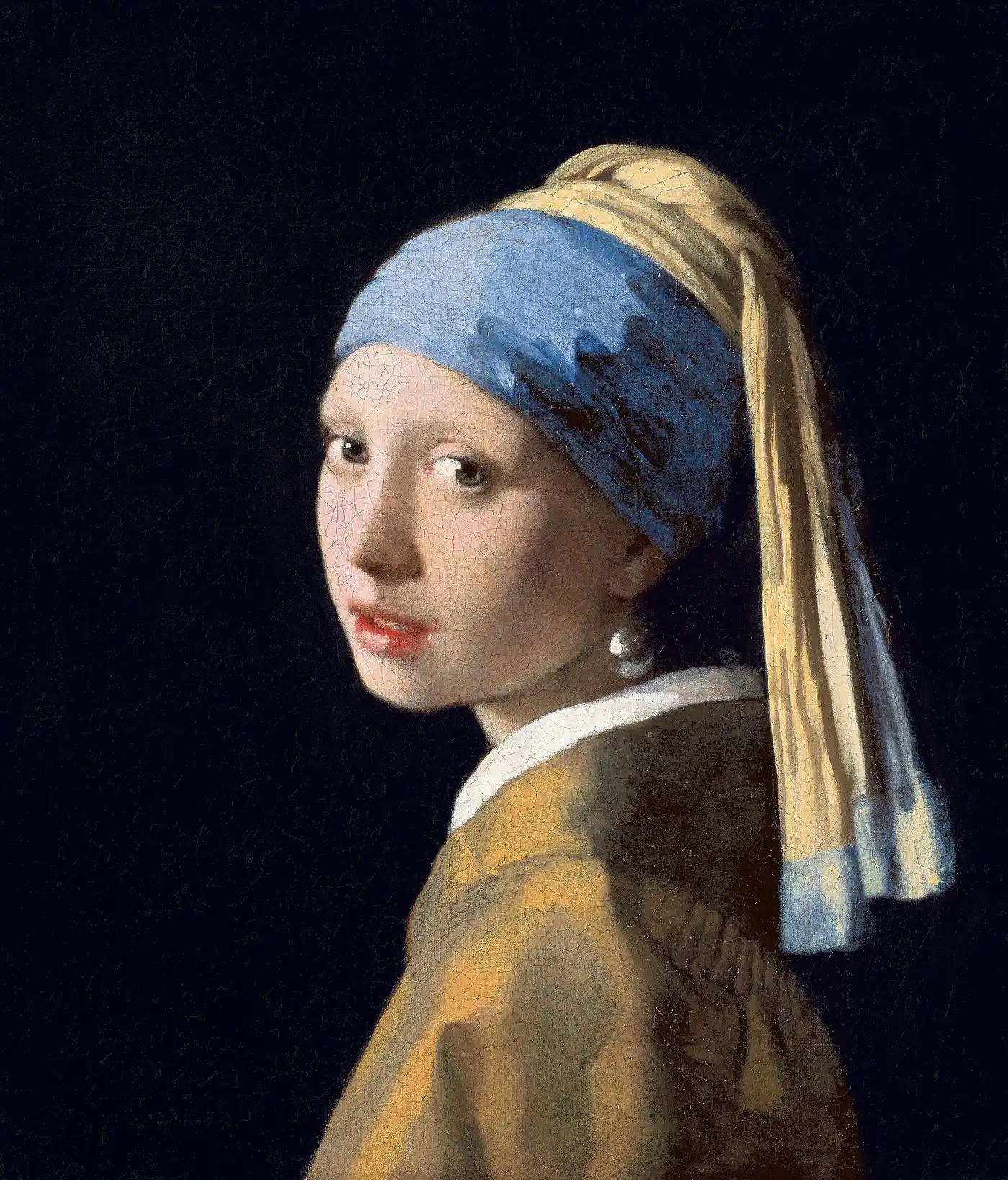
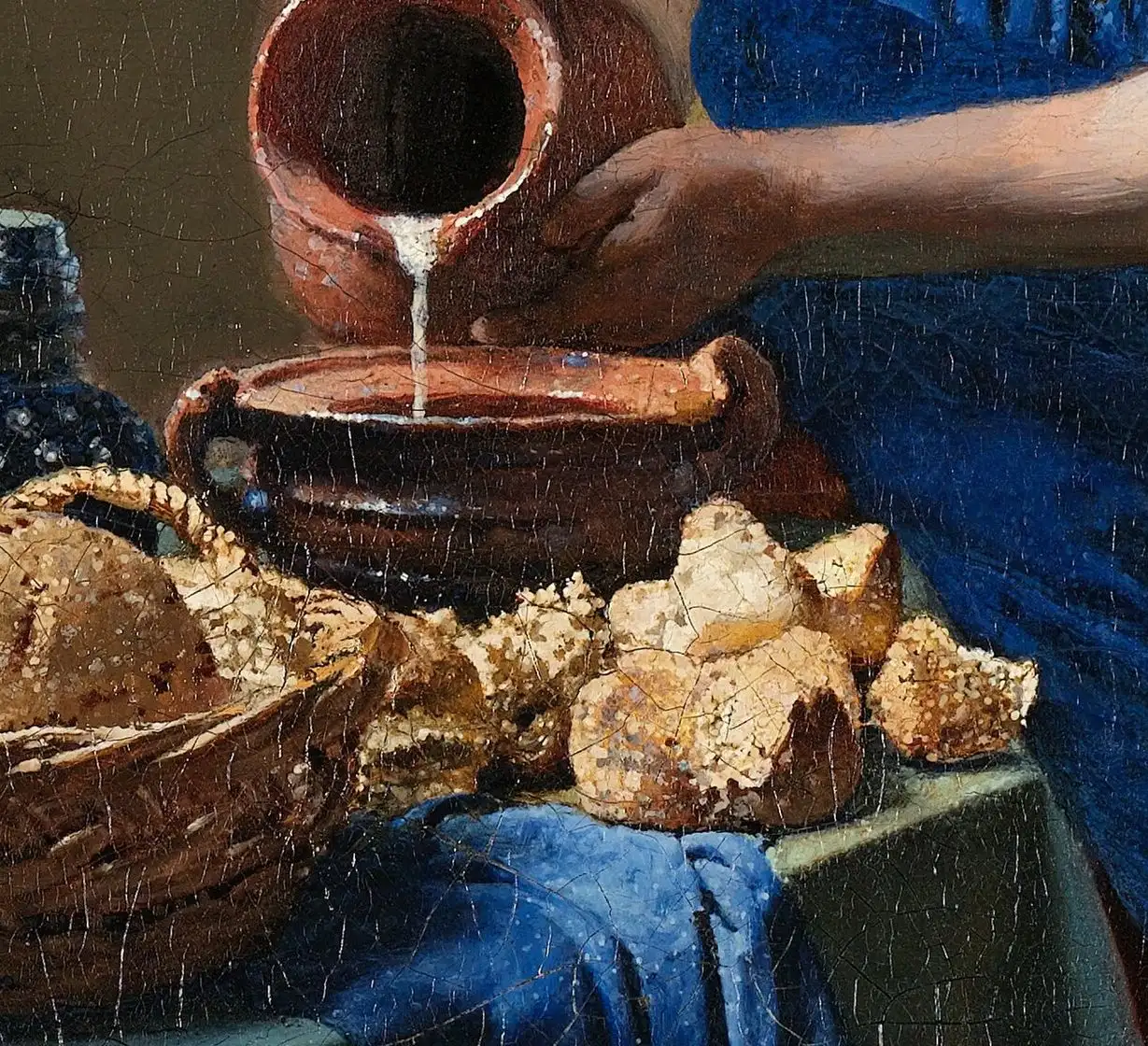
Across the bread in The Milkmaid, the rim of the jug, the lion-head finials and the pearl itself, Vermeer put small thick dots and dashes of light paint that sit above the surface. They are the picture's sparkle and they are only a millimetre or two across in the original. Copyists either omit them, which kills the light, or paint them at the same relative size on a canvas twice as large, at which point they stop being sparkle and become visible white spots.
Edges that are not drawn
Vermeer has almost no linear drawing. Forms are separated by a change of value, and many contours are deliberately out of focus — the front edge of the girl's shoulder, the near arm of a chair. Most copyists cannot resist tightening these, because a sharp edge looks like competence. A Vermeer with all its edges in focus reads as a photograph of a costumed model, and is the commonest failure in the mid-priced trade.
The blue is expensive and it shows
Vermeer used natural ultramarine, ground from lapis lazuli, not only in the visible blues but underneath other colours, which gives his shadows a distinctive cool cast. Modern synthetic ultramarine is a reasonable substitute for the visible blues. Phthalo blue is not: it is greener, far stronger, and it turns the turban in Girl with a Pearl Earring into a colour that painting has never contained.
Most requested works
Difficulty is this site's rating, 1 to 5. Vermeer has no easy pictures; the scale below runs from "hard" to "almost nobody gets it right". Prices are Art & See's published unframed list prices for the nearest standard canvas.
| Work | Year | Museum | Original size | Difficulty | Reproduction price range |
|---|---|---|---|---|---|
| Girl with a Pearl Earring | c. 1665 | Mauritshuis, The Hague | 44.5 × 39 cm | 5 | $249.95 (16 × 16 in) – $430.95 (30 × 24 in) |
| The Milkmaid | c. 1660 | Rijksmuseum, Amsterdam | 45.5 × 41 cm | 5 | $249.95 (16 × 16 in) – $430.95 (30 × 24 in) |
| The Astronomer | 1668 | Musée du Louvre, Paris | 51 × 45 cm | 4 | $249.95 (16 × 16 in) – $430.95 (30 × 24 in) |
| Girl Reading a Letter at an Open Window | c. 1657–59 | Gemäldegalerie, Dresden | 83 × 64.5 cm | 4 | $299.95 (20 × 16 in) – $529.95 (40 × 30 in) |
| View of Delft | c. 1660–61 | Mauritshuis, The Hague | 96.5 × 115.7 cm | 4 | $359.95 (24 × 20 in) – $529.95 (40 × 30 in) |
| The Lacemaker | c. 1669–70 | Musée du Louvre, Paris | 24.5 × 21 cm | 5 | Smallest stock canvas is 65 % larger than the original |
Dimensions from the holding museums, each record opened 2026-09-05: Mauritshuis (Girl with a Pearl Earring, 44.5 × 39 cm), Rijksmuseum (The Milkmaid, 45.5 × 41 cm), Musée du Louvre (The Astronomer, ark cl010064324). Reproduction prices from Art & See's public product pages, same date. Vermeer's typical proportion is about 1.11–1.15; the nearest stock rectangle is 24 × 20 in at 1.20, so a small stretch or a square canvas is unavoidable.
Common mistakes in cheap copies
- Opaque paint instead of glazes. The colours are right and the picture is dull. This is the failure that no photograph will show you.
- Every edge in focus. Contours tightened all round, so the figure looks cut out and pasted onto the background.
- No pointillé, or pointillé at the wrong scale. Either the sparkle is missing or it has grown into spots.
- A drawn pearl. A circle with a highlight, instead of two overlapping marks with no outline.
- Phthalo blue in the turban. Greener and far more intense than ultramarine, and instantly wrong to anyone who has seen the original.
- Bought too large. More Vermeer copies are ruined by size than by any technical failing. At 40 × 30 in you are looking at Girl with a Pearl Earring enlarged 2.3 times.
Sizes that work at home
Vermeer is the one artist in this guide where the advice is unambiguous: buy the smallest size you can live with. The pictures were made to be read from about a metre away by one person at a time, and every effect in them — the soft contour, the pointillé, the glaze — is scaled to that distance. Enlarging a Vermeer does not make it more impressive; it makes the technique visible as technique.
- 16 × 16 in (40.6 × 40.6 cm), $249.95. 91 % of the original Girl with a Pearl Earring. The closest thing to the real object you can order off a price list, and the size this page recommends.
- 20 × 20 in (50.8 × 50.8 cm), $309.95. 114 %. Still honest. Works in a narrow space where you stand close.
- 24 × 20 in (61 × 50.8 cm), $359.95. The nearest rectangle to Vermeer's proportions, and about 137 % of the original height.
- 30 × 24 in (76.2 × 61 cm), $430.95. 171 %. The upper limit before the pointillé stops working. Above this, order a different painter.
The one Vermeer that genuinely wants to be large is View of Delft, which is 96.5 × 115.7 cm to begin with and is a townscape rather than a face. Art & See's Vermeer search results are the place to check what is currently stocked; both Girl with a Pearl Earring and The Milkmaid open at $249.95 for the smallest square.
Light a Vermeer copy softly and from the front. Unlike a Klimt or a Van Gogh, there is no relief to bring out — raking light only exposes the canvas weave.
Where to buy
Three routes for a hand-painted Vermeer, with what each is actually good at. Checked 2026-09-05.
Sells the small square formats that suit Vermeer best, from $249.95, and sends a photograph of the finished painting for approval before shipping — which for a Vermeer is the only chance to check the pearl and the edges.
Art & See- Reproduction Gallery — Lists 40 Vermeer titles from $325 — its own pagination line reads "Now showing 1 to 30 of 40 paintings (Page 1 of 2)", counted 2026-09-05 — catalogue breadth is where it beats Art & See, and it matters when you want one of the less-reproduced interiors, the letter subjects or The Geographer rather than the two everyone sells.
- A Dafen workshop, ordered direct — Cheapest by a wide margin, but Vermeer is the worst possible subject for a fast workshop: glazing takes drying time, and drying time is exactly what the low price removes.
Copyright status
Vermeer died in Delft in 1675. There is no copyright in his paintings anywhere in the world and there has not been for centuries. Copies may be painted, sold, photographed and printed freely.
The Rijksmuseum and the Mauritshuis both publish high-resolution images of their Vermeers for free reuse, which is unusually generous and directly useful: it means a good studio has access to a reference file at the same resolution a conservator uses. If a copyist tells you they worked from the museum's own scan, that is a checkable claim and a good sign.
The remaining legal constraint is the same everywhere: a copy is a copy and must be sold as one. The rules are set out in are oil painting reproductions legal.
Frequently asked questions
What size should a Girl with a Pearl Earring reproduction be?
As close to 44.5 × 39 cm as the price list allows. On a standard ladder that means 16 × 16 in ($249.95) or 20 × 20 in ($309.95). The painting's effects are scaled to a viewing distance of about a metre, and enlarging it past roughly 70 cm tall makes the highlights and soft edges read as mistakes.
Are Vermeer reproductions legal?
Yes, without qualification. He died in 1675 and no copyright of any kind survives. Both the Mauritshuis and the Rijksmuseum also release high-resolution images of their Vermeers for free reuse.
Why do cheap Vermeer copies look dull even when the colours are right?
Because they are painted opaquely in one pass. Vermeer built colour in thin transparent glazes over a pale underpainting, so light passes through the paint and comes back out. Matching the final hue with opaque paint gives you the colour without the light, and no photograph will show you the difference.
Which Vermeer is easiest to have copied well?
View of Delft. It is a townscape rather than a face, it is already large at 96.5 × 115.7 cm so enlargement is not required, and small deviations in a roofline are forgiving in a way that small deviations in a mouth are not.
Sources
- Rijksmuseum's Vermeer exhibition most successful in its history — 650,000 visitors — Rijksmuseum. Accessed September 5, 2026.
- Girl with a Pearl Earring — collection record, 44.5 × 39 cm — Mauritshuis. Accessed September 5, 2026.
- The Milkmaid, Johannes Vermeer, c. 1660 — collection record SK-A-2344, 45.5 × 41 cm — Rijksmuseum. Accessed September 5, 2026.
- Vermeer exhibit comes to an end as Rijksmuseum's best attended show — NL Times. Accessed September 5, 2026.
- L'Astronome (The Astronomer), 1668, RF 1983 28 — collection record, ark cl010064324 — Musée du Louvre. Accessed September 5, 2026.
Keep reading
painting
Girl with a Pearl Earring reproduction: a small painting that punishes enlargement
The original is only 44.5 x 39 cm. Enlarging it forces a copyist to invent detail Vermeer never painted. Sizes, prices, and how to check the pearl.
painting
The Milkmaid reproduction: a 45 cm painting that punishes enlargement
Vermeer's Milkmaid is 45.5 x 41 cm at the Rijksmuseum. Its pointille highlights and empty back wall are what copies fail at. Sizes and prices.
catalog
The 20 most popular oil painting reproductions, and what each one costs to copy well
The 20 paintings ordered most often, cross-checked against five stores' own bestseller lists, with museum, original size, difficulty and price for each.
legal
Are Oil Painting Reproductions Legal?
Yes for public-domain paintings, no for artists still in copyright. Country rules, 21 artists with dates, and the line between a copy and a forgery.
buying
Museum Quality Oil Painting Reproductions: What to Check Before Ordering
A sourced checklist for materials, finished-painting approval, cancellation and returns, with policy exceptions and limits of visual checks.