painting
Girl with a Pearl Earring reproduction: a small painting that punishes enlargement
The original is only 44.5 x 39 cm. Enlarging it forces a copyist to invent detail Vermeer never painted. Sizes, prices, and how to check the pearl.
Oil Painting ReproductionsUpdated
The short answer
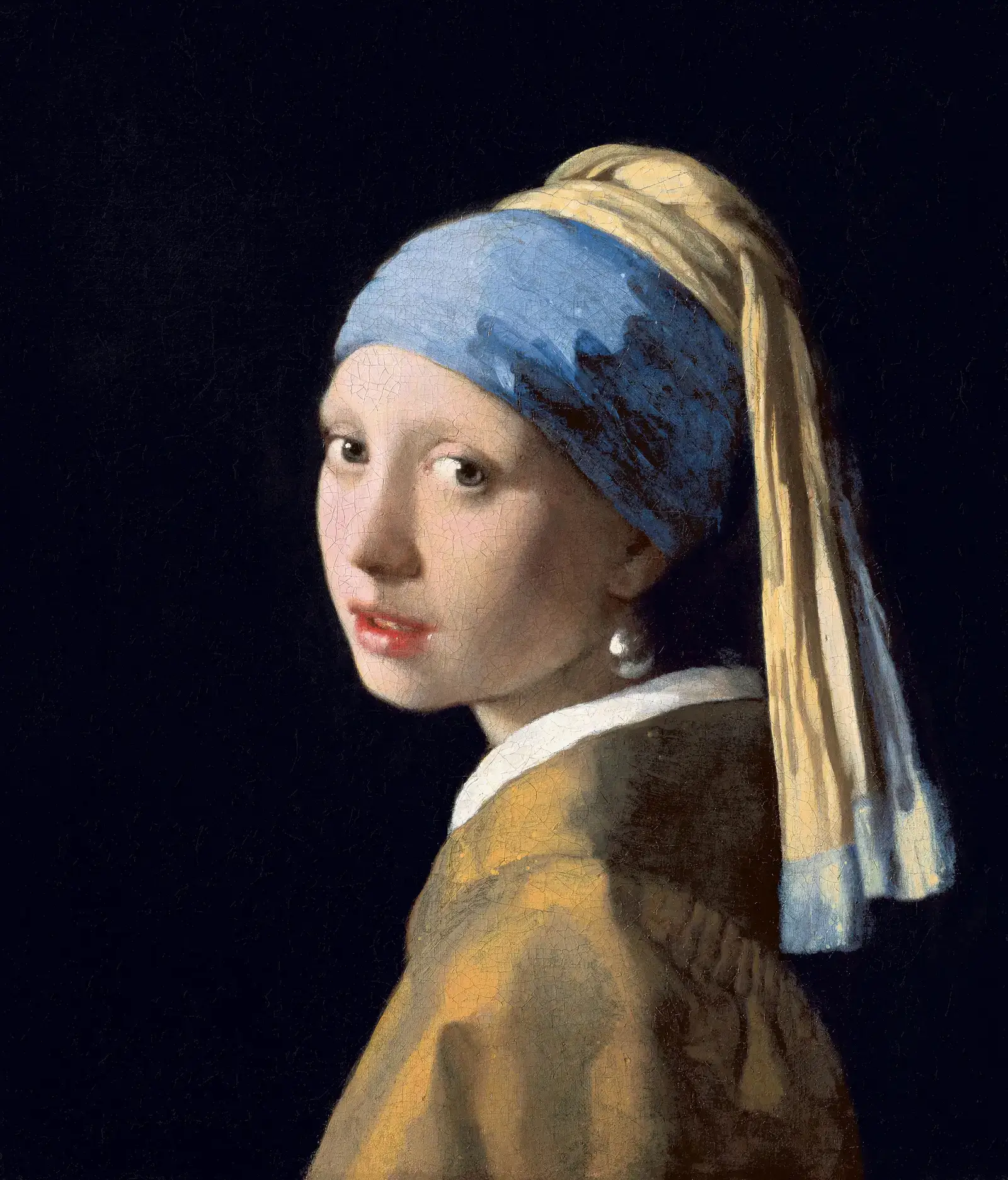
At 44.5 × 39 cm this is one of the smallest famous paintings in circulation, and everything in it is soft-edged. Order it at 16 × 16 in and it works; at 36 in the copyist has to invent detail Vermeer never painted.
The painting in numbers
| The original | What it means for a reproduction | |
|---|---|---|
| Year | About 1665 | Vermeer died in 1675; the image is public domain everywhere. |
| Where it is | Mauritshuis, The Hague, inv. 670 | The museum ran a full technical study, The Girl in the Spotlight, and publishes the findings. |
| Medium | Oil on canvas | Materially copyable, unlike the Mona Lisa's panel. |
| Original size | 44.5 × 39 cm (17.5 × 15.4 in) | Smaller than a sheet of A2 paper. Roughly the size of a 16 × 16 in stock canvas. |
| Aspect ratio | 1.14 : 1, portrait | A 16 × 16 in square crops about 12% off the height; a 20 × 16 in rectangle is 1.25:1 and closer. |
| Common reproduction sizes | 16 × 16 in, 20 × 16 in, 24 × 24 in, 30 × 24 in | The two smallest are within a few centimetres of the original. Anything above 24 in is an enlargement of about 150%. |
Dimensions from the Mauritshuis collection record, checked 2026-09-05.
Why it is hard to reproduce
The picture has almost no drawing in it. There is no contour around the cheek, no line at the edge of the turban, no outline on the pearl. Every boundary is a shift of tone applied wet into wet while the layer underneath was still soft. That technique is slow, it cannot be corrected, and it does not survive being scaled up.
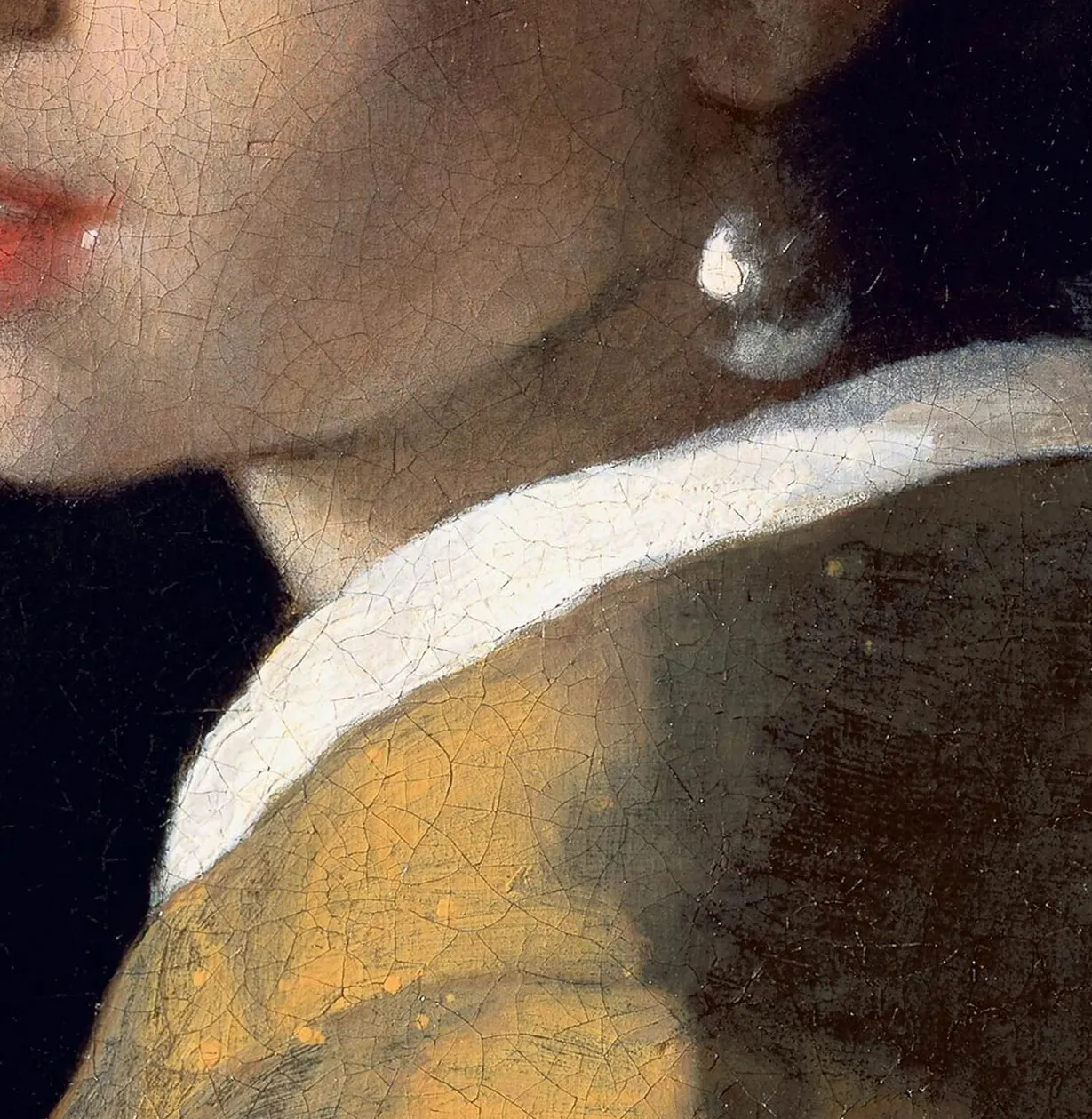
- The pearl is two strokes. A highlight and a reflected glow. Look closely and there is no pearl at all, only the two marks your eye completes. Copyists who paint the object rather than the marks produce a bead.
- The background changed. The Girl in the Spotlight study, published open-access in 2020, found that the flat dark ground was originally a green curtain, lost as the translucent green paint changed chemically. Copying today's black is copying 360 years of chemistry, not Vermeer's decision.
- Natural ultramarine. The turban is lapis-derived blue, which is granular and slightly warm. Modern synthetic ultramarine is cleaner and colder, so a technically accurate copy in modern paint reads a little too blue.
- Scale. At 44.5 cm the face is smaller than your hand. At 30 in it is larger than life, and the copyist must fill the extra area with detail the original does not contain.
What cheap copies get wrong
The single tell is the pearl. In a bad copy it is a grey sphere with a white dot and a dark rim, floating clear of the jaw. In the original it has no rim, no bottom edge, and it merges into the shadow of the neck.
- The pearl painted as an object with an outline and a specular dot.
- Eyelashes. Vermeer painted none; a copy working at 30 in almost always adds them.
- A hard edge along the cheek and the jaw, which turns a soft head into a cut-out.
- The background painted flat black instead of a dark warm brown-green with visible variation.
- Craquelure imitated with a crackle medium, which produces even, regular cracks where the original's are irregular and follow the weave.
Sizes and where it hangs well
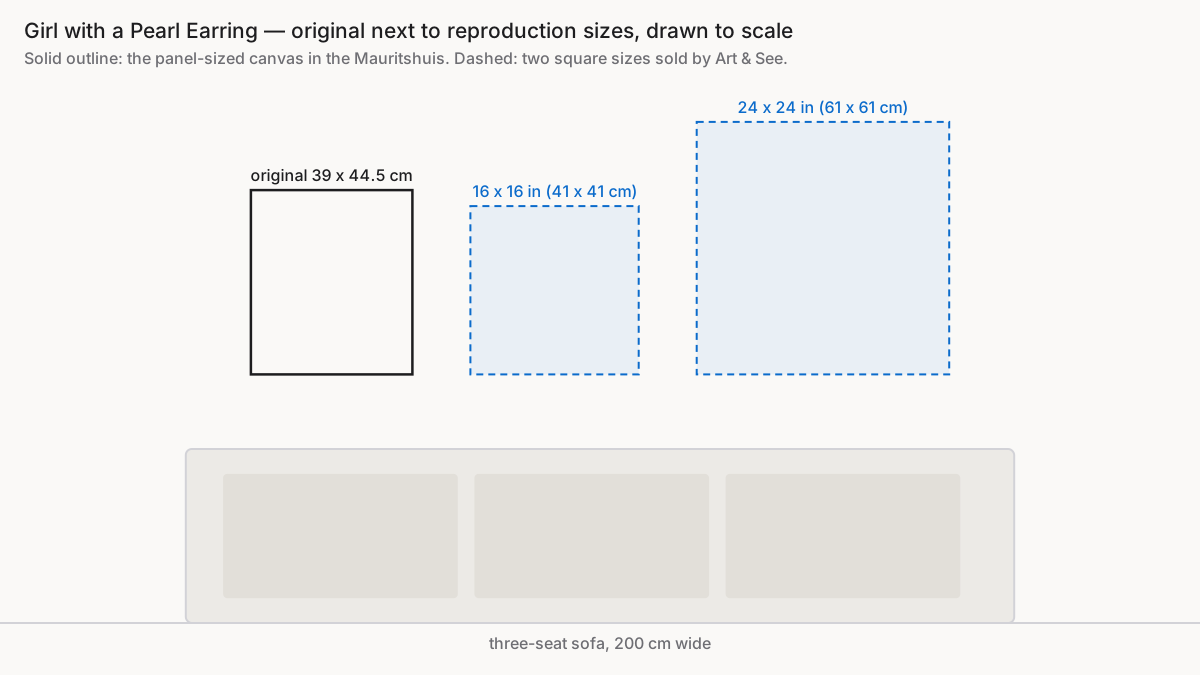
A picture this size does not carry a large wall on its own, and enlarging it to make it carry one is exactly what ruins it. It works beside a door, in a narrow alcove, at the top of a staircase, or as one of three small pictures in a row. Hang it at eye level: the girl is looking over her shoulder at someone standing, and the glance stops working when the canvas is above head height.
Price range
| Size | Art & See list price | Vs the original | Verdict |
|---|---|---|---|
| 16 × 16 in (41 × 41 cm) | $249.95 | About the same size | The size to order. |
| 20 × 16 in (51 × 41 cm) | $299.95 | 15% taller | Closest to the 1.14:1 proportion. |
| 20 × 20 in (51 × 51 cm) | $309.95 | 15% larger each way | Still within copying range. |
| 24 × 24 in (61 × 61 cm) | $380.95 | About 150% of the original | The point where invented detail starts. |
| 30 × 24 in (76 × 61 cm) | $430.95 | About 170% | Only if the wall demands it. |
Art & See prices from its published unframed ladder, verified 2026-09-05. Across the eight stores surveyed the same day, comparable hand-painted canvases ran roughly $150 to $1,100; the price does not track the size of the original, only the size of the canvas ordered.
Art & See lists this painting on its square ladder, starting at $249.95 for 16 × 16 in, which is within a couple of centimetres of the canvas in The Hague. That is an unusual case: for most famous paintings the cheapest listed size is far smaller than the original, and here it is not.
Where to buy
Three routes for a small, soft-edged painting.
Its smallest square size is close to the original's dimensions, the price is published rather than quoted, and the finished canvas is photographed for approval before dispatch.
Art & See- overstockArt — Consistently the cheapest of the stores surveyed, with canvases from $99 at 8 × 10 in, which is a sensible way to buy a picture whose original is this small.
- Mauritshuis online collection — Publishes a very high-resolution image and the technical study behind it, which is the reference to send a studio and the cheapest route if a print will do.
Copyright: what you can and cannot do
Johannes Vermeer died in 1675. The painting is public domain everywhere, and the Mauritshuis publishes its own high-resolution photograph for free reuse. You may commission, own, resell and photograph a hand-painted copy without any permission. Selling it as a Vermeer, or with his monogram, is fraud rather than infringement, and is prosecuted as such.
Frequently asked questions
What size is closest to the original?
16 × 16 in (41 × 41 cm) is within a few centimetres of the 44.5 × 39 cm canvas, and 20 × 16 in matches the proportion more exactly at 1.25:1 against the original's 1.14:1. Both are the smallest sizes most studios sell.
Why does the copy look sharper than the original?
Because the copyist worked from a zoomable file rather than from a canvas at arm's length, and because sharp edges are quicker to paint than soft ones. Vermeer's picture has no hard edge anywhere except the collar.
Should the reproduction include the cracks?
No. The craquelure is age damage, not part of the painting, and imitating it with crackle medium produces a regular grid that looks nothing like the real network. A studio offering 'antique finish' is selling a defect.
Sources
- Girl with a Pearl Earring, collection record — Mauritshuis, The Hague. Accessed September 5, 2026.
- The Girl in the Spotlight: Vermeer at work, his materials and techniques in Girl with a Pearl Earring — Heritage Science (open access). Accessed September 5, 2026.
- Best-selling art reproductions and price ladder — overstockArt. Accessed September 5, 2026.
- Top 100 most famous paintings, ranked listing — HandmadePiece. Accessed September 5, 2026.
- How long does copyright protection last? — United States Copyright Office. Accessed September 5, 2026.
- File:Meisje met de parel.jpg — Wikimedia Commons. Accessed September 5, 2026.
Keep reading
artist
Vermeer Reproductions: What a Good Copy Has to Get Right
Glazing, pointillé highlights and why Vermeer is the artist most damaged by enlargement. Original sizes, difficulty, prices and copyright status.
catalog
The 20 most popular oil painting reproductions, and what each one costs to copy well
The 20 paintings ordered most often, cross-checked against five stores' own bestseller lists, with museum, original size, difficulty and price for each.
price
How much do oil painting reproductions cost?
Compare equivalent sizes, finishes, shipping and payment terms with a dated total-cost worksheet. Unknown charges stay visible instead of becoming zero.
painting
The Milkmaid reproduction: a 45 cm painting that punishes enlargement
Vermeer's Milkmaid is 45.5 x 41 cm at the Rijksmuseum. Its pointille highlights and empty back wall are what copies fail at. Sizes and prices.