painting
Irises reproduction: the painting that has already changed colour
Van Gogh's Irises is 74.3 x 94.3 cm at the Getty. The flowers were violet before the red faded. What a copy should reproduce, and what it costs.
Oil Painting ReproductionsUpdated
The short answer
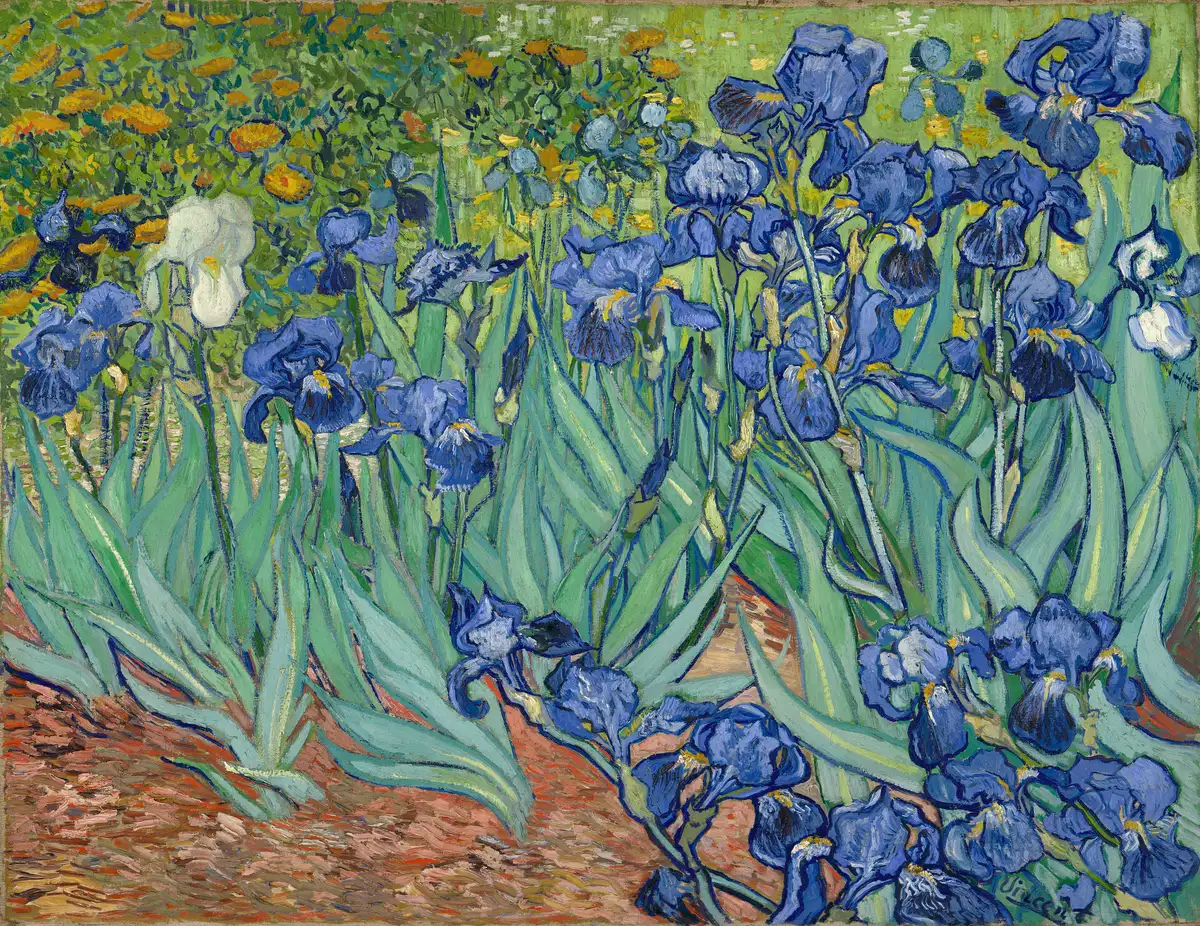
Oil on canvas, 74.3 × 94.3 cm, at the Getty. The flowers you see are blue because a red pigment faded; Van Gogh painted them violet. Decide which version you want before ordering. Expect $299.95 to $599.95 unframed.
The painting in numbers
| The original | What it means for a copy | |
|---|---|---|
| Year | May 1889, in his first weeks at the asylum in Saint-Rémy-de-Provence | Public domain; Van Gogh died in 1890. |
| Where it is | J. Paul Getty Museum, Los Angeles, inv. 90.PA.20, acquired 1990 | The Getty publishes its own conservation research on the painting, which is unusually useful here. |
| Medium | Oil on canvas | Medium matches — the difficulty is the thickness, not the material. |
| Original size | 74.3 × 94.3 cm (29.3 × 37.1 in) | Under a metre wide. A 40 × 30 in canvas slightly exceeds it. |
| Aspect ratio | 1.27 : 1 (landscape) | Between the 1.25:1 and 1.33:1 stock shapes; either crops only a few centimetres. |
| Common reproduction sizes | 20 × 16, 24 × 20, 30 × 24, 40 × 30 in | 40 × 30 in (102 × 76 cm) is the nearest size above the original. |
Dimensions, date, accession number and acquisition year from the J. Paul Getty Museum collection record, read 2026-09-05.
Why it is hard to reproduce
There are two hard things here and one of them is invisible. Start with the visible one: the paint is thick. Van Gogh loaded the brush and left every stroke standing, so the leaves are ridges of paint two or three millimetres proud of the canvas, each one laid in a single pass with a loaded flat brush and never touched again. A copyist who works the way most copyists work — thin underpainting, then modelling, then highlights — cannot get there. Impasto has to be right first time, because a second stroke into wet paint muddies both.
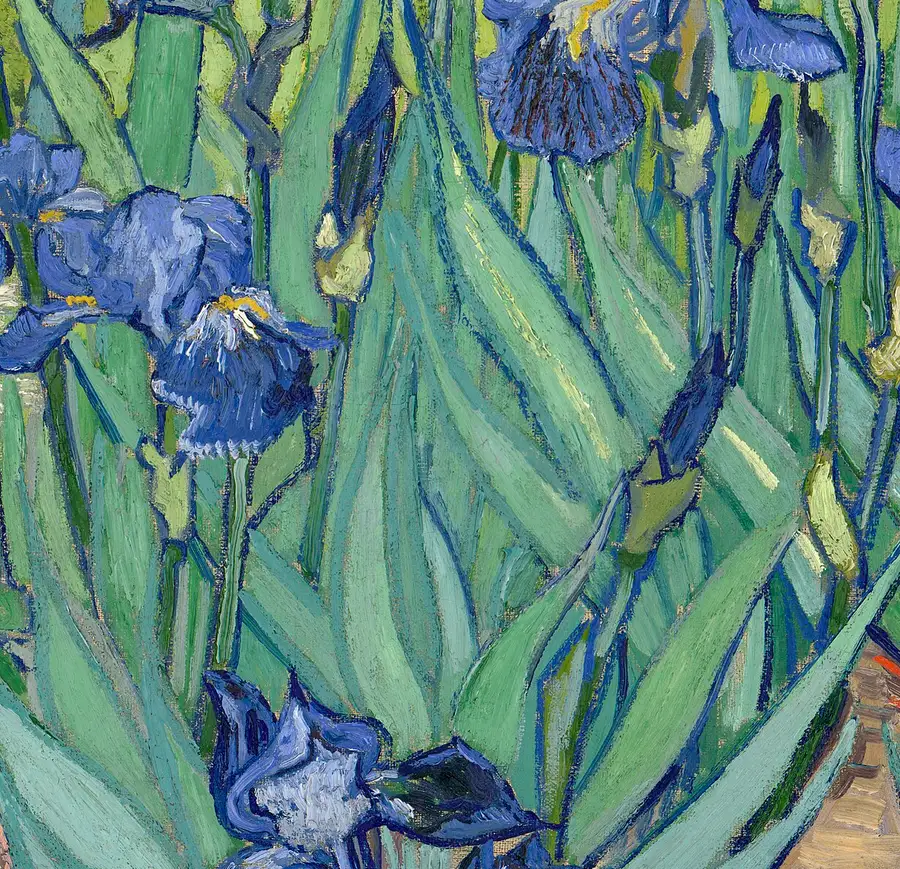
The invisible problem is colour. Getty conservators analysing the paint layers found a faded violet beneath the blue surface: Van Gogh mixed geranium lake, a fugitive red, with blue, and the red has largely gone. Associate paintings conservator Devi Ormond described going deeper into the paint and finding the violet still there. The analysis also identified cobalt blue and ultramarine, and areas that now read as muddy brown were originally brilliant orange. In other words, the picture on your screen is not the picture Van Gogh finished — the flowers were purple against a stronger orange ground, and the complementary contrast that drove the composition has decayed.
Which one should a studio paint? Almost all of them copy the faded surface, because that is what the reference photograph shows, and for most buyers that is the right answer: it is the painting people recognise. But it is a choice, and a studio that has never thought about it will not tell you it made one.
What cheap copies get wrong
- Flat paint. Printed-looking irises with no relief. Run your hand across a good copy and the leaves should be tangible.
- Too many strokes. Each leaf is one gesture. Copies built from short repeated dabs turn the bed into moss.
- Lost outlines. Van Gogh drew a dark blue-black contour beside most leaves. Blending it away removes the drawing that holds the mass together.
- A grey ground. The earth is warm red-orange. Cheap versions grey it down, and the blue immediately goes dull because the complementary is gone.
- The wrong Irises. Van Gogh painted several iris pictures, including a still life of irises in a vase now in the Metropolitan Museum. Confirm the Getty version — a garden bed, seen from above, with one white bloom.
Sizes and where it hangs well
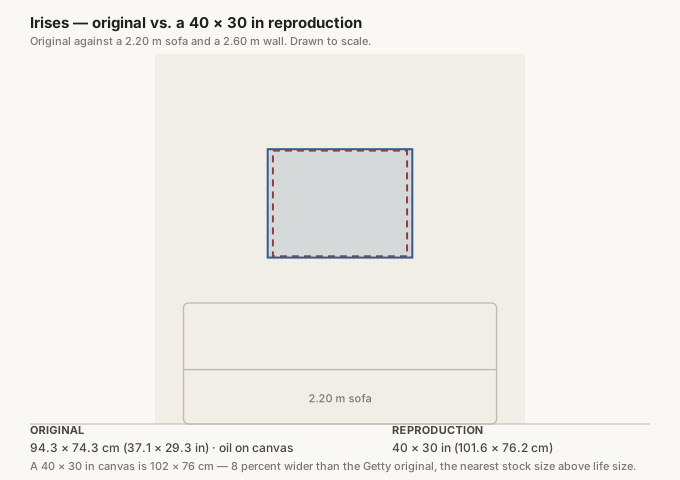
This is an all-over composition with no focal point and no horizon, which makes it forgiving: it works above a sofa, above a bed, in a stairwell, on a landing. Because the interest is in the surface rather than the subject, size matters less here than on most paintings — a 24 × 20 in canvas still reads correctly, which is not true of a portrait or an architectural picture.
What it does need is light from the side. Impasto is lit, not seen; a picture lamp or a window to one side turns the ridges into a second image at dusk. Hung flat under a downlight, the most expensive thing about the copy disappears. Keep it off strongly coloured walls — the orange ground fights terracotta and pink, and reads best against white, bone or a cool grey.
Price range
| Size (in) | Size (cm) | Price (USD, unframed) | Relative to the original |
|---|---|---|---|
| 20 × 16 | 51 × 41 | $299.95 | 54% of the original width |
| 24 × 20 | 61 × 51 | $359.95 | 65% |
| 30 × 24 | 76 × 61 | $430.95 | 81% |
| 40 × 30 | 102 × 76 | $529.95 | 108% — the nearest size above life size |
| 48 × 36 | 122 × 91 | $599.95 | 129% |
Art & See prices verified 2026-09-05 from the store's published price ladder. Frames are extra and, per the store's refund policy, final sale.
The eight studios were priced on 2026-09-05 against a single reference painting, Van Gogh's The Starry Night, at the nearest size each sells to 30 × 24 in: $239 at overstockArt, $299 at Reproduction Gallery, $354 at BrushWiz, $376 at HandmadePiece and $481.95 at 1st Art Gallery. TOPofART listed $1,116.87 for its single size, but on that date its add-to-cart opened a notice saying the studio was temporarily suspending new orders for oil painting reproductions, so it is not a live option. Art & See lists Irises as a stock product from $299.95 unframed; its shipping policy gives processing as 2–3 weeks typically, up to 4 weeks for complex work and up to 8 weeks for large or intricate pieces, and it sends a photograph of the finished canvas for approval before dispatch. On this painting the premium buys thickness: ask any studio how much paint goes on, because a thin Irises is a failed Irises at any price.
Where to buy
Three routes, and on this painting the decision is really about impasto.
Carries Irises as a standing product from $299.95 unframed, hand-painted in oil, with a preview photograph before dispatch — which on an impasto painting is the check that matters, since you can see the relief in raking light before it ships; it is roughly double the cheapest studio checked.
Art & See- overstockArt — Cheapest of the eight studios priced on 2026-09-05, at every size ($239 at 24 × 36 in), against a stated 6–8 week pre-order wait — the honest choice if budget is the binding constraint.
- Reproduction Gallery — Publishes 48 sizes for a single painting, from 23.2 × 29.5 in to 94.5 × 120.1 in — a range that brackets the Getty original's 29.3 × 37.1 in, so a canvas at close to actual size can be picked from the list instead of quoted. (TOPofART also sells at original dimensions, but on 2026-09-05 its checkout carried a notice suspending new oil-reproduction orders.)
Copyright
Vincent van Gogh died on 29 July 1890. Copyright in his work expired long ago — 70 years after death in the European Union and the United Kingdom, and pre-1929 publication in the United States — so painting, buying, selling and reselling a copy of Irises is entirely lawful and no licence or royalty is owed to the Getty.
The Getty makes its own high-resolution image of the painting available for unrestricted use under its Open Content Program, which is more generous than most museums and means the reference photograph itself carries no strings. The rules that still apply are about description, not reproduction: a canvas may be sold as 'after Van Gogh' or 'reproduction', never as an original. See are oil painting reproductions legal for the general position.
Frequently asked questions
How big is Van Gogh's Irises?
74.3 × 94.3 cm, or 29.3 × 37.1 inches, according to the Getty's collection record. A 40 × 30 in reproduction is 102 × 76 cm, about eight percent larger than the original.
Were the irises always blue?
No. Getty conservators found a faded violet under the blue surface: Van Gogh mixed a fugitive red, geranium lake, with blue, and the red has largely gone. Areas that now read as muddy brown were once brilliant orange.
Should a reproduction restore the original violet?
Almost no studio does, and for most buyers that is right — the faded version is the one people recognise. If you want the 1889 colour you must ask for it explicitly and supply a reference; expect the studio to treat it as a custom commission.
How thick should the paint be?
Visibly thick. On the leaves the original strokes stand two to three millimetres off the canvas. Ask for a preview photograph shot in raking side light, which is the only way to judge relief from a picture.
Sources
- Irises, 1889, accession 90.PA.20: dimensions, date, provenance — J. Paul Getty Museum. Accessed September 5, 2026.
- Irises (painting): pigment analysis, faded geranium lake, Saint-Rémy context — Wikipedia. Accessed September 5, 2026.
- Getty Open Content Program terms — J. Paul Getty Trust. Accessed September 5, 2026.
- File:Vincent van Gogh - Irises (1889).jpg — Wikimedia Commons. Accessed September 5, 2026.
- Irises (Q2282256): collection, inventory number, dating — Wikidata. Accessed September 5, 2026.
- Refund policy (frames final sale; preview and refinement before dispatch) — Art & See. Accessed September 5, 2026.
- Shipping policy (production time, preview photograph before dispatch) — Art & See. Accessed September 5, 2026.
Keep reading
artist
Van Gogh Reproductions: What a Good Copy Has to Get Right
Which Van Gogh paintings are worth reproducing in oil, what separates a real copy from a cheap one, sizes that work, prices and copyright status.
painting
Poppy Field reproduction: Monet's smallest famous painting
Monet's Les Coquelicots is only 50 x 65 cm and hung at the first Impressionist show. What an oil copy gets right, what it gets wrong, and prices.
painting
The Milkmaid reproduction: a 45 cm painting that punishes enlargement
Vermeer's Milkmaid is 45.5 x 41 cm at the Rijksmuseum. Its pointille highlights and empty back wall are what copies fail at. Sizes and prices.
catalog
The 20 most popular oil painting reproductions, and what each one costs to copy well
The 20 paintings ordered most often, cross-checked against five stores' own bestseller lists, with museum, original size, difficulty and price for each.
price
How much do oil painting reproductions cost?
Compare equivalent sizes, finishes, shipping and payment terms with a dated total-cost worksheet. Unknown charges stay visible instead of becoming zero.