artist
Van Gogh Reproductions: What a Good Copy Has to Get Right
Which Van Gogh paintings are worth reproducing in oil, what separates a real copy from a cheap one, sizes that work, prices and copyright status.
Oil Painting ReproductionsUpdated
The short answer
Van Gogh is the most reproduced painter in oil because his surface is thick enough to copy convincingly and his works are public domain. A faithful copy needs real impasto and the right stroke direction; expect $249.95 to $599.95 unframed at common wall sizes.
Why Van Gogh is reproduced so often
The Van Gogh Museum in Amsterdam received 1,860,000 visitors in 2025, and it holds the largest collection of his work anywhere, by an artist who sold almost nothing in his lifetime. That gap — between how many people want to live with a Van Gogh and how few Van Goghs exist — is the whole market for reproductions.
Three practical reasons put him ahead of every other painter in the hand-painted reproduction trade. First, copyright: he died on 29 July 1890, so nothing needs a licence anywhere in the world. Second, format: most of his best-known canvases sit between 70 and 95 cm on the long side, which is close enough to a standard reproduction canvas that the scaling is modest. Third, and least obvious, his paint is thick. Impasto gives a copyist something physical to imitate, and it gives a buyer something to check. A flat Van Gogh is wrong in a way anyone can see from across a room; a flat Vermeer is not.
What a faithful copy must get right
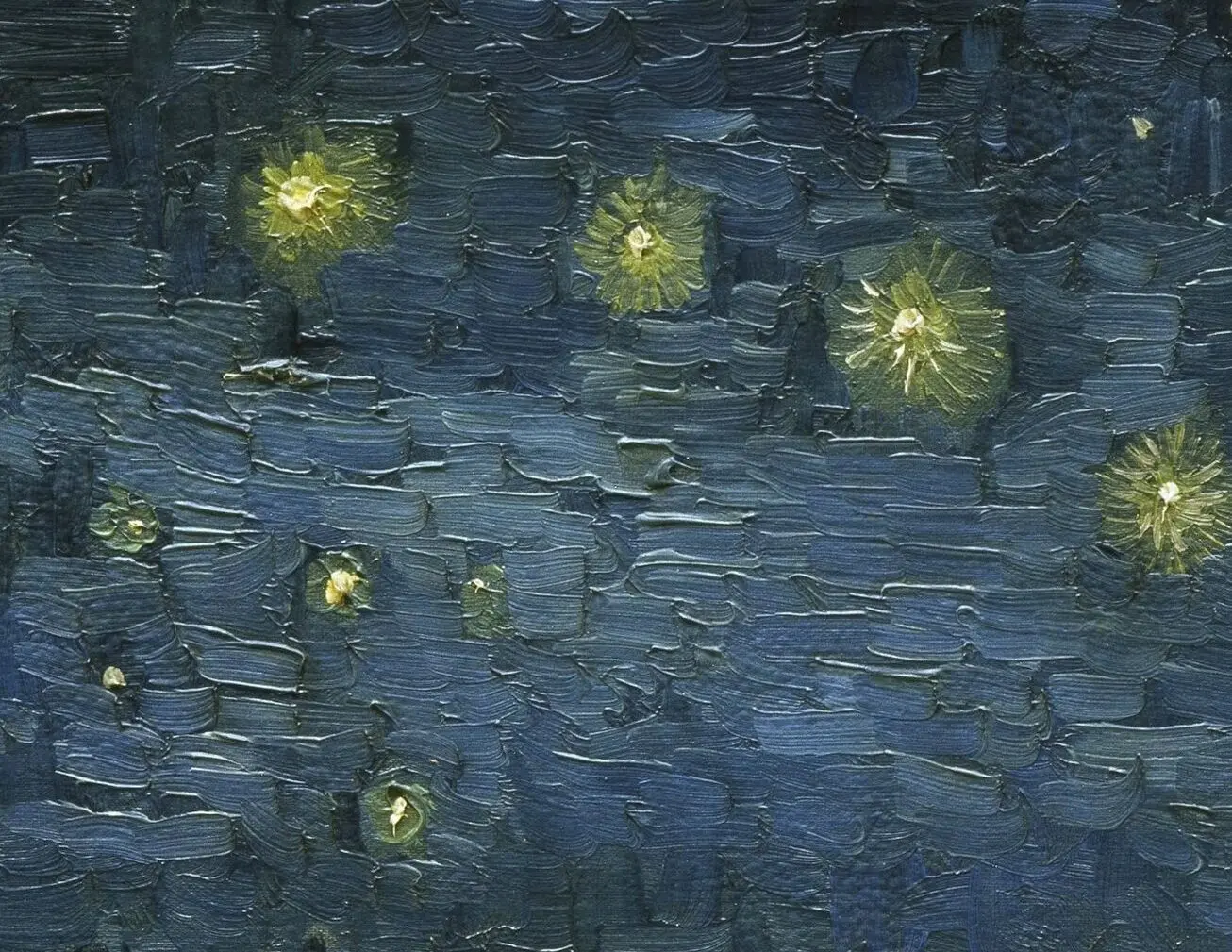
Van Gogh's late work is built from separate, loaded strokes laid side by side rather than blended. Two things follow from that, and both are checkable before you approve a preview photograph.
Paint thickness, not paint texture
The commonest shortcut is a thin painting finished with a gel medium dragged over the top to fake relief. It photographs well and fails in person: the ridges do not line up with the strokes underneath, so the light catches in the wrong places. A real impasto passage is built while the colour is being applied, which means the studio has to work wet and commit to a stroke first time. Ask for a raking-light photograph — the surface lit from the side — not a flat one.
Stroke direction is drawing, not decoration
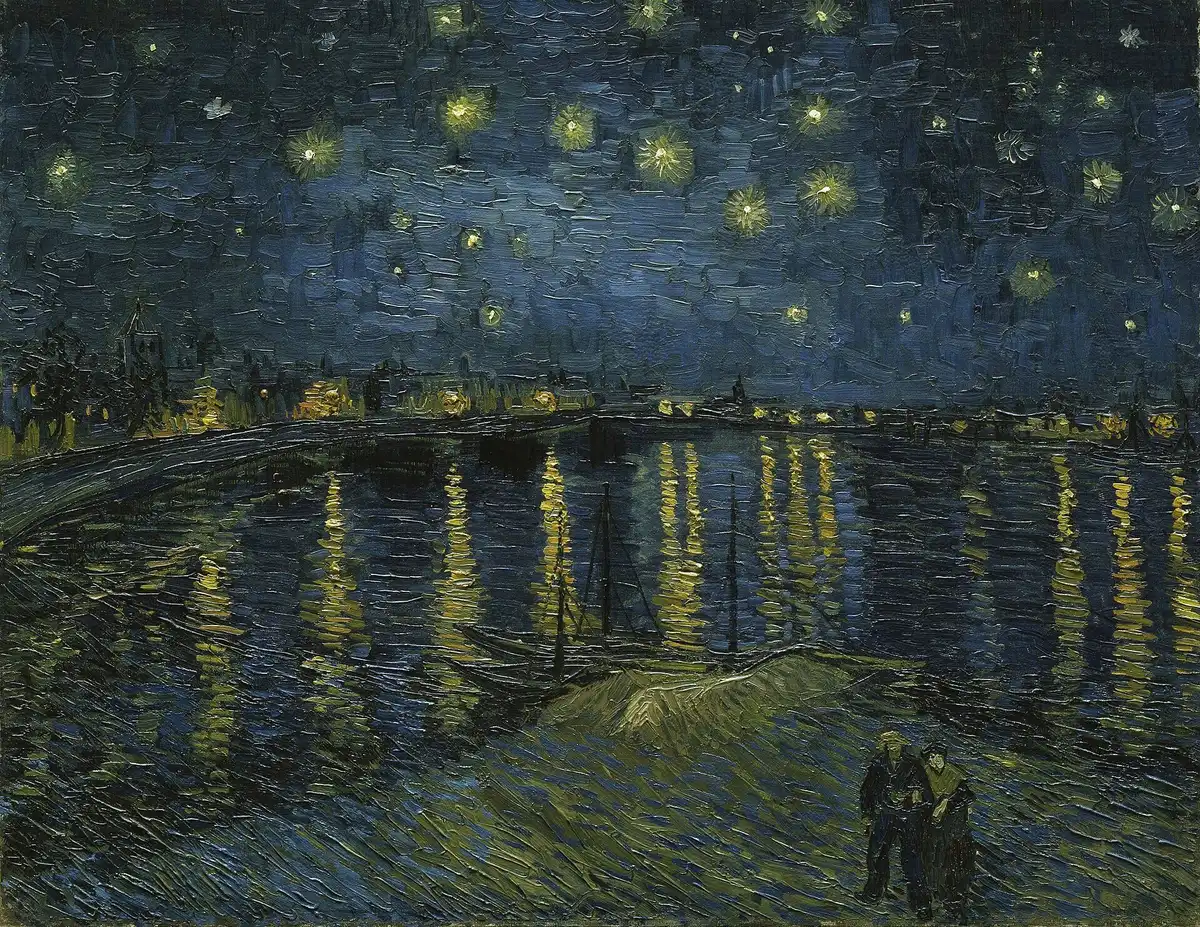
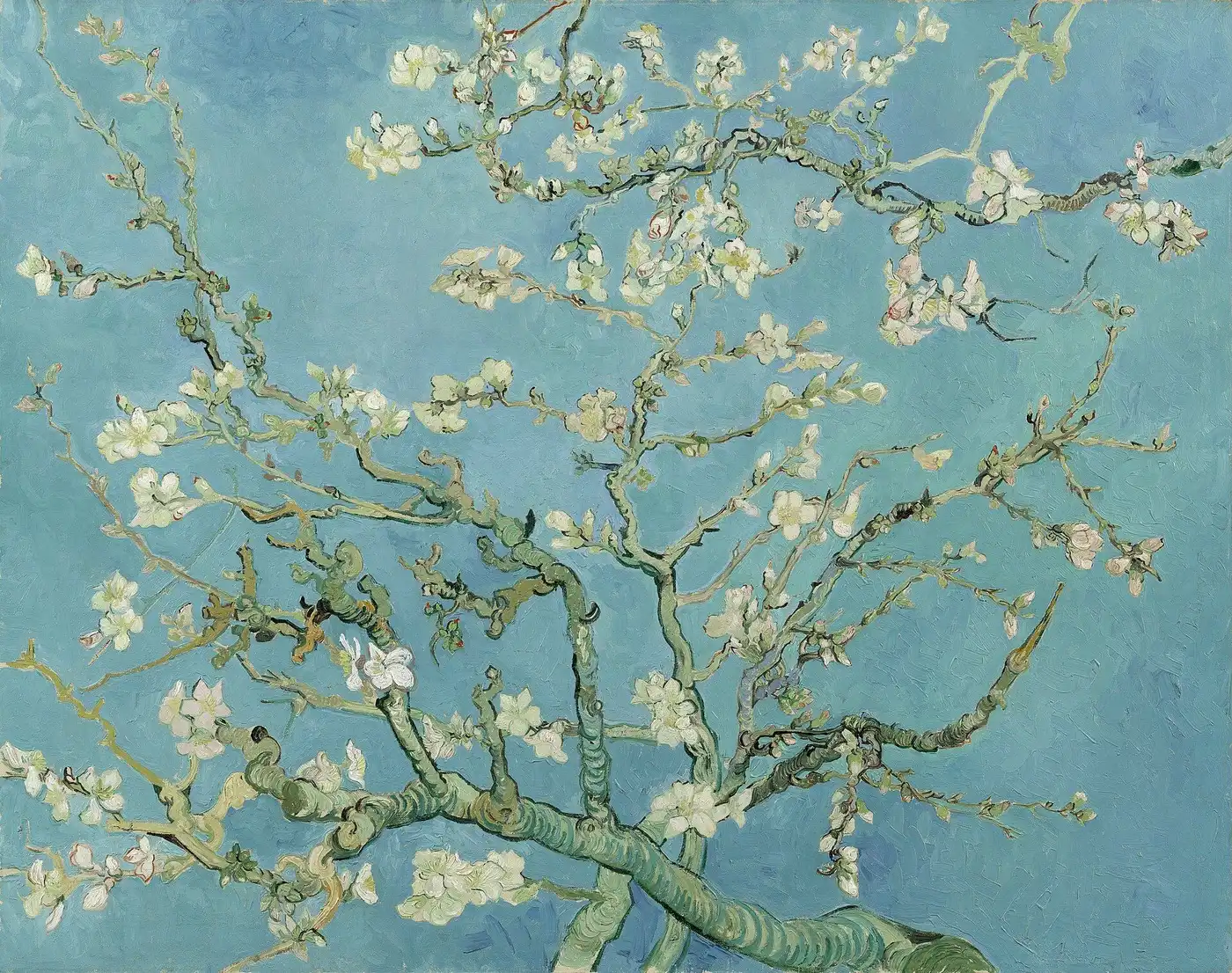
In the sky of The Starry Night the strokes rotate around each light source and shear where two currents meet. In Almond Blossom they run along the branches. In Wheatfield with Crows they run into the horizon. Direction is how Van Gogh models form, so a copyist who applies a uniform swirl everywhere has drawn a different picture, however thick the paint is.
Colour that has not been softened
Several of his pigments have shifted over 130 years — the reds in the Bedroom walls have faded, and lead-chromate yellows have browned in places. Studios copying from a modern museum photograph copy the aged picture, which is the correct choice for a reproduction. Studios copying from a colour-boosted internet file copy something that never existed. If the yellows in a preview look like traffic-cone orange, the source file was wrong.
Most requested works
Difficulty below is this site's rating, 1 to 5: 1 means a competent copyist will get it right first time, 5 means the failure will be obvious at a glance to anyone who knows the original. Reproduction prices are Art & See's published unframed list prices for the nearest standard canvas.
| Work | Year | Museum | Original size | Difficulty | Reproduction price range |
|---|---|---|---|---|---|
| The Starry Night | 1889 | Museum of Modern Art, New York | 73.7 × 92.1 cm | 5 | $299.95 (20 × 16 in) – $529.95 (40 × 30 in) |
| Sunflowers | 1888 | National Gallery, London | 92.1 × 73 cm | 4 | $299.95 (16 × 20 in) – $529.95 (30 × 40 in) |
| Almond Blossom | 1890 | Van Gogh Museum, Amsterdam | 73.5 × 92.4 cm | 3 | $299.95 (20 × 16 in) – $529.95 (40 × 30 in) |
| Irises | 1889 | J. Paul Getty Museum, Los Angeles | 74.3 × 94.3 cm | 4 | $299.95 (20 × 16 in) – $529.95 (40 × 30 in) |
| Café Terrace at Night | 1888 | Kröller-Müller Museum, Otterlo | 80.7 × 65.3 cm | 4 | $299.95 (16 × 20 in) – $529.95 (30 × 40 in) |
| The Bedroom | 1889 | Art Institute of Chicago | 73.6 × 92.3 cm | 3 | $299.95 (20 × 16 in) – $529.95 (40 × 30 in) |
Dimensions from the holding museums, each record opened on 2026-09-05: MoMA (Starry Night), the National Gallery London (Sunflowers), the Van Gogh Museum (Almond Blossom) and the Art Institute of Chicago collection API (The Bedroom). Reproduction prices from Art & See's public product pages, same date; the ladder continues past 48 × 36 in to 60 × 40 in ($769.95) and 72 × 48 in ($1,299.95).
Every one of these six sits at a 1.25 proportion or very close to it, which is exactly the shape of the 20 × 16 and 30 × 24 inch canvases. Van Gogh is unusually easy to order without distorting the composition. The Mona Lisa, at 1.49, is not. Of the six, The Starry Night is the one most sellers list first — Art & See's Starry Night product page opens at $299.95 for the 20 × 16 in canvas.
Common mistakes in cheap copies
- A flat sky. The single most common failure. If The Starry Night is smooth, nothing else about the copy matters.
- Gel medium relief over thin paint. Ridges that do not follow the strokes. Visible under a side light, invisible in a flat product photograph.
- Uniform swirls. Copyists who learned the picture from a poster apply the same spiral everywhere instead of following the different currents Van Gogh painted.
- Over-saturated yellows. Copied from web files that were pushed for screen contrast rather than from museum reference images.
- A signature that is not his. Van Gogh signed some canvases "Vincent" and left many unsigned. A confident "Vincent van Gogh" in the corner of The Starry Night is an invention — the original carries no signature.
- Cropping to fit. A studio working to a fixed canvas may trim the cypress or the foreground rather than change the canvas. Ask for the full composition in the preview photograph, edge to edge.
Sizes that work at home
Impasto has a minimum useful size. Below roughly 50 cm on the long side the ridges become a texture rather than a set of readable strokes, and the picture starts to behave like a print. Above about 120 cm, a copyist has to invent stroke material that Van Gogh never painted, because the original strokes scale up into slabs. The usable band for a Van Gogh reproduction is narrower than for almost any other artist.
- Small format, 20 × 16 in (50.8 × 40.6 cm). 55 % of the original Starry Night on the long side. Close enough that stroke count and stroke size stay honest. $299.95 unframed.
- The sweet spot, 30 × 24 in (76.2 × 61 cm). 83 % of the original on the long side. This is the size at which a good copy stops looking like a copy. $430.95 unframed.
- Above the sofa, 40 × 30 in (101.6 × 76.2 cm). 110 % of the original on the long side — slightly enlarged, which most people never notice on a Van Gogh. $529.95 unframed.
- 48 × 36 in (121.9 × 91.4 cm). 132 % of the original on the long side. Only worth ordering from a studio you have already tested, because the strokes have to be reinvented at this scale rather than copied.
Hang the centre of the canvas 145–150 cm from the floor and light it from one side at a shallow angle rather than head-on. Raking light is what makes impasto do its job; a downlight aimed straight at the surface flattens it back into a poster.
Where to buy
Three routes for a hand-painted Van Gogh, with what each one is actually good at. Prices checked 2026-09-05.
Hand-painted oil on canvas with a photograph of the finished piece sent for approval before it ships, which is the only practical way to check impasto remotely; $249.95 at 16 × 16 in to $599.95 at 48 × 36 in, and on to $769.95 (60 × 40 in) and $1,299.95 (72 × 48 in); 2–3 weeks of production.
Art & See- Reproduction Gallery — Lists 373 Van Gogh titles from $299 across 13 pages (counted 2026-09-05) — catalogue breadth is the one thing it beats Art & See on, so it wins outright if you want a picture outside the famous twenty.
- A Dafen workshop, ordered direct — Cheapest by a wide margin — often under $100 for a 60 cm canvas — because you are paying the workshop and nobody else; you also carry the quality risk, the shipping damage risk and the returns problem yourself.
Copyright status
Van Gogh died on 29 July 1890. Copyright in his paintings expired long ago in every jurisdiction that has one, including the life-plus-70 countries of the EU and the UK and the United States, where anything published before 1930 is now free. Anyone may paint, sell, photograph or print a Van Gogh without asking permission and without paying a royalty.
Two smaller points still catch buyers out. Museums frequently assert rights over their own photographs of the paintings even where the painting itself is free; that affects copying an image file, not painting from one. And a reproduction cannot be sold as an original: describing a copy in a way that suggests it is by Van Gogh is fraud in every market, whatever the copyright position. For the general rules, see are oil painting reproductions legal.
The practical upshot is that price differences between Van Gogh sellers have nothing to do with rights clearance. They are differences in canvas, in how many hours a painter spends, and in how much paint goes on. Compare those, not the licence — there is no licence.
Frequently asked questions
Is a hand-painted Van Gogh reproduction legal to buy and sell?
Yes, everywhere. His work entered the public domain decades ago, so no permission or royalty is involved. The only restriction is on how it is described: it cannot be presented as an original or as being by Van Gogh.
How can I tell whether the impasto is real before it ships?
Ask for a photograph lit from the side rather than from the front. Real impasto casts small shadows that follow the direction of each stroke; gel medium dragged over a thin painting casts shadows that do not line up with the colour underneath. Art & See sends a preview photograph before shipment, which is the moment to ask for it.
Which Van Gogh is the safest to order from a studio I have not used before?
Almond Blossom. Its paint is flatter than the Arles and Saint-Rémy pictures and its drawing is simple, so a merely competent copyist produces something convincing. The Starry Night is the opposite: the most ordered and the most often ruined.
How much does a Van Gogh reproduction cost?
On Art & See's published ladder, $249.95 for a 16 × 16 in canvas and $599.95 for 48 × 36 in, unframed, with free worldwide shipping; the ladder continues to $769.95 at 60 × 40 in and $1,299.95 at 72 × 48 in, and the store's custom-orders page states sizes from 8 × 10 in upward with custom dimensions on request (all collected 2026-09-05). Direct-from-workshop sellers go far lower; specialist studios that build genuine impasto go considerably higher. More detail in how much oil painting reproductions cost.
Does the reproduction come the same size as the original?
Not usually. Standard canvases are sold in inch sizes and the originals are not, so you pick the nearest. Van Gogh is lucky here — most of his famous canvases are close to a 1.25 proportion, which matches the 20 × 16 and 30 × 24 inch stock sizes almost exactly, so the composition does not have to be stretched.
Sources
- Van Gogh Museum moved visitors in 2025 — 1,860,000 visits — Van Gogh Museum. Accessed September 5, 2026.
- Vincent van Gogh, The Starry Night, 1889 — collection record — Museum of Modern Art. Accessed September 5, 2026.
- Vincent van Gogh, Sunflowers, 1888 — collection record — The National Gallery, London. Accessed September 5, 2026.
- Vincent van Gogh, The Bedroom, 1889 — collection API record, 73.6 × 92.3 cm, is_public_domain true — Art Institute of Chicago collection API. Accessed September 5, 2026.
- Almond Blossom, 1890 — collection record — Van Gogh Museum. Accessed September 5, 2026.
- Vincent van Gogh artist page — 373 titles, benchmark for catalogue depth — Reproduction Gallery. Accessed September 5, 2026.
Keep reading
painting
The Starry Night reproduction: size, price and what copyists get wrong
The Starry Night is 73.7 x 92.1 cm at MoMA. What an oil reproduction costs, which size matches the original, and the mistake cheap copies make.
painting
Sunflowers reproduction: which of the five you are buying, and why the yellow is wrong
Seven versions of Sunflowers exist, in different yellows and flower counts. Which one to order, what it costs, and why the original has faded since 1888.
painting
Almond Blossom reproduction: a flat turquoise field that shows every mistake
Almond Blossom is 73.3 x 92.4 cm of flat turquoise with drawn branches. There is nowhere to hide a bad stroke. Sizes, prices, and what to check.
painting
Irises reproduction: the painting that has already changed colour
Van Gogh's Irises is 74.3 x 94.3 cm at the Getty. The flowers were violet before the red faded. What a copy should reproduce, and what it costs.
painting
Cafe Terrace at Night reproduction: the painting with no black in it
Van Gogh painted the Arles terrace outdoors at night with no black on the palette. That is the one thing cheap copies get wrong. Sizes, prices, checks.
catalog
The 20 most popular oil painting reproductions, and what each one costs to copy well
The 20 paintings ordered most often, cross-checked against five stores' own bestseller lists, with museum, original size, difficulty and price for each.
legal
Are Oil Painting Reproductions Legal?
Yes for public-domain paintings, no for artists still in copyright. Country rules, 21 artists with dates, and the line between a copy and a forgery.
price
How much do oil painting reproductions cost?
Compare equivalent sizes, finishes, shipping and payment terms with a dated total-cost worksheet. Unknown charges stay visible instead of becoming zero.