painting
The Starry Night reproduction: size, price and what copyists get wrong
The Starry Night is 73.7 x 92.1 cm at MoMA. What an oil reproduction costs, which size matches the original, and the mistake cheap copies make.
Oil Painting ReproductionsUpdated
The short answer
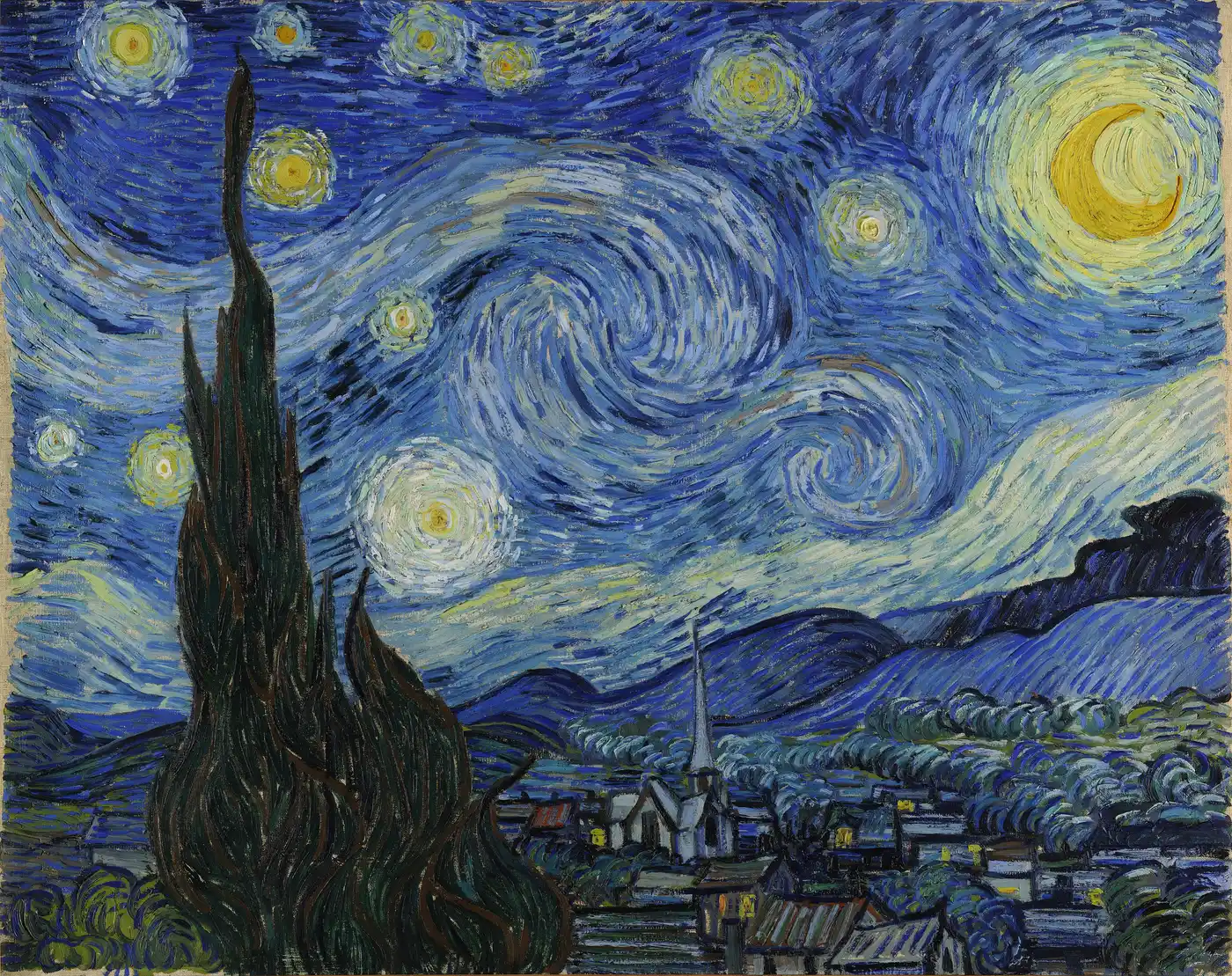
The original is 73.7 × 92.1 cm of thick, directional paint at MoMA. A hand-painted oil copy runs about $99 to $1,120 depending on the studio and size, and the thing that separates a good one from a bad one is stroke direction, not colour.
The painting in numbers
| The original | What it means for a reproduction | |
|---|---|---|
| Year | June 1889, painted at Saint-Remy-de-Provence | Van Gogh died in 1890, so the image is public domain everywhere. |
| Where it is | The Museum of Modern Art, New York (Lillie P. Bliss Bequest, 1941) | MoMA publishes a high-resolution image, which is what almost every studio works from. |
| Medium | Oil on canvas | The only painting on this list that a studio can match materially, one for one. |
| Original size | 73.7 × 92.1 cm (29 × 36 1/4 in) | Smaller than most buyers expect. A 40 × 30 in canvas is already larger than the original. |
| Aspect ratio | 1.25 : 1, landscape | Matches the 30 × 24 in and 40 × 30 in stock sizes exactly. A 48 × 36 in is 1.33:1, so the composition is stretched or cropped. |
| Common reproduction sizes | 20 × 16 in, 30 × 24 in, 40 × 30 in, 48 × 36 in | Only 30 × 24 and 40 × 30 keep the original proportions. |
Dimensions from the Museum of Modern Art collection record, checked 2026-09-05.
Why it is hard to reproduce
The difficulty is not the colour. Ultramarine, cobalt, chrome yellow and zinc white are ordinary studio pigments, and any competent painter can mix the palette in an afternoon. The difficulty is that the picture is made of direction. Each swirl is a rope of separate loaded strokes laid side by side, wet into wet, following the curve rather than filling it. Change the angle of those strokes and the sky stops turning.
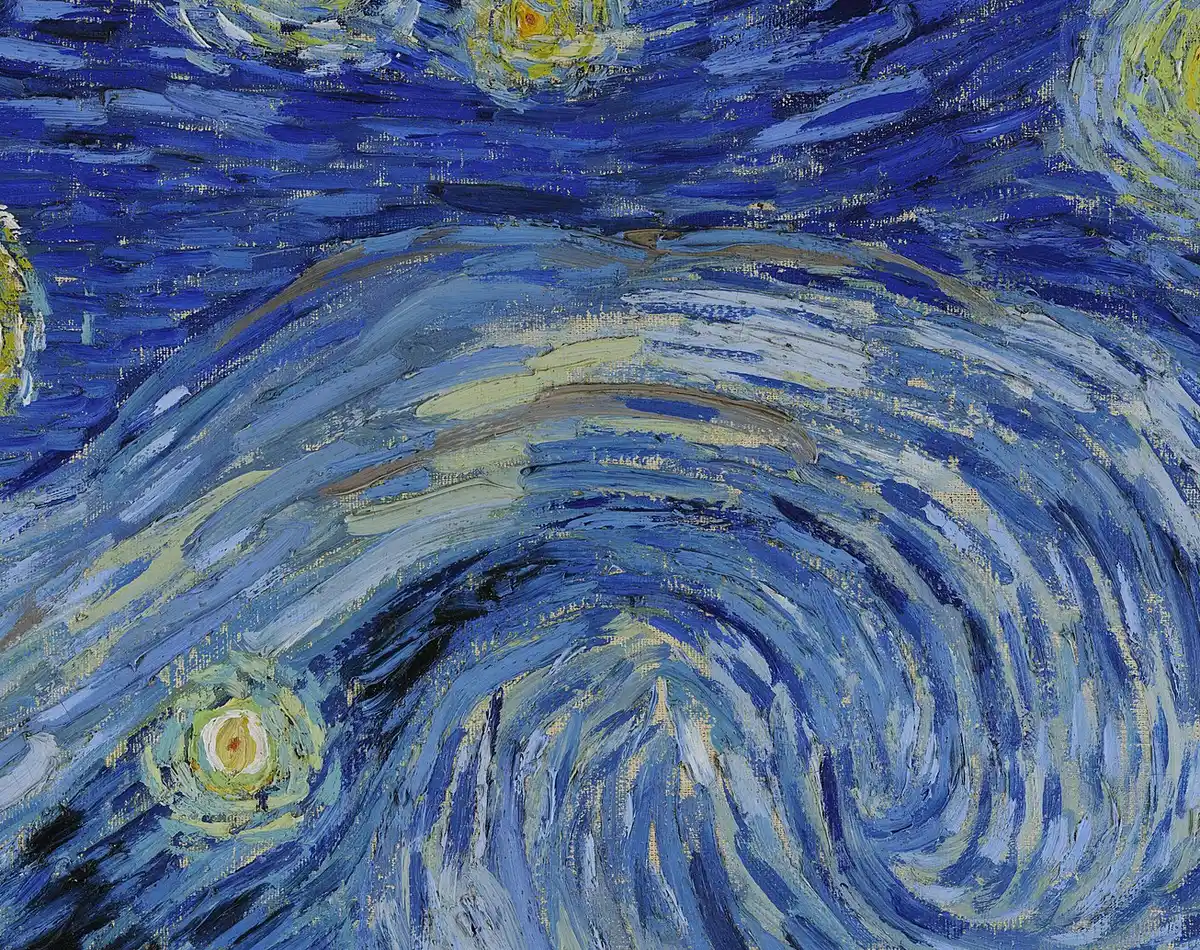
- Impasto height. The ridges stand proud of the canvas by a millimetre or more in the stars and the swirl. Building that in oil takes several sittings, because a thick layer skins over long before it dries through. Studios working to a two-week deadline either thin the paint or add a drying medium, and both change the light.
- Wet-into-wet edges. Where the pale blue meets the deep blue, Van Gogh dragged one wet colour into another. Copied a day later on dry paint, the same passage becomes a hard edge.
- Exposed ground. In the darker parts of the sky the canvas weave shows through, which is why the original does not read as a solid blue field. Copies painted opaque lose that vibration.
- The cypress. It is not black. It is a dense weave of dark green, brown and violet strokes that only reads as black from across the room.
What cheap copies get wrong
The single most common failure is a flat blue sky with white swirl lines drawn on top of it, like icing on a cake. The original has no underlying flat field at all: the light strokes and the dark strokes are laid in the same pass, at the same thickness, so neither sits on top of the other.
- Swirls painted as outlines over a filled background instead of as interlocking strokes.
- Impasto faked at the end with a thick clear gel over dried paint, which reflects light in a way real loaded brushwork does not.
- The eleven stars turned into even circles with a soft halo. In the original each halo is a spiral of concentric strokes, and no two are the same size.
- The village painted in more detail than the original, because the copyist is working from a zoomable file rather than a canvas seen at arm's length.
- The cypress reduced to a flat black silhouette.
Sizes and where it hangs well
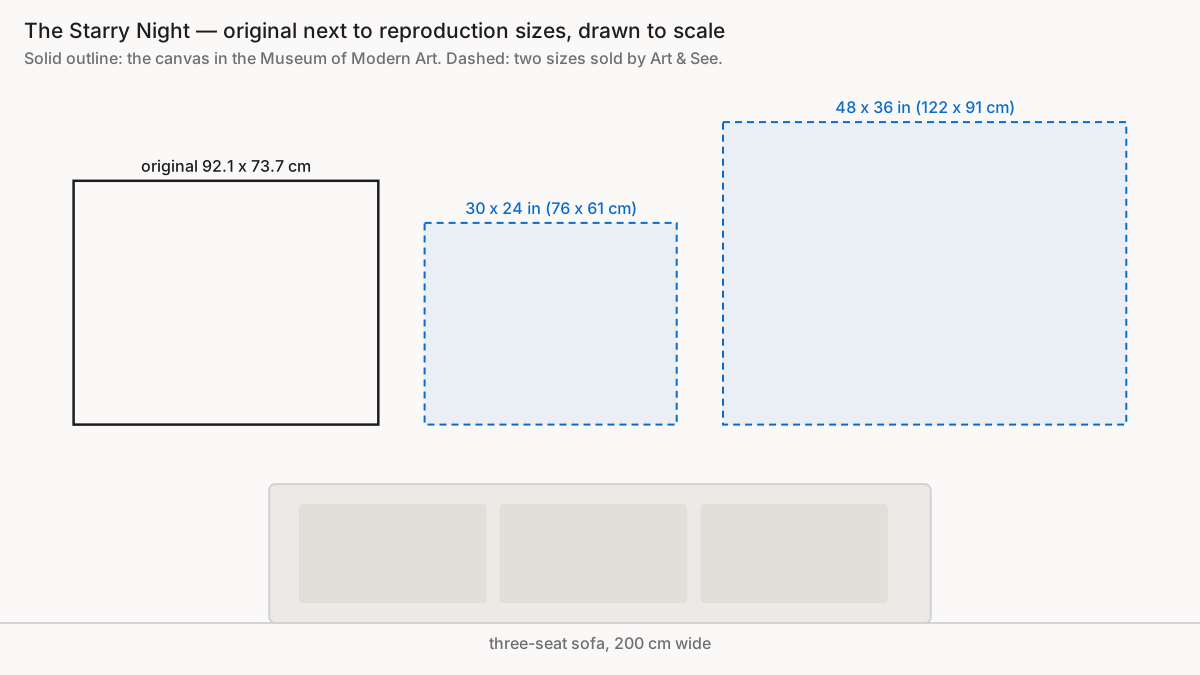
At 92 cm wide the original is a small picture by living-room standards: hung over a 200 cm sofa it covers under half the sofa's width and reads as modest. Most buyers who want it to anchor a wall order 40 × 30 in (102 × 76 cm) or larger. The picture takes enlargement well because the brushwork is large to begin with, which is not true of the Vermeers on this site. Above a fireplace or a long sideboard, 48 × 36 in works, but that ratio crops the composition slightly at the top and bottom; ask the studio which edge they will lose.
Price range
| Store | Smallest listed | Around 30 × 24 in | Largest compared here |
|---|---|---|---|
| overstockArt | $99 (8 × 10 in) | $239 (24 × 36 in) | $349 (36 × 48 in) |
| HandmadePiece | $224 (14 × 18 in) | $376 (24 × 30 in) | $557 (36 × 44 in) |
| BrushWiz | $300 (22 × 18 in) | $354 (28 × 24 in) | $498 (46 × 38 in) |
| Art & See | $299.95 (20 × 16 in) | $430.95 (30 × 24 in) | $599.95 (48 × 36 in); the ladder goes on to $1,299.95 at 72 × 48 in |
| 1st Art Gallery | $362.95 (20 × 16 in) | $481.95 (30 × 24 in) | $677.95 (48 × 36 in) |
| TOPofART | $1,116.87 (29 × 36.3 in, the only size sold) | not offered | not offered |
Collected 2026-09-05 from each store's own product page for this painting, with two exceptions to note. The 1st Art Gallery figures are the price charged under a permanent site-wide 50% banner, not the struck-through list price. Of the BrushWiz figures only the $300 default was displayed; $354 and $498 are derived from the size ladder and the per-painting surcharge the same page declares, so treat them as reconstructed rather than quoted. Art & See figures come from its published ladder, which continues past this table to $769.95 at 60 × 40 in and $1,299.95 at 72 × 48 in. Reproduction Gallery sells this painting from $299 but starts at 23.2 × 29.5 in, so it has no comparable small size.
The spread is real, not a quality signal on its own: the cheapest and most expensive canvases in that table are both described by their sellers as hand-painted oil. What the money buys is time on the canvas, and this is a painting where time shows. If you want the version Art & See sells at 30 × 24 in, the price is the same $430.95 as any other rectangular painting in its catalogue, because its ladder is set by size, not by subject.
Where to buy
Three routes, depending on what you are optimising for.
Sells this exact painting on a published seven-rung ladder, from $299.95 at 20 × 16 in to $1,299.95 at 72 × 48 in, sends a photograph of the finished canvas for approval before it ships, and charges nothing for worldwide shipping.
Art & See- overstockArt — Cheaper at every size, from $99 at 8 × 10 in, and ships from a US warehouse; the trade-off is a pre-order note of six to eight weeks on this item.
- TOPofART — Sells it only at the exact dimensions of the original, 29 × 36.3 in, for $1,116.87, which is the right call if matching the museum canvas matters more than the price. Check before ordering: on 2026-09-05 its add-to-cart opened a notice that the studio was temporarily suspending new oil reproduction orders because of workload.
Copyright: what you can and cannot do
Van Gogh died on 29 July 1890, so the painting itself has been out of copyright for well over a century in every country that uses a life-plus-70-years term. You may commission a copy, hang it, photograph it and sell it on. What you may not do is present it as an original or sign it with Van Gogh's signature, which moves the question from copyright to fraud. Museum photographs of the painting are a separate matter; the file used on this page is one Wikimedia Commons carries as public domain.
Frequently asked questions
What size should I order to match the original?
The MoMA canvas is 73.7 × 92.1 cm, which is 29 × 36 1/4 in. No common stock size is exactly that. The closest proportion is 30 × 24 in or 40 × 30 in, both 1.25:1; TOPofART is the only store in this comparison that sells the original dimensions, at $1,116.87, though on 2026-09-05 it was not taking new oil orders.
Why does my reproduction look flatter than the picture I saw online?
Because the museum photograph is lit to show the surface and your copy was probably photographed straight on. If the flatness survives in raking light, the impasto was never built: ask for a raking-light photo before shipping rather than after.
Is a canvas print a reasonable alternative here?
For this painting, less than for most. A print reproduces the colour perfectly and the surface not at all, and the surface is the subject. If the budget stops around $100, a good print is still the honest choice over a thin, fast oil copy.
Sources
- The Starry Night, collection record — The Museum of Modern Art. Accessed September 5, 2026.
- Starry Night reproduction, price ladder and size selector — TOPofART. Accessed September 5, 2026.
- Van Gogh Starry Night, hand-painted oil reproduction — overstockArt. Accessed September 5, 2026.
- Starry Night oil painting reproduction — 1st Art Gallery. Accessed September 5, 2026.
- How long does copyright protection last? — United States Copyright Office. Accessed September 5, 2026.
- File:Van Gogh - Starry Night - Google Art Project.jpg — Wikimedia Commons. Accessed September 5, 2026.
Keep reading
artist
Van Gogh Reproductions: What a Good Copy Has to Get Right
Which Van Gogh paintings are worth reproducing in oil, what separates a real copy from a cheap one, sizes that work, prices and copyright status.
catalog
The 20 most popular oil painting reproductions, and what each one costs to copy well
The 20 paintings ordered most often, cross-checked against five stores' own bestseller lists, with museum, original size, difficulty and price for each.
price
How much do oil painting reproductions cost?
Compare equivalent sizes, finishes, shipping and payment terms with a dated total-cost worksheet. Unknown charges stay visible instead of becoming zero.
painting
Cafe Terrace at Night reproduction: the painting with no black in it
Van Gogh painted the Arles terrace outdoors at night with no black on the palette. That is the one thing cheap copies get wrong. Sizes, prices, checks.