painting
Sunflowers reproduction: which of the five you are buying, and why the yellow is wrong
Seven versions of Sunflowers exist, in different yellows and flower counts. Which one to order, what it costs, and why the original has faded since 1888.
Oil Painting ReproductionsUpdated
The short answer
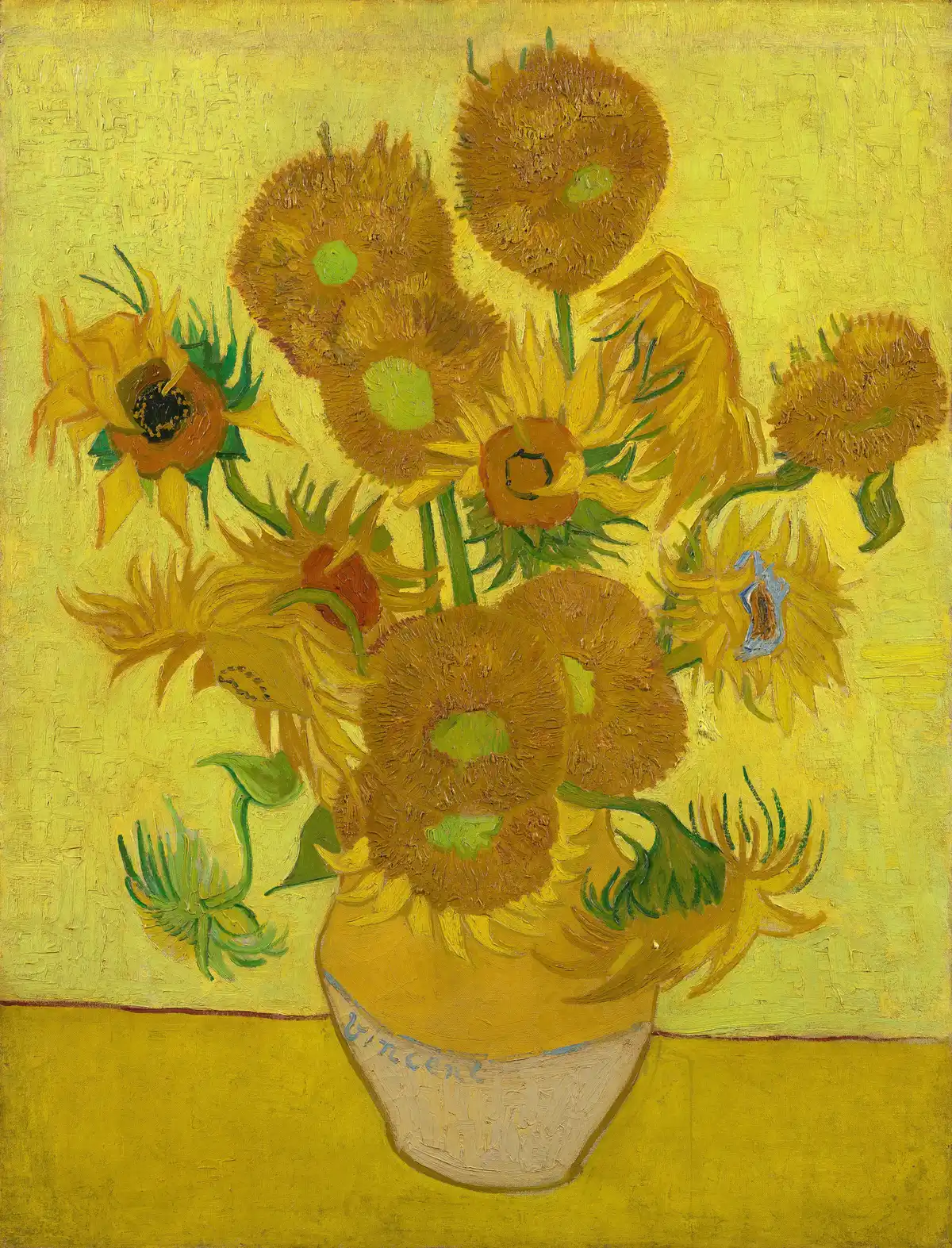
There is no single Sunflowers. The National Gallery counts seven versions, painted 1888-89, with different flower counts and grounds; five are on public display. Name the museum before you order, because studios default to whichever one they have on file.
The painting in numbers
| Version | Size and museum | How to tell it apart | Best reproduction size |
|---|---|---|---|
| Sunflowers, August 1888 | 92.1 × 73 cm, National Gallery, London | Fifteen flowers, pale yellow-green background, signed on the vase | 24 × 30 in (1.25:1 against the original's 1.26:1) |
| Sunflowers, January 1889 | 95 × 73 cm, Van Gogh Museum, Amsterdam | Van Gogh's own repetition of the London canvas, warmer and slightly taller | 24 × 30 in, or 30 × 40 in for a large wall |
| Still Life with Two Sunflowers, 1887 | Painted in Paris, not Arles; cut flowers on a table, not a vase | Two heads lying flat, no vase, turquoise ground | Sold by several stores under the plain title 'Sunflowers' |
| The other four versions | Neue Pinakothek Munich, Philadelphia Museum of Art, Sompo Museum Tokyo, and one in a private collection; a further version bought by a Japanese collector in 1921 was destroyed in the Second World War | Twelve or fifteen flowers; blue, turquoise or yellow grounds | Rarely offered; ask before assuming |
Dimensions and the count of versions from the National Gallery, London, which states that Van Gogh painted seven versions in total between 1888 and 1889 and that five are on public display; Amsterdam dimensions from the Van Gogh Museum. Both checked 2026-09-05.
Why it is hard to reproduce
The picture is yellow on yellow. The wall, the table, the vase and the flowers are all in the same family, separated only by temperature and value, with no complementary colour anywhere to give the eye a rest. Painting three or four yellows that stay distinct without turning muddy is genuinely difficult, and the shortcut is to introduce brown outlines. As soon as those appear, the picture becomes a diagram of sunflowers rather than a wall of light.
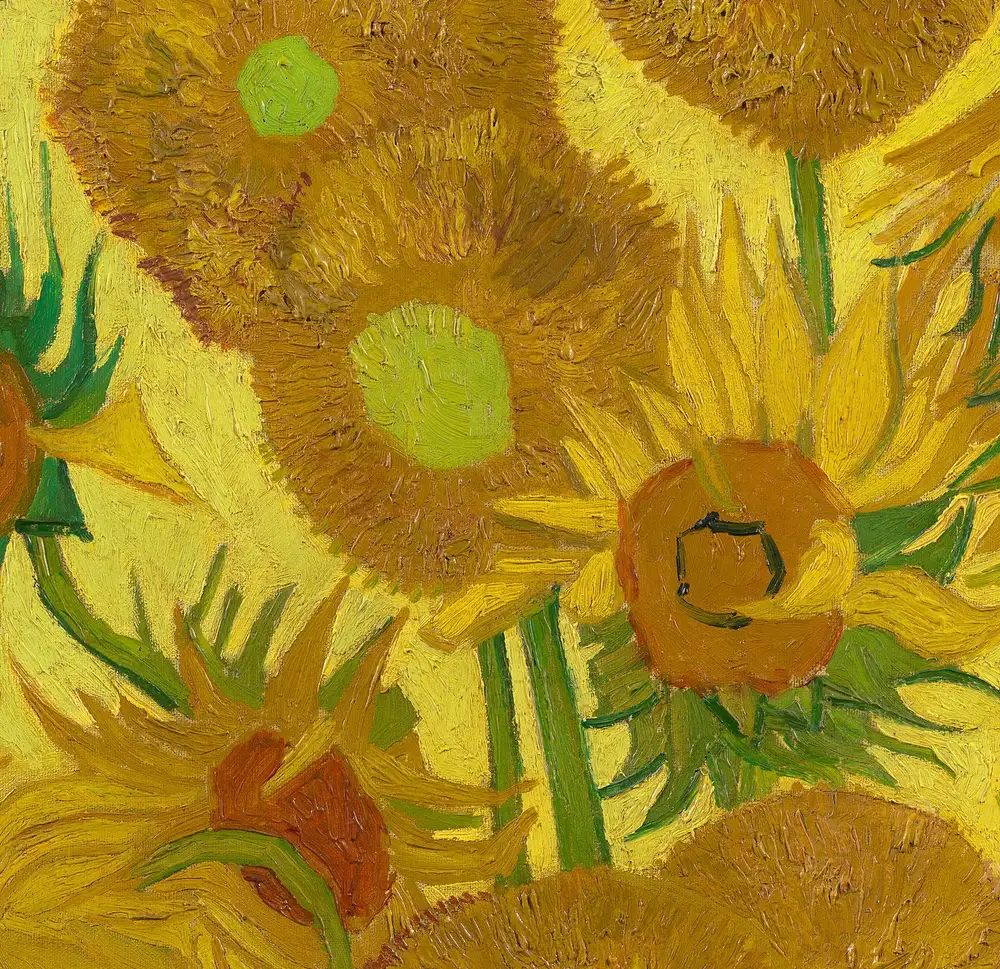
- The paint has changed. Van Gogh used chrome yellows, some of which darken toward olive-brown over time. The museum canvases are not the colour he mixed, so a perfectly faithful copy of today's photograph reproduces 135 years of chemical change.
- Impasto in the seed heads. The centres are built up in thick dabs. Copies that lay them flat lose the difference between the flat petals and the granular middles.
- Every stroke is final. The petals are single loaded marks. Going over one to correct it flattens the ridge and shows.
- The count matters. Fifteen flowers in London and Amsterdam, twelve in Munich, three or five in the earlier Paris pictures. A copy with the wrong number is a different painting.
What cheap copies get wrong
The commonest fault is brown outlining around every petal, which turns the bouquet into a colouring book. The second is a background painted in beige or cream rather than the greenish pale yellow of the London canvas, which destroys the effect Van Gogh was after: a yellow object against a yellow ground that still separates.
- Brown or black contours drawn around petals and around the vase.
- The background mixed with white into a cream, instead of a pale yellow-green of the same family.
- Seed heads painted flat, without the built-up dabs that carry the light.
- The wrong version supplied: a Paris still life of two cut flowers delivered against an order for the Arles vase.
- The flowers counted wrong, or petals invented to fill a canvas taller than the original's 1.26:1.
Sizes and where it hangs well
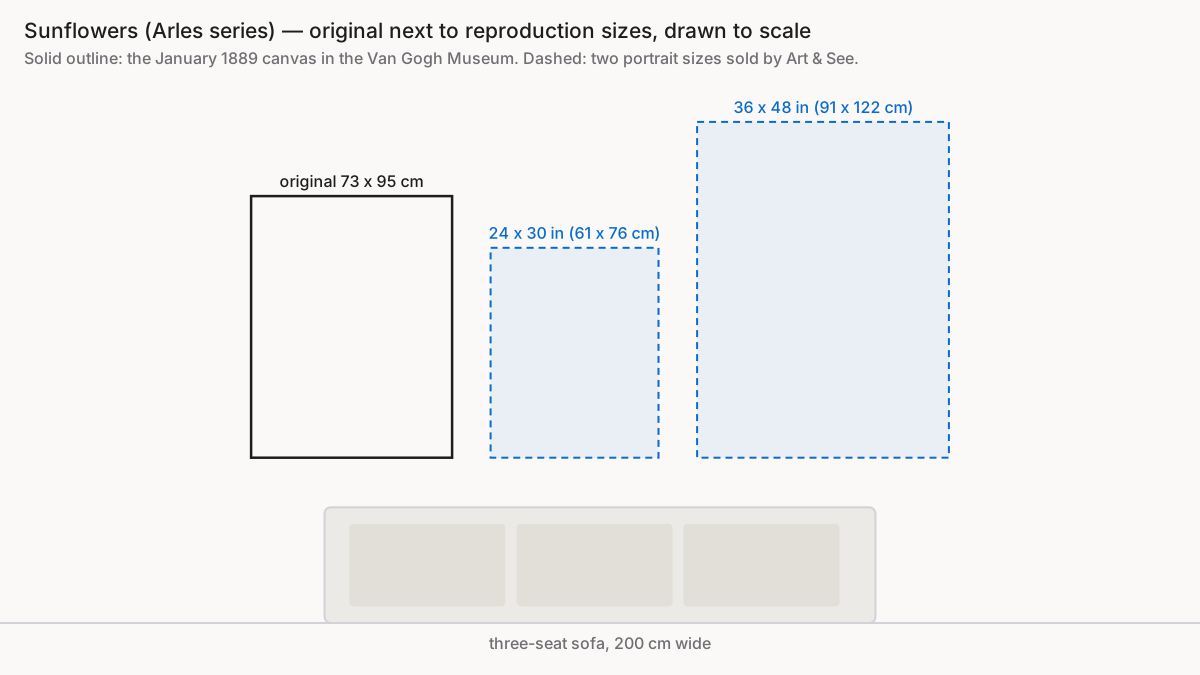
This is a portrait picture that reads as a block of warm colour from across a room, which makes it one of the safest choices for a large wall: enlargement does it little harm because the brushwork is bold and the composition is simple. It works over a sideboard, in a kitchen or dining room, and beside a window, where daylight raking across the impasto is a benefit rather than a problem. The one place it fails is a cool north-lit room with grey walls, where the yellows go green.
Price range
| Store | Small | Medium | Large |
|---|---|---|---|
| overstockArt (Vase with Fifteen Sunflowers) | $99 (8 × 10 in) | $179 (20 × 24 in) | $518 (24 × 36 in) |
| Art & See (square ladder) | $249.95 (16 × 16 in) | $380.95 (24 × 24 in) | $549.95 (36 × 36 in) |
| Art & See (rectangular ladder) | $299.95 (20 × 16 in) | $430.95 (30 × 24 in) | $599.95 (48 × 36 in) |
| HandmadePiece | $224 (14 × 18 in, base size) | $376 (24 × 30 in) | $557 (36 × 44 in) |
| 1st Art Gallery | $362.95 (20 × 16 in) | $481.95 (30 × 24 in) | $677.95 (48 × 36 in) |
Collected 2026-09-05. The overstockArt figures are for its own Vase with Fifteen Sunflowers listing; the HandmadePiece and 1st Art Gallery ladders are the ones measured on The Starry Night at the same date, and both stores apply the same ladder across their Van Gogh catalogue. Art & See applies the same ladder to every painting checked, and it runs two rungs past this table, to $769.95 at 60 × 40 in and $1,299.95 at 72 × 48 in. overstockArt's jump from $179 at 20 × 24 in to $518 at 24 × 36 in for this subject is the store's own listing, not a typing error on this page.
Art & See's catalogue does not carry the Arles vase series under that exact title; the closest listing is the 1887 Paris canvas of two cut sunflowers. For the version most buyers mean, start from the store's Van Gogh collection and confirm the title and flower count with the studio before ordering.
Where to buy
Three routes, and the version question decides which.
Its Van Gogh collection is deep and the price ladder is published, but the Arles vase Sunflowers is not listed under that title, so this is a route that needs one email before you order.
Art & See- overstockArt — Lists Vase with Fifteen Sunflowers explicitly, at prices from $99, which removes the version ambiguity and is the cheapest of the stores surveyed.
- National Gallery, London — Publishes the London canvas with its dimensions and a description of the picture, which is the reference to send a studio and the way to settle which version you actually want.
Copyright: what you can and cannot do
Van Gogh died in 1890 and every Sunflowers canvas is in the public domain worldwide. You may commission a copy at any size, resell it and display it commercially. Note that the National Gallery and the Van Gogh Museum hold rights in their own photography and in their trade marks, which is why a copy should never be sold with museum branding attached to it.
Frequently asked questions
How many Sunflowers paintings are there?
Seven, on the National Gallery's count: four painted in August 1888 and three repetitions in January 1889. Five are on public display, in London, Amsterdam, Munich, Philadelphia and Tokyo; one is in a private collection, and one bought by a Japanese collector in 1921 was destroyed in the Second World War. The earlier Paris still lifes of cut sunflowers are a separate group.
Which version should I order?
The London canvas of August 1888 or the Amsterdam repetition of January 1889 if you want the familiar image: fifteen flowers, pale yellow-green ground. Say which, and send the museum link, because 'Sunflowers' alone is not specific enough to order from.
Should a reproduction copy the faded colours?
That is a choice worth making explicitly. Some of Van Gogh's chrome yellows have darkened toward brown over more than a century, so a copy of today's photograph is a copy of an aged picture. Most studios copy what they see; ask if you want otherwise.
Sources
- Sunflowers, 1888, collection record — The National Gallery, London. Accessed September 5, 2026.
- Sunflowers, January 1889, collection record — Van Gogh Museum, Amsterdam. Accessed September 5, 2026.
- Best-selling art reproductions, Van Gogh listings and prices — overstockArt. Accessed September 5, 2026.
- Top 100 most famous paintings, ranked listing — HandmadePiece. Accessed September 5, 2026.
- How long does copyright protection last? — United States Copyright Office. Accessed September 5, 2026.
- File:Vincent van Gogh - Sunflowers - VGM F458.jpg — Wikimedia Commons. Accessed September 5, 2026.
Keep reading
artist
Van Gogh Reproductions: What a Good Copy Has to Get Right
Which Van Gogh paintings are worth reproducing in oil, what separates a real copy from a cheap one, sizes that work, prices and copyright status.
catalog
The 20 most popular oil painting reproductions, and what each one costs to copy well
The 20 paintings ordered most often, cross-checked against five stores' own bestseller lists, with museum, original size, difficulty and price for each.
price
How much do oil painting reproductions cost?
Compare equivalent sizes, finishes, shipping and payment terms with a dated total-cost worksheet. Unknown charges stay visible instead of becoming zero.
painting
Irises reproduction: the painting that has already changed colour
Van Gogh's Irises is 74.3 x 94.3 cm at the Getty. The flowers were violet before the red faded. What a copy should reproduce, and what it costs.