painting
Poppy Field reproduction: Monet's smallest famous painting
Monet's Les Coquelicots is only 50 x 65 cm and hung at the first Impressionist show. What an oil copy gets right, what it gets wrong, and prices.
Oil Painting ReproductionsUpdated
The short answer
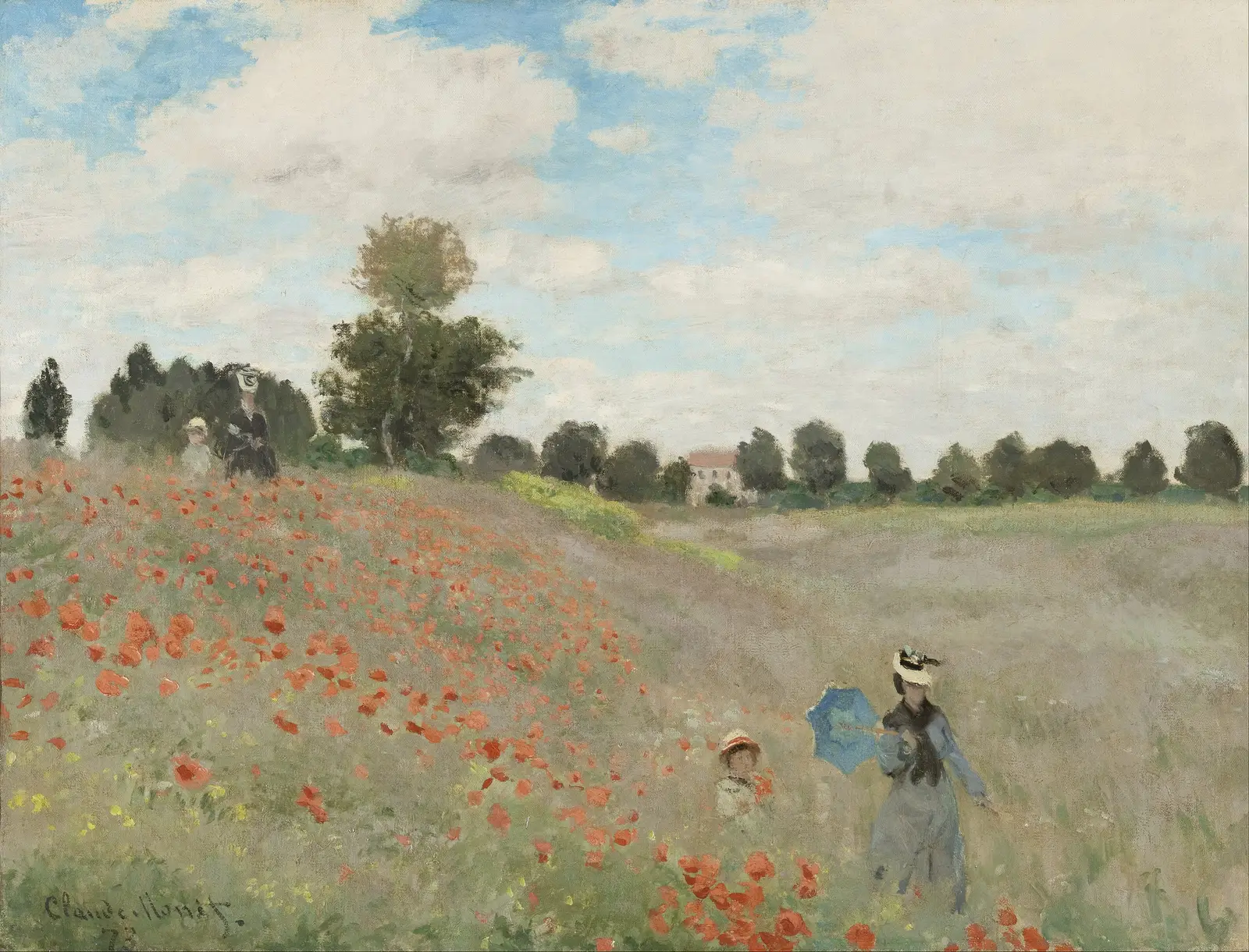
Oil on canvas, 50 × 65 cm — smaller than a 24 × 20 in reproduction. Shown at the First Impressionist Exhibition of 1874, now at the Musée d'Orsay. The difficulty is broken colour: separate dabs that must not be blended. $299.95 to $599.95.
The painting in numbers
| The original | What it means for a copy | |
|---|---|---|
| Year | 1873; shown the following year at the First Impressionist Exhibition, held in April 1874 at Nadar's studio | Public domain; Monet died in 1926 and his work is free of copyright since 1 January 1997 in the EU. |
| Where it is | Musée d'Orsay, Paris, inv. RF 1676; there since 1986 | Donated to the French state by Étienne Moreau-Nélaton in 1906. |
| Medium | Oil on canvas | Medium matches; the problem is the handling, not the material. |
| Original size | 50 × 65 cm (19.7 × 25.6 in) | Smaller than a 24 × 20 in reproduction canvas. |
| Aspect ratio | 1.30 : 1 (landscape) | Sits between the 1.25:1 and 1.33:1 stock shapes; both work with minimal cropping. |
| Common reproduction sizes | 20 × 16, 24 × 20, 30 × 24, 40 × 30 in | 24 × 20 in (61 × 51 cm) is the first size larger than the original. |
Dimensions and inventory number from the painting's Wikidata record (Q3231771), read 2026-09-05. The exhibition history is from the English Wikipedia article on the painting ('presented the following year at the First Impressionist Exhibition') and the article on that exhibition, which dates it to April 1874 at Nadar's studio.
Why it is hard to reproduce
Monet painted this outdoors in one or two sessions, and the whole picture is built from separate touches of unmixed colour sitting side by side. The green of the field is not one green: it is yellow-green, blue-green, grey-green and pink laid next to each other and mixed by your eye at viewing distance, not on the palette. That is what 'broken colour' means, and it is the single thing that separates a real Impressionist copy from a decorative one. Blend those touches together and the field turns into a flat lawn.
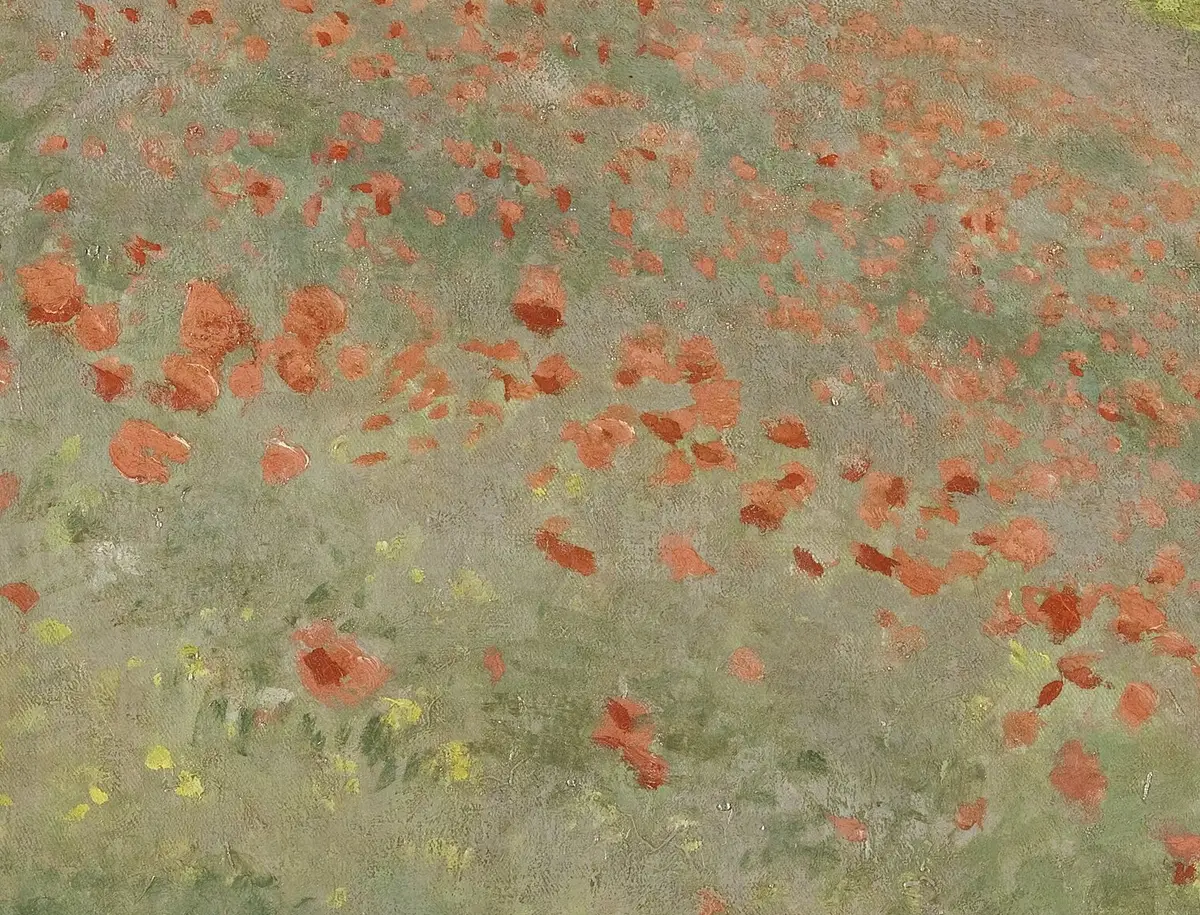
The poppies themselves are a scale trick. Near the bottom they are decisive red commas about a centimetre long; halfway up they are half that size and start to merge; near the treeline they are a red haze with no individual flower at all. There is no perspective drawing in the field, no converging lines, nothing but the diminishing size of those dabs — and it is enough. A copyist who paints the poppies at an even size across the slope destroys the depth of the picture in about ten minutes of work.
One structural detail is often missed. There are two mother-and-child pairs, one in the foreground and one further up the slope, and together they set the diagonal that holds the composition. The foreground woman is probably Camille Doncieux, Monet's wife, with their son Jean, six years old in 1873. Copies that shift the upper pair, or leave them out because they are indistinct, lose the axis of the picture.
What cheap copies get wrong
- Even poppies. Same size, same red, top to bottom. The field goes flat and the picture becomes wallpaper.
- One green. A single mixed green across the whole field, with the broken colour smoothed out. This is the most common failure and it is visible from three metres away.
- Missing second pair. The upper woman and child are faint and often dropped, which cuts the diagonal in half.
- Hard poppies at the treeline. In the original the top of the field dissolves. Copies that keep every flower crisp bring the horizon forward and flatten the slope.
- A blue sky. The sky is a warm pale grey-cream with soft cloud. Reference files circulating online often push it toward a postcard blue.
Sizes and where it hangs well
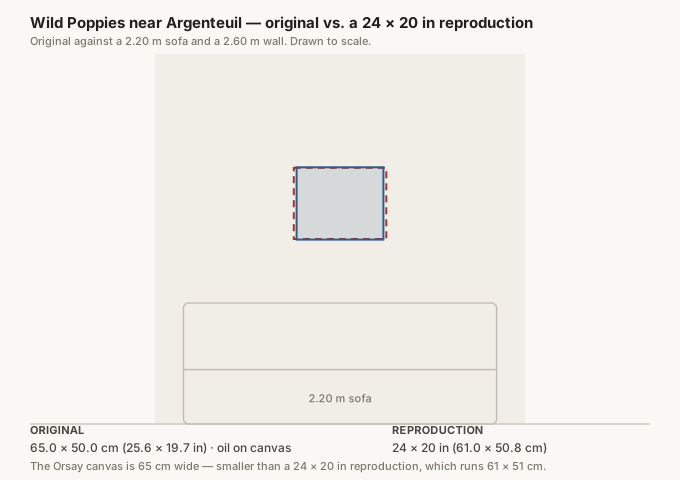
This is a small, quiet, bright picture and enlarging it is a genuine trade-off. At 20 × 16 in or 24 × 20 in it keeps the intimacy of a plein-air study and works beside a door, in a hallway, over a desk, in a bedroom. At 40 × 30 in the individual dabs become the size of a thumb and the picture switches from a field to a pattern of brushstrokes — impressive on a large wall, but no longer the painting Monet made.
It hangs well in daylight and badly under warm lamps, which kill the greens. Because the palette is soft and high-key it holds its own against colour: a green, blue or deep red wall suits it better than white, which makes the pale sky look empty. Centre at 1.5 m and give it room; it is a picture people step towards.
Price range
| Size (in) | Size (cm) | Price (USD, unframed) | Relative to the original |
|---|---|---|---|
| 20 × 16 | 51 × 41 | $299.95 | 78% of the original width |
| 24 × 20 | 61 × 51 | $359.95 | 94% — closest to actual size |
| 30 × 24 | 76 × 61 | $430.95 | 117% |
| 40 × 30 | 102 × 76 | $529.95 | 156% |
| 48 × 36 | 122 × 91 | $599.95 | 188% |
Art & See prices verified 2026-09-05 from the store's published price ladder. Frames are extra and, per the store's refund policy, final sale.
The eight studios were priced on 2026-09-05 against a single reference painting, Van Gogh's The Starry Night, at the nearest size each sells to 20 × 16 in: $149 at overstockArt, $251 at HandmadePiece, $300 at BrushWiz and $362.95 at 1st Art Gallery. Art & See lists this Monet as Wild Poppies, near Argenteuil from $299.95 unframed; its shipping policy gives processing as 2–3 weeks typically, up to 4 weeks for complex work and up to 8 weeks for large or intricate pieces, and a photograph of the finished canvas is sent for approval before dispatch. It is worth using that preview here: broken colour is the one thing that shows in a photograph.
Where to buy
Three routes, and on a small painting the near-actual-size option is usually the right one.
Carries this exact Monet as a standing product from $299.95 unframed, hand-painted in oil, with a preview photograph before dispatch; stated processing is 2–3 weeks typically, up to 4 weeks for complex work and up to 8 for large or intricate pieces. It costs about twice the cheapest studio priced.
Art & See- overstockArt — Cheapest of the eight studios priced on 2026-09-05, at every size ($149 at 16 × 20 in, close to the original's dimensions), with a stated 6–8 week pre-order wait.
- Reproduction Gallery — Publishes 48 sizes on a single painting, so a canvas at the original's exact 50 × 65 cm can be picked from the list rather than requested as a custom job.
Copyright
Claude Monet died on 5 December 1926. Under the 70-years-after-death rule his work entered the public domain in the European Union and the United Kingdom on 1 January 1997; in the United States it has been public domain much longer, the painting having been published well before 1929. No licence, royalty or permission from the Musée d'Orsay is required to have a copy painted, bought or sold.
The only live restriction concerns photographs. The Musée d'Orsay sets terms for the high-resolution files it distributes, and Google Arts and Culture, the source of the widely used image of this painting, applies its own. That is contract law about a photograph, not copyright in the painting, and it has no bearing on a hand-painted canvas.
Frequently asked questions
How big is Monet's Poppy Field?
50 × 65 cm, or about 19.7 × 25.6 inches. It is one of the smallest famous Impressionist paintings — a 24 × 20 in reproduction is already slightly larger than the original.
Is this the same as Poppy Field in a Hollow near Giverny?
No. Monet painted poppies several times. This is Les Coquelicots of 1873, painted at Argenteuil and now in the Musée d'Orsay, with two mother-and-child pairs on a slope. Check for the second, fainter pair when comparing listings.
What should I check on the preview photograph?
Two things: that the poppies get smaller and softer toward the treeline, and that the green field is made of several distinct greens rather than one mixed colour. Both are visible in a photo at normal resolution.
Is it better small or large?
Small. The picture was painted as a plein-air study at 50 × 65 cm, and at 40 × 30 in or larger the individual dabs grow to the size of a thumb and it reads as texture rather than a field.
Sources
- The Poppy Field near Argenteuil (Q3231771): dimensions, collection, inventory RF 1676 — Wikidata. Accessed September 5, 2026.
- First Impressionist Exhibition: April 1874, Nadar's studio, Louis Leroy in Le Charivari — Wikipedia. Accessed September 5, 2026.
- Impressionism: critical response, Monet among the harshest attacked — Wikipedia. Accessed September 5, 2026.
- The Poppy Field near Argenteuil: exhibition history, provenance, composition — Wikipedia. Accessed September 5, 2026.
- Coquelicots — collection record — Musée d'Orsay. Accessed September 5, 2026.
- File:Claude Monet - Poppy Field - Google Art Project.jpg — Wikimedia Commons. Accessed September 5, 2026.
- Directive 2006/116/EC on the term of protection of copyright — EUR-Lex. Accessed September 5, 2026.
- Refund policy (frames final sale; preview and refinement before dispatch) — Art & See. Accessed September 5, 2026.
- Shipping policy (production time, preview photograph before dispatch) — Art & See. Accessed September 5, 2026.
Keep reading
artist
Monet Reproductions: What a Good Copy Has to Get Right
Which Monet paintings reproduce well in oil, why broken colour defeats cheap copyists, plus original sizes, difficulty, prices and copyright.
painting
Irises reproduction: the painting that has already changed colour
Van Gogh's Irises is 74.3 x 94.3 cm at the Getty. The flowers were violet before the red faded. What a copy should reproduce, and what it costs.
painting
Dance at Bougival reproduction: a tall canvas no stock size fits
Renoir's Dance at Bougival is 181.9 x 98.1 cm — a 1.85:1 upright no standard canvas fits. What to order, what it costs, what copies miss.
catalog
The 20 most popular oil painting reproductions, and what each one costs to copy well
The 20 paintings ordered most often, cross-checked against five stores' own bestseller lists, with museum, original size, difficulty and price for each.
price
How much do oil painting reproductions cost?
Compare equivalent sizes, finishes, shipping and payment terms with a dated total-cost worksheet. Unknown charges stay visible instead of becoming zero.