painting
Dance at Bougival reproduction: a tall canvas no stock size fits
Renoir's Dance at Bougival is 181.9 x 98.1 cm — a 1.85:1 upright no standard canvas fits. What to order, what it costs, what copies miss.
Oil Painting ReproductionsUpdated
The short answer
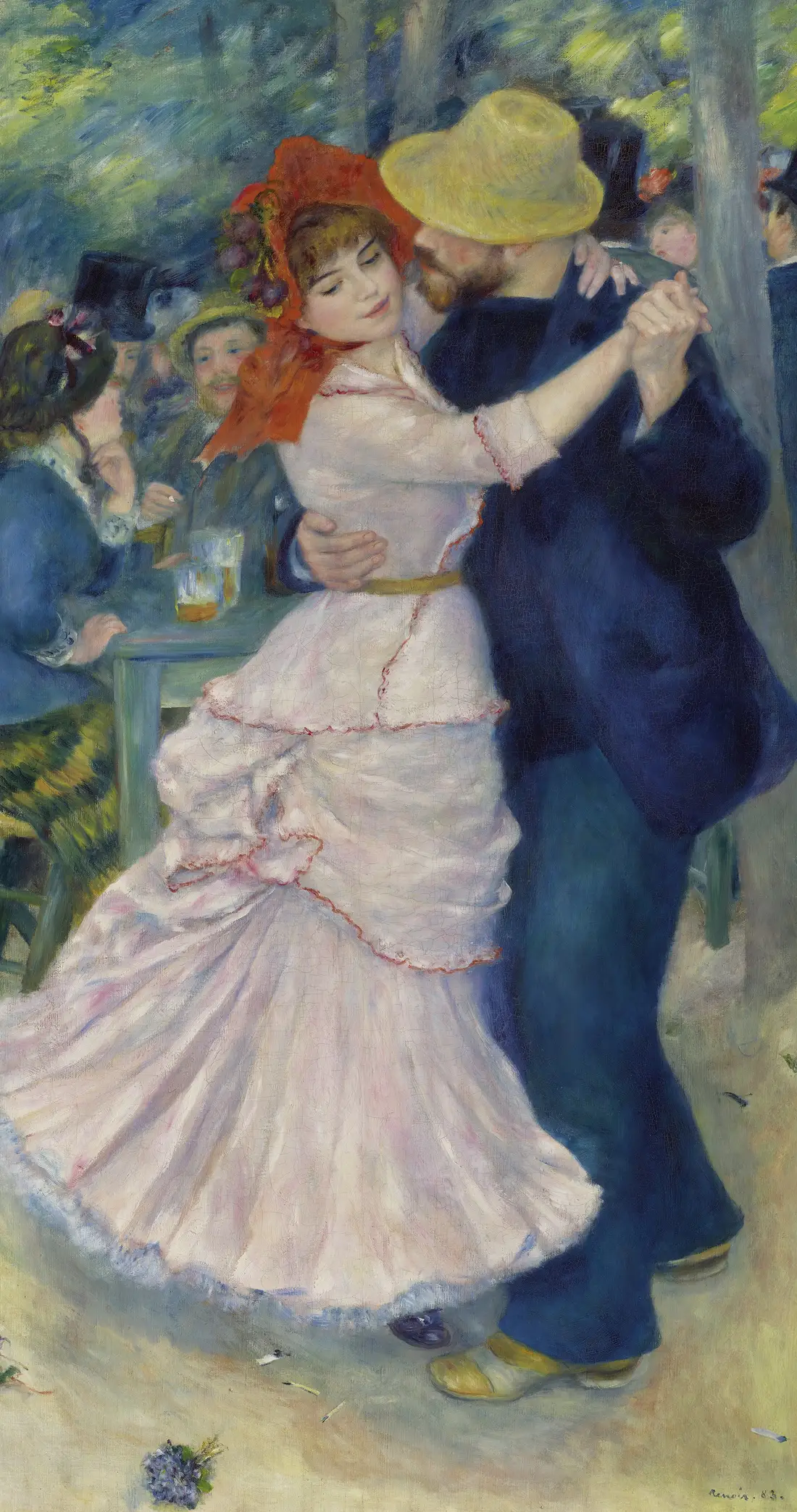
Oil on canvas, 181.9 × 98.1 cm, at the MFA Boston — nearly life-size and 1.85 times as tall as it is wide. No stock reproduction canvas has that shape, so this painting almost always needs a custom stretcher. Stock sizes: $430.95 to $599.95.
The painting in numbers
| The original | What it means for a copy | |
|---|---|---|
| Year | 1883, commissioned by the dealer Paul Durand-Ruel as one of three dance pictures | Public domain; Renoir died in 1919 and the work has been free of copyright in the EU since 1 January 1990. |
| Where it is | Museum of Fine Arts, Boston | Its two companions, Dance in the City and Dance in the Country, are at the Musée d'Orsay. |
| Medium | Oil on canvas | Medium matches; the difficulty is the edge quality. |
| Original size | 181.9 × 98.1 cm (71.6 × 38.6 in) | The figures are close to life size. |
| Aspect ratio | 1.85 : 1 (portrait) | The tallest stock canvas is 1.33:1, so a stock size crops roughly a quarter of the height. |
| Common reproduction sizes | 24 × 30, 30 × 40, 36 × 48 in | 36 × 48 in is 91 × 122 cm — two thirds of the original height and the wrong shape. |
Dimensions, dating and collection from the painting's Wikidata record (Q4451145) and the English Wikipedia article, read 2026-09-05.
Why it is hard to reproduce
Renoir's problem for a copyist is the edge. Almost nothing in this painting has a hard boundary: the woman's white dress dissolves into the ground at the hem, the man's shoulder merges with the crowd behind him, the leaves at the top are scumbled over the sky rather than drawn on it. He worked wet into wet, feathering one colour into its neighbour with a soft brush, and the sense of movement — two people mid-turn, not two people posing — comes almost entirely from that softness. Firm up those edges and the dancers stop and stand still.
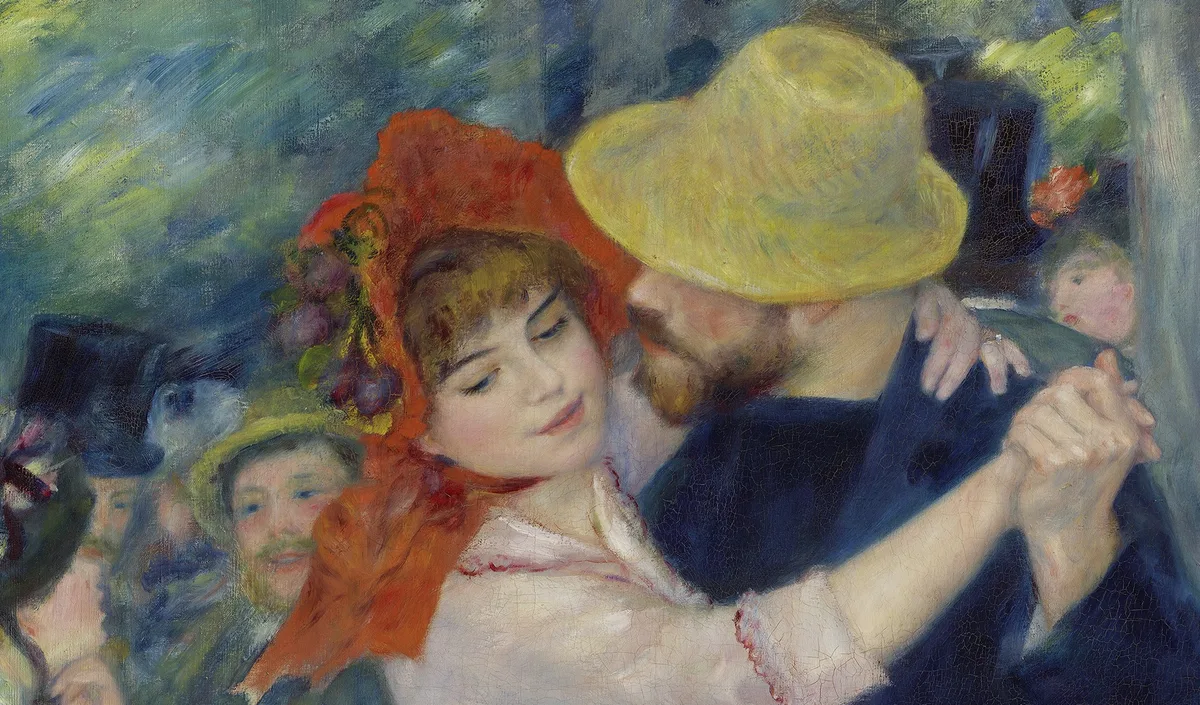
The colour is the second trap. The palette is nearly all pale — cream, dusty pink, pale blue-grey, sap green — with two saturated accents: the woman's red bonnet and the warmer red of the man's face and hands. Push any of the pale colours toward full strength and the accents stop working; the picture becomes noisy and the eye no longer goes to the bonnet first. Copies painted from a contrast-boosted screen image nearly always go this way.
Then there is the crowd. Behind the dancers is a café garden of seated figures, hats, glasses and tables, all painted as suggestions with no complete face among them. It is genuinely harder to paint an unresolved background convincingly than a resolved one, because there is no drawing to fall back on. Cheap versions either finish those figures — and the depth collapses — or reduce them to abstract smears.
What cheap copies get wrong
- Cut at the knees. Forced into a 1.33:1 stock canvas, the composition loses the ground at the bottom or the trees at the top, and with them the height that makes the dance feel like a real room.
- Hard outlines. Drawn contours around the dress and the sleeve freeze the movement.
- Saturated pastels. Pumping the pinks and blues kills the two red accents and makes the picture shout.
- Finished background faces. Every café-goer given eyes and a mouth pulls the crowd forward and flattens the space.
- Wrong dance. Renoir painted three dance pictures in 1883. Dance in the City has a black-suited man and a bare-shouldered woman indoors; Dance in the Country has a straw-hatted woman with a fan. Check for the red bonnet and the outdoor café.
Sizes and where it hangs well
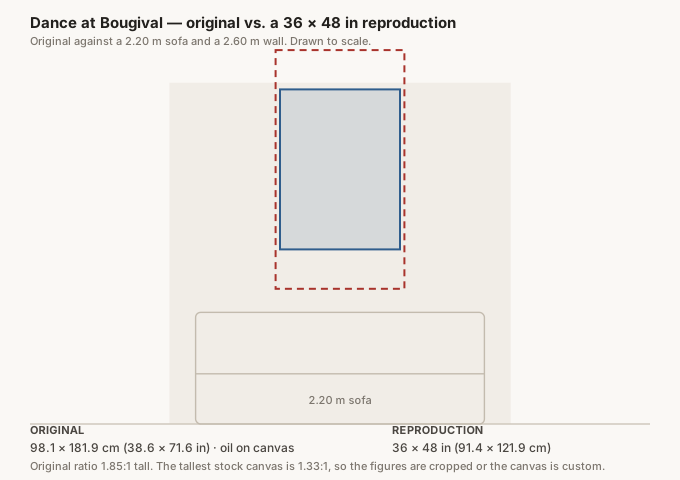
This is a tall, narrow, near-life-size painting, which makes it one of the few reproductions that genuinely wants a big wall on its own. Hung full size at 98 × 182 cm, the dancers are life-size and the effect in a room is closer to a doorway than to a picture — it works at the end of a hall, on a stair wall, or on a chimney breast in a room with height. Because it is upright it will not sit above a sofa without either overwhelming it or being shrunk to the point of pointlessness.
If the wall is under 2.4 m, order a custom 30 × 56 in canvas (76 × 142 cm), which keeps the 1.85:1 ratio at three quarters scale. If you have to use a stock size, note that 30 × 40 in and 36 × 48 in are the same 1.33:1 shape and crop identically — 36 × 48 in is simply bigger. Either way about 28 percent of the height goes. Pale walls suit it; the whole picture is high-key and it disappears on cream.
Price range
| Size (in) | Size (cm) | Price (USD, unframed) | Effect on the composition |
|---|---|---|---|
| 24 × 30 | 61 × 76 | $430.95 | 1.25:1 — crops 32% of the height |
| 30 × 40 | 76 × 102 | $529.95 | 1.33:1 — crops 28% of the height |
| 36 × 48 | 91 × 122 | $599.95 | Same 1.33:1 crop of 28%, at two thirds of life size |
| Custom 30 × 56 | 76 × 142 | Quoted per order | Correct 1.85:1 shape at three quarters scale |
| Custom 39 × 72 | 98 × 182 | Quoted per order | Full original size and proportion |
Art & See prices verified 2026-09-05 from the store's published price ladder, quoted width × height. Custom stretchers are not part of the published ladder and are quoted per order.
The eight studios were priced on 2026-09-05 against a single reference painting, Van Gogh's The Starry Night, at the nearest size each sells to 36 × 48 in: $349 at overstockArt, $498 at BrushWiz, $557 at HandmadePiece, $587 at Reproduction Gallery and $677.95 at 1st Art Gallery. The 2026-09-05 catalog snapshot of Art & See lists no product for this Renoir, so it goes through the Renoir search page. Its shipping policy gives processing as 2–3 weeks typically, extending to 4 weeks for complex work and up to 8 weeks for particularly large or intricate pieces — which a 1.8 m Renoir is — and a photograph of the finished canvas is sent for approval before dispatch.
Where to buy
Three routes. On this painting the size list matters more than the headline price.
Hand-painted oil with a preview photograph before dispatch; stated processing is 2–3 weeks typically, up to 4 weeks for complex work and up to 8 for large or intricate pieces, which a canvas this size is. This Renoir is not a standing product in its catalogue, so it has to be requested through the search page and the tall proportion negotiated.
Art & See- Reproduction Gallery — Publishes 48 sizes on a single painting, up to 94.5 × 120.1 in, which is the straightforward way to order a 1.85:1 upright without a custom quote — the deepest size catalogue of the eight studios priced on 2026-09-05.
- overstockArt — Cheapest of the eight studios priced on 2026-09-05, at every size ($349 at 36 × 48 in), with the caveat that its sizes are fixed standard shapes, so a faithful proportion is not on offer.
Copyright
Pierre-Auguste Renoir died on 3 December 1919. Under the 70-years-after-death rule his work entered the public domain in the European Union and the United Kingdom on 1 January 1990, and in the United States it has been public domain for far longer, having been published well before 1929. A hand-painted copy needs no licence and owes no royalty to the Museum of Fine Arts.
As always, the constraint that survives is honesty in description. 'After Renoir', 'reproduction' or 'copy' is accurate; presenting the canvas as an original, or removing all indication that it is a reproduction when reselling it, is not. The general position is set out in are oil painting reproductions legal.
Frequently asked questions
How big is Dance at Bougival?
181.9 × 98.1 cm — about 1.8 m tall, which makes the two dancers close to life size. It is the tallest painting covered in this series.
Why does no standard canvas fit it?
Its ratio is 1.85:1 while stock reproduction canvases run from 1.2:1 to 1.33:1. Ordering a stock size means cropping 28 percent of the height at 1.33:1 and 32 percent at 1.25:1, usually from the bottom.
Who are the dancers?
The prevailing view is that they are Renoir's friends Suzanne Valadon and Paul Lhote, though the identification is disputed — one scholar has proposed Hippolyte-Alphonse Fournaise as the man.
Is this one of a set?
Yes. Paul Durand-Ruel commissioned three dance pictures in 1883. The other two, Dance in the City and Dance in the Country, are in the Musée d'Orsay, and studios sometimes supply the wrong one.
Sources
- Dance at Bougival (Q4451145): dimensions, date, collection — Wikidata. Accessed September 5, 2026.
- Dance at Bougival: commission, models, companion paintings — Wikipedia. Accessed September 5, 2026.
- Collections search — Museum of Fine Arts, Boston — Museum of Fine Arts, Boston. Accessed September 5, 2026.
- File:Dance-At-Bougival.jpg — Wikimedia Commons. Accessed September 5, 2026.
- Directive 2006/116/EC on the term of protection of copyright — EUR-Lex. Accessed September 5, 2026.
- Shipping policy (production time, preview photograph before dispatch) — Art & See. Accessed September 5, 2026.
Keep reading
artist
Renoir Reproductions: What a Good Copy Has to Get Right
Feathered edges, green shadows in the flesh, and why hardening a Renoir ruins it. Plus original sizes, difficulty, prices and copyright status.
painting
Poppy Field reproduction: Monet's smallest famous painting
Monet's Les Coquelicots is only 50 x 65 cm and hung at the first Impressionist show. What an oil copy gets right, what it gets wrong, and prices.
painting
Nighthawks reproduction: the one famous painting you cannot legally have copied
Hopper's Nighthawks stays in copyright until 1 January 2038. What that means if you want one, and what the online hand-painted listings really are.
catalog
The 20 most popular oil painting reproductions, and what each one costs to copy well
The 20 paintings ordered most often, cross-checked against five stores' own bestseller lists, with museum, original size, difficulty and price for each.
price
How much do oil painting reproductions cost?
Compare equivalent sizes, finishes, shipping and payment terms with a dated total-cost worksheet. Unknown charges stay visible instead of becoming zero.