artist
Renoir Reproductions: What a Good Copy Has to Get Right
Feathered edges, green shadows in the flesh, and why hardening a Renoir ruins it. Plus original sizes, difficulty, prices and copyright status.
Oil Painting ReproductionsUpdated
The short answer
Renoir has no outlines: every form dissolves into the one behind it. Copies fail by hardening the edges and painting flesh in pink. Most of his famous canvases fit standard stretchers; expect $299.95 to $599.95 unframed at common wall sizes.
Why Renoir is reproduced so often
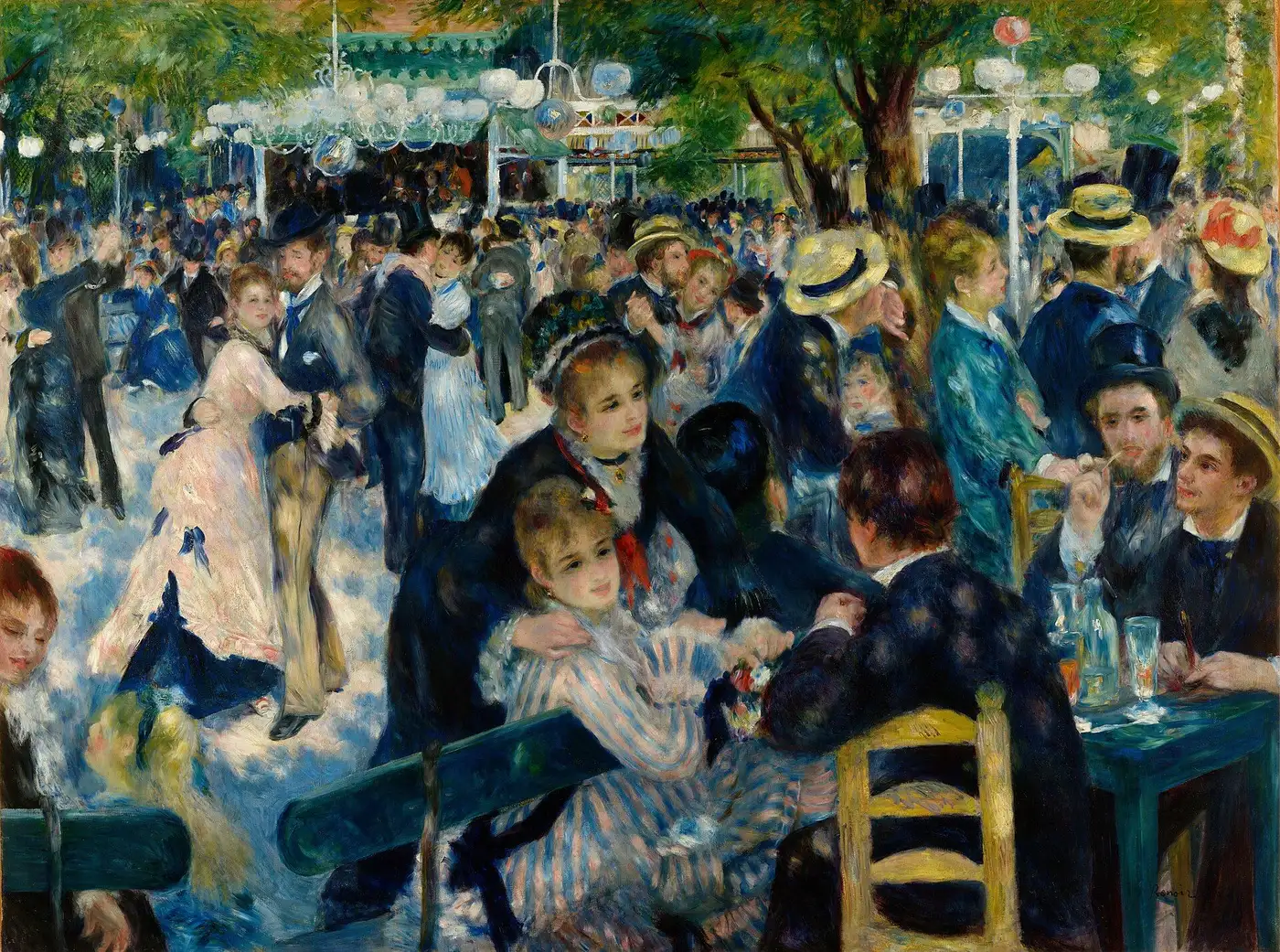
On 17 May 1990 the smaller version of Bal du moulin de la Galette sold at Sotheby's New York for $78.1 million to the Japanese businessman Ryoei Saito. Thirty-six years later that is still Renoir's auction record, unbeaten through several cycles of the market. The large version hangs at the Musée d'Orsay, which counted 3.78 million visitors in 2025.
Renoir sells as a reproduction for reasons that have little to do with auction prices. His subjects are people enjoying themselves outdoors: dances, lunches, riverbanks, children. He is also, unlike Klimt or Leonardo, conveniently shaped — four of the six pictures below sit inside the 1.19 to 1.37 band that the standard 24 × 20, 30 × 24 and 40 × 30 in stretchers cover, so they can be ordered without distorting the composition.
The catch is that Renoir's warmth is very easy to overcook, and a bad Renoir copy is worse than a bad copy of almost anyone else. It tips into sentimentality on its own.
What a faithful copy must get right
Feathered edges: nothing has a contour
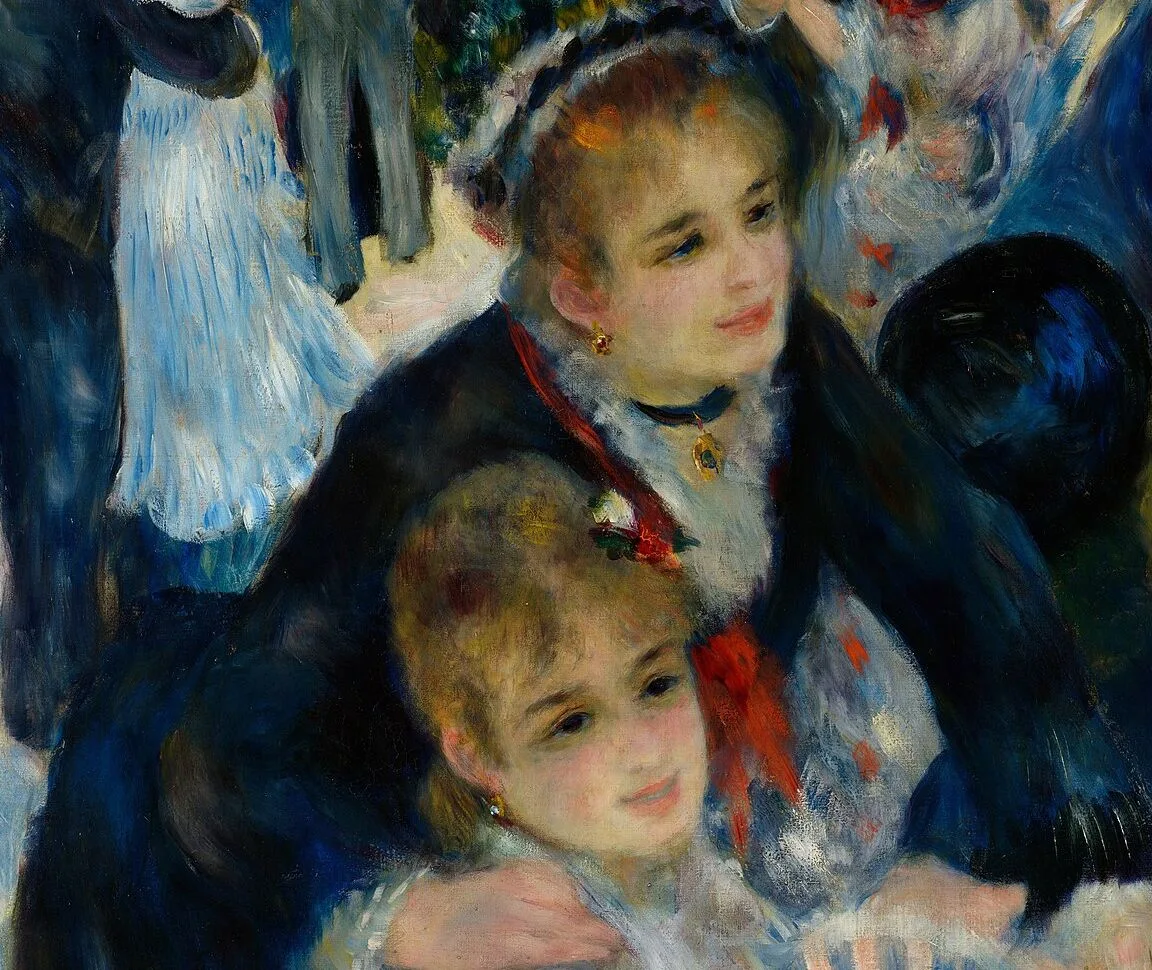
In the Impressionist decade Renoir dissolved the boundary between every form and its surroundings. A cheek meets a bonnet through a run of small overlapping strokes carrying colour from both; a dancer's shoulder is separated from the crowd behind it only by a change of temperature. There is no line, and there is barely an edge. This is the entire visual identity of his best-known pictures, and it is the first thing a copyist destroys, because a soft edge looks like an unfinished edge to anyone who has not studied the original.
Flesh is not pink
Renoir's skin is built from cream, pale yellow, coral and — critically — cool green and blue-violet in the shadows and at the turning edges. The famous "Renoir glow" is a temperature contrast, not a hue. Copyists who mix a warm flesh tone and shade it with brown produce the pink, doll-like Renoir that gives him his bad reputation. If there is no green anywhere in the shadowed side of a face, the copy is wrong.
Dappled light is patches, not gradients
The sunlight falling through the trees at the Moulin de la Galette is painted as discrete blobs of warm light sitting on cool shadow, including on faces and on the backs of jackets. Copyists smooth those into gradients because blobs on a face look like a mistake. Smoothed, the picture loses its subject — it is a painting about outdoor light, and the light stops moving.
Which Renoir period is being copied
After a trip to Italy in 1881 Renoir spent several years painting with hard contours and cooler, drier surfaces — the so-called Ingresque or manière aigre period, of which The Umbrellas is partly an example. A studio that applies the soft 1876 technique to an 1885 picture, or the reverse, has made a plausible-looking painting of the wrong artist. Say which year you want.
Most requested works
Difficulty is this site's rating, 1 to 5: 1 means a competent copyist gets it right first time; 5 means the failure is obvious to anyone who knows the original. Prices are Art & See's published unframed list prices for the nearest standard canvas.
| Work | Year | Museum | Original size | Difficulty | Reproduction price range |
|---|---|---|---|---|---|
| Bal du moulin de la Galette | 1876 | Musée d'Orsay, Paris | 131.5 × 176.5 cm | 5 | $299.95 (20 × 16 in) – $599.95 (48 × 36 in) |
| Luncheon of the Boating Party | 1880–81 | The Phillips Collection, Washington | 130.2 × 175.6 cm | 5 | $299.95 (20 × 16 in) – $599.95 (48 × 36 in) |
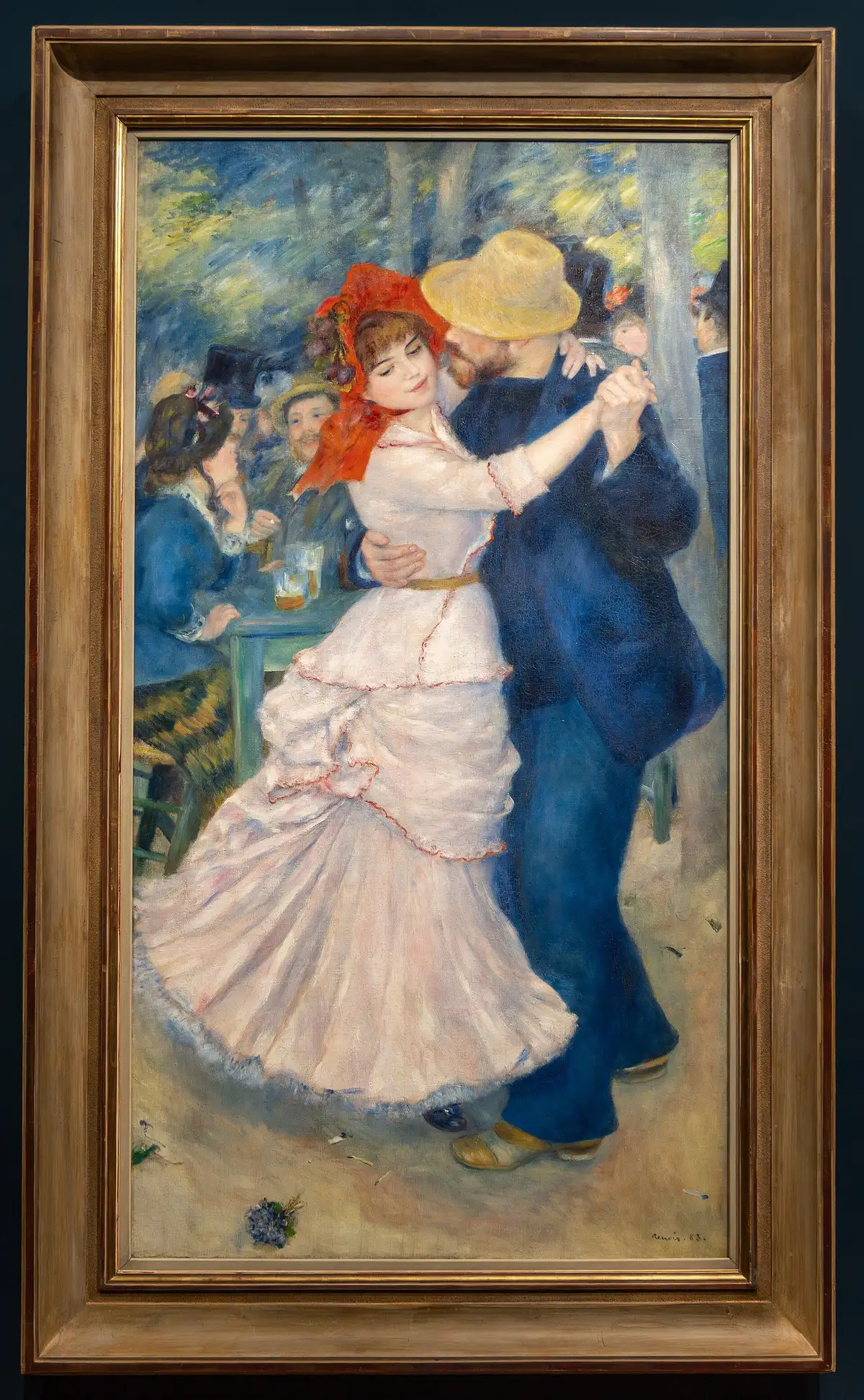
| Dance at Bougival | 1883 | Museum of Fine Arts, Boston | 181.9 × 98.1 cm | 4 | No stock canvas at 1.85:1 — custom order |
| Two Sisters (On the Terrace) | 1881 | Art Institute of Chicago | 100.4 × 80.9 cm | 4 | $299.95 (16 × 20 in) – $529.95 (30 × 40 in) |
| Girls at the Piano | 1892 | Musée d'Orsay, Paris | 116 × 90 cm | 3 | $299.95 (16 × 20 in) – $529.95 (30 × 40 in) |
| The Umbrellas | c. 1880–86 | The National Gallery, London | 180.3 × 114.9 cm | 4 | 1.57:1 — nearest is 60 × 40 in at 1.50, $769.95 |
Dimensions from the holding institutions, each record read 2026-09-05: Musée d'Orsay (RF 2739, "H. 131,5 ; L. 176,5 cm"), the Art Institute of Chicago collection API (Two Sisters), the Phillips Collection, the National Gallery London and Wikidata for Dance at Bougival. Reproduction prices from Art & See's public product pages, same date. The standard rectangles are 1.20, 1.25, 1.33 and — at 60 × 40 in ($769.95) and 72 × 48 in ($1,299.95) — 1.50.
Dance at Bougival is the one most people ask for and the one hardest to buy honestly: at 181.9 × 98.1 cm it is nearly twice as tall as it is wide, and no standard stretcher is that shape. Art & See's public catalogue did not return it as a product when checked on 2026-09-05; the Renoir search results are the place to look for the pictures that are stocked.
Common mistakes in cheap copies
- Outlined faces. The defining failure. A traceable jawline where Renoir painted none.
- Pink flesh with brown shadows. No green, no violet, no temperature change — the doll-like Renoir.
- Smoothed dappled light. Patches of sun turned into soft gradients, so the picture stops being about light.
- Prettified expressions. Renoir's faces are specific and often slightly awkward; copies make everyone conventionally attractive and the crowd turns generic.
- Uniform finish. In the originals the foreground figures are worked and the background is left loose. Copies that finish everything to the same degree flatten the space.
- The wrong Moulin de la Galette. There are two versions. The Musée d'Orsay canvas is 131.5 × 176.5 cm; the smaller one that set the auction record is a different painting. Confirm which by size and museum.
Sizes that work at home
Renoir's crowd scenes have a minimum viable size, and it is larger than most people expect. Bal du moulin de la Galette contains around fifty figures across 176.5 cm. Reduce it to a 20 × 16 in canvas and each head is roughly a centimetre across, at which point the faces become marks and the picture becomes wallpaper. The single-figure and two-figure pictures have no such problem.
- Crowd scenes: 48 × 36 in (121.9 × 91.4 cm), $599.95. 69 % of the Orsay canvas on its long side. The smallest size at which the Moulin de la Galette and the Luncheon still work as pictures rather than patterns.
- Crowd scenes, minimum: 40 × 30 in (101.6 × 76.2 cm), $529.95. 58 % on the long side. Acceptable in a room where you can stand close. Below this, choose a different painting.
- Two Sisters at 30 × 40 in (76.2 × 101.6 cm), $529.95. 101 % of the original on the long side — as near life size as the ladder allows, and almost exactly the right proportion.
- Girls at the Piano at 24 × 30 in (61 × 76.2 cm), $430.95. 66 % on the long side. A quiet picture that suits a smaller wall.
- Dance at Bougival. Custom only. Around 150 × 81 cm keeps the 1.85 proportion at a domestic scale; expect a bespoke quote rather than a list price.
Light Renoir warm and diffuse. Cool light kills the whole effect, because the picture's structure depends on warm light against cool shadow and a 5000 K lamp cancels half of that out.
Where to buy
Three routes for a hand-painted Renoir, with what each is genuinely better at. Checked 2026-09-05.
Hand-painted oil on canvas up to 48 × 36 in at $599.95 — the size the crowd scenes actually need — with a photograph of the finished piece for approval before shipping, which is when to check whether the faces have been outlined.
Art & See- Reproduction Gallery — Lists 301 Renoir titles from $299 across 11 pages (counted 2026-09-05) and quotes for non-standard shapes — catalogue breadth is where it beats Art & See, and it is the practical route to Dance at Bougival in its real proportion.
- A Dafen workshop, ordered direct — Cheapest by a wide margin, and Renoir is among the most-painted subjects in the workshops; the risk is that speed pushes copyists towards hard edges and pink flesh, which are exactly Renoir's failure modes.
Copyright status
Pierre-Auguste Renoir died on 3 December 1919. Copyright in his paintings expired in the life-plus-70 countries on 1 January 1990, and his work is free in the United States. There is no rights holder, no licence and no royalty on a Renoir reproduction anywhere in the world.
One caution that is specific to Renoir: he is among the most forged painters of the modern era, partly because his output was very large and partly because his late studio involved assistants. That is a problem for the original market, not for you. A reproduction sold openly as a reproduction is not a forgery, and it carries no attribution risk at all, which is one of the quiet advantages of buying a copy honestly.
The general framework, including how a copy must be described, is in are oil painting reproductions legal.
Frequently asked questions
Are Renoir reproductions legal?
Yes, everywhere. He died in 1919, so his work has been out of copyright in the EU and UK since 1990 and is free in the US. No licence, no royalty. The only rule is that a copy must be sold as a copy.
Why do cheap Renoir copies look like greeting cards?
Two reasons, both fixable. The edges get outlined, so figures look cut out instead of dissolving into the scene, and the flesh is painted pink and shaded with brown instead of built from warm lights against cool green-violet shadows. Ask for both to be corrected on the preview photograph.
How big does the Moulin de la Galette need to be?
At least 40 × 30 in, and 48 × 36 in if the wall allows. The original is 131.5 × 176.5 cm with about fifty figures in it. At 20 × 16 in each head is roughly a centimetre wide and the crowd stops being readable as people.
Can I buy Dance at Bougival at a normal price?
Rarely. Its proportion is 1.85:1 — 181.9 × 98.1 cm — and the longest standard stretcher is 1.50:1, at 60 × 40 in. It needs a bespoke frame and a bespoke quote; Art & See's custom-orders page does state that custom dimensions are available on request. Sellers who list it at a standard price have usually cropped the top and bottom, which removes the ground and the sky the composition depends on.
Sources
- Most expensive painting by Renoir sold at auction — $78.1 million, 17 May 1990 — Guinness World Records. Accessed September 5, 2026.
- Bal du moulin de la Galette, 1876, RF 2739 — collection record giving H. 131,5 ; L. 176,5 cm — Musée d'Orsay. Accessed September 5, 2026.
- Two Sisters (On the Terrace), 1881 — collection API record, 100.4 × 80.9 cm — Art Institute of Chicago collection API. Accessed September 5, 2026.
- Luncheon of the Boating Party, 1880–81 — collection record — The Phillips Collection. Accessed September 5, 2026.
- Fréquentation 2025 du musée d'Orsay — 3,78 millions de visiteurs — France Info. Accessed September 5, 2026.
- Pierre-Auguste Renoir artist page — 301 titles listed from $299, benchmark for catalogue depth — Reproduction Gallery. Accessed September 5, 2026.
Keep reading
painting
Dance at Bougival reproduction: a tall canvas no stock size fits
Renoir's Dance at Bougival is 181.9 x 98.1 cm — a 1.85:1 upright no standard canvas fits. What to order, what it costs, what copies miss.
catalog
The 20 most popular oil painting reproductions, and what each one costs to copy well
The 20 paintings ordered most often, cross-checked against five stores' own bestseller lists, with museum, original size, difficulty and price for each.
legal
Are Oil Painting Reproductions Legal?
Yes for public-domain paintings, no for artists still in copyright. Country rules, 21 artists with dates, and the line between a copy and a forgery.
buying
Museum Quality Oil Painting Reproductions: What to Check Before Ordering
A sourced checklist for materials, finished-painting approval, cancellation and returns, with policy exceptions and limits of visual checks.
price
How much do oil painting reproductions cost?
Compare equivalent sizes, finishes, shipping and payment terms with a dated total-cost worksheet. Unknown charges stay visible instead of becoming zero.