artist
Monet Reproductions: What a Good Copy Has to Get Right
Which Monet paintings reproduce well in oil, why broken colour defeats cheap copyists, plus original sizes, difficulty, prices and copyright.
Oil Painting ReproductionsUpdated
The short answer
Monet copies fail on colour, not on drawing. The originals are built from dozens of unmixed hues laid side by side; cheap copies average them on the palette and go grey. Expect $249.95 to $599.95 unframed at common wall sizes; buy the square formats.
Why Monet is reproduced so often
In May 2019 one of Monet's Meules (haystacks) sold at Sotheby's New York for $110.7 million — a record for the artist and the first Impressionist painting to pass $100 million at auction. The Musée d'Orsay, which holds the largest single group of his work, counted 3.78 million visitors in 2025. Monet is the default answer to "what should go above the sofa", and he has been for fifty years.
For a reproduction buyer he has two specific advantages. His subjects are almost all landscape, water and weather, which means a copy carries no likeness to get wrong — no face, no hands, no anatomy. And a large share of his best-known pictures are close to square, which happens to match the cheapest rung of every reproduction price ladder. A Water Lilies panel at 89.9 × 94.1 cm maps onto a 36 × 36 inch canvas with almost no distortion.
The disadvantage is that Monet is genuinely hard to copy, and the failure mode is subtle enough that a lot of buyers never notice they were sold something worse than they paid for.
What a faithful copy must get right
Broken colour: many hues, none of them mixed
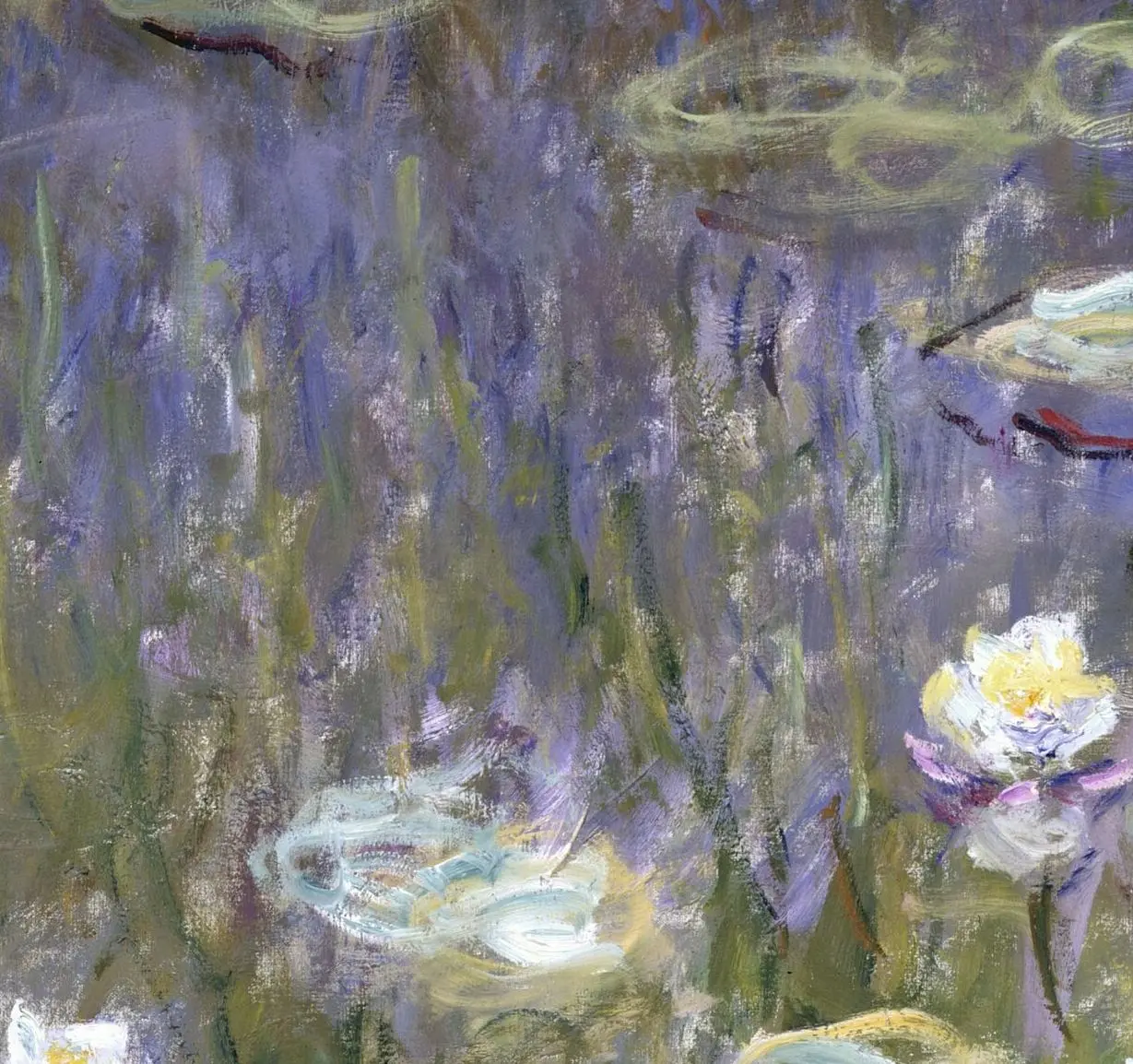
From the 1870s Monet built a surface out of small strokes of separate, largely unmixed colour placed next to each other, and let the eye do the blending. A patch of water that reads as blue-green at three metres is, up close, violet, pink, cream, olive and cobalt sitting side by side. Once a copyist mixes those on the palette to the average tone and lays it down as one colour, the picture becomes correct in a photograph and dead in the room. This is the single dividing line between a Monet copy that works and one that does not.
Wet-into-wet, and knowing when not to
The outdoor pictures of the 1870s and 1880s were largely worked wet-into-wet in one or two sittings, so strokes drag and pick up the colour beneath them. The late Nymphéas are the opposite: reworked over months, with dried layers scraped and painted over. A studio that treats every Monet the same way will make the early pictures look laboured and the late ones look thin. Ask which approach they used.
No black, and coloured shadows
Monet dropped black from his palette in his mature years and built dark passages out of deep blues, violets and greens. A shadow painted with black plus a hue is instantly recognisable — it goes chalky as it dries and sits in front of the picture instead of inside it. It is worth asking a studio directly whether black is on the palette for a Monet commission.
Most requested works
Difficulty is this site's rating, 1 to 5: 1 means a competent copyist gets it right first time; 5 means the failure is obvious to anyone who knows the original. Reproduction prices are Art & See's published unframed list prices for the nearest standard canvas.
| Work | Year | Museum | Original size | Difficulty | Reproduction price range |
|---|---|---|---|---|---|
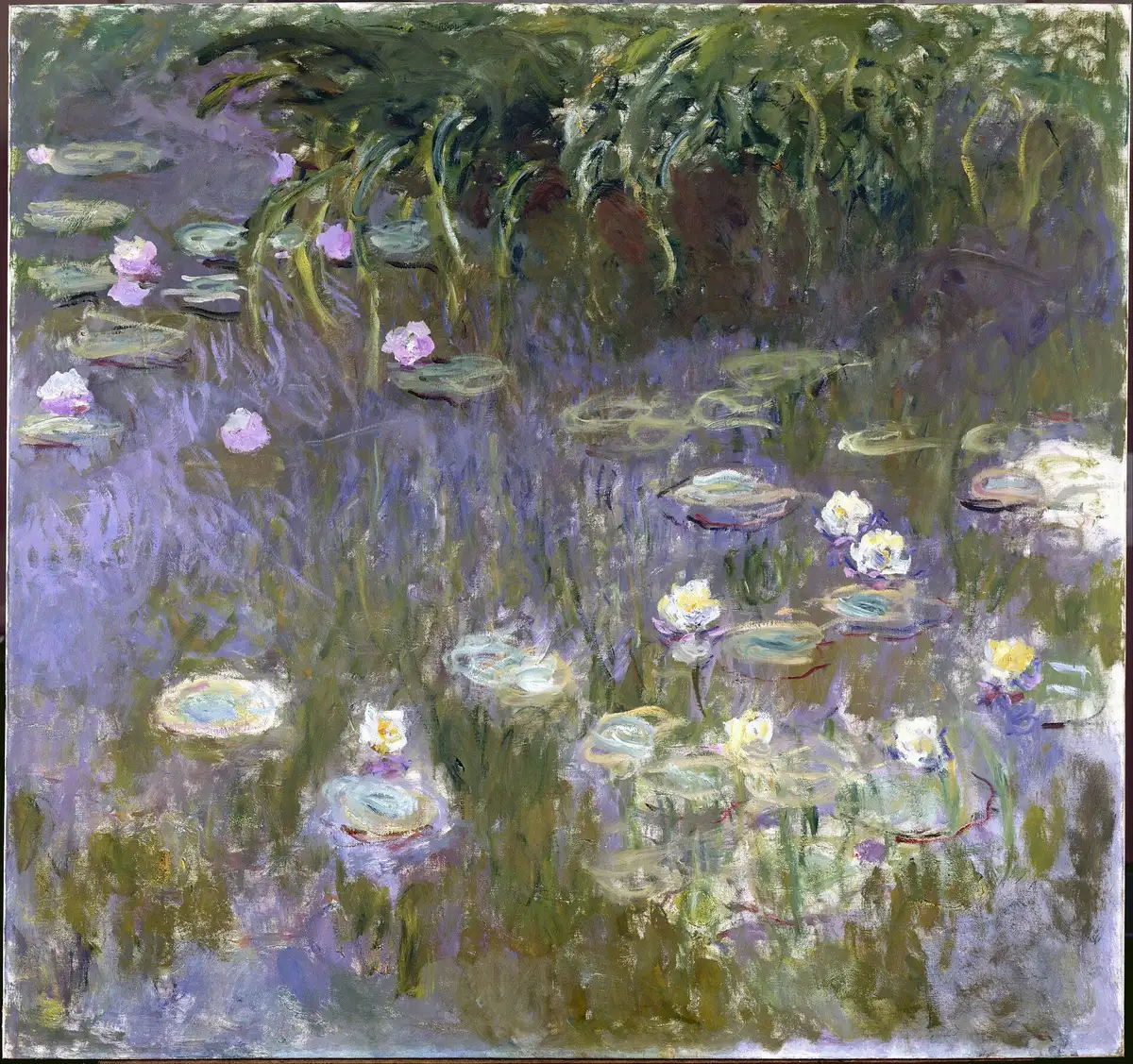
| Water Lilies | 1906 | Art Institute of Chicago | 89.9 × 94.1 cm | 5 | $249.95 (16 × 16 in) – $549.95 (36 × 36 in) |
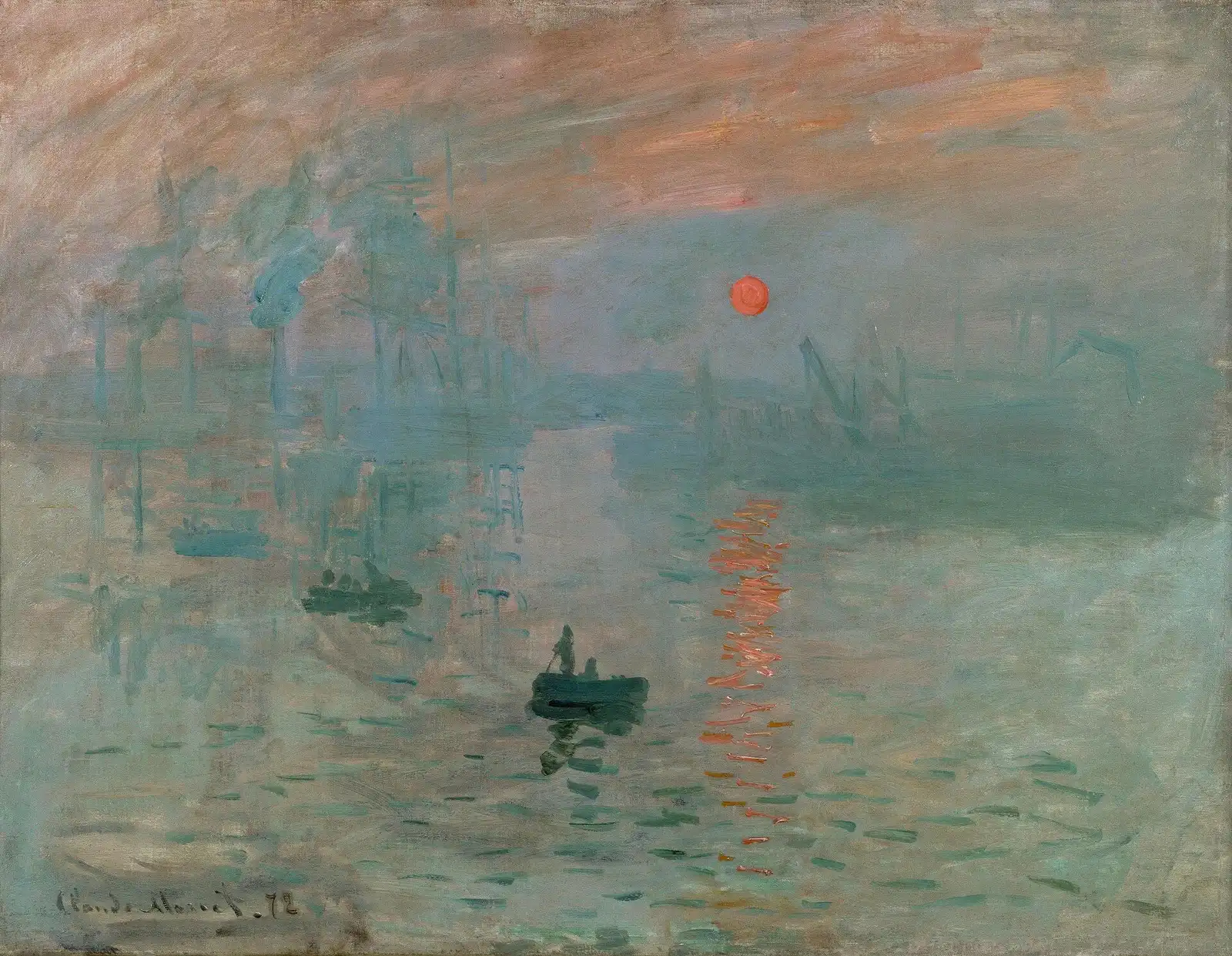
| Impression, Sunrise | 1872 | Musée Marmottan Monet, Paris | 50 × 65 cm | 3 | $299.95 (20 × 16 in) – $599.95 (48 × 36 in) |
| Water Lily Pond (Japanese Bridge) | 1900 | Art Institute of Chicago | 89.8 × 101 cm | 4 | $299.95 (20 × 16 in) – $599.95 (48 × 36 in) |
| Poppy Field, near Argenteuil | 1873 | Musée d'Orsay, Paris | 50 × 65 cm | 3 | $299.95 (20 × 16 in) – $599.95 (48 × 36 in) |
| Stacks of Wheat (End of Summer) | 1890–91 | Art Institute of Chicago | 60 × 100.5 cm | 4 | 1.68:1 — nearest is 60 × 40 in at 1.50, $769.95 |
| Cliff Walk at Pourville | 1882 | Art Institute of Chicago | 66.5 × 82.3 cm | 3 | $299.95 (20 × 16 in) – $529.95 (40 × 30 in) |
Dimensions from the Art Institute of Chicago collection API and the Musée Marmottan Monet's own record for inv. 4014, both read 2026-09-05. Reproduction prices from Art & See's public product pages, same date. The standard rectangles are 1.20, 1.25, 1.33 and — at 60 × 40 in and 72 × 48 in — 1.50; anything longer needs a bespoke stretcher.
Art & See's Claude Monet collection carries the water-lily subjects at $249.95 for the smallest square. Note the shape trap: the great Nymphéas panels in the Orangerie are about 2 metres high and up to 17 metres long. Nothing on a standard price ladder can hold that composition, so what is sold as "Water Lilies" is always one of the easel-sized canvases, not the panoramas.
Common mistakes in cheap copies
- Averaged colour. The defining failure. Twelve hues become one, and the water goes flat teal.
- Black in the shadows. Chalky, dead darks that sit on the surface rather than receding.
- Too much contrast. Copies made from screen images inherit the boosted contrast of a web JPEG. Monet's actual value range is narrow, especially in the fog and Thames pictures.
- Hard lily pads. The pads in the late pictures are painted as broken ellipses that half-dissolve. Copyists outline them, and the pond turns into a diagram of a pond.
- A tidy surface. Monet's canvases are physically uneven — scraped areas, dried layers overpainted, brush drag. A uniformly smooth Monet has been finished by someone who was thinking about a customer, not about the picture.
- Wrong picture entirely. "Water Lilies" is a series title covering scores of separate canvases, not the name of one painting. Confirm the exact picture by museum, year and dimensions before ordering, never by the title alone.
Sizes that work at home
Broken colour needs distance to do its work. The optical mixing that makes a Monet glow happens at roughly four to six times the width of the canvas, which is why a Monet in a narrow hallway never looks right no matter how good the copy is. Measure how far back you can stand before you choose a size.
- 24 × 24 in (61 × 61 cm), $380.95. Needs about 2.5 m of viewing distance. The smallest size at which a square Water Lilies still reads as a pond rather than a pattern.
- 30 × 30 in (76.2 × 76.2 cm), $479.95. 81 % of the Art Institute's 1906 canvas on its long side. The closest match on the ladder to a real easel-scale Monet.
- 36 × 36 in (91.4 × 91.4 cm), $549.95. Within 3 % of the 1906 canvas on both sides — the nearest thing to full size on the ladder. Works in a room where you can stand 3.5 m back.
- 40 × 30 in (101.6 × 76.2 cm), $529.95. The landscape option — right for Impression, Sunrise, Poppy Field and the wheat stacks, all of which sit near a 1.3 proportion.
One warning about Impression, Sunrise specifically: the Marmottan's own record (inv. 4014) gives 50 × 65 cm without the frame, roughly the size of a laptop opened flat. Ordered at 40 × 30 in you are looking at a picture enlarged 1.6 times on each side — 101.6 cm against 65 — which turns Monet's quick strokes into wide bands. It is one of the few famous paintings that is genuinely better bought small.
Where to buy
Three routes for a hand-painted Monet, and what each is actually good at. Checked 2026-09-05.
Hand-painted oil on canvas, square formats from $249.95, and a photograph of the finished painting sent for approval before it ships — the only remote way to check whether the colour was broken or averaged.
Art & See- Reproduction Gallery — Lists 614 Monet titles from $299 across 21 pages (counted 2026-09-05), which matters because so many of his pictures come in series — if you want a specific Rouen Cathedral or a specific Haystack rather than a famous one, catalogue breadth is where it beats Art & See.
- A Dafen workshop, ordered direct — Cheapest route by a wide margin, and Monet is the subject most workshops have painted most often; you take on the quality risk and the returns problem yourself.
Copyright status
Monet died on 5 December 1926. Copyright expired in the life-plus-70 countries on 1 January 1997 and his pre-1930 work is free in the United States as well. No permission, no royalty, no rights holder to approach. Every Monet reproduction sold today is legal on the copyright question, wherever it was painted.
What is not automatically legal is the description. A copy must be sold as a copy. Some museums also assert rights in their own photographs of the paintings — that constrains reusing an image file, not painting from one. The general framework is set out in are oil painting reproductions legal.
Because there is no licence cost anywhere in the chain, a price difference between two Monet sellers is a difference in labour and materials only. That is worth remembering when a store implies its prices reflect "authorised" status. There is nothing to authorise.
Frequently asked questions
Are Monet reproductions legal?
Yes. Monet died in 1926 and his work has been in the public domain in the EU and UK since 1997, and in the US for his pre-1930 paintings. No licence is needed to paint or sell a copy — only honest description.
Which Monet reproduces best?
The square Water Lilies canvases and the Japanese Bridge pictures, because they need no likeness, they match standard square canvases almost exactly, and the subject tolerates small deviations. Impression, Sunrise is the most misjudged: at 50 × 65 cm the original is tiny, and it loses more than most pictures when enlarged.
How can I tell a good Monet copy from a cheap one in a photograph?
Zoom in on a patch of water. If you can count four or five distinct unmixed colours inside a two-centimetre square, the copyist worked the way Monet did. If it is one blended tone with a highlight, the colour was averaged on the palette, and the painting will look flat in the room however good the drawing is.
What does a hand-painted Monet cost?
On Art & See's published ladder, $249.95 for 16 × 16 in and $599.95 for 48 × 36 in, unframed, free worldwide shipping, 2–3 weeks of production; the ladder runs on to $769.95 at 60 × 40 in and $1,299.95 at 72 × 48 in (collected 2026-09-05). Direct-from-workshop prices run far lower and specialist studios far higher; see how much oil painting reproductions cost.
Can I get a Water Lilies at the size of the ones in the Orangerie?
No, and no standard seller offers it. The Orangerie panels are around 2 metres tall and up to 17 metres long. Every commercially sold Water Lilies reproduction is based on one of the easel-scale canvases, typically between 80 and 100 cm square.
Sources
- Monet's Meules sells for $110.7 million, a new artist record — Sotheby's. Accessed September 5, 2026.
- Fréquentation 2025: 3,78 millions de visiteurs au musée d'Orsay — France Info. Accessed September 5, 2026.
- Claude Monet, Water Lilies, 1906 — collection API record, 89.9 × 94.1 cm — Art Institute of Chicago collection API. Accessed September 5, 2026.
- Claude Monet, Stacks of Wheat (End of Summer), 1890–91 — collection API record, 60 × 100.5 cm — Art Institute of Chicago collection API. Accessed September 5, 2026.
- Impression, soleil levant, inv. 4014 — the museum record giving H. 50 cm, l. 65 cm without the frame — Musée Marmottan Monet. Accessed September 5, 2026.
- Claude Monet artist page — catalogue depth benchmark — Reproduction Gallery. Accessed September 5, 2026.
Keep reading
painting
Water Lilies reproduction: which one you are actually ordering
Monet painted around 250 Water Lilies. Naming the museum and the year is the difference between the picture you want and whatever the studio has on file.
painting
Impression, Sunrise reproduction: the sun is not brighter than the sky
Measured on the Commons file, Monet's sun is slightly darker than the sky around it. Copies that brighten it break the painting. Sizes, prices, checks.
painting
Poppy Field reproduction: Monet's smallest famous painting
Monet's Les Coquelicots is only 50 x 65 cm and hung at the first Impressionist show. What an oil copy gets right, what it gets wrong, and prices.
catalog
The 20 most popular oil painting reproductions, and what each one costs to copy well
The 20 paintings ordered most often, cross-checked against five stores' own bestseller lists, with museum, original size, difficulty and price for each.
legal
Are Oil Painting Reproductions Legal?
Yes for public-domain paintings, no for artists still in copyright. Country rules, 21 artists with dates, and the line between a copy and a forgery.
buying
Museum Quality Oil Painting Reproductions: What to Check Before Ordering
A sourced checklist for materials, finished-painting approval, cancellation and returns, with policy exceptions and limits of visual checks.