painting
Impression, Sunrise reproduction: the sun is not brighter than the sky
Measured on the Commons file, Monet's sun is slightly darker than the sky around it. Copies that brighten it break the painting. Sizes, prices, checks.
Oil Painting ReproductionsUpdated
The short answer
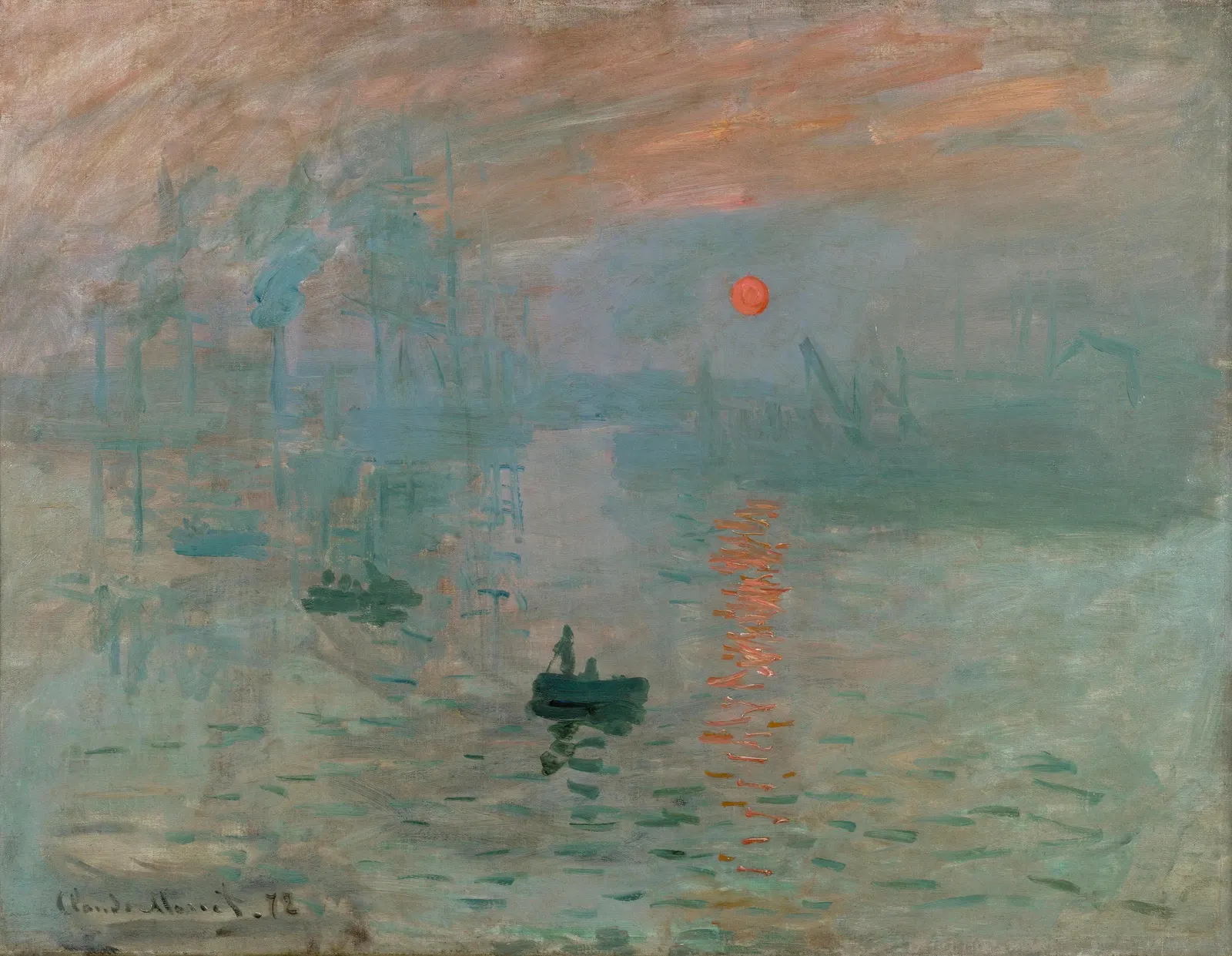
The painting that named Impressionism is small, thin and fast: 50 × 65 cm, one campaign, and a sun almost exactly as bright as the mist behind it. Copies that make the sun glow are copying a sunrise, not this painting.
The painting in numbers
| The original | What it means for a reproduction | |
|---|---|---|
| Year | 1872, the harbour at Le Havre | Monet died in 1926; the painting is public domain. |
| Where it is | Musee Marmottan Monet, Paris | The museum records it as 50 × 65 cm unframed, 75 × 91 × 10 cm in its frame. |
| Medium | Oil on canvas, thinly painted in a single campaign | Very little paint. A thick, laboured copy is wrong before the colour is judged. |
| Original size | 50 × 65 cm (19.7 × 25.6 in) | Small. A 20 × 16 in canvas is already close, and 40 × 30 in is more than double. |
| Aspect ratio | 1.3 : 1, landscape | A 40 × 30 in canvas is 1.33:1, the closest common size. |
| Title | Monet's own title gave the Impressionist movement its name after the 1874 exhibition | Stores list it under three spellings; search Impression, soleil levant as well. |
Dimensions from the Musee Marmottan Monet collection record, checked 2026-09-05.
Why it is hard to reproduce
The sun does not glow because it is bright. It glows because it is a strong warm hue sitting on a cool ground of nearly the same lightness, so the eye cannot fix its edge. Sampling the Wikimedia Commons file used on this page, Monet - Impression, Sunrise.jpg, bears this out: a 108-pixel square on the sun disc and three matched squares in the surrounding mist give a Rec. 709 luminance of about 121 for the sun against 128 to 134 for the sky. The sun is very slightly darker than the mist it sits in. The exact figures shift by a few points with the size of the sample; the direction does not.
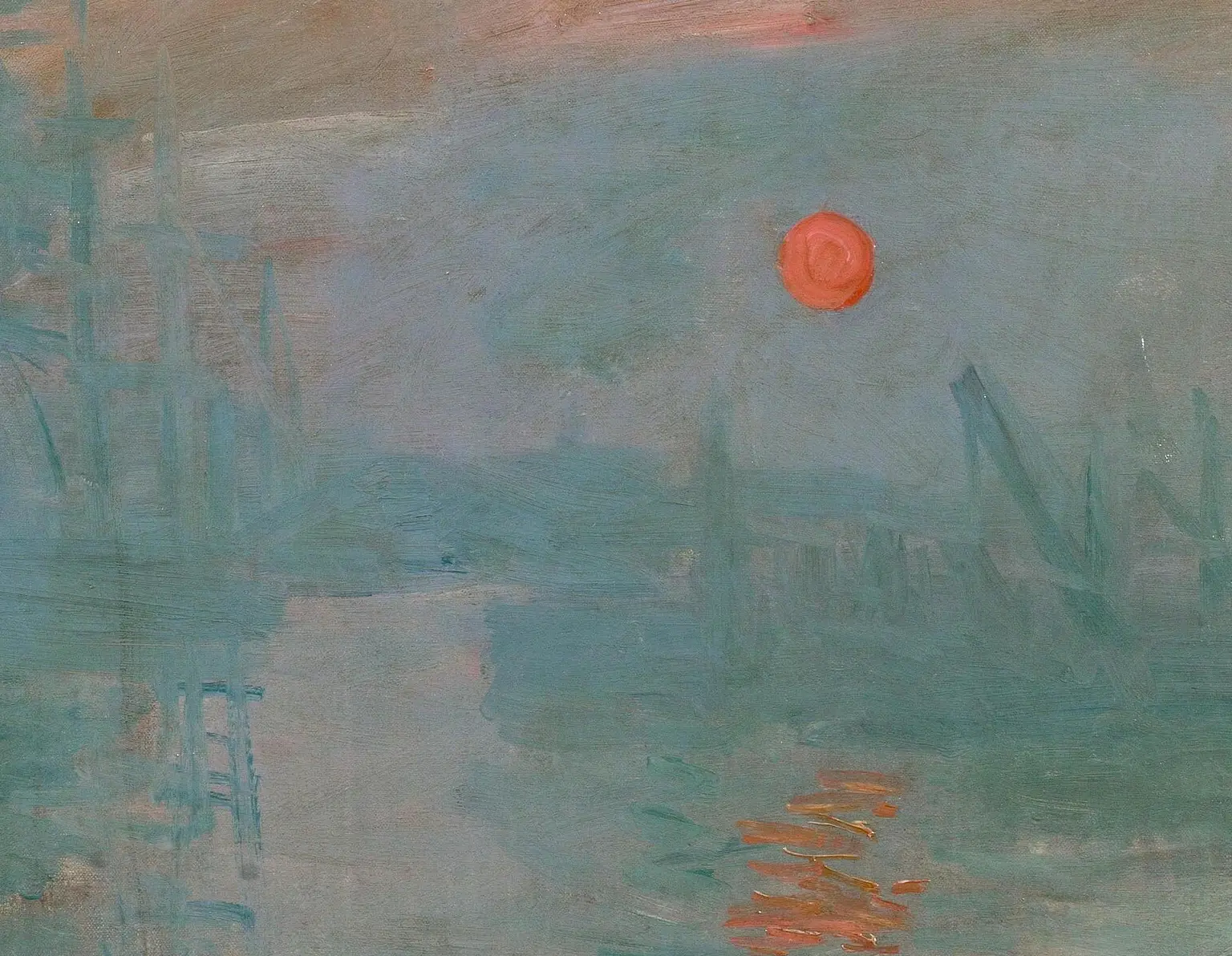
- Thin paint. Most of the canvas is a single layer with the ground showing through. Copyists trained on impasto add body, and the mist turns solid.
- Almost no drawing. The masts, cranes and boats are a handful of dry strokes. Painting them accurately makes them too present; the original leaves them ambiguous.
- One campaign. The picture was made quickly and looks it. Reworking any passage destroys the quality that the 1874 critics attacked it for.
- The reflection is separate marks. The orange trail on the water is a column of short, broken horizontal strokes with grey between them, not a continuous streak.
What cheap copies get wrong
The commonest fault is a brighter sun. A copyist adds white or yellow to the orange to make it read as a light source, and the disc detaches from the mist and sits on the canvas like a sticker. Every subtle thing about the painting depends on it not doing that.
- The sun lightened, yellowed, or given a halo it does not have.
- The mist painted opaquely instead of thinly, so the harbour behind it disappears rather than dissolving.
- The reflection painted as a continuous orange streak instead of separated dabs.
- The boats and cranes drawn in too clearly, which turns an atmosphere into a scene.
- Saturation raised across the board so the picture matches a phone screen, which kills the grey that everything else depends on.
Sizes and where it hangs well
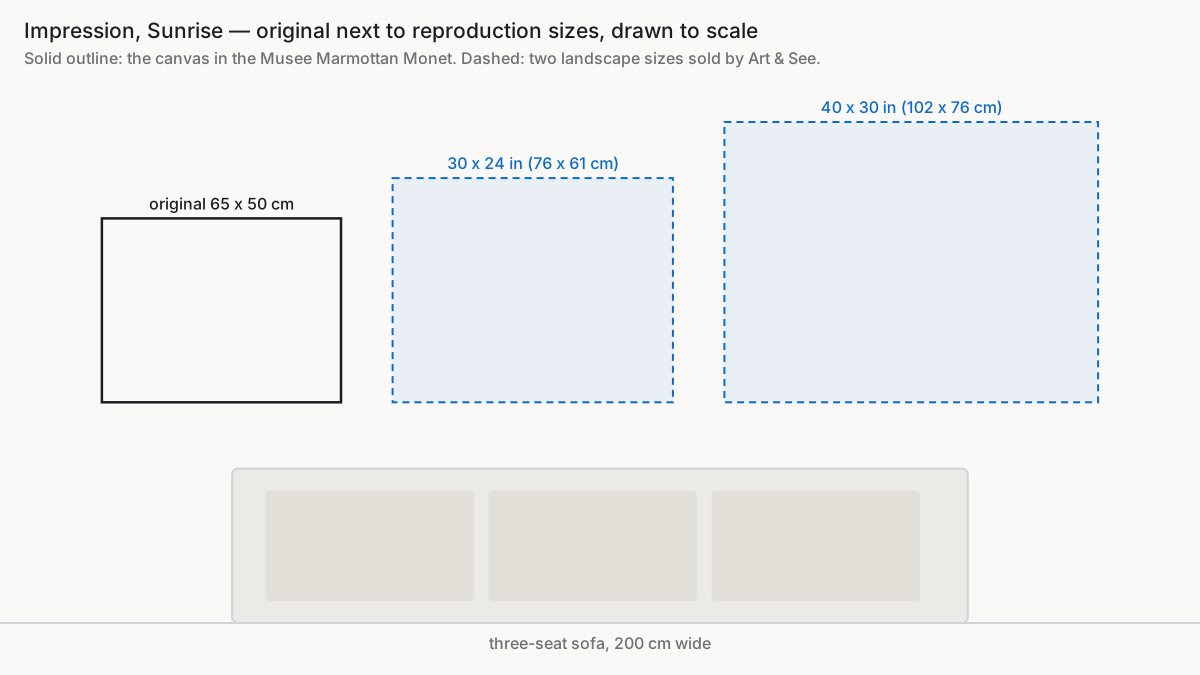
This is a quiet picture and it does not want to be large. At 40 × 30 in the thin paint starts to look empty, because there is not enough incident to fill the area; at 20 × 16 in, close to the original, it holds together. It suits a study, a bedroom or a hallway at close viewing distance, on a wall that is not competing with a window: strong daylight washes out the narrow value range that the whole effect depends on.
Price range
| Size | Art & See list price | Vs the original | Note |
|---|---|---|---|
| 20 × 16 in (51 × 41 cm) | $299.95 | About 80% of the width | Closest to the museum canvas. |
| 24 × 20 in (61 × 51 cm) | $359.95 | About 95% | Ratio 1.2:1, slightly squarer. |
| 30 × 24 in (76 × 61 cm) | $430.95 | About 115% | Ratio 1.25:1; a good compromise. |
| 40 × 30 in (102 × 76 cm) | $529.95 | About 155% | Ratio 1.33:1, closest proportion, but the thin paint starts to thin out. |
| 48 × 36 in (122 × 91 cm) | $599.95 | About 190% | Too large for this picture in most rooms. |
Art & See prices from its published unframed rectangular ladder, verified 2026-09-05; it continues past this table to $769.95 at 60 × 40 in and $1,299.95 at 72 × 48 in. overstockArt listed this subject at $199 on the same date; HandmadePiece ranked it eighth on its top-100 page and ninth on its best-selling page.
Art & See lists Impression, Sunrise as a horizontal painting from $299.95, which is the size closest to the original. It is one of the few famous subjects where the smallest listed canvas is also the right one.
Where to buy
Three routes for a small, thin, quiet painting.
Lists it explicitly with a published ladder and photographs the finished canvas for approval, which is when to run the greyscale check on the sun.
Art & See- overstockArt — Listed this subject at $199 on 2026-09-05, the cheapest of the stores surveyed, and ships from the United States rather than painting to order abroad.
- Musee Marmottan Monet — Holds the painting and publishes its exact dimensions and frame size, which is the record to check against any store listing that claims a different size.
Copyright: what you can and cannot do
Claude Monet died on 5 December 1926, so Impression, Sunrise is out of copyright in the European Union and the United States. You may commission a hand-painted copy, sell it, and hang it in a business. The Musee Marmottan Monet holds rights in its own photography of the painting; the file used on this page is a Wikimedia Commons file carried as public domain.
Frequently asked questions
Why does the sun look so weak in reproductions?
Usually the opposite problem: it looks too strong. In the original the sun is close in lightness to the mist and differs mainly in hue. Measured on the Commons file used here it is about 121 in Rec. 709 luminance against 128 to 134 for the sky, so it is fractionally darker.
What size should I order?
The original is 50 × 65 cm, about 20 × 26 in. A 20 × 16 in canvas is close in width; 30 × 24 in is a comfortable compromise. Above 40 × 30 in the thin, fast paint handling begins to look sparse rather than atmospheric.
Is it worth paying more for this subject than for a Starry Night?
No. This is a quick, thinly painted picture, and studios price by canvas size rather than by difficulty. If a seller charges a premium for this subject specifically, ask what the premium buys.
Sources
- Impression, soleil levant, collection record — Musee Marmottan Monet, Paris. Accessed September 5, 2026.
- Best-selling art reproductions and price ladder — overstockArt. Accessed September 5, 2026.
- Top 100 most famous paintings, ranked listing — HandmadePiece. Accessed September 5, 2026.
- 100 most famous paintings, best-selling reproductions — HandmadePiece. Accessed September 5, 2026.
- How long does copyright protection last? — United States Copyright Office. Accessed September 5, 2026.
- File:Monet - Impression, Sunrise.jpg — Wikimedia Commons. Accessed September 5, 2026.
Keep reading
artist
Monet Reproductions: What a Good Copy Has to Get Right
Which Monet paintings reproduce well in oil, why broken colour defeats cheap copyists, plus original sizes, difficulty, prices and copyright.
catalog
The 20 most popular oil painting reproductions, and what each one costs to copy well
The 20 paintings ordered most often, cross-checked against five stores' own bestseller lists, with museum, original size, difficulty and price for each.
price
How much do oil painting reproductions cost?
Compare equivalent sizes, finishes, shipping and payment terms with a dated total-cost worksheet. Unknown charges stay visible instead of becoming zero.
painting
Water Lilies reproduction: which one you are actually ordering
Monet painted around 250 Water Lilies. Naming the museum and the year is the difference between the picture you want and whatever the studio has on file.