painting
Water Lilies reproduction: which one you are actually ordering
Monet painted around 250 Water Lilies. Naming the museum and the year is the difference between the picture you want and whatever the studio has on file.
Oil Painting ReproductionsUpdated
The short answer
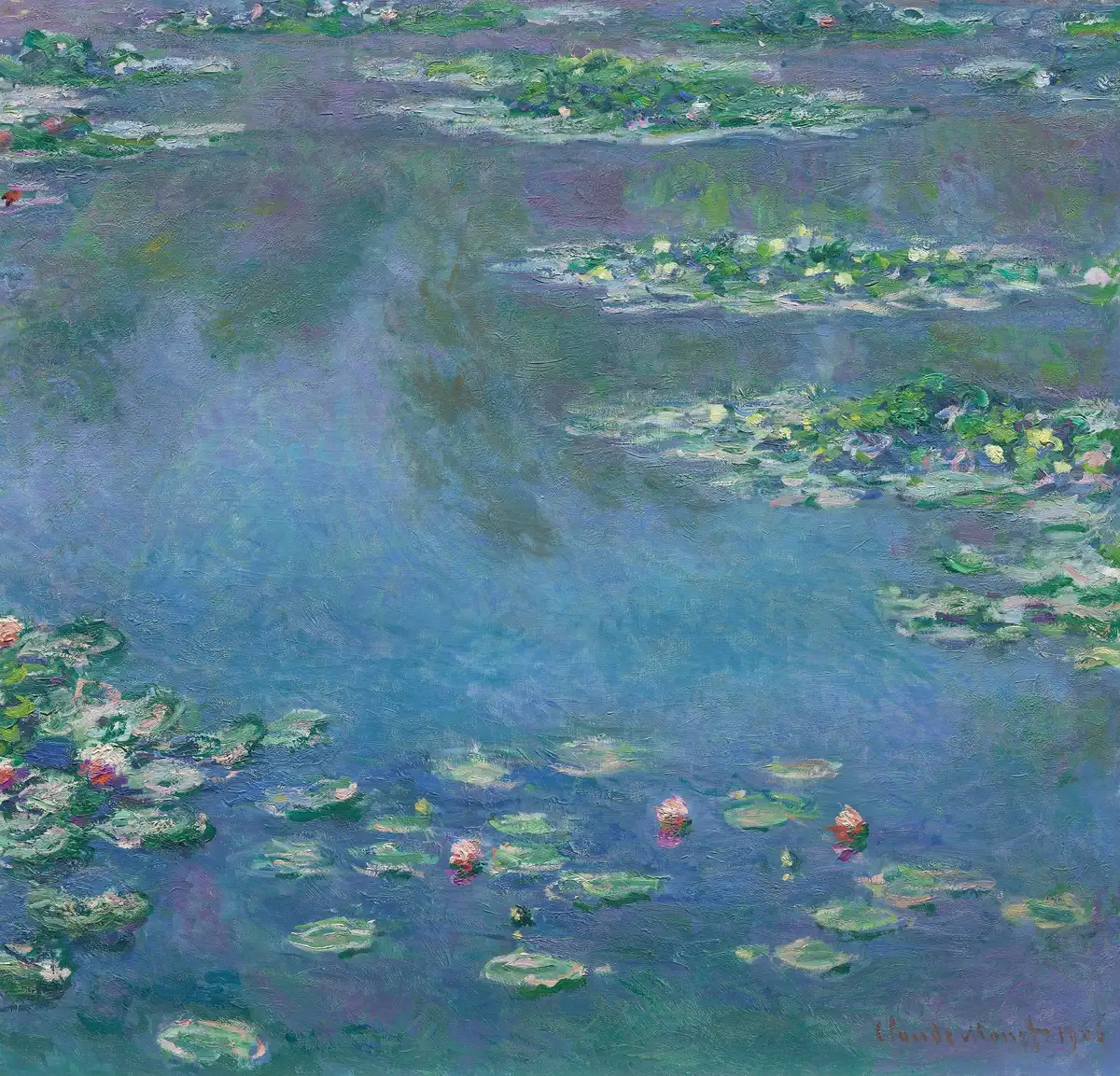
There is no single Water Lilies. The Art Institute of Chicago puts the series at around 250 paintings, made from the late 1890s to Monet's death in 1926, from 90 cm square to two-metre panels. Order by museum and year.
The painting in numbers
| Version | Size and museum | What it looks like | Best reproduction size |
|---|---|---|---|
| Water Lilies, 1906 | 89.9 × 94.1 cm, Art Institute of Chicago | Almost square, no bank, pads in three loose diagonals | 24 × 24 in or 30 × 30 in (the original is 1.05:1) |
| Water Lily Pond, 1900 | 89.8 × 101 cm, Art Institute of Chicago | The Japanese footbridge across the top third | 30 × 24 in; the bridge needs the landscape format |
| Water Lily Pond, 1917–19 | 130.2 × 201.9 cm, Art Institute of Chicago | Wide, near-abstract, willow reflections | 48 × 36 in or larger; below that it becomes a smudge |
| The Orangerie panels, 1914–26 | About 2 m high, eight compositions in two oval rooms, Musee de l'Orangerie | Mural scale, painted to wrap the viewer | Not reproducible as a single canvas at any stock size |
Dimensions from the Art Institute of Chicago collection records, checked 2026-09-05. Monet died in 1926; all versions are public domain.
Why it is hard to reproduce
There is nothing to draw. Take the lily pads out and what remains is a field of violet, green and pink strokes with no horizon, no bank and no object at a known size. A copyist working from a photograph has no landmarks to check proportion against, which is why so many copies drift: the pads end up evenly spaced, the water ends up one colour, and the picture turns into wallpaper.
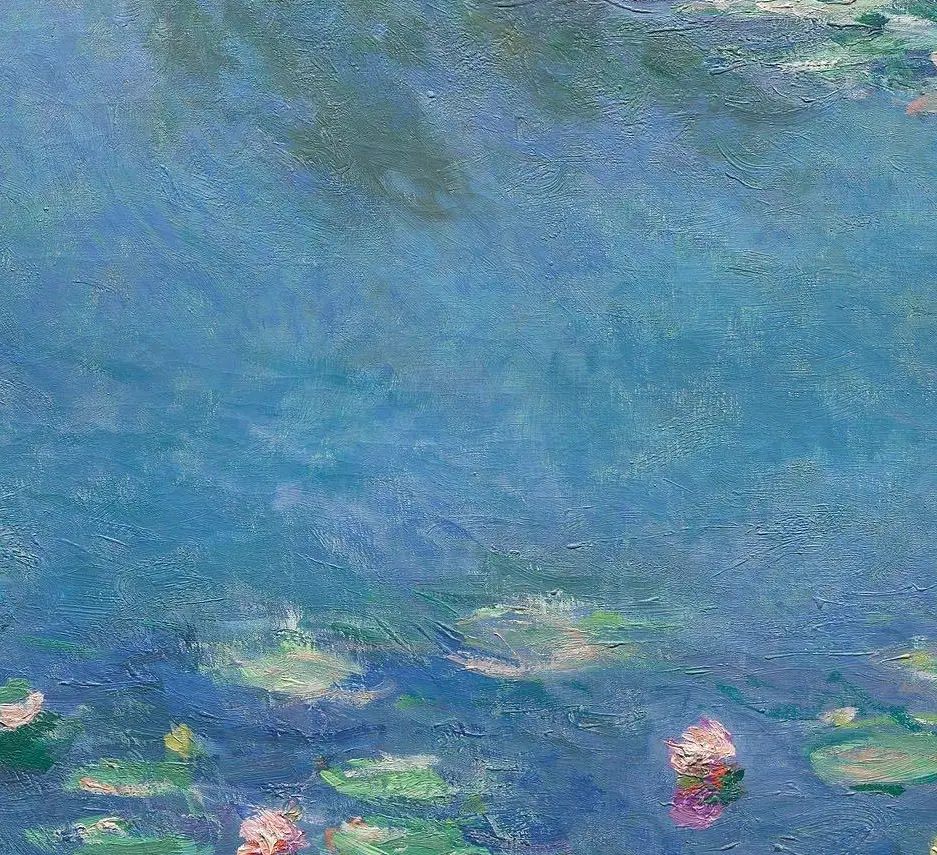
- The surface is built in campaigns. Monet worked the same canvas over months, letting layers dry and painting into them again. A studio copying in one or two sessions gets a single stratum of paint where the original has four, and the colour goes dead.
- The violets are structural. The complements that make the green read as water are laid next to each other, not mixed. Any copyist who blends them for speed produces grey.
- No contours. Every edge in the picture is a change of colour, not a line. Outlining the pads, which is the fastest way to make the shapes read, is also the fastest way to make the copy look like a poster.
- Square-ish format. The 1906 canvas is 1.05:1. On a standard 1.25:1 rectangle the composition has to be stretched or cropped, and the pads lose their diagonal.
What cheap copies get wrong
The commonest fault is inventing a bank. Cheap versions add a strip of green at the top so the picture reads as a landscape, because a pond without a shoreline is uncomfortable to paint. Monet removed exactly that strip on purpose, over twenty years of work.
- A horizon, a bank or a bit of grass added at the top edge.
- Lily pads drawn as clean ellipses with white flowers on top, where the original has many pads that are two strokes and no flower at all.
- Water painted as a single blue-green wash with reflections added afterwards.
- A composite: pads from one version, willow reflections from another, bridge from a third. This is why naming the museum and year matters.
- Saturation pushed up so the picture matches a screen rather than a canvas.
Sizes and where it hangs well
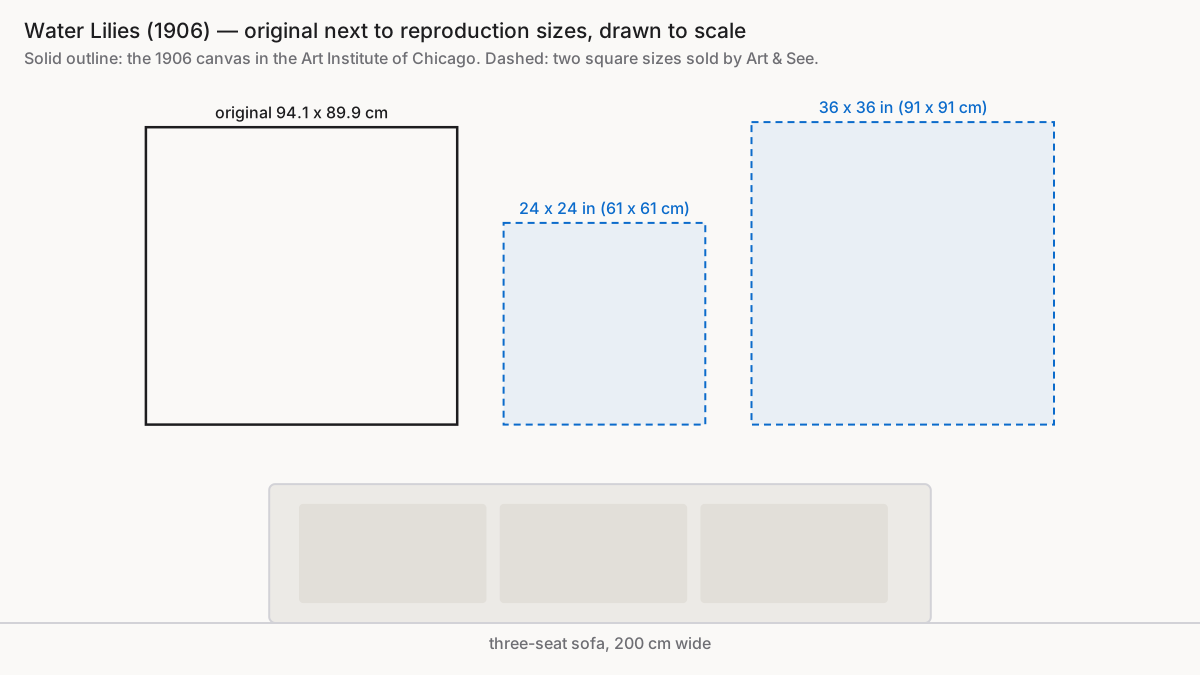
This is the one popular subject that improves with distance, because the strokes only resolve into water when you cannot see them individually. In a room where the sofa is two metres from the wall, 30 × 30 in is the smallest size that works; under three metres, 24 × 24 in is fine. Hang it where the light is indirect: a raking window turns the ridges of paint into stripes and flattens the pond.
Price range
| Size | Art & See list price | Viewing distance it suits | Note |
|---|---|---|---|
| 16 × 16 in (41 × 41 cm) | $249.95 | Under 1.5 m | Reads as pattern rather than water. |
| 20 × 20 in (51 × 51 cm) | $309.95 | 1.5–2 m | Workable in a hallway. |
| 24 × 24 in (61 × 61 cm) | $380.95 | 2–2.5 m | Two thirds of the original's height. |
| 30 × 30 in (76 × 76 cm) | $479.95 | 2.5–3.5 m | Closest common size to the museum canvas. |
| 36 × 36 in (91 × 91 cm) | $549.95 | Over 3 m | Slightly larger than the original in both directions. |
Art & See prices from its published unframed square ladder, verified 2026-09-05. Across eight stores surveyed on the same date, comparable hand-painted oil canvases ran roughly $150 to $1,100; Reproduction Gallery lists more Monet compositions than any other store in that group.
If you want a single canvas rather than a hunt, Art & See lists Water Lilies at the square ladder above, and a second Nympheas composition separately. If you want an exact version by year, a store with a deeper Monet catalogue is the better starting point, even at a higher price.
Where to buy
Three routes, depending on how specific your version is.
Sells Water Lilies on its five-rung square ladder, $249.95 to $549.95, alongside a Monet collection page, and photographs the finished canvas for approval before it ships. Square is the whole ladder here: the larger 60 × 40 in and 72 × 48 in rungs exist only for rectangular works.
Art & See- Reproduction Gallery — Lists individual Monet compositions by year, including Water Lilies c.1917 and Bridge over a Pond of Water Lilies 1899, which matters more than price if you want one specific version.
- Art Institute of Chicago image download — Publishes the 1906 canvas as a public-domain file you can have printed locally, which is the cheapest honest way to get the colour right.
Copyright: what you can and cannot do
Claude Monet died on 5 December 1926. Every Water Lilies canvas is out of copyright in the European Union and the United States, and museums including the Art Institute of Chicago publish their photographs of them under a public-domain designation. You may commission a copy at any size, sell it, and hang it in a commercial space.
Frequently asked questions
How many Water Lilies paintings are there?
The Art Institute of Chicago says the series numbers around 250 paintings, made from the late 1890s until Monet's death in 1926, plus the eight large compositions installed in two oval rooms at the Musee de l'Orangerie in Paris. That is why 'Water Lilies' on its own is not an order.
Which version should I choose for a living room?
The near-square 1906 canvas in Chicago if you want water with no bank and no bridge; the 1900 Water Lily Pond if you want the Japanese footbridge. The 1917–19 canvas is the most abstract and needs 48 in or more to work.
Why does my copy look flat compared with the museum photograph?
Usually because it was painted in one layer. The originals were built over months in several campaigns, and the depth comes from earlier layers showing through. Ask how many sittings the studio plans; two is normal, one is a warning.
Sources
- Water Lilies, 1906, collection record — Art Institute of Chicago. Accessed September 5, 2026.
- Artworks API: Monet dimensions and public-domain status — Art Institute of Chicago. Accessed September 5, 2026.
- Popular oil paintings, Monet listings by year — Reproduction Gallery. Accessed September 5, 2026.
- Water Lily Pond (Symphony in Green), reproduction listing — TOPofART. Accessed September 5, 2026.
- How long does copyright protection last? — United States Copyright Office. Accessed September 5, 2026.
- File:Claude Monet - Water Lilies - 1906, Ryerson.jpg — Wikimedia Commons. Accessed September 5, 2026.
Keep reading
artist
Monet Reproductions: What a Good Copy Has to Get Right
Which Monet paintings reproduce well in oil, why broken colour defeats cheap copyists, plus original sizes, difficulty, prices and copyright.
catalog
The 20 most popular oil painting reproductions, and what each one costs to copy well
The 20 paintings ordered most often, cross-checked against five stores' own bestseller lists, with museum, original size, difficulty and price for each.
price
How much do oil painting reproductions cost?
Compare equivalent sizes, finishes, shipping and payment terms with a dated total-cost worksheet. Unknown charges stay visible instead of becoming zero.
painting
Impression, Sunrise reproduction: the sun is not brighter than the sky
Measured on the Commons file, Monet's sun is slightly darker than the sky around it. Copies that brighten it break the painting. Sizes, prices, checks.