painting
The Birth of Venus reproduction: what to know before you buy
Botticelli's Birth of Venus is tempera on canvas, 172.5 x 278.5 cm, ratio 1.61:1. What that means for an oil copy: sizes, prices, common mistakes.
Oil Painting ReproductionsUpdated
The short answer
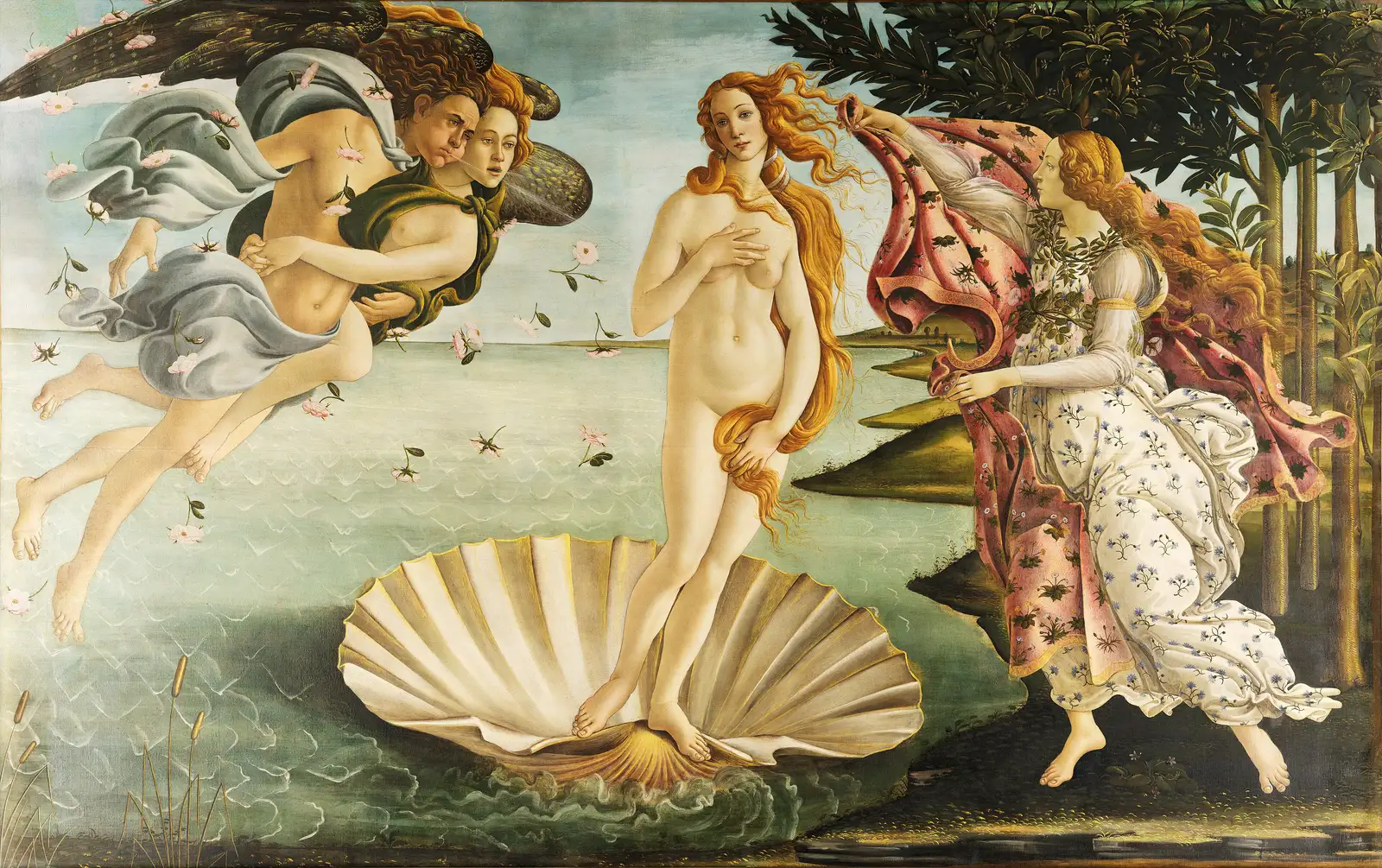
The original is tempera on canvas, 172.5 × 278.5 cm, at the Uffizi. An oil copy changes the medium and almost always the proportion: at 1.61:1 the painting is wider than any stock canvas. Expect $359.95 to $599.95 unframed.
The painting in numbers
| The original | What it means for a copy | |
|---|---|---|
| Year | c. 1485 | Public domain everywhere; no licence needed to paint or sell a copy. |
| Where it is | Galleria degli Uffizi, Florence, inv. 1890 no. 878 | The Uffizi does not lend it, so every copy works from photographs. |
| Medium | Tempera on canvas | Egg tempera, not oil. Every commercial reproduction is a translation, not a copy of the technique. |
| Original size | 172.5 × 278.5 cm (67.9 × 109.6 in) | Nearly 2.8 m wide — larger than most sofas. |
| Aspect ratio | 1.61 : 1 (landscape) | The widest stock canvas sold by reproduction studios is 1.33 : 1. |
| Common reproduction sizes | 24 × 20, 30 × 24, 40 × 30, 48 × 36 in | All four are 1.2–1.33 : 1, so a stock canvas crops the sea or stretches the figures. |
Dimensions and medium from the Galleria degli Uffizi catalogue entry, read 2026-09-05. Reproduction sizes from the price ladders of eight studios collected the same day.
Why it is hard to reproduce
The problem is the medium. Botticelli painted in egg tempera on two pieces of canvas sewn together over a gesso ground tinted blue, and he skipped the green underlayer he normally used beneath flesh. Tempera dries in minutes and cannot be blended wet-into-wet, so form is built from thousands of separate hatched strokes and the surface ends up matte, thin and slightly chalky. Oil does the opposite: it stays open for hours, blends smoothly and dries to a film with depth and gloss.
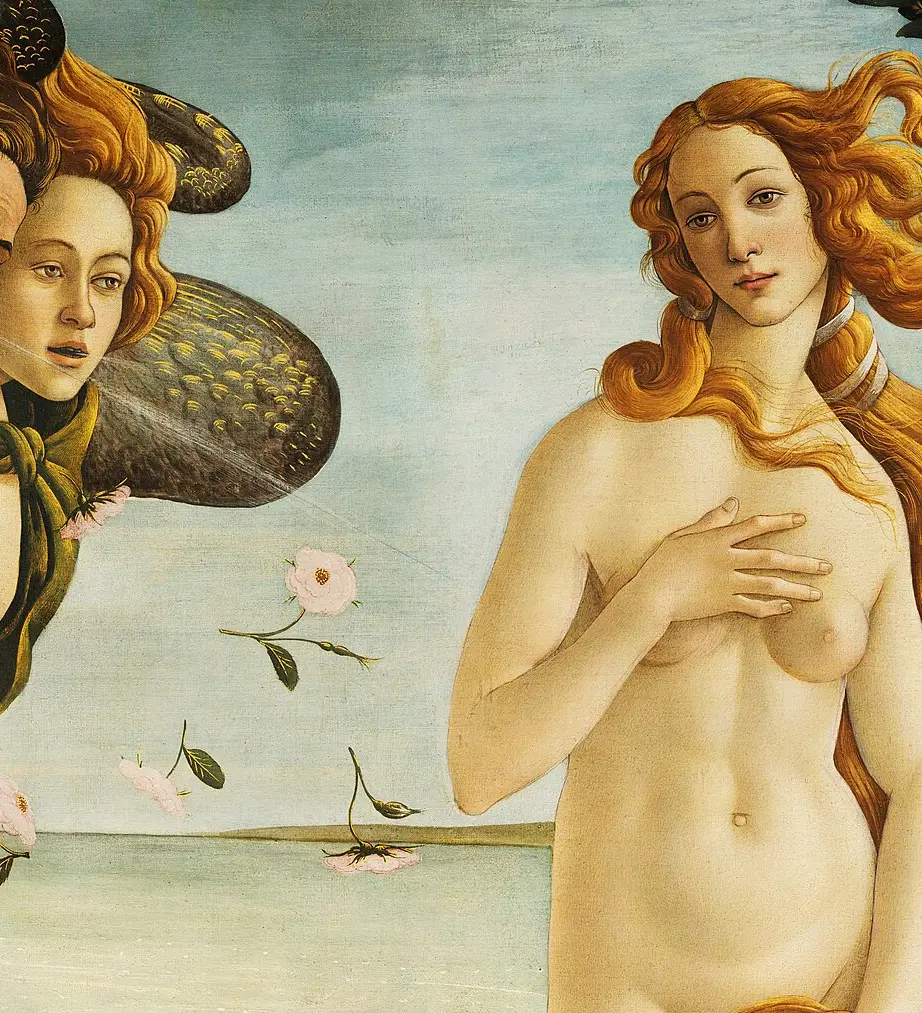
Three specific things carry the picture and all three are tempera effects. The contour line: Venus is drawn, not modelled, with a fine dark outline that survives through the paint. The flatness: her flesh has almost no cast shadow, which is why she reads as a relief rather than a body in a room. And the gold: Botticelli used gold as a pigment for highlights on the hair, the wings, the textiles, the shell and the landscape, applied after the panel was framed, then finished the surface with a cool grey varnish. Painters who work only in oil tend to replace the gold with yellow ochre and the outline with a soft edge, and the picture immediately looks like a nineteenth-century salon nude.
What cheap copies get wrong
- Skin that glows. Oil rendering with warm shadows and pink highlights turns Venus into a Bouguereau. The original flesh is nearly one value, with the drawing doing the work.
- Lost outline. Blending the contour away is the single most common failure and it destroys the pose.
- Cropped sea. To fit a 4:3 canvas, studios cut the left and right edges. Zephyr and Chloris move to the frame edge and the empty water that gives the picture its calm disappears.
- Hair without metal. The gold highlights become flat yellow, so the hair stops catching light and reads as a wig.
- Wrong Venus. Search results mix Botticelli's Venus with Alexandre Cabanel's 1863 Birth of Venus, a reclining nude on waves. Check the shell before you order.
Sizes and where it hangs well
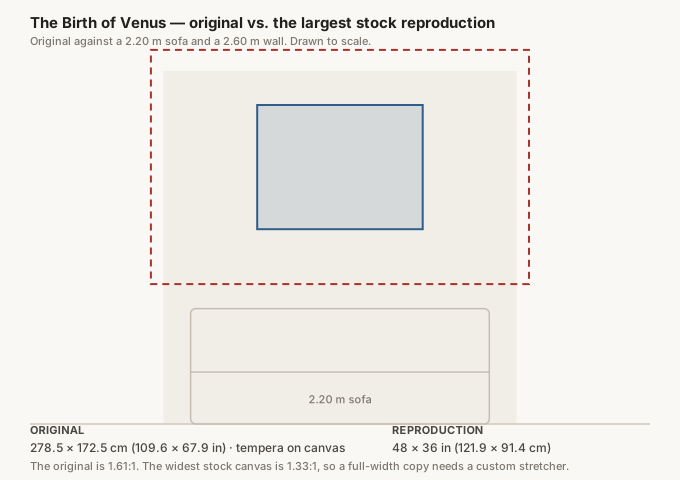
This is a wide, quiet, pale picture and it needs a wall to itself. Above a 2.2 m sofa, a 48 × 36 in canvas leaves 49 cm of wall on each side, which is comfortable; anything under 30 × 24 in reads as a postcard because the figures shrink below life-scale recognition. Hang the centre at about 1.55 m from the floor. Because the palette is almost entirely pale green, cream and gold, it dies on a white wall and comes alive on a warm mid-tone — putty, clay, deep olive.
If the proportion matters to you, ask for a custom stretcher rather than a stock size. A 60 × 37 in canvas keeps the 1.61:1 ratio; studios that publish long size ladders quote this without a special order.
Price range
| Size (in) | Size (cm) | Price (USD, unframed) | Share of the original's width |
|---|---|---|---|
| 24 × 20 | 61 × 51 | $359.95 | 22% |
| 30 × 24 | 76 × 61 | $430.95 | 27% |
| 40 × 30 | 102 × 76 | $529.95 | 36% |
| 48 × 36 | 122 × 91 | $599.95 | 44% |
| Custom 60 × 37 | 152 × 94 | Quoted per order | 55%, and the only option that keeps 1.61 : 1 |
Art & See prices verified 2026-09-05 from the store's published price ladder. Frames are extra and, per the store's refund policy, final sale.
The eight studios were priced on 2026-09-05 against a single reference painting, Van Gogh's The Starry Night, so the ladder is comparable rather than Botticelli-specific. At 48 × 36 in it ran from $349 at overstockArt to $677.95 at 1st Art Gallery, with BrushWiz at $498, HandmadePiece at $557 and Reproduction Gallery at $587. Art & See sits at $599.95 for that size and lists the Botticelli search results rather than a dedicated product page for this painting. Its shipping policy gives processing as 2–3 weeks typically, extending to 4 weeks for complex work and up to 8 weeks for particularly large or intricate pieces — a 48 × 36 in Botticelli is both — and a photograph of the finished canvas is sent for approval before shipping.
Where to buy
Three routes, depending on whether you care most about price, proportion or the preview.
Hand-painted oil on canvas with a photo of the finished piece sent for approval before it ships; published processing is 2–3 weeks typically, up to 4 weeks for complex work and up to 8 for large or intricate pieces. It is not the cheapest, and Botticelli's version is not a standing catalogue product, so it goes through the search page.
Art & See- overstockArt — Cheapest of the eight studios priced on 2026-09-05, at every size ($149 at 16 × 20 in, $349 at 36 × 48 in), with the trade-off that the page states a 6–8 week pre-order wait.
- Reproduction Gallery — Publishes 48 sizes on a single painting, from 23.2 × 29.5 in to 94.5 × 120.1 in, so a 1.61:1 stretcher can be ordered without a custom quote.
Copyright
Botticelli died in 1510, so the painting itself is out of copyright everywhere on earth. Painting it, selling the canvas and hanging it are all lawful, and no licence or royalty is owed to the Uffizi or to anyone else. What is not lawful is selling a copy as an original, or as an unattributed 'after Botticelli' work without saying it is a reproduction.
One local wrinkle is worth knowing. Italy's cultural-heritage code (Legislative Decree 42/2004, articles 107–108) requires authorisation and a fee for the commercial reproduction of images of state-owned works, and the Uffizi has enforced it. That rule governs photographs and their reuse, not the act of painting a new canvas, and it has no effect on a buyer outside Italy.
Frequently asked questions
Is the Birth of Venus oil or tempera?
Tempera on canvas, according to the Uffizi's own catalogue entry. Oil reproductions are translations into a different medium, which is why they usually look glossier and softer-edged than the original.
How big is the original Birth of Venus?
172.5 × 278.5 cm — about 1.7 m tall and just under 2.8 m wide. A 48 × 36 in reproduction, the largest common stock size, is 122 × 91 cm, roughly 44 percent of the original's width.
Why do so many reproductions look like a different painting?
Two reasons. Alexandre Cabanel painted a completely different Birth of Venus in 1863 and it is more widely stocked; and Botticelli's flat tempera modelling gets rendered in blended oil, which turns a drawn figure into a modelled one.
Can I get one in the original proportions?
Yes, but not off the shelf. Stock canvases top out at 1.33:1 while the painting is 1.61:1, so ask for a custom stretcher — roughly 60 × 37 in keeps the ratio.
Sources
- The Birth of Venus — catalogue entry — Gallerie degli Uffizi. Accessed September 5, 2026.
- The Birth of Venus (Botticelli) — technique, support and pigments — Wikipedia. Accessed September 5, 2026.
- File:Sandro Botticelli - La nascita di Venere - Google Art Project - edited.jpg — Wikimedia Commons. Accessed September 5, 2026.
- The Birth of Venus (Cabanel, 1863) — Musée d'Orsay. Accessed September 5, 2026.
- Codice dei beni culturali e del paesaggio, arts. 107–108 (reproduction of cultural property) — Normattiva (Italian Official Gazette). Accessed September 5, 2026.
- Refund policy (frames final sale; preview and refinement before dispatch) — Art & See. Accessed September 5, 2026.
- Shipping policy (production time, preview photograph before dispatch) — Art & See. Accessed September 5, 2026.
Keep reading
painting
The Last Supper reproduction: copying a ruined wall at one seventh scale
Leonardo's Last Supper is 460 x 880 cm of decayed wall painting, not oil on canvas. What a copy is really copying, what size to order, what it costs.
painting
The Creation of Adam reproduction: turning a fresco into an oil painting
Michelangelo's Creation of Adam is a 280 x 570 cm fresco 20 m above the floor. What changes when it becomes an oil on canvas, and what a copy costs.
catalog
The 20 most popular oil painting reproductions, and what each one costs to copy well
The 20 paintings ordered most often, cross-checked against five stores' own bestseller lists, with museum, original size, difficulty and price for each.
price
How much do oil painting reproductions cost?
Compare equivalent sizes, finishes, shipping and payment terms with a dated total-cost worksheet. Unknown charges stay visible instead of becoming zero.