painting
The Creation of Adam reproduction: turning a fresco into an oil painting
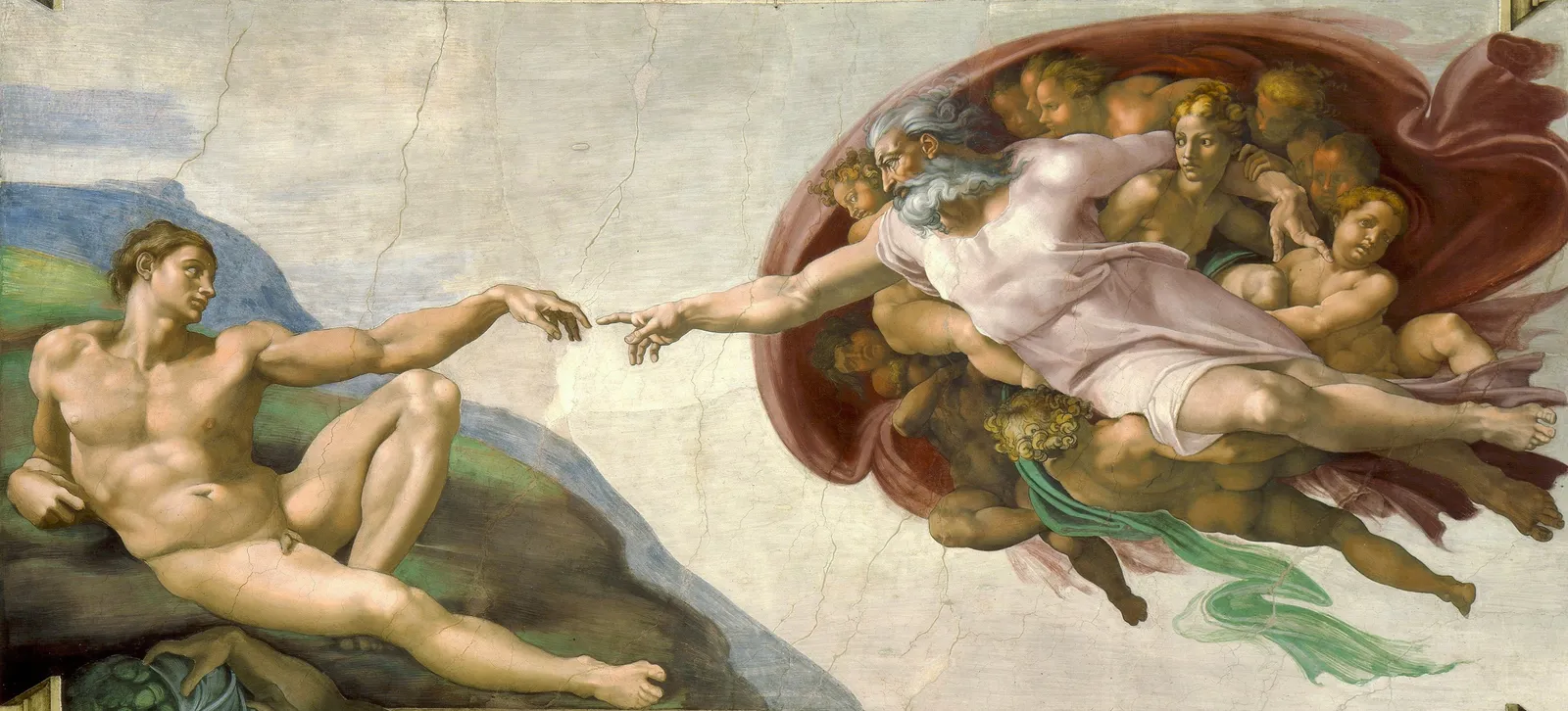
Michelangelo's Creation of Adam is a 280 x 570 cm fresco 20 m above the floor. What changes when it becomes an oil on canvas, and what a copy costs.
Oil Painting ReproductionsUpdated
The short answer
The original is buon fresco — pigment absorbed into wet lime plaster — on a vault about 20 m above the chapel floor, roughly 280 × 570 cm. An oil-on-canvas version changes the surface, the palette and the viewing distance. Expect $359.95 to $599.95 unframed.
The painting in numbers
| The original | What it means for a copy | |
|---|---|---|
| Year | c. 1511, part of the ceiling painted 1508–1512 | Public domain; Michelangelo died in 1564. |
| Where it is | Sistine Chapel, Vatican City — a vault about 20 m above the floor | Nobody has ever seen it at reading distance except restorers on scaffolding. |
| Medium | Buon fresco: pigment in lime water painted into wet plaster | Matte, absorbent and chalky. Oil on canvas is glossy and sits on the surface. |
| Panel size | approx. 280 × 570 cm (110 × 224 in) | Almost 5.7 m across, on a curved vault. |
| Aspect ratio | 2.04 : 1 (landscape) | Twice as wide as tall. The widest stock canvas is 1.33:1. |
| Common reproduction sizes | 30 × 24, 40 × 30, 48 × 36 in | 48 × 36 in is 122 cm wide: about one fifth of the panel, in the wrong shape. |
Panel dimensions and dating from the painting's Wikidata record (Q500242); chapel height from the Sistine Chapel architectural description, both read 2026-09-05.
Why it is hard to reproduce
Fresco and oil are opposite processes. In buon fresco the pigment is suspended in lime water and painted into plaster that is still wet; as the lime carbonates, the colour becomes part of the wall. The result is matte, slightly absorbent, and lit by the white of the plaster showing through thin colour rather than by white paint on top. Only pigments that survive an alkaline environment can be used at all, which is why the palette is a narrow set of earths, terre verte, lime white and a few costly blues. Oil paint reverses every one of those conditions: it lies on the surface, dries glossy, deepens in tone as it cures, and accepts any pigment you like.
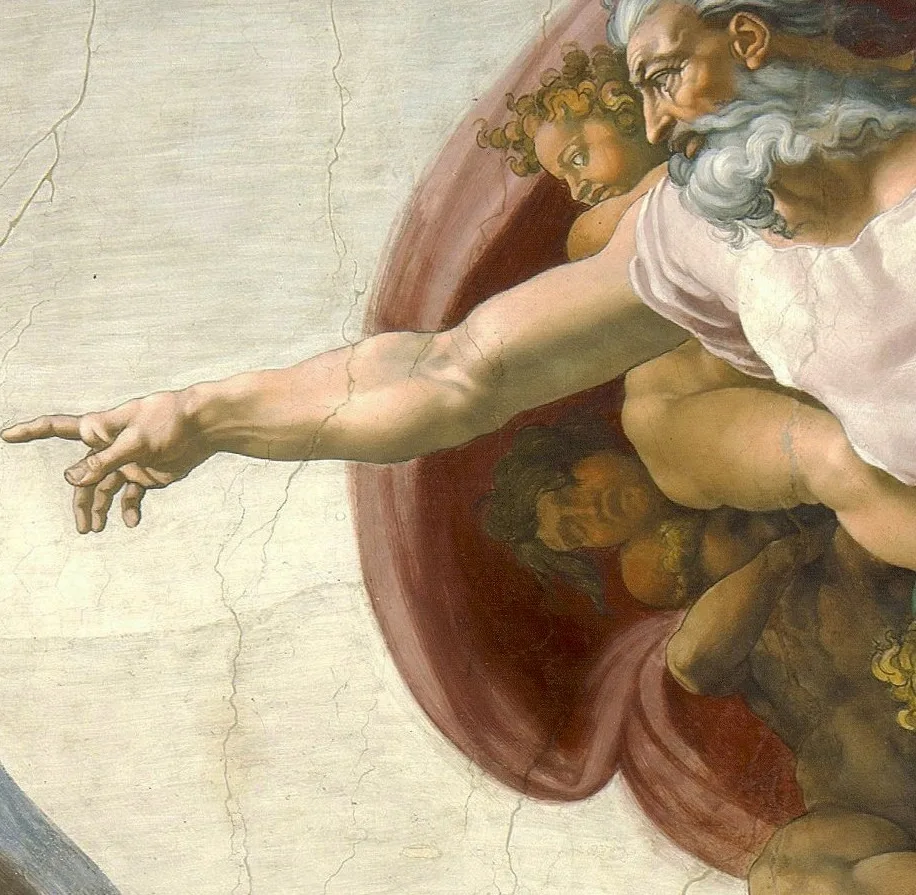
The second thing is viewing distance. Michelangelo painted for people standing 20 m below, so the drawing is emphatic, the contours are strong, the modelling is broad and the shadows are simplified. Reproduce that faithfully on a canvas hung at eye level in a living room and it can look coarse — the compensations designed to survive 20 m of air are visible at two. Studios that soften and refine the modelling to suit a domestic distance are making a defensible choice, but they are no longer copying the fresco.
Colour is the third. The restoration carried out between 1980 and 1994 removed centuries of candle soot and animal-glue varnish and revealed a far brighter, more acid palette than the one in every pre-1980 reproduction: shot pinks, apple greens, hard oranges. Older reference photographs show a brown, sombre picture that no longer exists. If a studio's reference is a pre-restoration plate, the canvas you receive will be a copy of the dirt.
What cheap copies get wrong
- Gloss varnish. The single worst decision on this subject. Fresco is dead matte; a shiny Creation of Adam looks like a bar sign.
- Only the hands. Sold as the famous fragment, cropped to the two fingers. It is a legitimate crop, but it is not the panel, and the price should reflect a much smaller composition.
- A brown palette. Copied from pre-restoration photographs. The colours behind God's cloak are pink, green and lilac, not sepia.
- Painted-on cracks. Some studios imitate the plaster craquelure with brushwork. It reads as dirt on a canvas rather than as age in a wall.
- Deep shadows. Oil naturally darkens; fresco shadows are pale and open. Modelling Adam's torso with rich oil darks turns a fresco figure into a Baroque one.
Sizes and where it hangs well
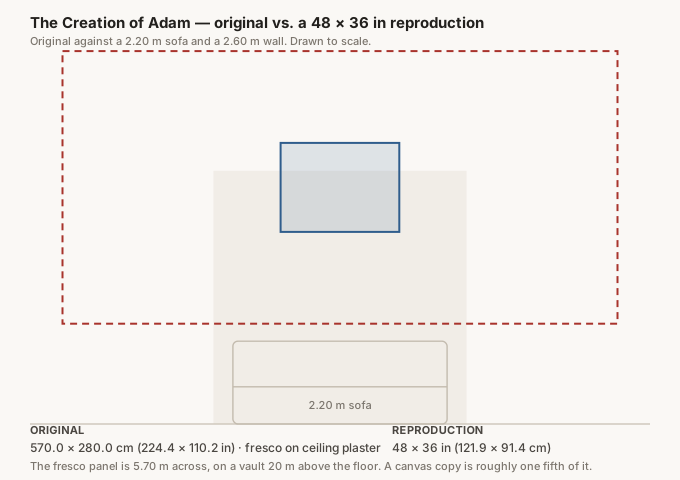
The composition is a long horizontal with a strong empty middle, so it needs width rather than height and it fails in a square space. Above a 2.2 m sofa or a long sideboard is the natural place; a custom 60 × 29 in canvas (152 × 74 cm) holds the 2.04:1 ratio and fills that wall properly. On a stock 48 × 36 in canvas the panel loses about a third of its width, which usually means cutting the angels at God's left or the landscape under Adam.
Hang it low — centre at about 1.45 m — because the figures read horizontally and the gap between the fingers should be at eye level. Since the original is matte and pale, it holds up on a strong wall colour: deep green, oxblood and charcoal all work, and white makes the chalky palette look washed out. Ask for a matte varnish; on this subject it is worth more than a frame.
Price range
| Size (in) | Size (cm) | Price (USD, unframed) | Reduction from the 5.7 m panel |
|---|---|---|---|
| 30 × 24 | 76 × 61 | $430.95 | 7.5 : 1, and 39% of the width cropped |
| 40 × 30 | 102 × 76 | $529.95 | 5.6 : 1, and 35% of the width cropped |
| 48 × 36 | 122 × 91 | $599.95 | 4.7 : 1, and 35% of the width cropped |
| Custom 60 × 29 | 152 × 74 | Quoted per order | 3.7 : 1 with the correct 2.04 : 1 shape |
| Detail crop, 24 × 20 | 61 × 51 | $359.95 | The two hands only — a different picture, priced as a small one |
Art & See prices verified 2026-09-05 from the store's published price ladder. Custom stretchers are quoted per order and are not part of the published ladder.
The eight studios were priced on 2026-09-05 against a single reference painting, Van Gogh's The Starry Night, at the nearest size each sells to 48 × 36 in: $349 at overstockArt, $498 at BrushWiz, $557 at HandmadePiece, $587 at Reproduction Gallery and $677.95 at 1st Art Gallery. The 2026-09-05 catalog snapshot of Art & See lists no product for this fresco, so it goes through the Michelangelo search page. Its shipping policy gives processing as 2–3 weeks typically, extending to 4 weeks for complex work and up to 8 weeks for particularly large or intricate pieces — the bracket a wide fresco panel falls into — and a photograph of the finished canvas is sent for approval before dispatch.
Where to buy
Three routes. Ask every one of them for a matte finish.
Hand-painted oil with a preview photograph before dispatch; stated processing is 2–3 weeks typically, up to 4 weeks for complex work and up to 8 for large or intricate pieces. This fresco is not a standing catalogue product, so it has to be requested through the search page, and the price sits in the middle of the market rather than at the bottom.
Art & See- Reproduction Gallery — Publishes 48 sizes on a single painting, so a wide 2.04:1 canvas can be picked from the list — the practical answer for a panel this shape, and a deeper size catalogue than any other studio checked.
- overstockArt — Cheapest of the eight studios priced on 2026-09-05, at every size ($349 at 36 × 48 in), against a stated 6–8 week pre-order wait and a fixed set of standard proportions.
Copyright
Michelangelo died in 1564, so the fresco is in the public domain worldwide. Painting a copy, buying one, hanging it and reselling it are all lawful, and the Vatican has no copyright claim over the image of a sixteenth-century work.
What the Vatican Museums do control is photography inside the chapel and the licensing of the high-resolution files produced during the 1980–1994 restoration, which was funded in exchange for image rights. Those are contractual terms attached to particular photographs, not copyright in Michelangelo's painting, and they do not restrict a hand-painted canvas made from a freely licensed reference. The general framework is in are oil painting reproductions legal.
Frequently asked questions
How big is The Creation of Adam?
The panel is roughly 280 × 570 cm, set into a vault about 20 m above the Sistine Chapel floor. It is one scene among many on a ceiling painted between 1508 and 1512.
Can an oil painting look like a fresco?
Not exactly, but it can get close. Ask for thin paint, a light ground left visible in the mid-tones, and a matte varnish. A glossy, thickly painted version will never read as plaster.
Why do old and new reproductions look so different?
The 1980–1994 restoration removed centuries of soot and glue varnish and uncovered a much brighter palette. Copies made from pre-restoration photographs are brown; the fresco is not.
Is the hands-only version a good buy?
It is a real crop and it hangs well in a small space, but it is a fragment of a 5.7 m composition. Pay a small-canvas price for it, not the price of the whole panel.
Sources
- The Creation of Adam (Q500242): dimensions, dating, material — Wikidata. Accessed September 5, 2026.
- The Creation of Adam: composition, the 1990 neuroanatomy reading — Wikipedia. Accessed September 5, 2026.
- Restoration of the Sistine Chapel frescoes, 1980–1994 — Wikipedia. Accessed September 5, 2026.
- Sistine Chapel — dimensions and ceiling height — Wikipedia. Accessed September 5, 2026.
- File:Michelangelo - Creation of Adam (cropped).jpg — Wikimedia Commons. Accessed September 5, 2026.
- Shipping policy (production time, preview photograph before dispatch) — Art & See. Accessed September 5, 2026.
Keep reading
painting
The Last Supper reproduction: copying a ruined wall at one seventh scale
Leonardo's Last Supper is 460 x 880 cm of decayed wall painting, not oil on canvas. What a copy is really copying, what size to order, what it costs.
painting
The Birth of Venus reproduction: what to know before you buy
Botticelli's Birth of Venus is tempera on canvas, 172.5 x 278.5 cm, ratio 1.61:1. What that means for an oil copy: sizes, prices, common mistakes.
legal
Are Oil Painting Reproductions Legal?
Yes for public-domain paintings, no for artists still in copyright. Country rules, 21 artists with dates, and the line between a copy and a forgery.
catalog
The 20 most popular oil painting reproductions, and what each one costs to copy well
The 20 paintings ordered most often, cross-checked against five stores' own bestseller lists, with museum, original size, difficulty and price for each.
price
How much do oil painting reproductions cost?
Compare equivalent sizes, finishes, shipping and payment terms with a dated total-cost worksheet. Unknown charges stay visible instead of becoming zero.