painting
The Last Supper reproduction: copying a ruined wall at one seventh scale
Leonardo's Last Supper is 460 x 880 cm of decayed wall painting, not oil on canvas. What a copy is really copying, what size to order, what it costs.
Oil Painting ReproductionsUpdated
The short answer
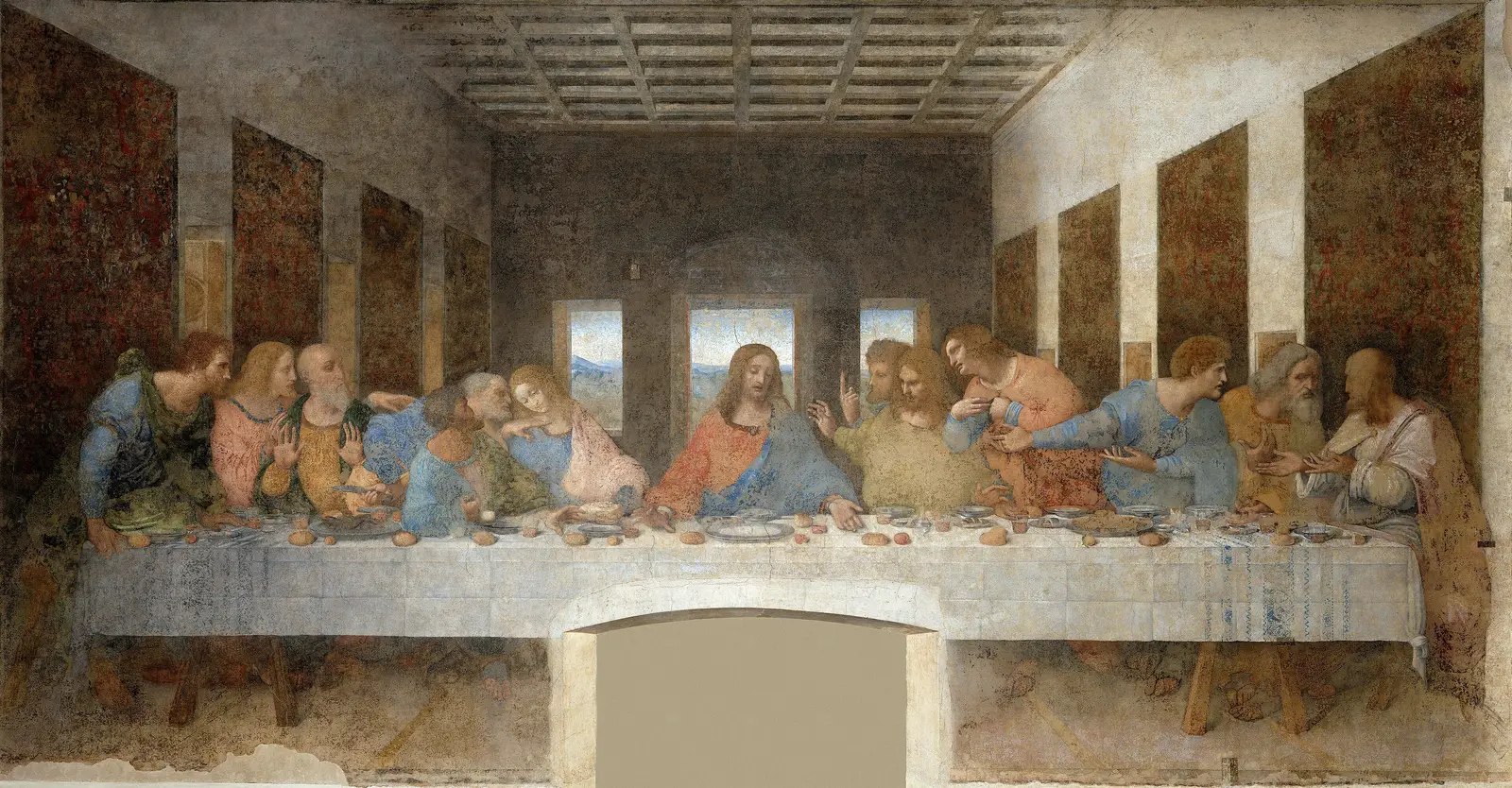
The original is a 460 × 880 cm wall painting in a Milan refectory, not an oil on canvas, and most of Leonardo's paint is gone. Any canvas copy is a 7:1 reduction and a reconstruction. Expect $430.95 to $599.95 unframed.
The painting in numbers
| The original | What it means for a copy | |
|---|---|---|
| Year | c. 1495–1498 | Public domain; Leonardo died in 1519. |
| Where it is | Refectory of Santa Maria delle Grazie, Milan | It is a wall, not a movable painting. Visitor numbers are capped and timed. |
| Medium | Tempera on a ground of gesso, pitch and mastic, over dry wall plaster | Not fresco and not oil. Leonardo's experiment is exactly why it failed. |
| Original size | 460 × 880 cm (181 × 346 in) | 8.8 m across — wider than most rooms are long. |
| Aspect ratio | 1.91 : 1 (landscape) | The widest stock canvas is 1.33:1, so a stock size crops a third of the width. |
| Common reproduction sizes | 30 × 24, 40 × 30, 48 × 36 in | 48 × 36 in is 122 cm wide: one seventh of the mural's width. |
Dimensions, dating and medium from the English Wikipedia infobox for the painting and its cited literature, read 2026-09-05. The Wikidata record (Q128910) gives a height of 700 cm rather than 460 cm; 460 × 880 cm is the figure in the standard literature and in the museum's own material, and is the one used here.
Why it is hard to reproduce
A true fresco is painted into wet plaster, which binds the pigment into the wall and forces the painter to work fast in one-day sections. Leonardo did not want to work fast. He painted onto dry plaster over a ground of gesso, pitch and mastic so that he could revise endlessly, and the paint never bonded. It began flaking within his own lifetime. By 1532 Gerolamo Cardano described the picture as blurred and colourless compared with what he remembered as a boy. Five centuries of damp, soot, clumsy repainting, French troops using the refectory as a stable in 1796 and a 1943 bomb followed. The restoration led by Pinin Brambilla Barcilon between 1978 and 1999 stripped away earlier overpaint and stabilised what remained; very little of Leonardo's own paint survives.
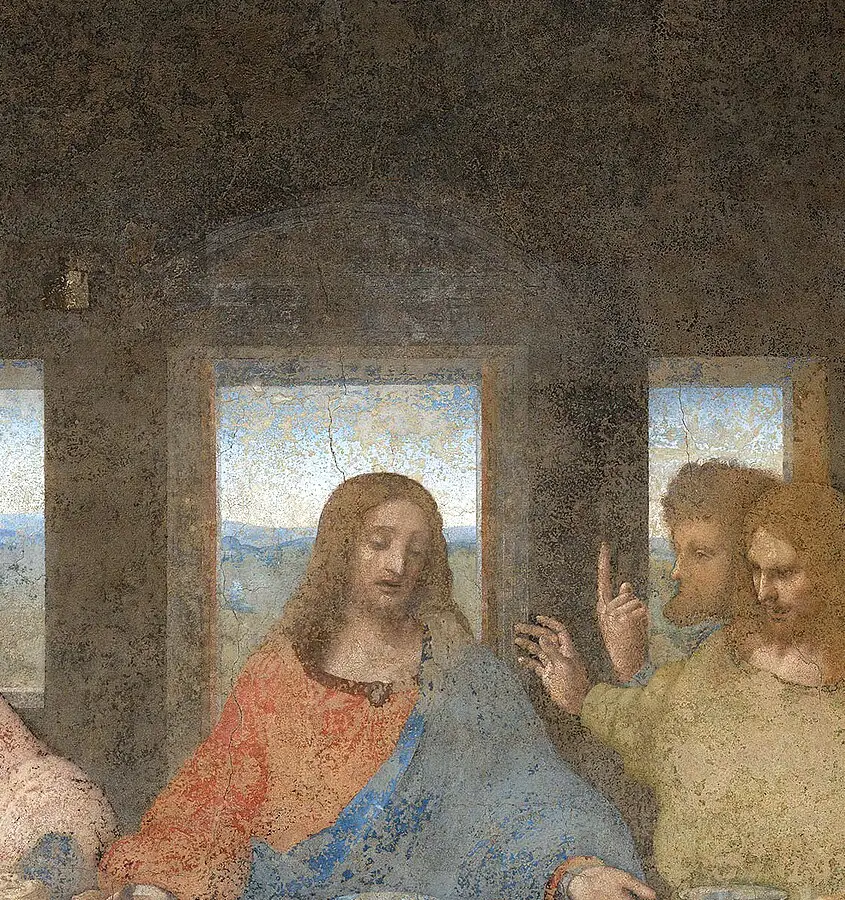
That is the first decision a studio makes and it is rarely discussed: do you paint what is on the wall today, mottled and pale, or do you paint a reconstruction of what it looked like in 1498? Most commercial copies quietly do the second, taking colour from sixteenth-century painted copies rather than the original. It is a defensible choice — but it means the canvas you receive does not look like the thing you queued to see in Milan.
The second difficulty is the architecture. The composition is a one-point perspective locked to a vanishing point behind Christ's right temple, and Leonardo designed it for a viewer standing several metres back and about four metres below. Reduce it to a metre-wide canvas at eye level and the perspective stops doing its job: the ceiling coffers become a decorative grid instead of a tunnel. Copies that redraw the coffers freehand, without rebuilding the perspective construction, produce a room that visibly bends.
What cheap copies get wrong
- A drifting vanishing point. Every orthogonal in the ceiling and the wall tapestries must converge on one point. Freehand copies miss it and the room tilts.
- Saturated colour. Painting the restored surface in strong reds and blues produces a picture that looks like a printed holy card, not a wall.
- Thirteen identical faces. The apostles are grouped in fours and each group has one figure carrying the reaction. Copies that render all thirteen heads at equal intensity flatten the drama.
- Cropped ends. Squeezed onto a 4:3 canvas, the outer apostles lose their arms and the two side tapestries disappear.
- Hands. More than fifty hands appear in the picture and most cheap versions simplify them into mittens. They are the second thing a viewer looks at.
Sizes and where it hangs well
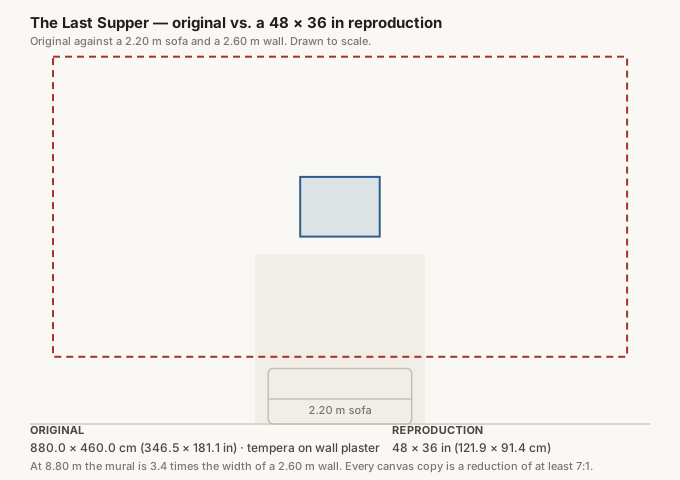
Scale is the whole problem. The mural covers an end wall of a monastery dining hall and the figures are life-size and a half. On a 48 × 36 in canvas each apostle's head is about 3 cm across, which is roughly a thumbnail, and the reduction is about 7:1. Below 40 × 30 in the faces stop reading as individuals and the picture becomes a pattern of robes.
So order it wide and hang it long. This is a picture for a dining room — that is what it was painted for — above a sideboard or a long table, centred low at about 1.5 m because the composition reads across rather than up. If you want the proportion honoured rather than the size, a custom 48 × 25 in stretcher keeps the 1.91:1 ratio and looks far better than a cropped 48 × 36 in.
Price range
| Size (in) | Size (cm) | Price (USD, unframed) | Reduction from the original |
|---|---|---|---|
| 30 × 24 | 76 × 61 | $430.95 | 11.5 : 1 — heads about 2 cm across |
| 40 × 30 | 102 × 76 | $529.95 | 8.7 : 1 |
| 48 × 36 | 122 × 91 | $599.95 | 7.2 : 1, and 30% of the width cropped |
| Custom 48 × 25 | 122 × 64 | Quoted per order | 7.2 : 1 with the full composition and the correct 1.91 : 1 shape |
| Custom 72 × 38 | 183 × 97 | Quoted per order | 4.8 : 1 — the smallest size at which faces read across a room |
Art & See prices verified 2026-09-05 from the store's published price ladder. Custom stretchers are quoted per order and are not part of the published ladder.
The eight studios were priced on 2026-09-05 against a single reference painting, Van Gogh's The Starry Night, at the nearest size each sells to 48 × 36 in: $349 at overstockArt, $498 at BrushWiz, $557 at HandmadePiece, $587 at Reproduction Gallery and $677.95 at 1st Art Gallery. Art & See does not carry Leonardo's Last Supper as a catalogue product — the version in its catalogue is El Greco's, a different painting — so it goes through the Last Supper search page. Its shipping policy gives processing as 2–3 weeks typically, extending to 4 weeks for complex work and up to 8 weeks for particularly large or intricate pieces — the category a wide Last Supper falls into — and a photo of the finished canvas is sent for approval before shipping.
Where to buy
Three routes, and the choice turns almost entirely on whether you want the original's proportions.
Hand-painted oil on canvas with a preview photograph before dispatch; stated processing is 2–3 weeks typically, up to 4 weeks for complex work and up to 8 for large or intricate pieces. Leonardo's version is not a standing product, so it has to be requested through the search page, and the price is mid-market rather than low.
Art & See- Reproduction Gallery — Publishes 48 sizes on a single painting, up to 94.5 × 120.1 in, so a wide 1.91:1 stretcher can be ordered from the size list instead of negotiated — the deepest size catalogue of the eight studios priced on 2026-09-05.
- overstockArt — Cheapest of the eight studios priced on 2026-09-05, at every size ($349 at 36 × 48 in), against a stated 6–8 week pre-order wait and a fixed set of standard shapes.
Copyright
Leonardo da Vinci died in 1519. The painting is in the public domain in every jurisdiction and always has been under modern copyright law, so painting, selling and hanging a copy is lawful without permission from the church, the Italian state or anyone else.
Two adjacent points are worth knowing. Photography inside the refectory is restricted, and the high-resolution files used by studios generally come from licensed campaigns with their own terms — a contract question, not a copyright one, and not one that touches a hand-painted canvas. Separately, Italy's cultural-heritage code (Legislative Decree 42/2004, articles 107–108) requires authorisation for commercial reproduction of images of state-held cultural property; again, it governs photographs rather than the act of painting.
Frequently asked questions
Is The Last Supper a fresco?
No, and that is why it decayed. True fresco binds pigment into wet plaster. Leonardo painted onto dry plaster over gesso, pitch and mastic so he could keep revising; the paint never bonded and began flaking within his lifetime.
How big is The Last Supper?
460 × 880 cm — 4.6 m tall and 8.8 m wide, covering an end wall of the refectory at Santa Maria delle Grazie in Milan. A 48 × 36 in reproduction is about one seventh of the width.
Should the copy look faded like the original?
That is your call and you should make it explicitly. Most commercial copies paint a reconstruction with fuller colour, taking cues from sixteenth-century copies. If you want the wall as it looks today, say so and supply a post-1999 restoration photograph as the reference.
What size keeps the original proportions?
Any 1.91:1 rectangle. A custom 48 × 25 in stretcher is the usual answer; a stock 48 × 36 in canvas crops roughly 30 percent of the width or distorts the figures.
Sources
- The Last Supper (Leonardo): dimensions, medium, restoration history — Wikipedia. Accessed September 5, 2026.
- The Last Supper (Q128910): location, dating, material — Wikidata. Accessed September 5, 2026.
- Cenacolo Vinciano — visiting rules and conservation conditions — Museo del Cenacolo Vinciano. Accessed September 5, 2026.
- File:Leonardo da Vinci (1452-1519) - The Last Supper (1495-1498).jpg — Wikimedia Commons. Accessed September 5, 2026.
- Codice dei beni culturali e del paesaggio, arts. 107–108 — Normattiva (Italian Official Gazette). Accessed September 5, 2026.
- Shipping policy (production time, preview photograph before dispatch) — Art & See. Accessed September 5, 2026.
Keep reading
artist
Leonardo Reproductions: What a Good Copy Has to Get Right
Sfumato measured in micrometres, why no standard canvas matches the Mona Lisa's shape, original sizes, difficulty ratings, prices and copyright status.
painting
The Creation of Adam reproduction: turning a fresco into an oil painting
Michelangelo's Creation of Adam is a 280 x 570 cm fresco 20 m above the floor. What changes when it becomes an oil on canvas, and what a copy costs.
painting
The Birth of Venus reproduction: what to know before you buy
Botticelli's Birth of Venus is tempera on canvas, 172.5 x 278.5 cm, ratio 1.61:1. What that means for an oil copy: sizes, prices, common mistakes.
catalog
The 20 most popular oil painting reproductions, and what each one costs to copy well
The 20 paintings ordered most often, cross-checked against five stores' own bestseller lists, with museum, original size, difficulty and price for each.
price
How much do oil painting reproductions cost?
Compare equivalent sizes, finishes, shipping and payment terms with a dated total-cost worksheet. Unknown charges stay visible instead of becoming zero.