artist
Leonardo Reproductions: What a Good Copy Has to Get Right
Sfumato measured in micrometres, why no standard canvas matches the Mona Lisa's shape, original sizes, difficulty ratings, prices and copyright status.
Oil Painting ReproductionsUpdated
The short answer
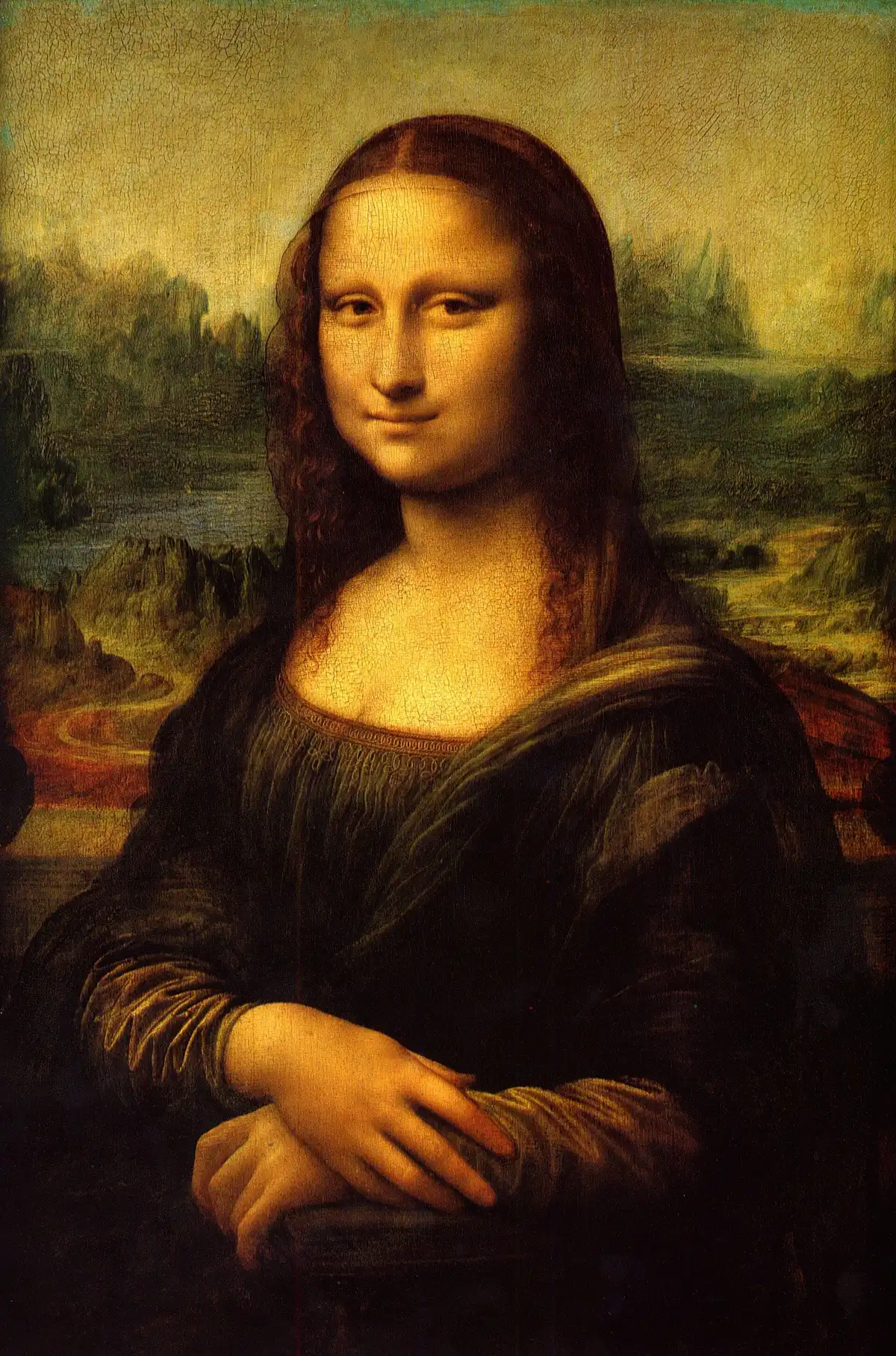
Leonardo's shading is built from up to thirty glaze layers, some only a few micrometres thick. No hand copy reproduces that; what a good one reproduces is the drawing and the transitions. Expect $299.95 to $529.95 unframed at common wall sizes.
Why Leonardo is reproduced so often
The Louvre received 9 million visitors in 2025, up from 8.7 million the year before, and it is under enough pressure from the crowd in front of one picture that it has announced plans to give the Mona Lisa a dedicated room with its own entrance. Separately, in November 2017 Salvator Mundi sold at Christie's New York for $450.3 million, still the highest price ever paid for a painting at auction.
Fewer than twenty paintings are securely attributed to Leonardo, and none will ever be for sale. The demand for copies is therefore permanent, and the Mona Lisa is almost certainly the single most reproduced image in the history of painting, in oil and in everything else.
Two structural facts shape what you can actually buy. The originals are on wood panels; reproductions are on canvas, so the surface will never match. And The Last Supper is a wall, not a picture — a mural in tempera and oil on dry plaster in Santa Maria delle Grazie, 460 × 880 cm, in poor condition and heavily restored. Every reproduction of it is a copy of a restoration.
What a faithful copy must get right
Sfumato is a physical process, not a soft brush
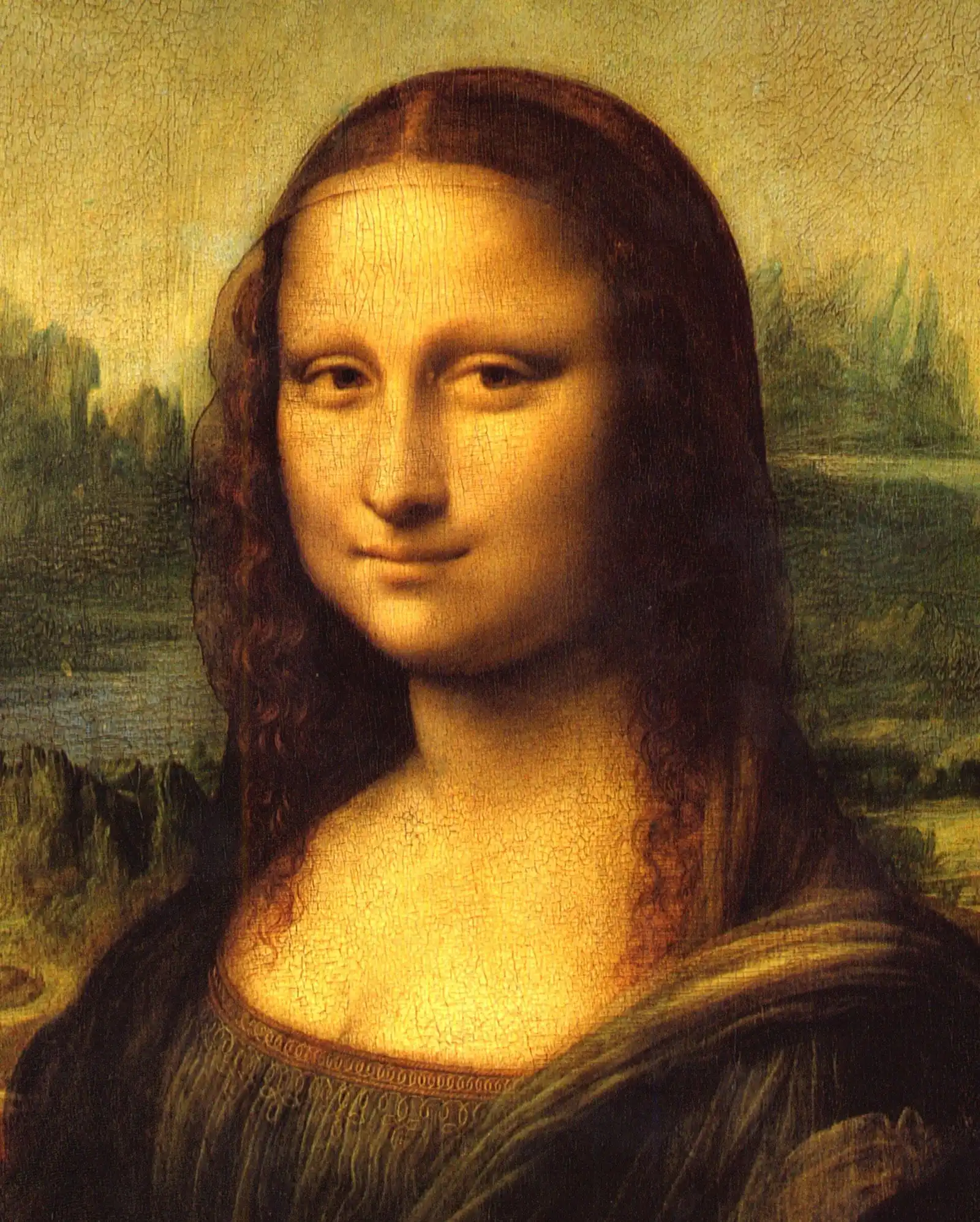
In 2010 a team led by Philippe Walter at the C2RMF, the French national museums research centre inside the Louvre, analysed the faces of seven Leonardos with portable X-ray fluorescence spectroscopy — without taking a single sample — and published the results in Angewandte Chemie (DOI 10.1002/anie.201001116). It was the first direct measurement of the sfumato glazes. What they found, as Chemical & Engineering News summarised it, is that a shadow on a face is not one layer but "a multitude of up to 30 very thin brushstrokes, some just a few micrometers thick", of pigmented translucent glaze over a lead-white priming and a flesh tone. A human hair is about seventy micrometres across.
No hand-painted reproduction at any price does that. What separates a good copy from a bad one is therefore not the method but the result: a transition from light to dark with no visible boundary anywhere in it, and a shadow that stays transparent instead of going opaque. Copyists reach for a soft brush and blend wet paint, which produces a smear rather than a graduation. Look for a smooth ramp; reject a smudge.
The corners of the mouth and eyes
Leonardo deliberately left the two places the eye reads expression from — the corner of the mouth and the outer corner of the eye — indeterminate, dissolved into shadow. That indeterminacy is why the expression appears to change. A copyist who resolves either corner has fixed the expression, and the copy will look pleasant and inert. Ask specifically about this on a preview photograph; it is the single most reliable test of a Mona Lisa copy.
The landscape does not have the same focus as the face
The blue distance behind the figure is deliberately hazy, cooler and lower in contrast — aerial perspective, which Leonardo wrote about at length. Copyists paint it with the same attention as the face because it is easier to paint a legible rock than an illegible one, and the result is a picture with no depth: the sitter and the mountains sit on the same plane.
Most requested works
Difficulty is this site's rating, 1 to 5: 1 means a competent copyist gets it right first time; 5 means the failure is obvious to anyone who knows the original. Prices are Art & See's published unframed list prices for the nearest standard canvas — and for Leonardo, "nearest" is doing a lot of work.
| Work | Year | Museum | Original size | Difficulty | Reproduction price range |
|---|---|---|---|---|---|
| Mona Lisa | c. 1503–19 | Musée du Louvre, Paris | 79.4 × 53.4 cm (poplar panel) | 5 | $299.95 (16 × 20 in) – $529.95 (30 × 40 in) |
| The Last Supper | 1495–98 | Santa Maria delle Grazie, Milan | 460 × 880 cm (mural) | 4 | No stock canvas at 1.9:1 — custom order |
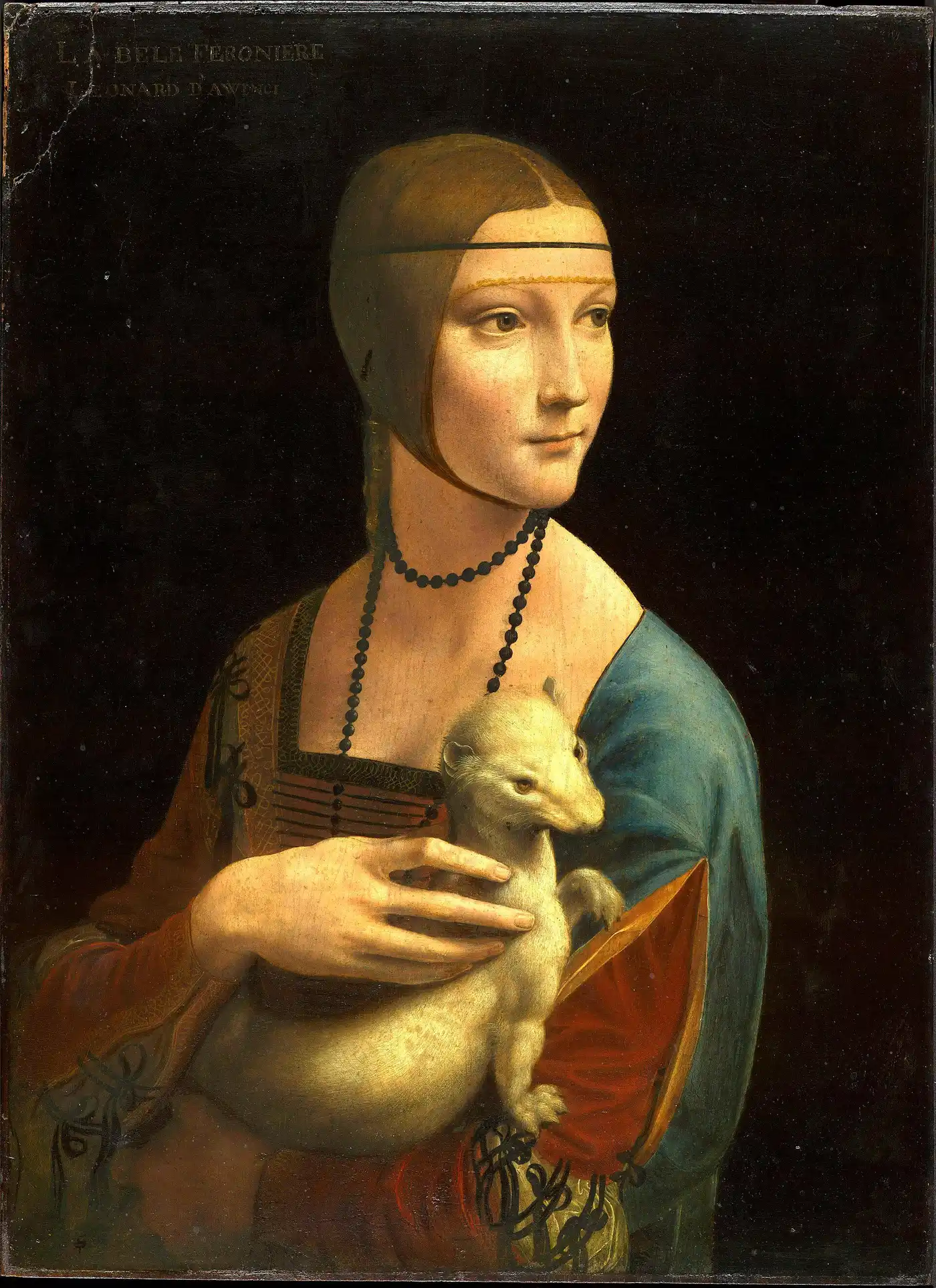
| Lady with an Ermine | c. 1489–91 | Czartoryski Museum, Kraków | 54.8 × 40.3 cm (walnut panel) | 5 | $299.95 (16 × 20 in) – $529.95 (30 × 40 in) |
| The Virgin of the Rocks | c. 1483–86 | Musée du Louvre, Paris | 199 × 122 cm | 4 | No stock canvas at 1.63:1 — custom order |
| Salvator Mundi | c. 1500 | Private collection (attributed) | 65.7 × 45.4 cm | 4 | $299.95 (16 × 20 in) – $529.95 (30 × 40 in) |
| Vitruvian Man | c. 1490 | Gallerie dell'Accademia, Venice | 34.4 × 25.5 cm (drawing) | 2 | A drawing, not a painting — copied in oil it is a different object |
Dimensions from the holding institutions; the Mona Lisa figure is the Louvre's own (ark cl010062370, read 2026-09-05, "Hauteur 0,794 m ; Largeur 0,534 m"), the rest from the museums and Wikidata. Reproduction prices from Art & See's public product pages, same date. The standard rectangles are 1.20, 1.25, 1.33 and — at 60 × 40 in ($769.95) and 72 × 48 in ($1,299.95) — 1.50.
That last note is not a quibble. The Mona Lisa is 79.4 × 53.4 cm — a 1.49 proportion — and so, near enough, is Salvator Mundi at 1.45. Every rectangle on the ladder up to 48 × 36 in is 1.33 or squarer, so at ordinary sizes you receive a Mona Lisa about 10 % squarer than Leonardo's, with either extra landscape invented at the sides or the figure subtly broadened. The proportion does exist on the ladder, at 60 × 40 in and 72 × 48 in, both 1.50 — but 60 × 40 in is 152.4 cm tall, nearly twice the panel, and $769.95. Art & See's Mona Lisa product page starts at $299.95, and the same geometry applies there as everywhere else on the standard ladder.
Common mistakes in cheap copies
- Drawn eyelids and drawn mouth corners. The commonest failure and the most damaging. Leonardo has no lines there at all.
- Blending instead of layering. Wet paint dragged with a soft brush gives a grey smear where a graduation should be. Visible as a slight muddiness across the cheek.
- A sharp landscape. The background painted at the same focus as the face, which flattens the whole picture.
- Modern flesh colour. Copies that skip the varnish cast and paint pink skin. Defensible if declared, jarring if not.
- Stretched proportions. A 1.49 painting delivered on a 1.33 canvas. Ask what happens at the sides.
- The Last Supper, cropped. At 1.9:1 the mural does not fit any stock stretcher, so sellers crop the ends — usually losing the outer apostles — or squash it. Check the figure count in the preview.
Sizes that work at home
The Mona Lisa surprises almost everyone who sees it: the Louvre's own record gives 79.4 × 53.4 cm, roughly the size of a bathroom mirror. A reproduction at that scale is discreet and correct. A reproduction at a metre tall is a statement about the Mona Lisa rather than a copy of it, which is a legitimate choice but a different one.
- 16 × 20 in (40.6 × 50.8 cm), $299.95. 64 % of the original height. Reads well in a hallway or a study where you pass close to it.
- 20 × 24 in (50.8 × 61 cm), $359.95. 77 % of the original height. The most honest off-the-shelf option.
- 24 × 30 in (61 × 76.2 cm), $430.95. 96 % of the original height — the closest a standard canvas gets to life size, at a slightly squarer proportion.
- 30 × 40 in (76.2 × 101.6 cm), $529.95. 128 % of the original height, and 1.8 times its area. Only worth it if the wall demands it.
- 60 × 40 in (101.6 × 152.4 cm), $769.95. 192 % of the original height, and the only rung whose 1.50 proportion actually matches the panel. A Mona Lisa at double life size is a decision, not a default.
- The Last Supper. No standard size works. Budget for a bespoke stretcher around 1.9:1 — a 200 × 105 cm canvas is a reasonable domestic target — and expect a custom quote.
Light it evenly and softly. There is no impasto to catch and no metal leaf to reflect; the only thing raking light will reveal on a Leonardo copy is canvas texture the original never had.
Where to buy
Three routes for a hand-painted Leonardo, with what each is genuinely better at. Checked 2026-09-05.
Hand-painted oil on canvas from $249.95 with a photograph of the finished piece sent for approval before shipping — which for a Leonardo is the moment to check the mouth and eye corners before anything is packed.
Art & See- Reproduction Gallery — Lists 23 Leonardo titles from $319 (counted 2026-09-05) and quotes for non-standard proportions, which is the practical route to The Last Supper at 1.91:1 or The Virgin of the Rocks at 1.63:1 in their real shape.
- A Dafen workshop, ordered direct — Cheapest by a wide margin, and the Mona Lisa is the single most-painted subject in the workshops, so competence is more common here than for most artists; you still carry the quality and returns risk yourself.
Copyright status
Leonardo died on 2 May 1519. There is no copyright in any of his work anywhere, and there is no rights holder to ask. Painting, selling, printing and photographing copies of the Mona Lisa are all unrestricted.
Italy is the one place where a related restriction exists, and it is worth knowing about because it is often reported as copyright when it is not. Italy's cultural heritage code lets state institutions control the commercial reuse of images of Italian cultural property, and Italian courts have applied it to items including the Vitruvian Man. That is an Italian rule about images of state-held objects, enforced in Italy; it is not copyright, and it has no bearing on whether you can commission a painted copy elsewhere.
As everywhere, the copy must be sold as a copy. See are oil painting reproductions legal for the general framework.
Frequently asked questions
Can a hand-painted copy really reproduce sfumato?
Not literally. The 2010 Louvre study found shadows built from up to thirty glaze applications, some only a few micrometres thick. No commercial copyist works that way at any price. What a good copy reproduces is the effect: an unbroken transition from light to dark with no visible edge, and shadows that stay transparent.
Is a Mona Lisa reproduction legal?
Yes, everywhere. Leonardo died in 1519 and no copyright exists. Italy separately restricts the commercial use of photographs of Italian state-held cultural property, but that is a different rule, enforced in Italy, and it does not stop you commissioning a painted copy.
Why is my Mona Lisa reproduction a different shape from the original?
Because the Louvre's record gives 79.4 × 53.4 cm — a 1.49 proportion — and every rung of the ladder up to 48 × 36 in is 1.33 or squarer. At those sizes the canvas is about 10 % squarer than the panel, so either extra landscape appears at the sides or the figure is broadened. The 1.50 proportion does exist, at 60 × 40 in and 72 × 48 in, but those are 152 cm and 183 cm tall and cost $769.95 and $1,299.95.
What size should The Last Supper be?
Whatever your wall allows at roughly 1.9:1, because nothing on a standard price ladder is that shape. Around 200 × 105 cm is a workable domestic scale. Beware sellers who deliver it on a 40 × 30 in canvas: the composition has been cropped or squashed, and the apostles at the ends are usually what went.
Sources
- Revealing the Sfumato Technique of Leonardo da Vinci by X-Ray Fluorescence Spectroscopy — Angewandte Chemie International Edition (Walter et al., 2010). Accessed September 5, 2026.
- One Mona Lisa Mystery Solved — "a multitude of up to 30 very thin brushstrokes, some just a few micrometers thick" — Chemical & Engineering News (American Chemical Society). Accessed September 5, 2026.
- Portrait de Lisa Gherardini, dite La Joconde, INV 779 — collection record giving Hauteur 0,794 m; Largeur 0,534 m — Musée du Louvre. Accessed September 5, 2026.
- The Louvre remains the world's most-visited museum — 9 million visitors in 2025 — ARTnews. Accessed September 5, 2026.
- Leonardo da Vinci artist page — catalogue depth benchmark — Reproduction Gallery. Accessed September 5, 2026.
Keep reading
painting
Mona Lisa reproduction: you are copying the varnish, not the painting
The Louvre says oxidised varnish now filters the Mona Lisa yellow and turns its sky green. Every copy reproduces that filter. Sizes, prices, what to ask.
painting
The Last Supper reproduction: copying a ruined wall at one seventh scale
Leonardo's Last Supper is 460 x 880 cm of decayed wall painting, not oil on canvas. What a copy is really copying, what size to order, what it costs.
catalog
The 20 most popular oil painting reproductions, and what each one costs to copy well
The 20 paintings ordered most often, cross-checked against five stores' own bestseller lists, with museum, original size, difficulty and price for each.
legal
Are Oil Painting Reproductions Legal?
Yes for public-domain paintings, no for artists still in copyright. Country rules, 21 artists with dates, and the line between a copy and a forgery.
buying
Museum Quality Oil Painting Reproductions: What to Check Before Ordering
A sourced checklist for materials, finished-painting approval, cancellation and returns, with policy exceptions and limits of visual checks.