painting
The Great Wave reproduction: it was never a painting
Hokusai's Great Wave is a 24 x 36 cm woodblock print, not an oil painting. What an oil version changes, what it should cost, and what honest sellers say.
Oil Painting ReproductionsUpdated
The short answer
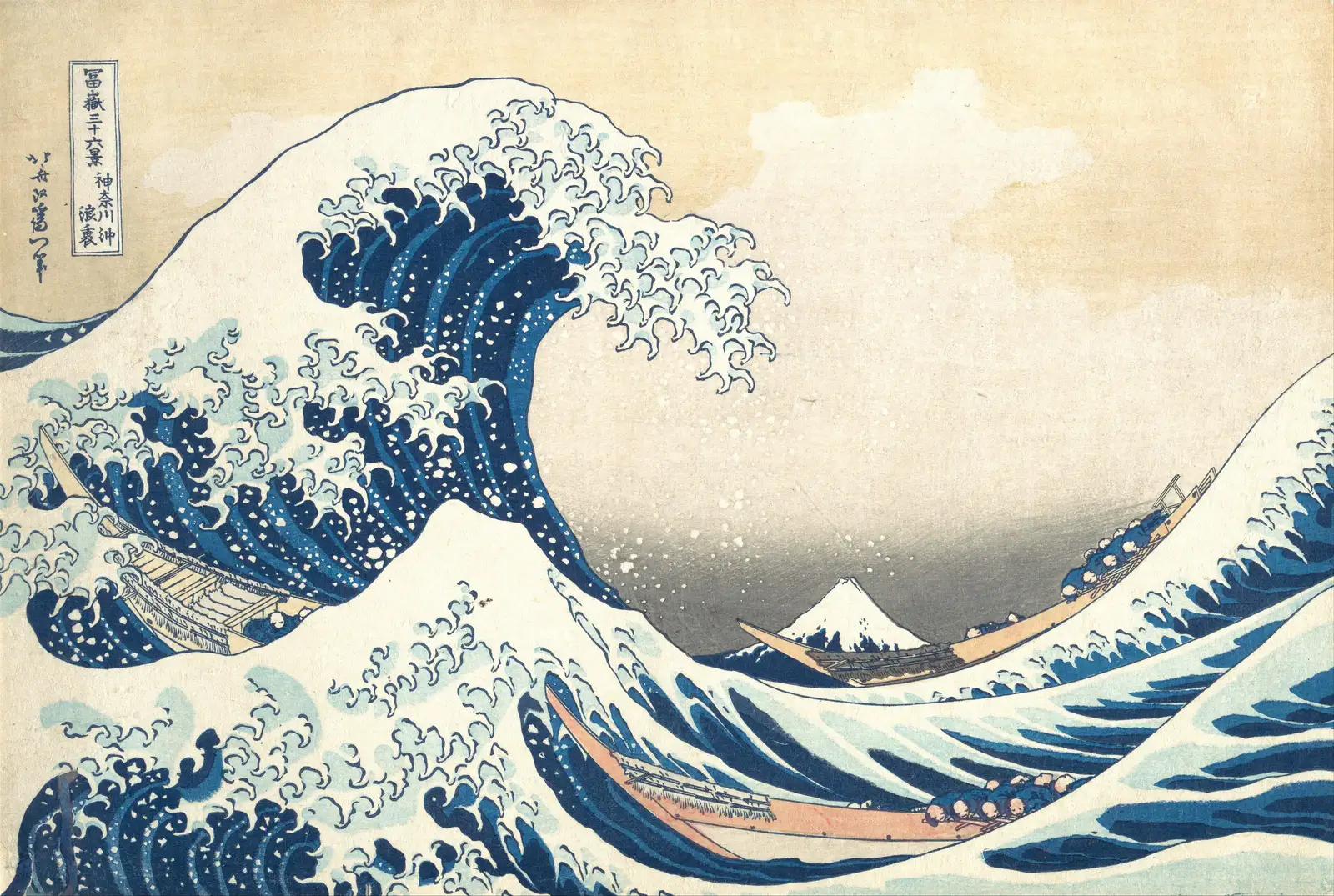
The Great Wave is a woodblock print smaller than a sheet of A3; the British Museum estimates as many as 8,000 impressions were printed. Every oil reproduction of it is a translation into a medium Hokusai never used, and the good ones admit it.
The painting in numbers
| The original | What it means for a reproduction | |
|---|---|---|
| Year | About 1830–32, first sheet of Thirty-six Views of Mount Fuji | Hokusai died in 1849; the image is public domain everywhere. |
| Where it is | There is no single original. Impressions are held by the Metropolitan Museum of Art, the British Museum, the Art Institute of Chicago and many others | You choose an impression, not a painting. The British Museum's Capucine Korenberg has identified 113 surviving impressions and estimates up to 8,000 were printed; they differ in colour and in wear. |
| Medium | Woodblock print, ink and colour on paper (ukiyo-e) | Flat colour areas, a printed key line, no brushwork and no impasto anywhere. |
| Original size | 24.4 × 35.7 cm (9 5/8 × 14 1/16 in) at the Met | Smaller than A3. Any canvas over 20 in is an enlargement of more than 140%. |
| Aspect ratio | 1.46 : 1, landscape (oban format) | A 40 × 30 in canvas is 1.33:1, so the image is either cropped at the sides or given extra sky. |
| Colour | Printed in Prussian blue, then a recent import to Japan; the pink and yellow inks have faded in many impressions | Different museum impressions look measurably different. Say which one you want copied. |
Dimensions and medium from the Metropolitan Museum of Art's collection record for accession 36491, which also declares the image public domain. Checked 2026-09-05.
Why it is hard to reproduce
The difficulty is the opposite of the one Van Gogh sets. A print has no brushwork at all: each colour is a flat, even area laid by a carved block, bounded by a printed line of constant weight. Oil paint wants to do the reverse. Every natural gesture a trained oil painter makes, a loaded stroke, a soft blend, a variation in pressure, is a departure from the source.
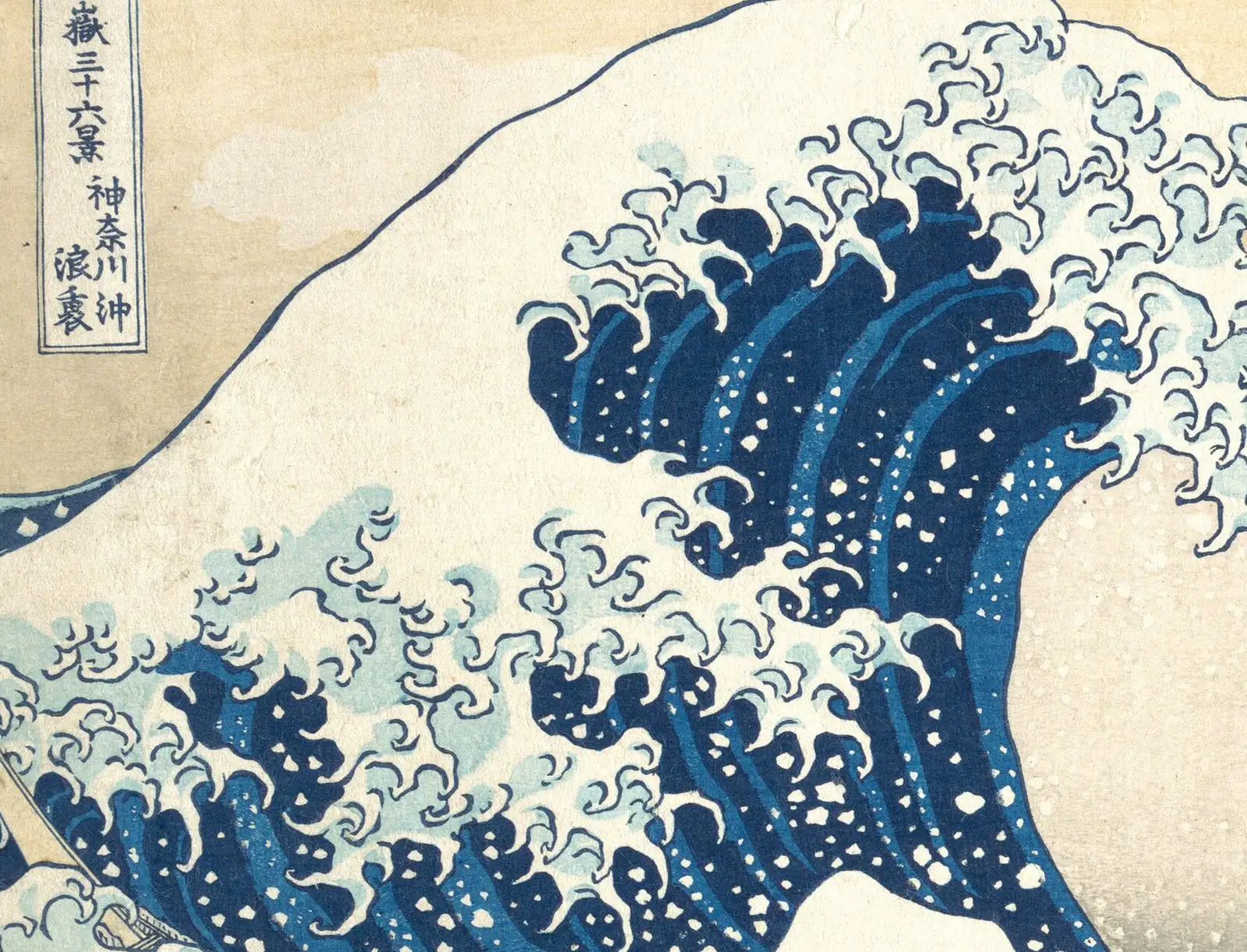
- Flatness is the subject. Making the blue even across half a metre of canvas, with no streaks and no variation, is a discipline most reproduction studios never practise.
- The key line must not vary. In the print it is one weight throughout. Painted by hand it thickens on curves and thins on straights, and the drawing loses its snap.
- Impressions differ. Early impressions are darker and the sky has a pink band; later and faded ones are paler. A copyist working from a random web image inherits whatever that impression's state is.
- Grain and paper. The subtle texture of the paper and the slight misregistration of the blocks are part of how the image reads. Canvas weave replaces them with something quite different.
What cheap copies get wrong
The commonest fault is texture. Studios add visible impasto and blended gradients to make the canvas look 'painterly', which is exactly what the source does not contain. The result is a wave that ripples where the print is flat, and a Mount Fuji with a soft edge where the print has a hard one.
- Brushy gradients in the sky and inside the wave, where the print has flat bands.
- Foam painted with modelled highlights instead of as flat white shapes.
- A key line that varies in thickness, which is unavoidable by hand and rarely compensated for.
- A faded impression copied faithfully, so the sky's pink band is missing and the blue is weak.
- Sold as 'oil painting reproduction of the original painting'. It is a print, and a seller who does not know that has not looked.
Sizes and where it hangs well
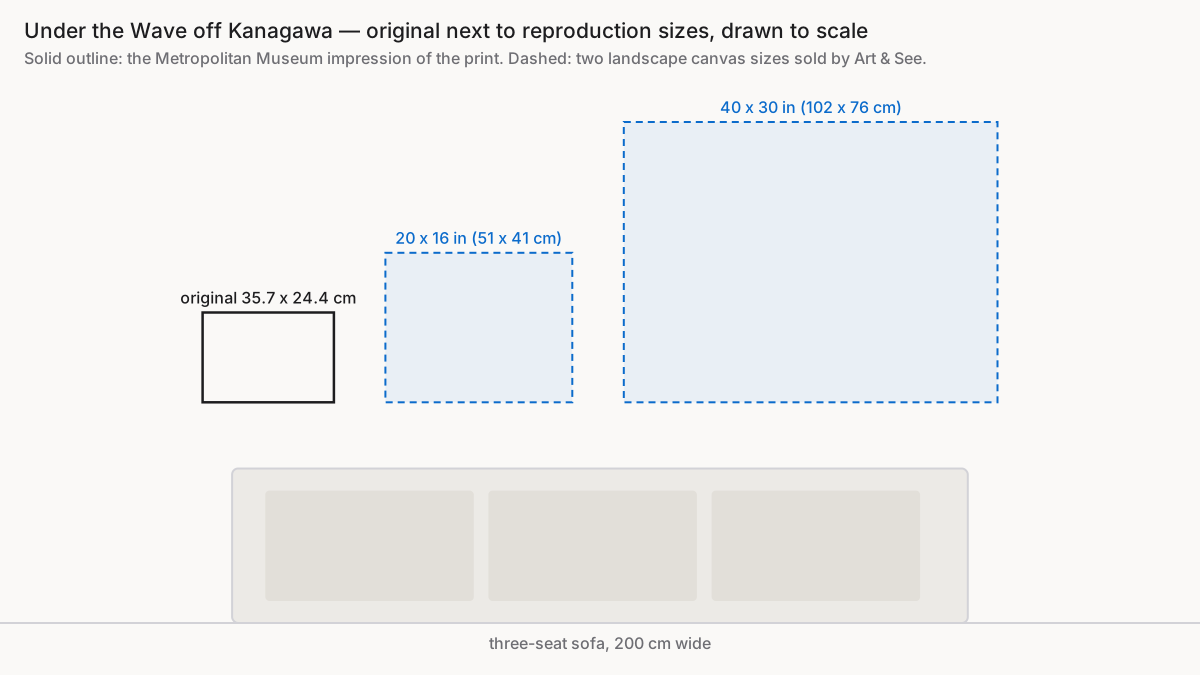
Enlargement suits this image better than it suits most, because flat colour and hard edges do not blur when scaled and there is no brushwork to invent. A 40 × 30 in canvas over a sofa works, and so does a long, narrow crop across a corridor, though cropping loses Mount Fuji, which is the joke of the picture. Hang it away from direct sun: if the studio has used a strong Prussian-blue substitute, it is the colour most likely to shift.
Price range
| Size | Art & See list price | Vs the original print | Note |
|---|---|---|---|
| 20 × 16 in (51 × 41 cm) | $299.95 | About 140% of the width | Already larger than the print. |
| 24 × 20 in (61 × 51 cm) | $359.95 | 170% | Ratio 1.2:1, noticeably squarer than the print. |
| 30 × 24 in (76 × 61 cm) | $430.95 | 215% | Ratio 1.25:1. |
| 40 × 30 in (102 × 76 cm) | $529.95 | 285% | The usual choice for a sofa wall. |
| 48 × 36 in (122 × 91 cm) | $599.95 | 340% | Ratio 1.33:1; the print's 1.46:1 needs a crop or added sky. |
Art & See prices from its published unframed rectangular ladder, verified 2026-09-05; the ladder continues to $769.95 at 60 × 40 in and $1,299.95 at 72 × 48 in. This subject is not listed as a product in the store's catalogue on that date. Reproduction Gallery did list The Great Wave off Kanagawa among its popular oil paintings the same day.
The subject is not in Art & See's catalogue under this title, and the store's custom-orders page promises custom sizes, orientation changes and colour or content modifications rather than any painting on request, so the honest route there is a catalogue search rather than a product link. If the search returns nothing, a store that lists the composition explicitly is the better starting point, and Reproduction Gallery does.
Where to buy
Three routes for a print that people buy as a painting.
The honest answer for this subject is that the store does not list it, so the search link may return nothing. Its custom-orders page offers custom dimensions, orientation changes and colour or content modifications, and its published ladder starts at $299.95 for a landscape canvas, so ask rather than assume.
Art & See- Reproduction Gallery — Listed The Great Wave off Kanagawa in its popular paintings on 2026-09-05, which removes the guesswork; its catalogue is the largest of the stores surveyed.
- The Metropolitan Museum of Art — Publishes its impression as a public-domain file at high resolution, which is both the right reference to send a studio and the cheapest way to get an accurate print of a print.
Copyright: the print question
Katsushika Hokusai died in 1849, so the image is in the public domain everywhere and the Metropolitan Museum of Art marks its own photograph of the print as public domain too. Copying it in oil is legal, and so is selling the result. The only honesty issue is description: a hand-painted canvas of this image is a reproduction of a woodblock print, not of a painting, and a listing that says otherwise is wrong on a fact you can check in one click.
Frequently asked questions
Is The Great Wave a painting?
No. It is a woodblock print, the first sheet of Hokusai's series Thirty-six Views of Mount Fuji, printed in ink and colour on paper at about 24.4 × 35.7 cm. Thousands of impressions were pulled, and museums around the world hold them.
Then why is it sold as an oil painting reproduction?
Because demand for it as wall art is enormous and hand-painted canvas is what reproduction studios sell. It is a translation into another medium, which is legitimate as long as the listing does not claim the original was an oil painting.
Which impression should a studio copy?
Name one. The Metropolitan Museum of Art and the Art Institute of Chicago both publish high-resolution files, and the colours differ between impressions because the pink and yellow inks faded at different rates; the British Museum has catalogued 113 surviving impressions and dated them by the wear on the blocks. A random web image is a lottery.
Sources
- Under the Wave off Kanagawa (Kanagawa oki nami ura), accession 36491 — The Metropolitan Museum of Art. Accessed September 5, 2026.
- Collection API record: medium, dimensions and public-domain status — The Metropolitan Museum of Art. Accessed September 5, 2026.
- The making and evolution of Hokusai's Great Wave (impressions printed and surviving) — Capucine Korenberg, The British Museum. Accessed September 5, 2026.
- Popular oil paintings, including The Great Wave off Kanagawa — Reproduction Gallery. Accessed September 5, 2026.
- Top 100 most famous paintings, ranked listing — HandmadePiece. Accessed September 5, 2026.
- How long does copyright protection last? — United States Copyright Office. Accessed September 5, 2026.
- File:Tsunami by hokusai 19th century.jpg — Wikimedia Commons. Accessed September 5, 2026.
Keep reading
catalog
The 20 most popular oil painting reproductions, and what each one costs to copy well
The 20 paintings ordered most often, cross-checked against five stores' own bestseller lists, with museum, original size, difficulty and price for each.
price
How much do oil painting reproductions cost?
Compare equivalent sizes, finishes, shipping and payment terms with a dated total-cost worksheet. Unknown charges stay visible instead of becoming zero.
legal
Are Oil Painting Reproductions Legal?
Yes for public-domain paintings, no for artists still in copyright. Country rules, 21 artists with dates, and the line between a copy and a forgery.
buying
Museum Quality Oil Painting Reproductions: What to Check Before Ordering
A sourced checklist for materials, finished-painting approval, cancellation and returns, with policy exceptions and limits of visual checks.