painting
The Kiss reproduction: gold leaf, square format, and what you actually get
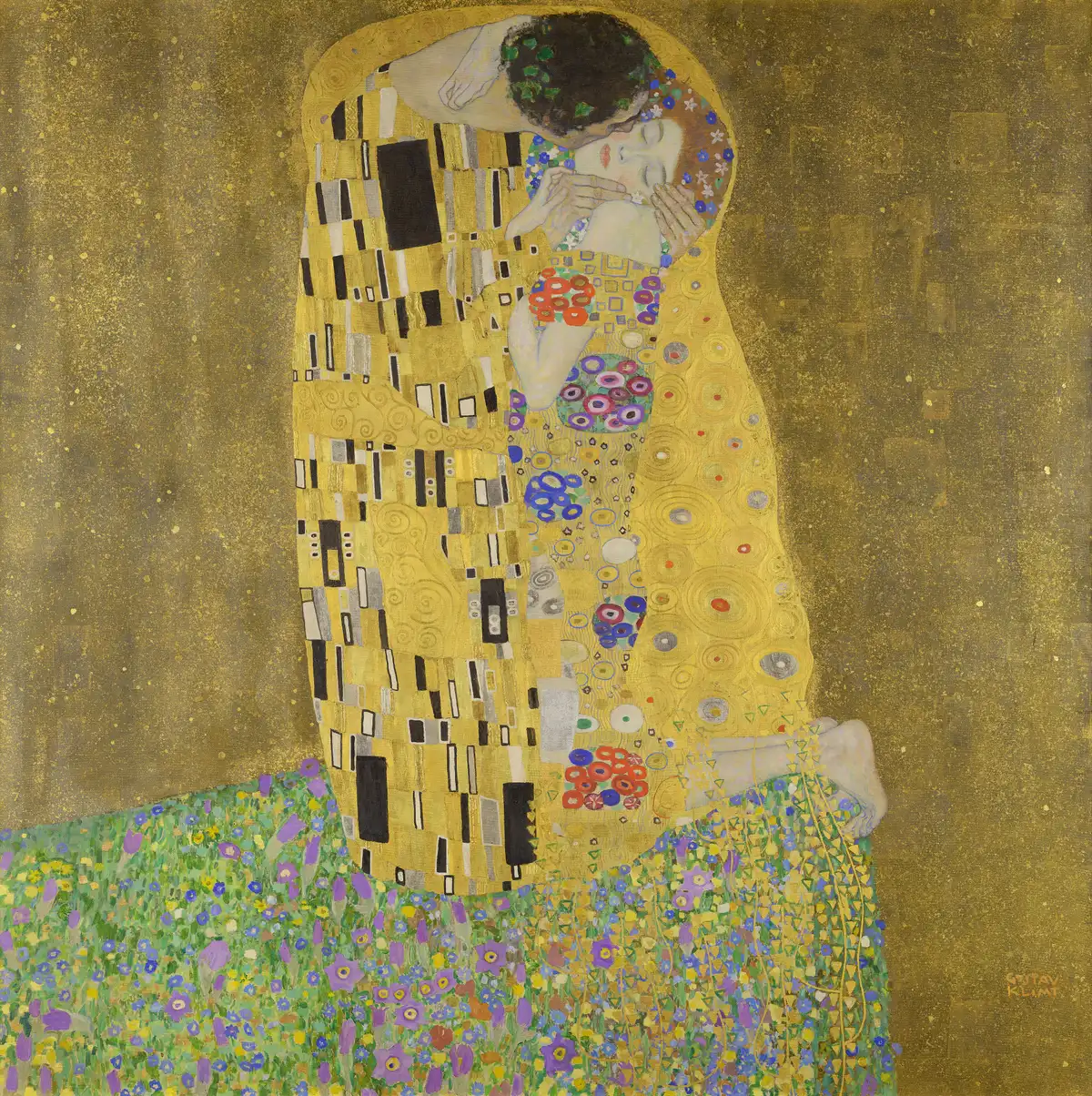
Klimt's The Kiss is 180 x 180 cm of oil, gold leaf, silver and platinum. What a reproduction can and cannot copy, what it costs, how to check the gold.
Oil Painting ReproductionsUpdated
The short answer
The original is a 180 × 180 cm square carrying gold, silver and platinum leaf over a brass-leaf ground. An oil-only reproduction cannot reproduce that light, so the question when buying is what the studio puts where the metal was.
The painting in numbers
| The original | What it means for a reproduction | |
|---|---|---|
| Year | Begun about 1907, shown unfinished at the 1908 Kunstschau as Liebespaar, completed by mid-1909 and first catalogued as Der Kuss that autumn | Klimt died in 1918, so the image is public domain. Stores that date it 1907-08 are using the popular dating, not the museum's. |
| Where it is | Belvedere, Vienna, inv. 912 | The museum's online record and its essay on the painting describe the build-up of metal and paint, which is more useful to a buyer than any store description. |
| Medium | Figural area: gold leaf, silver leaf, platinum leaf and oil-resin paints on primed canvas. Background: Schlagmetall, a base-metal leaf in brass, overpainted with glazes and scattered with metal-leaf flakes | Three metals plus a fourth underneath. Almost every reproduction sold as 'oil on canvas' replaces all of them with yellow paint. |
| Original size | 180 × 180 cm (70.9 × 70.9 in) | Nearly two metres square. The largest square most studios sell is 36 × 36 in, one fifth of the area. |
| Aspect ratio | 1 : 1 | Only a square canvas keeps the composition. On any rectangle the halo behind the man's head is cut. |
| Common reproduction sizes | 16 × 16 in, 24 × 24 in, 30 × 30 in, 36 × 36 in | All square, all far smaller than the original. |
Dimensions, dating and materials from the Belvedere's object record and essay for inv. 912, read 2026-09-05. The record is published in German; the medium line above is a translation of it.
Why it is hard to reproduce
Metal leaf is not a colour, it is a mirror. Gold leaf laid on adhesive size and burnished reflects the light in the room, so the robe changes as you walk past it; the flowers, painted in ordinary oil, do not. That contrast between a reflective field and a matt one is the whole optical idea of the picture, and yellow ochre plus white cannot produce it at any price.
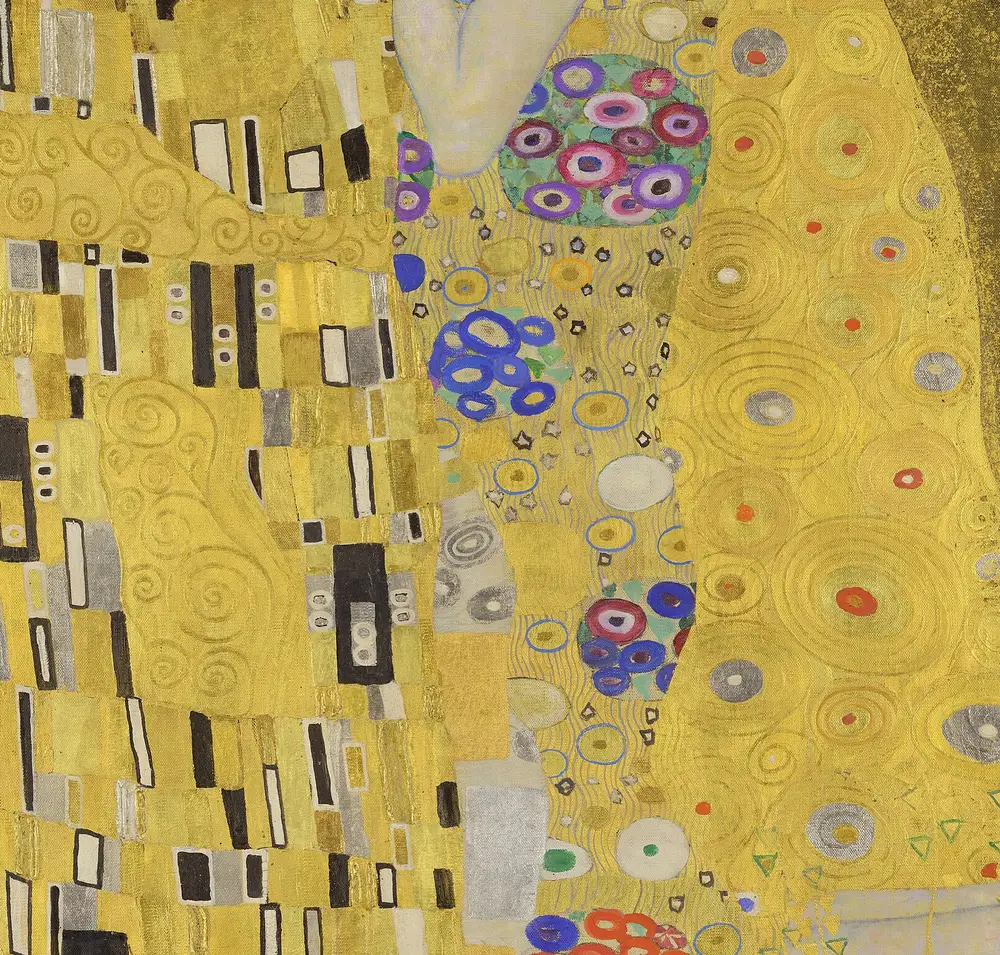
- Three metals do three different jobs. The Belvedere's record lists silver leaf and platinum leaf alongside the gold; the cooler rectangles on the man's robe are not gold that has gone grey, they are a different metal. Copies painted in one yellow lose the split between the two figures.
- Ornament does not scale. At 180 cm the spirals in the man's robe are the width of a thumbnail. At 36 in they are the width of a match head, and at 16 in they cannot be drawn at all, so the copyist simplifies. Compare the count of shapes, not the general effect.
- Square is unforgiving. Any error in the tilt of the couple's axis is obvious in a square field, because there is no long side to absorb it.
- The metal came first. The Belvedere's essay notes that the ornamented areas, and the background, were laid over Schlagmetall before the painting proper, so Klimt had to plan the composition precisely in advance: its boundaries were fixed by the edges of the metal-primed fields. A copyist painting the image first and adding gold afterwards is working in the reverse order.
- The meadow is glazed. The flowers under the couple's feet sit in thin transparent layers over a warm ground, which is a slow, multi-session technique on a deadline that usually allows one.
What cheap copies get wrong
The commonest fault is a uniform gold: one mixed yellow-ochre tone brushed across the entire robe and background, so the picture reads as a flat yellow poster with two heads in it. In the original the ground is a duller, greener, beaten metal and the robes are brighter, which is what pushes the couple forward.
- Bronze powder or gold acrylic instead of leaf. It looks convincing in the seller's photograph and turns brown-green within a few years as the copper in it oxidises.
- The man's rectangles reduced from dozens to a handful, and the woman's circles turned into a repeating stamp.
- The gold applied over the whole canvas first and the figures painted on top, which reverses the original order and kills the edge quality.
- A rectangular canvas sold as 'The Kiss', with the top of the halo and the bottom of the meadow cropped away.
- Flowers painted opaque, so the meadow looks like confetti rather than a glazed field.
Sizes and where it hangs well
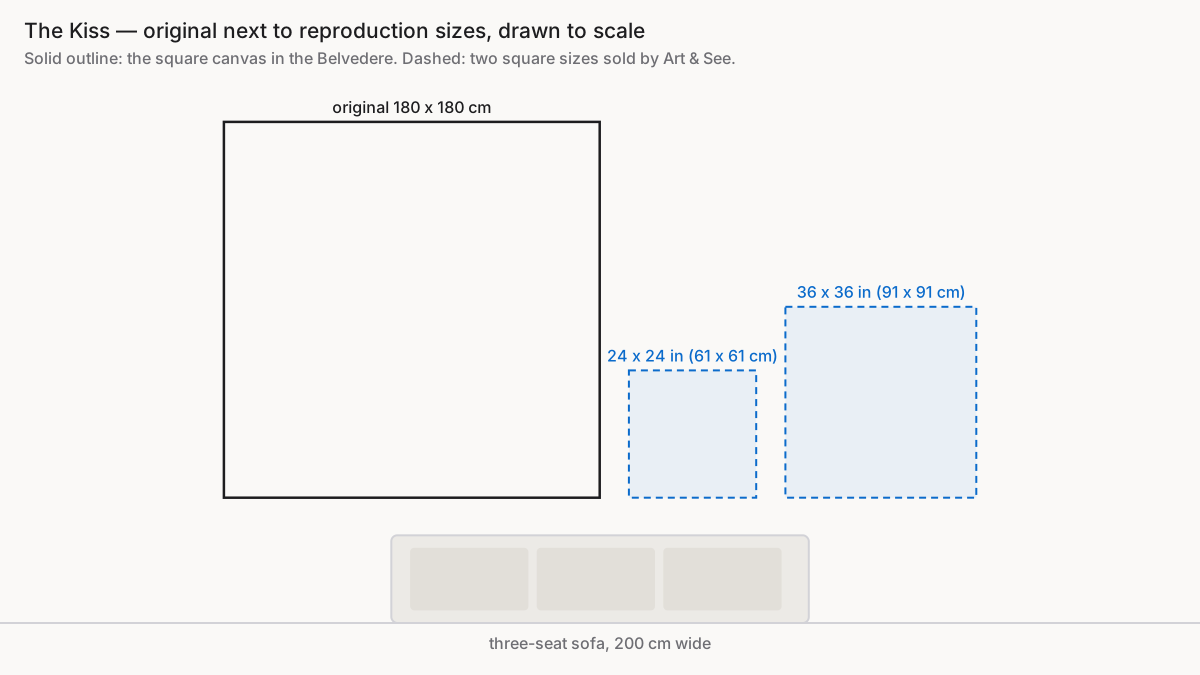
A square hangs badly in the middle of a long wall and well on a short one, in a stairwell, or centred over a low chest. Because the ornament is the content, size matters more here than in almost any other popular reproduction: at 16 × 16 in the robes become texture, at 36 × 36 in they become pattern again. If the wall can take it, this is the painting on which to spend the extra 12 inches rather than the extra gold.
Price range
| Size | Art & See list price | Area vs the original | Note |
|---|---|---|---|
| 16 × 16 in (41 × 41 cm) | $249.95 | 5% | Ornament becomes texture at this size. |
| 20 × 20 in (51 × 51 cm) | $309.95 | 8% | The smallest size at which the rectangles still read as rectangles. |
| 24 × 24 in (61 × 61 cm) | $380.95 | 11% | The size most buyers of this painting choose. |
| 30 × 30 in (76 × 76 cm) | $479.95 | 18% | Works over a chest or in a stairwell. |
| 36 × 36 in (91 × 91 cm) | $549.95 | 26% | Half the original in each direction; a quarter of its area. |
Art & See prices from its published unframed ladder, verified 2026-09-05. Across the eight stores surveyed on the same date, hand-painted oil reproductions of comparable size ran from about $150 to about $1,100, with gold treatment almost never specified in the listing.
Klimt is one of the paintings where the cheapest listing is most likely to disappoint, because the saving is taken out of exactly the part you are buying. Art & See lists The Kiss at the same square ladder it uses for every square painting in its catalogue, from $249.95 at 16 × 16 in to $549.95 at 36 × 36 in.
Where to buy
Three routes for this painting specifically.
Carries it at five true square sizes, publishes the price before you configure anything, and sends a photograph of the finished canvas for approval before dispatch.
Art & See- overstockArt — The cheapest of the stores surveyed at every size, and the right choice if the budget is the constraint; it sells The Kiss as a full-view canvas rather than at museum dimensions.
- Belvedere museum shop — Sells a licensed giclee print from the museum's own photography, which reproduces the colour more accurately than any hand-painted copy, and none of the surface.
Copyright: what you can and cannot do
Gustav Klimt died on 6 February 1918, so The Kiss entered the public domain across the European Union in 1989 and is out of copyright everywhere that uses a life-plus-70 term. Commissioning, owning, reselling and photographing a hand-painted copy is legal. The Belvedere's own photographs of the painting are a separate right; the image on this page is a Wikimedia Commons file carried as public domain.
Frequently asked questions
Do reproductions of The Kiss use real gold leaf?
Usually not. Most listings that say 'gold' mean gold-coloured oil paint or bronze powder in medium. Real leaf is a separate craft and a separate cost; if a studio does it, it says so and charges for it. Ask before you order, not after.
What size is closest to the original?
None sold as stock. The original is 180 × 180 cm, about 71 × 71 in. The largest common square is 36 × 36 in, which is half the original's height and about a quarter of its area. Anything larger is a custom commission.
Why do so many copies look yellow rather than gold?
Because metal reflects and paint does not. A photograph taken straight on makes gold leaf look like yellow paint too, which is why an angled photo of the finished canvas is the only useful check. It is also worth knowing that the Belvedere records three different leaf metals in the picture, not one.
Sources
- Gustav Klimt, Der Kuss (Liebespaar), inv. 912 — object record and essay (in German) — Belvedere, Vienna. Accessed September 5, 2026.
- Why did Gustav Klimt use gold? — Belvedere, Vienna. Accessed September 5, 2026.
- Gustav Klimt, The Kiss (Lovers), licensed giclee print — Belvedere museum shop. Accessed September 5, 2026.
- Best-selling art reproductions — overstockArt. Accessed September 5, 2026.
- How long does copyright protection last? — United States Copyright Office. Accessed September 5, 2026.
- File:The Kiss - Gustav Klimt - Google Cultural Institute.jpg — Wikimedia Commons. Accessed September 5, 2026.
Keep reading
artist
Klimt Reproductions: What a Good Copy Has to Get Right
Real gold leaf or gold paint, why most Klimt copies fail, which paintings fit a standard canvas, original sizes, prices and the copyright position.
catalog
The 20 most popular oil painting reproductions, and what each one costs to copy well
The 20 paintings ordered most often, cross-checked against five stores' own bestseller lists, with museum, original size, difficulty and price for each.
price
How much do oil painting reproductions cost?
Compare equivalent sizes, finishes, shipping and payment terms with a dated total-cost worksheet. Unknown charges stay visible instead of becoming zero.
buying
Museum Quality Oil Painting Reproductions: What to Check Before Ordering
A sourced checklist for materials, finished-painting approval, cancellation and returns, with policy exceptions and limits of visual checks.