artist
Klimt Reproductions: What a Good Copy Has to Get Right
Real gold leaf or gold paint, why most Klimt copies fail, which paintings fit a standard canvas, original sizes, prices and the copyright position.
Oil Painting ReproductionsUpdated
The short answer
A Klimt copy stands or falls on the gold. Metal leaf laid over a ground reflects and shifts as you move; gold-coloured paint reads as flat mustard. Ask what the gold is before you order. Prices run $249.95 to $549.95 unframed for the square sizes.
Why Klimt is reproduced so often
On 18 November 2025 Klimt's Portrait of Elisabeth Lederer sold at Sotheby's New York for $236.4 million — the highest price ever paid at auction for a work of modern art, and the second highest for any artwork after Leonardo's Salvator Mundi at $450.3 million in 2017. That figure did not create the demand for Klimt reproductions; it confirmed it. The Kiss has been among the two or three most requested hand-painted copies in the trade for decades.
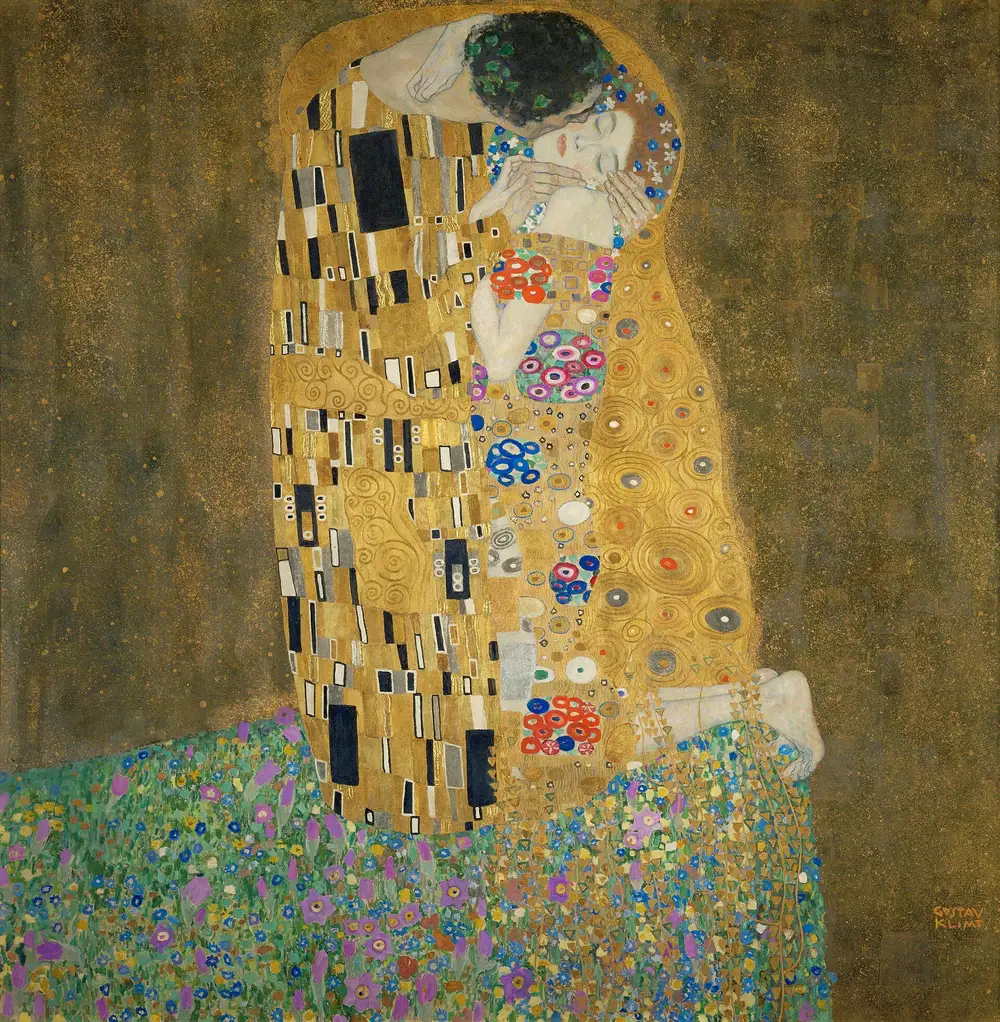
There is also a purely practical reason. The Kiss is 180 × 180 cm: a perfect square. Standard reproduction canvases come in 16 × 16, 20 × 20, 24 × 24, 30 × 30 and 36 × 36 inches, so the composition transfers with no cropping, no stretching and no argument. As the table below shows, most of Klimt's other famous pictures are extreme verticals or horizontals that no standard ladder carries at all.
And Klimt is the rare painter whose most valuable single ingredient can be bought by the sheet. The Belvedere's own record is unusually specific about what that ingredient is: the figures are "Blattgold, Blattsilber, Blattplatin" — gold, silver and platinum leaf — in oil-resin paint on primed canvas, while the background is Schlagmetall, brass imitation leaf, glazed over and scattered with metal flakes. The same entry records that the Austrian ministry paid Klimt 25,000 crowns for the picture, the highest the Moderne Galerie had then paid for a work by a living artist. Whether a studio actually buys any of that is the question this page is really about.
What a faithful copy must get right
Metal leaf, not gold-coloured paint
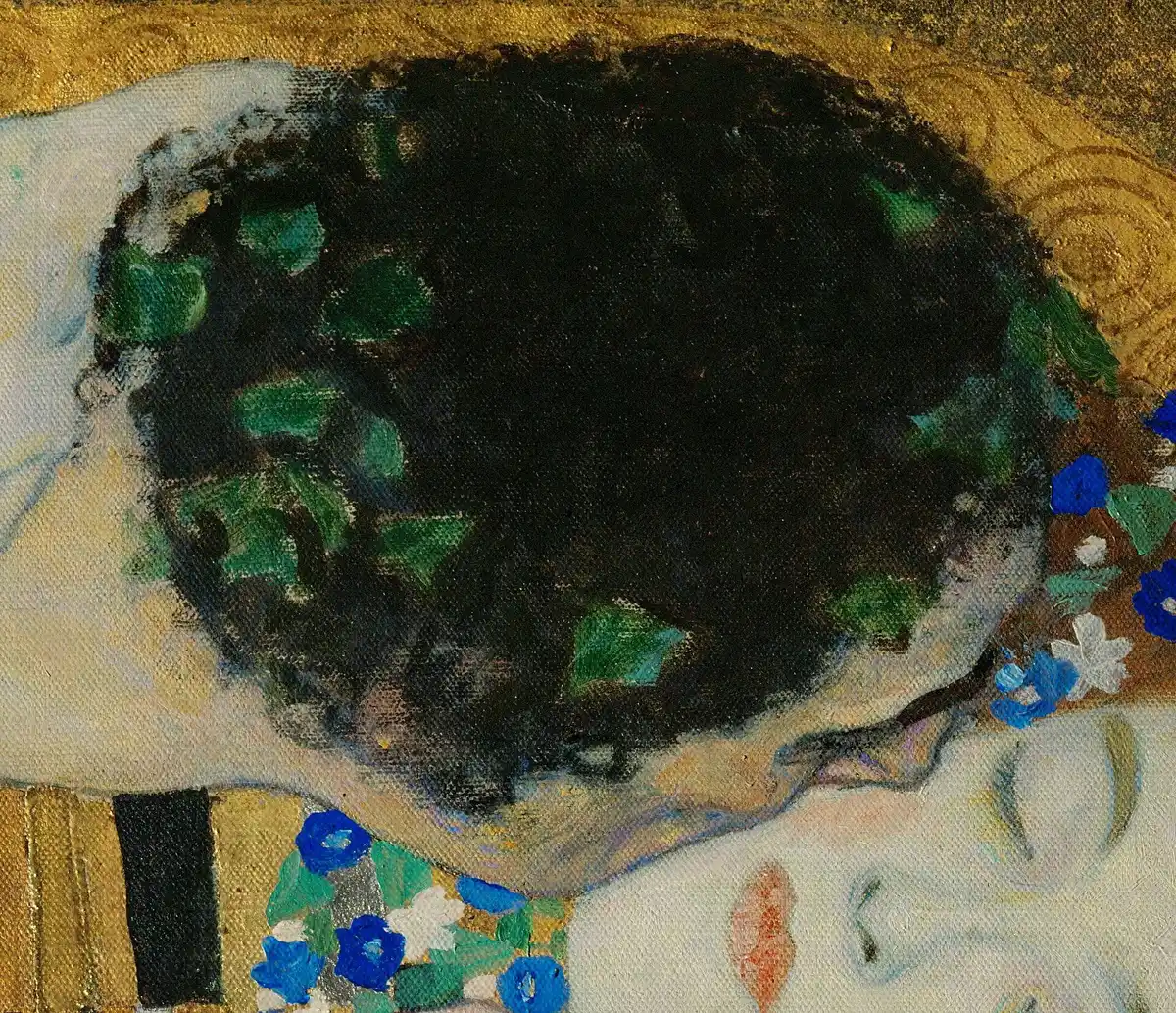
Klimt — the son of a gold engraver — applied gold and silver leaf onto a prepared ground, sometimes over raised gesso so the ornament sits proud of the surface, and tooled patterns into it. Leaf reflects specularly: the gold looks different from every angle, goes near-white under a lamp and near-brown in shade. Bronze or mica pigment mixed into oil paint does not do this. It scatters light instead of reflecting it, so it reads as a fixed dull yellow from every position in the room. Photographed straight on, the two look similar; walk past them and they are nothing alike.
Three questions worth asking a studio
- Is it leaf or paint? If leaf, is it genuine gold, or imitation leaf (a brass alloy, sometimes called Dutch metal)? Imitation leaf is legitimate and far cheaper, but it tarnishes without a sealing varnish and it is a different colour. Either answer is acceptable; no answer is not.
- Is the ornament raised? Klimt built some of the pattern up in relief before gilding. A copy that paints the pattern flat loses the shadow inside the ornament.
- Is there more than one metal? The Kiss uses gold along with silver and platinum tones. A copy in one gold is missing a third of the picture's colour range.
The contrast between flat and modelled
The whole design of The Kiss rests on a collision: faces, hands and feet are painted with conventional naturalistic modelling, and everything else is a flat decorated field with no depth at all. Copyists who model the robes even slightly — adding shading to make them look like cloth — destroy the effect, because the picture only works if the bodies are the only three-dimensional thing in it. Conversely, copyists who flatten the faces to match the robes produce a poster.
Most requested works
Difficulty is this site's rating, 1 to 5: 1 means a competent copyist gets it right first time; 5 means the failure is obvious to anyone who knows the original. Prices are Art & See's published unframed list prices for the nearest standard canvas — with a caveat noted below for the pictures whose shape has no standard canvas.
| Work | Year | Museum | Original size | Difficulty | Reproduction price range |
|---|---|---|---|---|---|
| The Kiss | c. 1907–09 | Belvedere, Vienna | 180 × 180 cm | 5 | $249.95 (16 × 16 in) – $549.95 (36 × 36 in) |
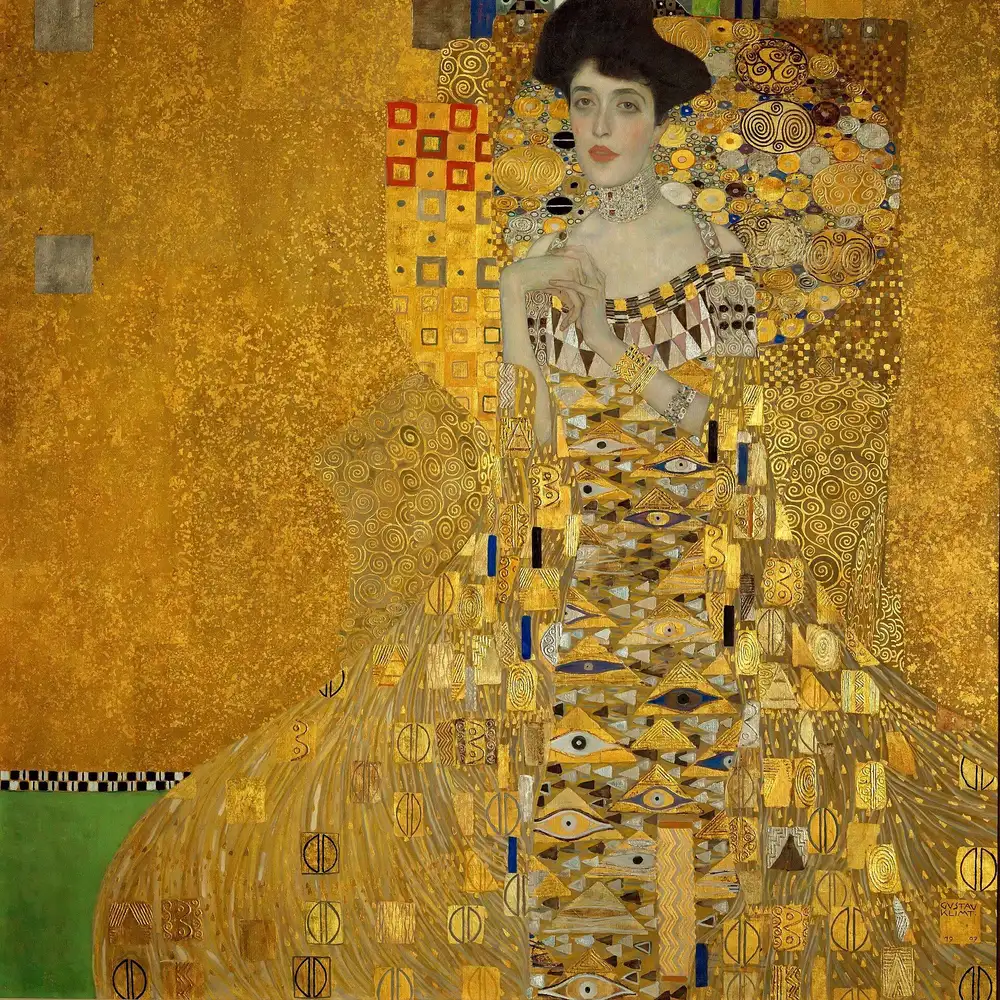
| Portrait of Adele Bloch-Bauer I | 1907 | Neue Galerie, New York | 140 × 140 cm | 5 | $249.95 (16 × 16 in) – $549.95 (36 × 36 in) |
| Judith I | 1901 | Belvedere, Vienna | 84 × 42 cm | 4 | No stock canvas at 2:1 — custom order |
| Danaë | 1907 | Private collection, Vienna | 77 × 83 cm | 3 | $249.95 (16 × 16 in) – $549.95 (36 × 36 in) |
| Portrait of Emilie Flöge | 1902 | Wien Museum, Vienna | 178 × 80 cm | 4 | No stock canvas at 2.2:1 — custom order |
| Water Serpents II | 1904–07 | Private collection | 80 × 145 cm | 4 | No stock canvas at 1.8:1 — custom order |
The Kiss is dated, measured and described from the Belvedere's own record (inv. 912, "um 1907-1909 … 180 × 180 cm"); the rest from Wikidata and the standard catalogues raisonnés, all read 2026-09-05. Reproduction prices from Art & See's public product pages, same date. The standard rectangles are 1.20, 1.25, 1.33 and — at 60 × 40 in ($769.95) and 72 × 48 in ($1,299.95) — 1.50, so anything longer than 1.50 needs a bespoke stretcher.
Only two of the six fit a stock canvas without compromise, and both are square. That is the real explanation for why The Kiss dominates Klimt reproduction sales: it is the one great Klimt that the supply chain can make cheaply. Art & See's Klimt search results are the place to check what is currently stocked; its listed The Kiss product opens at $249.95 for the 16 × 16 in square.
Common mistakes in cheap copies
- Bronze-powder "gold". The default in the low-price trade. Flat, matte, and identical from every viewing angle.
- One gold instead of several. The originals mix warm gold, pale gold, silver and platinum. A single tone collapses the ornament into wallpaper.
- Ornament drawn rather than built. Klimt's spirals and rectangles have physical edges. Painted-on pattern has no shadow and no relief.
- Modelled robes. Shading added to the gold field to make it read as fabric. This is the change that most often ruins an otherwise competent copy.
- Softened faces. The faces in The Kiss and Judith I are drawn precisely and unsentimentally. Copyists prettify them, and the picture becomes greeting-card.
- Cropping to fit a rectangle. The Kiss is square. A version delivered on a 20 × 16 in canvas has lost part of the flowered ground or has been stretched, and either way it is not the composition.
Sizes that work at home
Gold behaves differently from paint in a room, and that changes the sizing advice. Leaf needs an angled light source to come alive; under flat ambient light a gilded canvas can look duller than a painted one. Plan the lighting before the size.
- 24 × 24 in (61 × 61 cm), $380.95. 34 % of the original Kiss. Enough for the ornament to stay legible. Good over a console or a bed head.
- 30 × 30 in (76.2 × 76.2 cm), $479.95. 42 % of the original. The size at which the two figures start to read as figures at normal room distance.
- 36 × 36 in (91.4 × 91.4 cm), $549.95. The largest square on the standard ladder, and half the original. This is as close as an off-the-shelf order gets.
- Full scale, 180 × 180 cm. Off the ladder entirely. A studio can build it, but it is a bespoke commission and the gilding cost scales with the area, not with the price list.
Hang it where a lamp or a window throws light across the surface at a shallow angle rather than straight at it, and hang it at eye level — Klimt's gold loses most of its behaviour above 160 cm because you stop seeing the reflection and start seeing only the local colour.
Where to buy
Three routes for a hand-painted Klimt, and what each is genuinely better at. Checked 2026-09-05.
Hand-painted oil on canvas in the square sizes that fit The Kiss without cropping, from $249.95, with a photograph of the finished piece sent for approval before shipping — the moment to ask whether the gold is leaf or paint.
Art & See- Reproduction Gallery — Lists 162 Klimt titles from $349 across 6 pages (counted 2026-09-05) — catalogue breadth is where it beats Art & See, and it matters here because the non-square pictures, Judith and Emilie Flöge and the Water Serpents, are rarely stocked anywhere.
- A Dafen workshop, ordered direct — Cheapest by a wide margin and the only route where genuine gold-leaf work is sometimes offered as an explicit paid upgrade; you carry the quality and returns risk yourself, and gilding quality varies enormously.
Copyright status
Klimt died on 6 February 1918. Copyright in his paintings expired in the life-plus-70 countries on 1 January 1989, and his work is free in the United States as well. Nobody licenses Klimt; nobody can. A hand-painted copy of The Kiss is as legal to make and sell as a copy of a Van Gogh.
Ownership history is a separate matter and worth knowing about, because several major Klimts were looted under the Nazi regime and restituted after long litigation — Adele Bloch-Bauer I returned to Maria Altmann in 2006 and now hangs at the Neue Galerie in New York. Restitution does not affect copyright, and it does not affect your right to own a copy. It does mean that captions and provenance claims on reproduction sites are frequently out of date about where the original hangs.
As always, the copy must be described as a copy. The broader rules are in are oil painting reproductions legal.
Frequently asked questions
Do Klimt reproductions use real gold?
Some do and most do not. At the low end the gold is bronze or mica pigment mixed into paint, which looks flat and identical from every angle. Genuine gold leaf, or imitation brass leaf, is laid in sheets over a prepared ground and reflects light differently as you move. Ask which one you are buying; the answer should be specific.
Is a Klimt reproduction legal?
Yes. Klimt died in 1918 and his work has been out of copyright in Europe since 1989 and is free in the US. No licence, no royalty. The only requirement is that a copy is sold as a copy.
What size should I buy The Kiss at?
Square, always — the Belvedere gives the original as 180 × 180 cm, and any rectangular canvas means cropping or stretching. 30 × 30 in ($479.95) is the size at which the two figures resolve properly at normal room distance; 36 × 36 in ($549.95) is the largest square on the standard ladder, and half the original's height.
Why can't I buy Judith I or the Emilie Flöge portrait at a normal price?
Because their proportions are roughly 2:1 and the longest standard reproduction canvas is 1.50:1 — the 60 × 40 in and 72 × 48 in sizes at the top of the ladder. There is no stock stretcher at 2:1, so those pictures need a bespoke frame and a bespoke quote; Art & See's custom-orders page does state that custom dimensions are available on request. It is the main reason Klimt's tall pictures are almost absent from the mainstream reproduction market.
Sources
- $236.4 Million Klimt Portrait Sets Records as Sotheby's Inaugurates the Breuer — Sotheby's. Accessed September 5, 2026.
- Der Kuss (Liebespaar) — the Belvedere's own catalogue essay by Franz Smola and Markus Fellinger, on the 1908 Kunstschau, the 25,000-crown purchase, and Klimt's use of gold leaf with further metal applications — Belvedere, Vienna — Sammlung Online. Accessed September 5, 2026.
- Adele Bloch-Bauer I — collection and restitution history — Neue Galerie New York. Accessed September 5, 2026.
- Klimt portrait breaks modern art record with $236m sale — Al Jazeera. Accessed September 5, 2026.
- Gustav Klimt artist page — catalogue depth benchmark — Reproduction Gallery. Accessed September 5, 2026.
Keep reading
painting
The Kiss reproduction: gold leaf, square format, and what you actually get
Klimt's The Kiss is 180 x 180 cm of oil, gold leaf, silver and platinum. What a reproduction can and cannot copy, what it costs, how to check the gold.
catalog
The 20 most popular oil painting reproductions, and what each one costs to copy well
The 20 paintings ordered most often, cross-checked against five stores' own bestseller lists, with museum, original size, difficulty and price for each.
legal
Are Oil Painting Reproductions Legal?
Yes for public-domain paintings, no for artists still in copyright. Country rules, 21 artists with dates, and the line between a copy and a forgery.
buying
Museum Quality Oil Painting Reproductions: What to Check Before Ordering
A sourced checklist for materials, finished-painting approval, cancellation and returns, with policy exceptions and limits of visual checks.
process
How Oil Painting Reproductions Are Made
The 12 steps of a hand-painted oil reproduction, how long each takes, why drying cannot be rushed, and what separates a $100 copy from a $1,000 copy.