artist
Rembrandt Reproductions: What a Good Copy Has to Get Right
Thick lead white in the light, almost nothing in the dark. Why cheap Rembrandt copies go opaque, plus sizes, difficulty, prices and copyright.
Oil Painting ReproductionsUpdated
The short answer
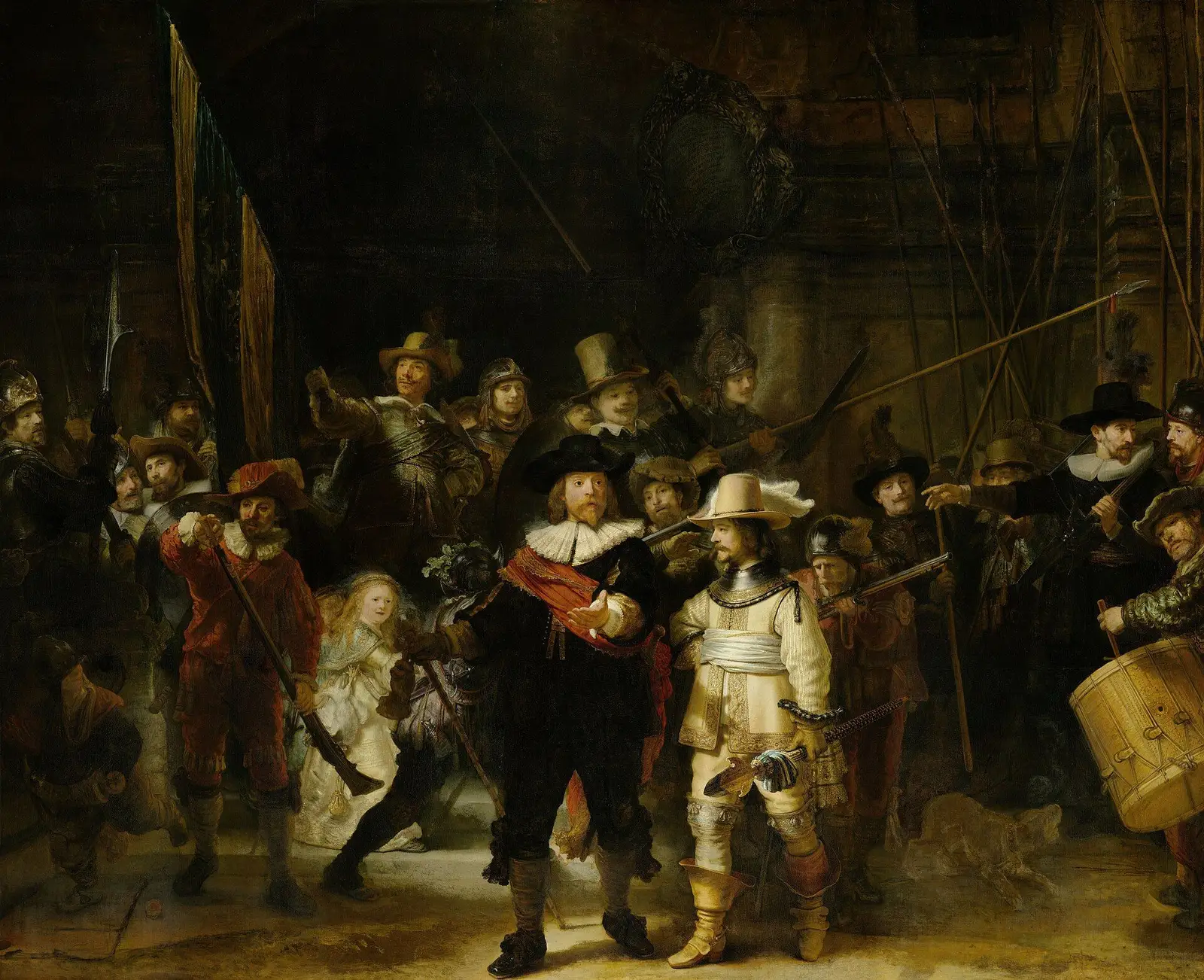
Rembrandt's lit passages are physically thick and his darks are almost bare canvas under a glaze. Copies that paint the shadows solidly lose the depth entirely. Proportions fit standard canvases well; expect $299.95 to $599.95 unframed at common wall sizes.
Why Rembrandt is reproduced so often
The Rijksmuseum welcomed over 2.3 million visitors in 2025, and a large share of them walked straight to one room. Operation Night Watch, the largest research and restoration project ever undertaken on the painting, has been running since 2019 inside a glass chamber in full view of the public; over the course of 2025 the team began removing the varnish. Rembrandt is the rare Old Master whose restoration is itself a visitor attraction.
For a reproduction buyer he has one large advantage over Leonardo or Klimt: his canvases are shaped like normal canvases. The Night Watch is a 1.20 proportion, the Anatomy Lesson is 1.28, The Jewish Bride is 1.37. All of those map onto standard 24 × 20, 30 × 24 and 40 × 30 inch stretchers with almost no distortion. What he does not have is any tolerance for a copyist who does not understand how his darks are made.
What a faithful copy must get right
Thick in the light, almost nothing in the dark
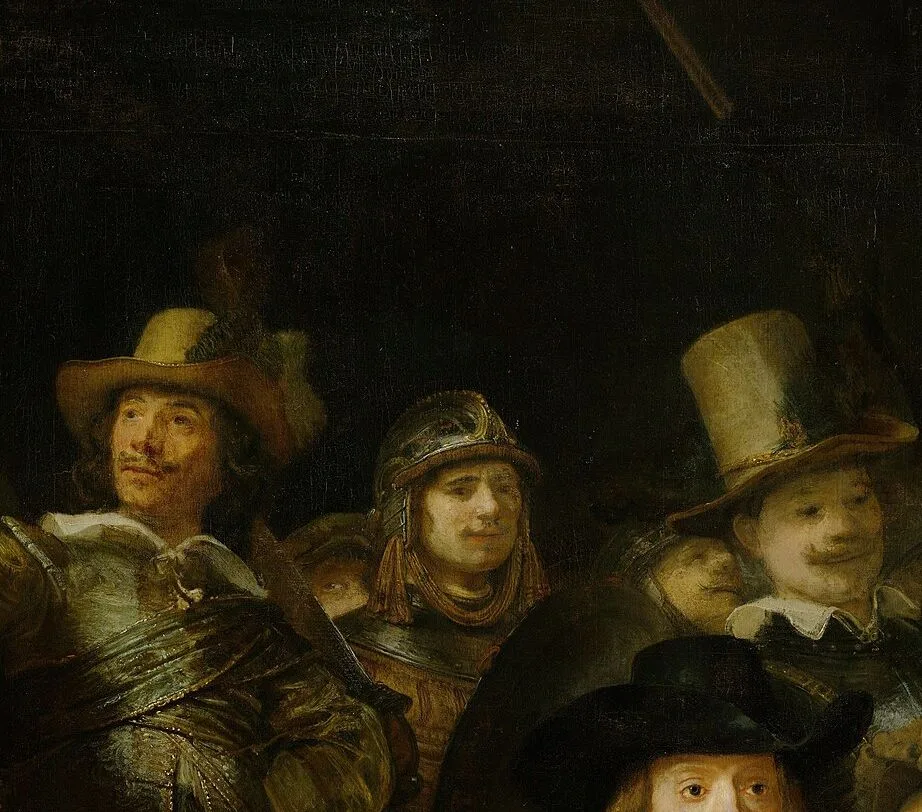
A Rembrandt is physically uneven. Lit passages — a collar, a forehead, the sleeve of a militiaman — are built up in loaded lead white, sometimes standing several millimetres proud, worked with the brush handle and in the late works with a knife. The dark passages are the opposite: a thin transparent brown glaze over a warm ground, in places barely covering the weave. The light is where the paint is.
Cheap copies invert this. They paint the darks in solid opaque brown-black — because opaque paint is faster and covers a cheap canvas — and they flatten the lights, because thick paint takes weeks to dry and the order has to ship. The result is a picture with the right composition and no interior: everything sits on the same plane, and the figures look stuck onto a wall rather than standing in a dark room.
One light source, and a lot of the picture given up to shadow
Rembrandt lights a scene from one direction and lets the rest go. In The Night Watch whole figures at the back are barely legible; in the late self-portraits half the head is unreadable. Copyists find this uncomfortable and raise the shadows so that everything can be seen. It is the most common single edit and it destroys the picture, because the drama is entirely in what has been sacrificed.
Drawing done with the brush
There is no underdrawing showing through and no outline. Hands, lace and armour are described with fast loaded strokes that read as detail from two metres and as abstraction from twenty centimetres. A copy that renders lace as lace, thread by thread, has more information than the original and less life.
Most requested works
Difficulty is this site's rating, 1 to 5: 1 means a competent copyist gets it right first time; 5 means the failure is obvious to anyone who knows the original. Prices are Art & See's published unframed list prices for the nearest standard canvas.
| Work | Year | Museum | Original size | Difficulty | Reproduction price range |
|---|---|---|---|---|---|
| The Night Watch | 1642 | Rijksmuseum, Amsterdam | 379.5 × 453.5 cm | 5 | $359.95 (24 × 20 in) – $599.95 (48 × 36 in) |
| Self-Portrait | 1659 | National Gallery of Art, Washington | 84.5 × 66 cm | 5 | $299.95 (20 × 16 in) – $529.95 (40 × 30 in) |
| The Anatomy Lesson of Dr Nicolaes Tulp | 1632 | Mauritshuis, The Hague | 169.5 × 216.5 cm | 4 | $299.95 (20 × 16 in) – $599.95 (48 × 36 in) |
| The Jewish Bride | c. 1665–69 | Rijksmuseum, Amsterdam | 121.5 × 166.5 cm | 5 | $299.95 (20 × 16 in) – $599.95 (48 × 36 in) |
| The Storm on the Sea of Galilee | 1633 | Stolen from the Isabella Stewart Gardner Museum, 1990 | 160 × 128 cm | 4 | $299.95 (16 × 20 in) – $529.95 (30 × 40 in) |
| Self-Portrait with Two Circles | c. 1665–69 | Kenwood House, London | 114.3 × 94 cm | 5 | $299.95 (16 × 20 in) – $529.95 (30 × 40 in) |
Dimensions from the holding institutions, each record read 2026-09-05: Rijksmuseum (The Night Watch, The Jewish Bride), National Gallery of Art Washington (Self-Portrait, 84.5 × 66 cm), Mauritshuis (Anatomy Lesson, 169.5 × 216.5 cm). Reproduction prices from Art & See's public product pages, same date. Unlike Klimt or Leonardo, every Rembrandt here sits between 1.19 and 1.37, which the standard 24 × 20, 30 × 24 and 40 × 30 in stretchers cover.
The Storm on the Sea of Galilee is a special case: it was taken from the Isabella Stewart Gardner Museum in March 1990 and has never been recovered. The museum still hangs the empty frame. A reproduction is currently the only way anyone can put that picture on a wall, which is an unusually honest reason to buy one. Art & See's Rembrandt search results are the place to check what is currently stocked.
Common mistakes in cheap copies
- Opaque darks. The defining failure. Solid brown-black instead of a thin transparent glaze over a warm ground, and the picture loses all its depth.
- Raised shadows. Background figures made legible "so you can see them". Every one of those decisions costs the picture some of its drama.
- Flattened lights. Lead-white impasto replaced by a smooth pale passage, so the collars and faces stop catching the light in the room.
- Cool darks. Rembrandt's shadows are warm — brown, olive, amber. Copies made with a black-plus-blue mixture go grey and modern.
- Over-rendered lace and armour. Described in the original with a few fast strokes; rendered in a bad copy thread by thread, which reads as fussy from any distance.
- A Night Watch at 24 × 20 in. The figures are life-size in the original. At that canvas the picture becomes an illustration of itself.
Sizes that work at home
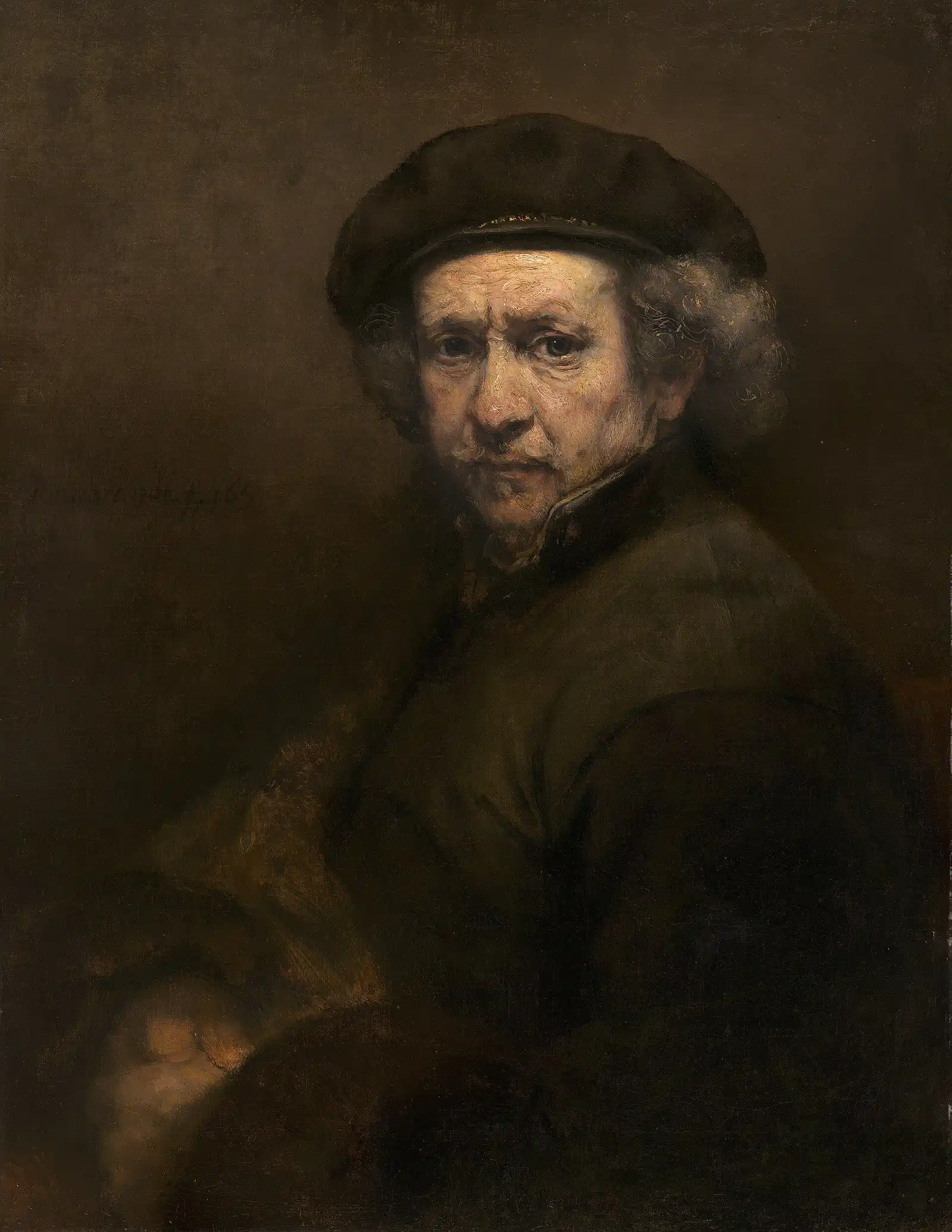
Rembrandt divides cleanly into two size problems. The single-figure paintings — the self-portraits, the Jewish Bride — are already domestic scale and reproduce honestly on standard canvases. The group pieces do not, and no price ladder will fix that.
- Self-portraits at 30 × 24 in (76.2 × 61 cm), $430.95. 90 % of the 1659 canvas on its long side. Close to a real Rembrandt head, which is the point of owning one.
- Self-portraits at 40 × 30 in (101.6 × 76.2 cm), $529.95. 120 % on the long side. Slightly heroic, and it suits a stairwell.
- The Jewish Bride at 40 × 30 in, $529.95. 61 % of the original on the long side (101.6 cm against 166.5) and almost exactly its proportion. The best value on this page.
- The Night Watch at 48 × 36 in (121.9 × 91.4 cm), $599.95. About a quarter of the original on each side — 26.9 % by width, 24.1 % by height. Faces that are life-size in Amsterdam arrive about 6 cm tall. Consider whether you want the composition or the experience, because you cannot have both off a price list.
Hang Rembrandt low and light it from one side, warm rather than cool. A single directional light at 3000 K does more for a Rembrandt copy than any amount of extra money spent on the painting, because it reproduces the lighting condition the picture was designed around.
Where to buy
Three routes for a hand-painted Rembrandt, with what each is genuinely better at. Checked 2026-09-05.
Hand-painted oil on canvas from $249.95 at 16 × 16 in to $599.95 at 48 × 36 in, and on to $769.95 (60 × 40 in) and $1,299.95 (72 × 48 in), with a photograph of the finished piece before shipping — the moment to check whether the shadows are transparent or filled in.
Art & See- Reproduction Gallery — Lists 47 Rembrandt titles from $325 (counted 2026-09-05) and quotes for non-standard sizes — a browsable list rather than the four or five group pieces every store stocks. Catalogue breadth is the criterion on which it beats Art & See.
- A Dafen workshop, ordered direct — Cheapest by a wide margin; also the highest-variance option for Rembrandt specifically, because transparent darks require drying time between layers and the low price is largely bought by removing that time.
Copyright status
Rembrandt van Rijn died on 4 October 1669. There is no copyright in his work anywhere in the world, and there is no estate or foundation with any claim over reproductions.
He is also unusually well served by open access. The Rijksmuseum publishes high-resolution files of The Night Watch, The Jewish Bride and the rest of its holdings for free reuse, and the National Gallery of Art in Washington releases its Rembrandts under a CC0 dedication. A studio has no excuse for working from a low-resolution web image, and it is a fair question to ask which file they used.
The one enduring restriction is description: a copy is a copy, and Rembrandt attribution is a live scholarly argument in which even the museums change their minds. Nothing bought from a reproduction seller has any attribution status at all. The general rules are in are oil painting reproductions legal.
Frequently asked questions
Why do cheap Rembrandt copies look flat?
Because the darks are painted opaquely. In the originals the shadows are a thin transparent glaze over a warm ground — in places barely covering the canvas — while the lit passages carry thick lead white. Fill in the shadows with solid paint and the picture loses its interior, however accurate the drawing is.
Are Rembrandt reproductions legal?
Yes. He died in 1669, no copyright survives anywhere, and both the Rijksmuseum and the National Gallery of Art release high-resolution images of their Rembrandts for free reuse. Only the description is regulated: a copy must be sold as a copy.
What size should a Night Watch reproduction be?
Honestly, none of the standard sizes work. The original is 379.5 × 453.5 cm; 48 × 36 in is about a quarter of that on each side and even the largest rung on the ladder, 72 × 48 in at $1,299.95, is only 40 % of its width. Either shrinks life-size figures to roughly 6 cm heads. If you want the picture rather than the poster, budget for a bespoke stretcher at a 1.2 proportion and at least 2 metres wide.
Can I buy the reconstructed Night Watch with the missing figures?
Only by asking. The canvas was cut down in 1715 and the Rijksmuseum published a reconstruction of the lost areas in 2021. Most sellers copy the surviving canvas by default. If you want the full composition, specify it in writing before the studio starts, because it is a different picture on the left-hand side.
Sources
- The Rijksmuseum in 2025 — over 2.3 million visitors, Operation Night Watch progress — Rijksmuseum. Accessed September 5, 2026.
- For the first time in 300 years The Night Watch is complete again — Rijksmuseum. Accessed September 5, 2026.
- Rembrandt van Rijn, Self-Portrait, 1659 — collection record, 84.5 × 66 cm, open access — National Gallery of Art, Washington. Accessed September 5, 2026.
- The Anatomy Lesson of Dr Nicolaes Tulp, 1632 — collection record — Mauritshuis. Accessed September 5, 2026.
- The theft — Rembrandt's The Storm on the Sea of Galilee, stolen 18 March 1990 — Isabella Stewart Gardner Museum. Accessed September 5, 2026.
- Rembrandt van Rijn artist page — 47 titles listed from $325, benchmark for catalogue depth — Reproduction Gallery. Accessed September 5, 2026.
Keep reading
catalog
The 20 most popular oil painting reproductions, and what each one costs to copy well
The 20 paintings ordered most often, cross-checked against five stores' own bestseller lists, with museum, original size, difficulty and price for each.
legal
Are Oil Painting Reproductions Legal?
Yes for public-domain paintings, no for artists still in copyright. Country rules, 21 artists with dates, and the line between a copy and a forgery.
buying
Museum Quality Oil Painting Reproductions: What to Check Before Ordering
A sourced checklist for materials, finished-painting approval, cancellation and returns, with policy exceptions and limits of visual checks.
process
How Oil Painting Reproductions Are Made
The 12 steps of a hand-painted oil reproduction, how long each takes, why drying cannot be rushed, and what separates a $100 copy from a $1,000 copy.